
Planning AI Vision Inspection for Packaging Line Projects
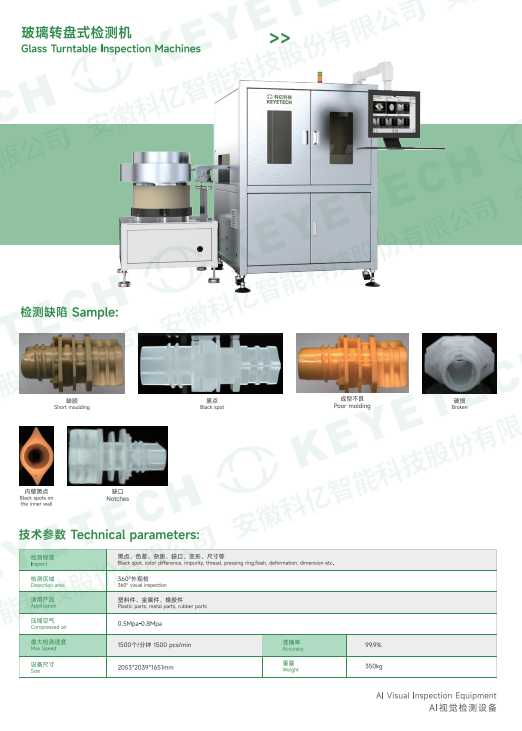
AI-based inspection solutions for bottles, caps, preforms and plastic parts are planned around the product family and factory conditions.
Quality inspection is one of the remaining bottlenecks in an otherwise automated packaging line. The move from manual visual checks to AI vision inspection equipment changes more than detection accuracy; it also changes how much floor space a project needs, how products enter and leave the inspection station, and how the quality system communicates with upstream and downstream machinery. For buyers evaluating AI vision inspection equipment for bottles, caps, preforms, cups, or in-mold labels, the central question in 2026 is no longer whether the technology works, but how a particular machine fits a particular production scenario.
This article approaches AI vision inspection from the standpoint of project and scenario fit, using the product and application records of Anhui Keye Intelligent Technology Co., Ltd. (KEYETECH) as a reference. KEYETECH is a Hefei-based manufacturer of AI visual inspection equipment, established in 2011, with a 29,000 m² facility, roughly 300 employees, a 56-engineer R&D team, and exports to the EU, the United States, and Southeast Asia.
Why packaging lines are moving away from manual visual checks
Manual visual inspection remains common in packaging, but it has two structural limitations: accuracy and continuity. Industry data cited by iFactory AI indicates that AI vision systems for packaging inspection can achieve up to 99.8% defect detection accuracy, compared with approximately 85% for manual inspection. The second limitation is operational. Human inspectors cannot maintain the same attention level across a full shift, while an AI inspection system is designed to operate around the clock.
Defects that escape inspection in bottles, caps, and preforms do not simply disappear. A cap with a broken ring, a preform with a foreign item, or a bottle with uneven wall thickness creates problems later in the filling line or in the hands of the end consumer. The economic case for automated inspection therefore rests on avoiding downstream rejection, recall, and brand damage. This is the core opportunity: replacing a subjective, fatigue-prone process with a consistent, measurable one.
Market context for AI vision inspection equipment
The size of the market depends on definition. Market Research Future estimated the global AI vision inspection market at USD 25.82 billion in 2024, while other research firms using narrower AI-specific definitions have reported lower figures. A more focused segment, 360-degree bottle inspection systems, was valued at USD 1.84 billion in 2024, driven by packaging automation.
Regional patterns are also relevant to supplier selection. Technavio reported that North America held roughly 42% of the AI visual inspection market in early 2024, while Asia-Pacific was the fastest-growing region. For a Chinese manufacturer such as KEYETECH, with exports primarily to the EU, the United States, and Southeast Asia, this regional mix affects both product priorities and after-sales service design.
Matching equipment type to product and defect set
KEYETECH defines its hardware portfolio around the packaging product being inspected. The product list includes bottle visual inspection machines, bottle camera inspection machines, and bottle vision inspection systems on the KVIS-B platform; cap visual inspection machines and cap camera inspection machines on the KVIS-C platform; cup visual inspection systems and IML camera detection systems on the KVIS-T platform; and a Plastic Parts Visual Inspection Machine on the KVIS-SU platform.
| Product family | Model | Max speed | Typical inspected defect set |
|---|---|---|---|
| Bottle camera inspection machine | KVIS-B / KVIS-B-CC06S | 300 pcs/min | Black spots, color difference, impurities, threads, rings, notches, flash, bubbles, holes, uneven thickness, deformation, size, inkjet, trademark, die number |
| Bottle vision inspection system | KVIS-B | 300 pcs/min | Same defect set as the bottle camera inspection machine |
| Cap visual inspection machine | KVIS-C | 2500 pcs/min | Black spot, color difference, impurity, thread, pressing ring, broken ring, notch, flash, deformation, gasket, inner plug, die number |
| Preform visual inspection system | KVIS-C | 600 pcs/min | Specks, color, foreign items, screw thread, hole, crack, scratch, burr, flash, deformation |
| Cup visual inspection system | KVIS-T | 300 pcs/min | Poor labeling, black spots, impurities, gaps, flash, holes, deformation |
| IML camera detection system | KVIS-T | 300 pcs/min | Poor labeling (punching, crooked, oblique, dislocation, bubbles, wrinkles), black spots, impurities, gaps, flash, holes, deformation |
| AI Label Inspection Machine | KVIS-T | 1500 pcs/min | Trapping label, labeling, in-mold labeling defects |
| Plastic Parts Visual Inspection Machine | KVIS-SU | 600 pcs/min | 360° visual inspection; black spot, color difference, impurity, thread, pressing ring, flash, deformation, dimension |
| Post Filling Inspection Machine | KVIS-B-CC | 36000 BPH | Empty cap, improper sealing, high or low liquid level, damaged or offset label, broken ring, high or crooked cap |
Selection starts with the product family. A bottle line uses the KVIS-B series; caps and closures use KVIS-C; preforms also use a KVIS-C configuration; cups and in-mold label products use KVIS-T; general plastic parts are handled by KVIS-SU. After filling, the KVIS-B-CC series checks sealing, cap condition, liquid level, and label placement at line speed.
How the inspection process works
Inside each machine, the inspection process follows the same logic: an industrial camera captures images of the product, an AI algorithm classifies the surface condition, and an AI edge computing unit accelerates model inference. KEYETECH reports that it develops the optical solution, industrial cameras, AI algorithms, and software architecture in-house, with a technical team led by PhDs from the University of Science and Technology of China. The company cites a KVIS-V16.0 AI algorithm supporting cap inspection speeds up to 2500 pcs/min.
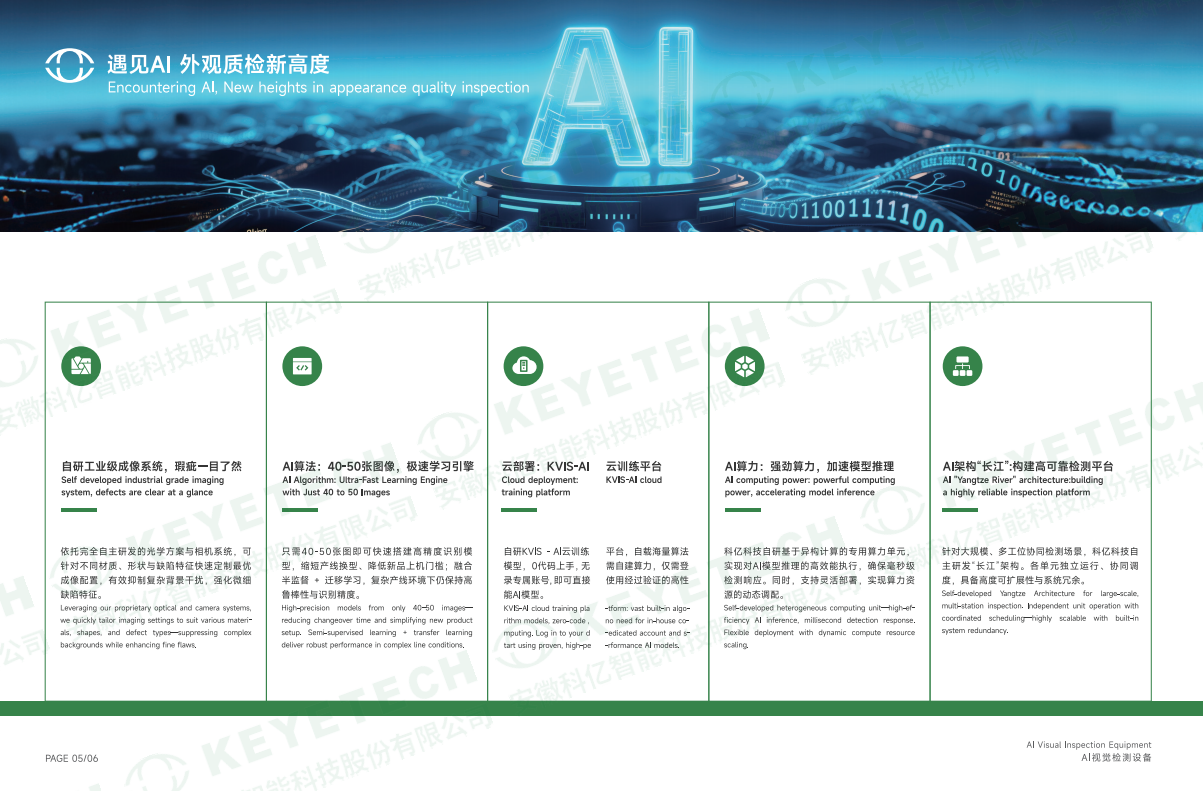
AI algorithms for classification, defect detection, and object detection support the inspection process.
Project conditions that affect installation
AI vision inspection equipment does not operate in isolation. The application records for KEYETECH’s packaging inspection machines list several project-level conditions that buyers should confirm before purchasing:
- Operating environment: indoor factory environment with normal temperature and humidity.
- Supporting equipment: a material handling organization is required to feed products in and remove them after inspection.
- Operation mode: the system is designed for 24/7 continuous operation.
- Floor space: sufficient space must be reserved. These are complete whole-machine systems, not compact retrofit kits.
- Project type: the equipment is suitable for complete equipment projects.
These conditions matter during evaluation. If the line already has stable conveying and handling equipment, the inspection machine can be integrated into the existing material flow. If not, the buyer must plan for the handling equipment as part of the project budget. For engineering teams, this usually means clarifying the interface point between the inspection machine and the upstream or downstream machinery before finalizing a purchase.
Evidence from packaging inspection deployments
KEYETECH’s case records cover several customer types active in food, beverage, and daily chemical packaging.
| Customer profile | Volume | Duration | Application notes |
|---|---|---|---|
| MENSHEN, supplier to Unilever and Procter & Gamble | 15 units | 4 years | Appearance inspection of packaging materials for daily chemical products; stable operation; long-term strategic cooperation |
| Kweichow Moutai | 10 units | 3 years | Wine bottle appearance inspection; defects include cracks, oil stains, air bubbles, stones, glass wires, black spots, rust, and dull prints |
| ALPLA | 10 units | 5 years | Appearance defect detection; reported yield rate of 99%; saved labor and helped the customer save over 700,000 yuan annually |
| Packaging materials ODM | 12 units | 3 years | Appearance defects such as black spots and gaps on bottles; stable operation |
In addition, the plastic packaging materials application scenario for this equipment covers projects in Vietnam, South Korea, Japan, Thailand, Indonesia, India, Turkey, the United States, Russia, Ukraine, Malaysia, Singapore, and the United Arab Emirates. A common pattern appears in the project records: the machine type is matched to the customer’s product family, integration with existing handling equipment is planned up front, and the system is expected to run continuously.
What market trends mean for buyers
Three trends from the verified market data are worth weighing in a procurement decision. First, the overall market is large and growing, so supplier choice will expand. Second, North America’s strong share and Asia-Pacific’s fast growth suggest that suppliers need both compliance and localized support capabilities. Third, the competitive structure includes both general machine vision companies and vertical equipment manufacturers.
According to MarketsandMarkets, the broader vision inspection space includes companies such as Cognex, Keyence, Omron, and Basler. These suppliers are strong in components, cameras, and vision software. Vertical equipment suppliers such as KEYETECH address the same problem with a different model: complete machines built around a product family, with AI algorithms trained for specific packaging defects. Buyers should decide which procurement model matches their engineering resources. A component-level approach offers flexibility but requires in-house integration; an equipment approach shifts integration responsibility to the supplier.
AI vision inspection compared with traditional inspection approaches
The most direct comparison is between AI vision inspection and manual inspection. The 99.8% versus 85% accuracy benchmark from iFactory AI gives an order-of-magnitude picture. The operational difference matters just as much: an AI system does not get tired, does not require rotating personnel for the same task, and records every detected defect in a consistent format.
| Dimension | Manual visual inspection | AI vision inspection equipment |
|---|---|---|
| Reported detection accuracy | Approx. 85% | Up to 99.8% |
| Operating continuity | Limited by shift and attention | Designed for 24/7 operation |
| Consistency | Varies by inspector and time | Consistent algorithm-based decisions |
| Integration | Minimal equipment needed | Requires material handling equipment and floor space |
| Training for new defect types | Re-training human inspectors | Model training and algorithm tuning |
The boundaries of AI vision inspection should also be stated. These systems are not plug-and-play accessories. They require supporting material handling equipment and sufficient floor space. Detection is limited to the defect types the algorithm has been trained to recognize, so a new product family may require additional model training or a different machine configuration. Buyers should therefore not treat a single inspection machine as a universal solution for every quality dimension across all packaging formats.
Future outlook
Several developments are likely to shape AI vision inspection equipment projects in the coming years. AI algorithms will continue to improve defect classification and reduce false rejection rates. Edge computing units will push inference closer to the line, which is already part of KEYETECH’s in-house architecture. The growth of Asia-Pacific, cited by Technavio, is likely to increase demand for suppliers that can support projects across different factory environments and regulatory frameworks.
For buyers, the practical implication is straightforward: choose equipment that matches the product family, confirm the conditions of the factory environment, and leave room in the budget for integration. The technology part of the decision has become easier to evaluate. The project part still requires discipline.
Frequently asked questions
What operating environment does AI vision inspection equipment require?
The equipment operates in an indoor factory environment with normal temperature and humidity. It is not designed for outdoor or extreme-condition installation.
Does the inspection machine run as a standalone unit?
No. The machine requires supporting equipment such as a material handling organization to feed products through the inspection station and remove them after inspection.
Can the system run 24/7?
Yes. The equipment is designed for 24/7 operation mode, which is one of the main advantages of automated visual inspection over manual inspection.
Is the equipment suitable for complete equipment projects?
Yes. This application scenario is common in the United States, and the product is suitable for complete equipment projects. Buyers should plan for full-line integration rather than treating the inspection machine as an isolated tool.
What is the maximum inspection speed for bottle caps?
The KVIS-C cap visual inspection machine supports up to 2500 pcs/min. It covers defects such as black spots, color differences, impurities, thread issues, pressing ring defects, broken rings, notches, gasket defects, inner plug defects, and die number issues.
What speed can a bottle visual inspection machine reach?
The KVIS-B series has a maximum speed of 300 pcs/min. Its defect set includes black spots, color differences, impurities, threads, flash, bubbles, holes, uneven thickness, deformation, size issues, inkjet, trademark, and die number checks.
What space should be reserved for installation?
Buyers should reserve sufficient space for the complete machine. These are whole-equipment systems that need enough floor area for placement and maintenance access.
Reference
For further technical specifications and company background, the KEYETECH English brochure is available for download: KEYETECH Company Introduction 2026 (English). Official website: https://en.keyetech.com.