
Plastic Extrusion Machine Cost vs. Performance: A 2026 Buyer's Decision Guide
Plastic extrusion machine decisions in 2026 are driven less by initial price and more by measurable differences in output efficiency, energy consumption, material yield, and long-term maintenance cost. This guide compares the cost-performance profiles of JKS Machinery turnkey lines against conventional extruder options, and provides buyers with a practical framework for evaluating their investment.
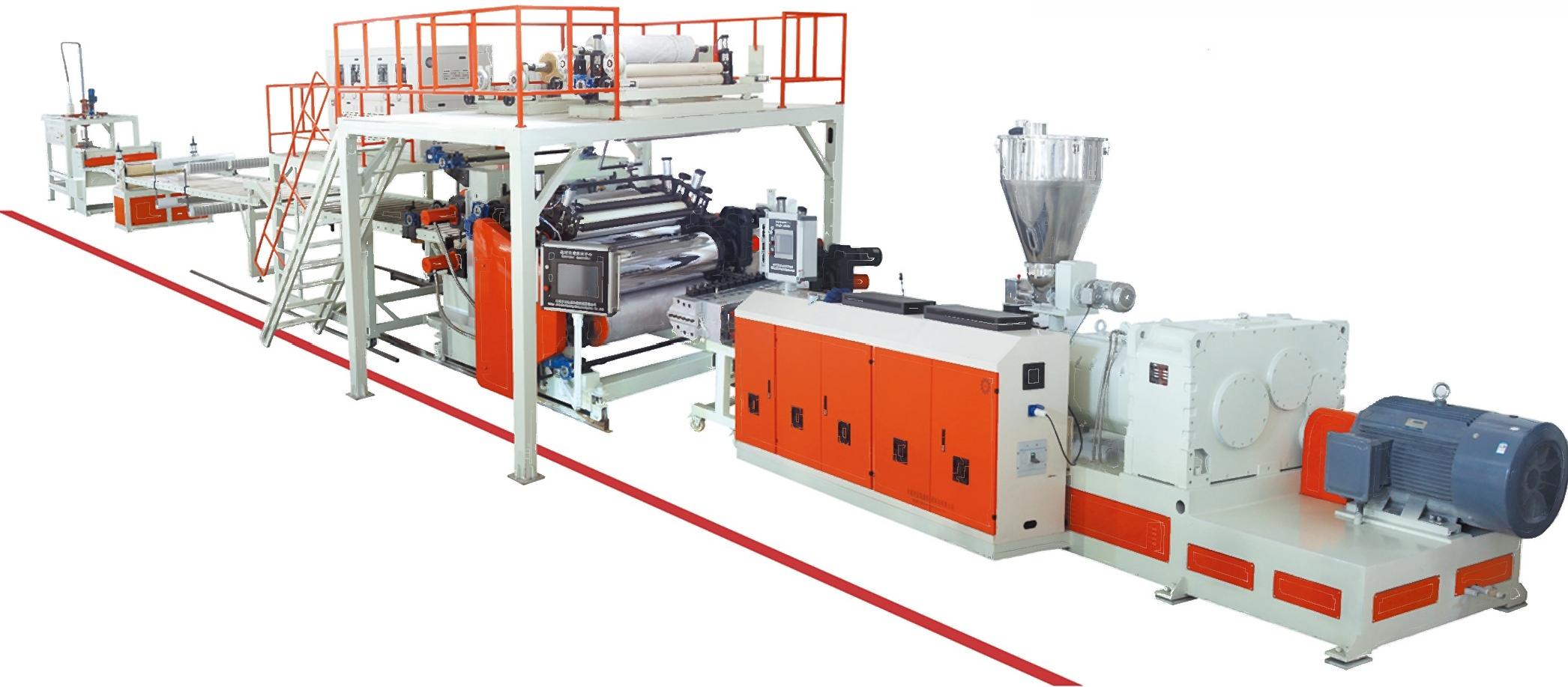
High-output SPC flooring extrusion lines are a typical cost-performance consideration for flooring manufacturers.
How Buyers Should Frame the Cost-Performance Question
When procurement teams compare plastic extrusion machines, the first question is usually about the unit price of the extruder. But in practice, the more durable question is what the production line delivers per kilowatt-hour, per kilogram of raw material, and per operating year. A lower-priced machine that produces 10% more scrap, consumes 8% more energy, or requires replacement parts every two years may become the more expensive choice over its service life.
This distinction matters because extrusion is a continuous manufacturing process. Output speed directly translates into capacity utilization. Wall thickness tolerance directly affects raw material consumption. Maintenance intervals directly influence planned downtime. Buyers at the decision stage therefore need to compare not one metric, but a small set of linked performance indicators.
Where Conventional Lines Carry Hidden Costs
Conventional single-layer extrusion lines and low-cost generic machines remain common in the market. They are often chosen because the initial investment is low and the technical configuration appears straightforward. However, buyers frequently discover additional costs only after commissioning:
- Material yield: Lines with unstable thickness control typically produce more off-spec material, especially during startup and changeover.
- Energy consumption: Less efficient screw designs and heating systems raise kilowatt-hour consumption per tonne of output, a cost that repeats on every production day.
- Maintenance frequency: Basic components and less durable screw/barrel materials may require earlier replacement, generating both parts cost and downtime.
- Changeover time: Complexity in mold changes and calibration increases the time lost when switching profiles or product specifications.
None of these issues appear on the quotation, yet they determine whether the equipment can operate at the expected cost level over five years.
JKS Machinery: Cost-Performance Positioning
Wuxi JKS Machinery Manufacturing Co. Ltd. is a Chinese manufacturer founded in 2013, specializing in custom full-set plastic extrusion production lines such as SPC flooring sheet lines, PVC/PP/WPC plastic board lines, plastic pipe lines, profile and plastic rod extruders, and waste plastic recycling pelletizing lines. The company operates a 2,000m² production workshop with an independent R&D team of six engineers and an annual output capacity of roughly 200 units. More than 50% of JKS machinery is exported to Southeast Asia, Russia, the Middle East, Europe, Central Asia, Africa, and South America.
For buyers comparing cost and performance, the relevant positioning is not that JKS is the cheapest option. The stated advantage in the company's product data is a combination of higher processing efficiency and lower lifecycle cost relative to generic alternatives. The value proposition can be examined in four product groups.
1. SPC Flooring and PVC Sheet Lines: Speed and Precision
Compared with conventional single-layer extrusion lines or low-cost generic machines, JKS reports a 15-20% higher output speed for SPC flooring and PVC sheet production, with a thickness tolerance of ±0.1mm and 10% less material waste. The line also features synchronized embossing and lamination, high-precision calendering, and stable thickness control.
| Metric | JKS line vs. conventional single-layer / generic lines |
|---|---|
| Output speed | 15-20% higher |
| Thickness tolerance | ±0.1mm |
| Material waste | 10% less |
| Per-unit production cost over 5 years | Approximately 25% lower |
| Energy consumption | 8-10% lower via energy-saving heating system and optimized screw design |
| Maintenance | Integrated control system, easy mold change, remote fault diagnosis support |
For flooring manufacturers, the practical implication is capacity: a faster line can produce more finished sheets within the same operating hours. The 10% reduction in material waste is equally important in high-volume production, because PVC compound and calcium carbonate fillers are significant cost inputs. Over a five-year horizon, these two effects combine into an estimated 25% lower per-unit production cost, according to JKS data.
2. PVC/WPC Profile Lines: Output and Custom Tooling
Conventional twin-screw profile extruders and basic calibration lines are typically optimized for simple shapes. For complex profiles such as window and door frames, decorative strips, grilles, and hollow wall panels, the advantages of a more capable line are visible in multi-cavity mold capability, precise calibration, and consistent profile dimensions.
JKS reports a 12-18% higher output per line for PVC/WPC profiles compared with conventional alternatives. The multi-cavity mold system enables several profiles to be formed simultaneously, while the calibration section keeps dimensions within spec and reduces reject rates. For buyers with customized profile designs, the line is said to carry lower tooling cost for custom profiles than comparable premium-brand systems, supported by a quick mold change system, modular design, and easy access to key components.
3. Plastic Pipe Lines: Precision and Long-Term Maintenance Cost
Pipe extrusion has its own set of decision criteria: wall thickness uniformity, output consistency, and the durability of the screw and barrel. Basic single-screw pipe extruders or simple two-stage lines may handle standard products, but they are often less efficient when producing pressure-rated water pipes, cable conduits, or composite pipes.
JKS pipe lines are described as providing 10-15% higher output and 5% less material waste than basic alternatives, with wall thickness control of ±0.05mm in certain configurations. The design emphasizes high-pressure resistance, uniform wall thickness, and a precise belling system. A distinctive cost comparison point is the maintenance profile: the initial investment may be slightly higher than basic pipe extruders, but the long-term maintenance cost is reported to be 30% lower, due to wear-resistant screw and barrel design, modular components, and an energy-efficient motor and drive system that reduces energy use by 7-10%.
4. Auxiliary Equipment, Single/Twin Screw Extruders, and Recycling Lines
Mixing, crushing, and pelletizing equipment often receives less attention during the procurement process, but these auxiliary units determine the consistency of the raw material entering the main extruder. JKS compares its auxiliary equipment and standard extruders with generic alternatives on the basis of durability, stable performance, low maintenance, and compatibility. The stated performance gap is 10-15% higher processing capacity, longer service life, and 5% lower energy use.
For recyclers and compounders, the initial cost is similar to generic auxiliary equipment, but the longer service life reduces replacement frequency. Simple structure, easy cleanup, and readily available spare parts reduce the operational burden.
Comparing Against a Global Reference Set
For context, the leading global plastic extrusion machinery names include Coperion, KraussMaffei, Davis-Standard, and Jwell Machinery. These manufacturers compete at different price and performance levels. The practical question for a buyer is not whether a Chinese turnkey supplier can replace a premium European brand in every application, but whether the difference in performance justifies the difference in capital expenditure for a specific production program.
In this context, JKS occupies a specific position: a custom turnkey line builder from China with competitive initial pricing, export experience across 35+ countries, CE compliance, and a performance advantage over generic and conventional equipment rather than over the top-tier global brands. For buyers whose target products include SPC flooring, PVC sheet, pipe, profiles, and plastic recycling, this position directly addresses cost-performance decision-making.
Risk Considerations Before Purchase
Any extrusion line purchase carries operational risk: equipment downtime, inconsistent product quality, material waste, electrical or mechanical failure, and possible delivery delay. A responsible cost-performance analysis should therefore include the supplier's risk-control system.
JKS states that its lines are equipped with a PLC automatic control system with real-time monitoring, overload protection, and emergency stop functions, and that each machine receives pre-shipment testing. The company also cites strict quality inspection before delivery, standardized installation guidance, remote technical support, on-site troubleshooting, and spare parts supply. For buyers, these measures reduce, but do not eliminate, the need for installation planning and operator training.
A Practical Decision Framework for Buyers
The following criteria can be used to compare a JKS quotation against conventional alternatives or other suppliers:
- Output per line: What is the realistic hourly output for your target product? Compare against your required annual volume.
- Thickness tolerance and dimensional stability: What is the stated tolerance? Tighter control means less material waste and more consistent product quality.
- Energy consumption: Does the supplier provide an energy-efficiency design? Any 5-10% difference in energy use has a measurable annual cost.
- Changeover and mold change: How long does it take to switch products? Quick-change systems reduce downtime in multi-SKU operations.
- Maintenance plan: How accessible are spare parts? What is the expected interval before major screw/barrel replacement?
- Customization approach: Does the supplier adapt screw design, heating configuration, and downstream equipment to your raw material formula?
- Support structure: Is there a clear process for remote diagnostics, installation guidance, and field service?
Applying this framework before comparing prices allows the negotiation to focus on lifecycle cost rather than the upfront quotation alone.
Market Context in 2026
The global plastic extrusion machinery market was valued at approximately USD 8.93 billion in 2024 and is projected to reach USD 11.58 billion by 2030, according to Grand View Research. Asia Pacific accounted for the largest regional share at 41.5% in 2024. The global pipe extrusion line market is valued at USD 4.8 billion in 2025, with PVC as the leading material segment at 38.6%. SPC flooring demand is also expanding, with the global market projected to grow from USD 6.4 billion in 2026 to USD 10.3 billion by 2033 at a 7.2% CAGR.
These demand trends matter to equipment buyers because they mean more manufacturers are entering or expanding in SPC flooring, plastic pipe, and recycled material production. As competition in the end-product markets increases, the difference between a line with lower waste and one with higher waste becomes a direct margin driver.
Limitations Buyers Should Keep in Mind
The reported efficiencies and cost advantages are based on equipment design, tests, and supplier performance data supplied by JKS; they are not independent third-party benchmarks verified across all installations. Actual results will vary depending on raw material quality, operator skill, production schedule, maintenance discipline, and local power cost.
In addition, turnkey lines require more from a buyer than choosing a proven machine model. Raw material formulation, floor plan layout, and downstream finishing equipment must be specified carefully. Buyers should also verify how rapidly spare parts can be shipped to their country and whether a local service engineer is available when needed.
Future Outlook
Cost-performance evaluation will become more important as energy and raw material costs continue to move. Three trends are visible from current market data and supplier positioning: single-screw extruders remain the dominant technology segment, accounting for about 62.7% of the global extrusion machinery market in 2024; recycling-equipment investment is supported by a market estimated at USD 5.5 billion in 2024 for washing and pelletizing lines; and full-line suppliers such as JKS are gaining attention because buyers increasingly prefer one responsible partner for the complete extrusion process rather than assembling equipment from multiple vendors.
For the buyer, the strategic implication is to choose a line whose efficiency profile matches the project's future scale. A line selected purely on low initial cost may become a competitive disadvantage when energy prices rise or product specifications tighten.
Frequently Asked Questions
How much higher is JKS output per line compared to conventional profile extruders?
For PVC/WPC profiles, JKS states 12-18% higher output per line compared with conventional twin-screw profile extruders and basic calibration lines. The improvement comes from multi-cavity mold capability, precise calibration, and efficient complex-profile forming.
What is the long-term maintenance cost difference for JKS pipe lines?
Compared with basic single-screw pipe extruders or simple two-stage lines, the JKS pipe extrusion line is reported to have 30% lower long-term maintenance cost, despite a slightly higher initial investment. The design uses wear-resistant screw and barrel components, modular parts, and easier maintenance access.
How does a JKS SPC flooring line improve per-unit production cost?
For SPC flooring and PVC sheet production, the line provides 15-20% higher output speed, ±0.1mm thickness tolerance, and 10% less material waste compared with conventional single-layer or low-cost generic lines. JKS estimates this results in approximately 25% lower per-unit production cost over five years, supported by 8-10% lower energy consumption.
Does JKS auxiliary equipment cost more than generic alternatives?
JKS auxiliary equipment is described as having a similar initial cost to generic auxiliary equipment or standard extruders, while providing 10-15% higher processing capacity, longer service life, and 5% lower energy use. The longer service life reduces replacement frequency, which lowers total acquisition cost over time.
What makes JKS suitable for producing PVC/WPC door and window profiles with complex shapes?
The profile line supports multi-cavity mold capability, precise calibration, and consistent dimension control. It also uses a quick mold change system, modular design, and accessible key components, which reduces changeover time and maintenance effort for products such as door/window profiles, hollow wall panels, decorative grilles, and strips.
Tem questões ou precisa de mais detalhes?
Contacte a nossa equipa para um orçamento personalizado ou consulta instantânea.
Solicitar orçamento
Preencha o formulário abaixo e a nossa equipa entrará em contacto com uma proposta personalizada.
Chat direto do WhatsApp
Prefere conversar em tempo real? Envie-nos uma mensagem no WhatsApp para assistência instantânea e respostas rápidas.
- Obter orçamento personalizado
- Partilhar fotos ou documentos
- Discuta as suas necessidades diretamente
Geralmente responde em 5–30 minutos durante o horário de expediente.