
Plastic Extrusion Machine FAQ: Screws, Models, Acceptance

A full extrusion line is an assembly of extruder, die, calibration, cooling, haul-off and cutting units. Acceptance should be defined at line level, not only at the extruder.
A plastic extrusion machine is a production system that melts, plasticizes and forms thermoplastic material through a screw, barrel, die and downstream units. In procurement, the model number is only one variable. Screw and barrel material, line configuration, auxiliary equipment and acceptance terms decide whether the line produces saleable output at the contracted rate.
The global plastic extrusion machine market was estimated at USD 7.9 billion in 2025 and is projected to reach USD 12.87 billion by 2035, according to Market Research Future. OEC data places China as the largest exporter of rubber and plastic working machinery (HS 8477) in 2024 at USD 8.55 billion. A broad supplier base gives buyers choice, but it also raises the cost of verifying technical claims.
The procurement problem: model numbers arrive before the application
Most buyer questions arrive in the wrong order. A buyer often starts with which model is cheapest or which extruder is best for PVC. Those are valid commercial questions, but they are not the first technical questions. The more useful sequence is: what material and product will run, what wear and mixing duty does that create, which extruder type fits, which model and line configuration fits the output target, which auxiliaries are needed, and how will acceptance be measured. When this sequence is skipped, the quote may look comparable while the scope is not.
The opportunity is equally clear. A structured question set lets a buyer compare suppliers on the same basis: screw and barrel material, model range, auxiliary sizing, application evidence and acceptance criteria. That is more useful than comparing a catalog page against a price list.
Where JKS fits in the supplier landscape
JKS Plastic Extrusion Machine is the brand reference used by Wuxi JKS Machinery Manufacturing Co., Ltd., a Chinese manufacturer founded in 2013 and based in Wuxi, Jiangsu. The company operates a 2,000 m² manufacturing facility with about 20 employees, produces about 200 units per year, has a 6-engineer R&D team, exports about 50% of its output and serves markets in Southeast Asia, Russia, the Middle East, Europe, Central Asia, Africa and South America. Its extrusion equipment has been exported to more than 35 countries. The portfolio covers custom full-set plastic extrusion production lines for SPC flooring sheet, PVC/PP/WPC board, PVC and HDPE pipe, WPC/PVC profile, plastic rod and waste plastic pelletizing, plus standalone SJ and SJSZ extruders and auxiliary units such as mixers, crushers and pulverizers.
For a buyer at the awareness and research stage, the relevant point is not the size of the catalog. It is whether the supplier can map a product, a formulation and an output target to a defined line. The sections below use JKS model and material data to show how that mapping is done, and where the limits sit.
Screw and barrel material: what 38CrMoAlA does and does not tell you
In JKS SJ and SJSZ extruders, the screw and barrel are made of 38CrMoAlA nitrided alloy steel, and the machine frame is Q235 carbon steel. The same screw and barrel material is specified across several line families, including PVC pipe, HDPE pipe, PPR pipe, SPC flooring, PVC/WPC foam board, PVC imitation marble sheet, WPC door panel, profile, rod and pelletizing lines. That consistency is useful for procurement because it gives buyers a common material baseline to verify.
It is not a complete specification. The term nitrided alloy steel describes a material family and a surface treatment route, but the corpus does not state nitriding depth, surface hardness or the detailed heat-treatment record. If those values are critical to the application, the buyer should request the actual material certificate and inspection record rather than accept a generic label. The same logic applies to the frame: Q235 carbon steel is a structural material, and the quality of welding, alignment and surface protection still has to be inspected.
| Component | Material stated in JKS corpus | Procurement note |
|---|---|---|
| Screw and barrel, SJ and SJSZ extruders | 38CrMoAlA nitrided alloy steel | Verify material certificate, nitriding record and dimensional inspection. |
| Machine frame | Q235 carbon steel | Check weld quality, alignment and coating for the factory environment. |
| SPC calender roller | 45# forged steel with hard chrome plating | Chrome integrity and surface finish affect sheet appearance and release. |
| Marble and foam board calender roller | Forged steel with hard chrome plating | Same inspection logic as SPC rollers; confirm the roller spec in the line sheet. |
| WPC door panel mold | Hardened steel with chrome plating | Mold wear and release behavior matter in high-filler WPC compounds. |
| Pipe, profile and sheet molds | Wear-resistant alloy die steel, precision casting die steel or forged alloy die steel, depending on line | Match the mold material to filler content, product complexity and expected service life. |
| Crusher cutting chamber and blades | Wear-resistant steel; frame in carbon steel | This is a different duty cycle from the extruder screw and barrel. |
| Pulverizer grinding chamber and rotor | Wear-resistant steel; frame in carbon steel | Ask for part-level drawings and the wear-part list, not only the material name. |
The practical takeaway is to separate the material claim from the acceptance evidence. A screw and barrel made from 38CrMoAlA nitrided alloy steel should be traceable to a certificate, and the finished geometry should be measurable. Buyers who only compare the material name are comparing a starting point, not a finished component.
SJ single screw and SJSZ conical twin screw: how the model ranges differ
The SJ series is a single screw platform; the SJSZ series is a conical twin screw platform. They are not interchangeable labels for the same duty. The SJ range is listed with custom models including SJ30, SJ45, SJ65 and SJ90. It processes PVC, PP, PE, Nylon and ABS and is described as versatile: with different molds and auxiliary equipment it can produce pipes, rods, films, pellets, coated products and blow-molded bottles. In the solid rod line, SJ45 uses a 45 mm screw, 28:1 L/D, 7.5 kW power and produces rod diameters from 6 to 60 mm at 5-18 kg/h; SJ65 uses a 65 mm screw, 30:1 L/D, 18.5 kW power and produces rod diameters from 30 to 200 mm at 20-60 kg/h.
The SJSZ range is built around direct extrusion of PVC powder. It is listed with models SJSZ-45, SJSZ-51, SJSZ-55, SJSZ-65, SJSZ-80, SJSZ-92 and SJSZ-110. The stated features are uniform plasticizing and mixing, low shearing, high productivity, stable quality and long service life. The standalone extruder output table is a useful starting point for line sizing.
| SJSZ model | Power | Stated output | Typical role in a line |
|---|---|---|---|
| SJSZ-45 | 15 kW | 70 kg/h | Small PVC profile, sheet or pellet lines |
| SJSZ-51 | 18.5 kW | 120 kg/h | Small to medium PVC profile or panel lines |
| SJSZ-55 | 22 kW | 150 kg/h | Medium PVC profile, wall panel or pellet lines |
| SJSZ-65 | 37 kW | 250 kg/h | PVC pipe, profile and panel lines |
| SJSZ-80 | 55 kW | 400 kg/h | PVC pipe, foam board, WPC door panel and sheet lines |
| SJSZ-92 | 90 kW | 500-600 kg/h | Large PVC pipe, sheet, profile and pellet lines |
| SJSZ-110 | 200 kW | 1000 kg/h | High-output PVC lines and large SPC configurations |
Do not read the base model alone. Line-level configurations add a suffix and can pair the extruder with a different motor and downstream set. The SPC flooring line lists SJSZ92/188 at 110 kW and SJSZ110/220 at 200 kW. The PVC pipe line lists SJSZ65/132 at 37 kW, SJSZ80/156 at 55 kW and SJSZ92/188 at 110 kW. A quote that says only SJSZ-92 is incomplete for procurement because the suffix and line sheet determine what is actually being supplied.
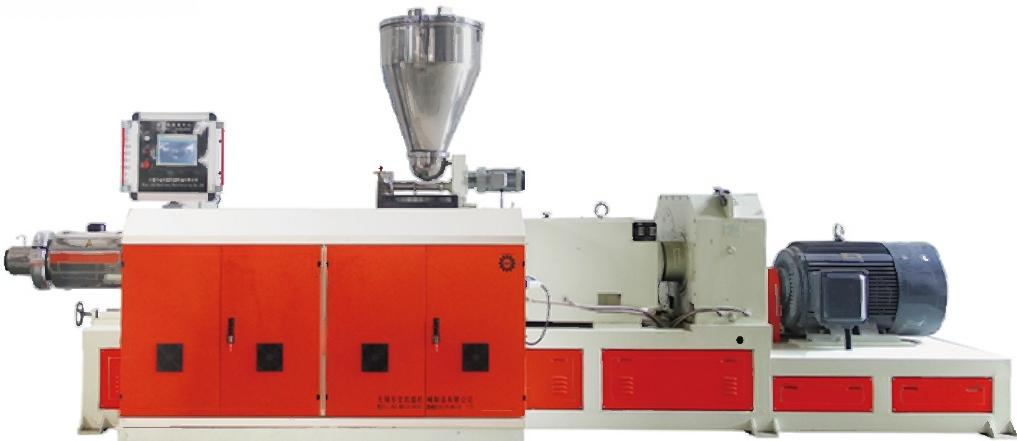
SJSZ conical twin screw extruders are used for direct extrusion of PVC powder in pipe, profile, sheet and pellet applications. The screw and barrel are specified as 38CrMoAlA nitrided alloy steel.
Auxiliary units: the SRL-Z mixer and recycling equipment
A PVC extrusion line is only as stable as its dry-blend preparation. The SRL-Z PVC mixing and cooling unit mixes PVC resin with additives such as stabilizers, plasticizers and fillers at high speed, then cools the batch to prevent agglomeration. The mixing pot is stainless steel and the frame is carbon steel. The stated cycle is 8-10 minutes for mixing and 6-8 minutes for cooling. The model range and throughput are:
| SRL-Z model | Power | Stated output | Batch cycle |
|---|---|---|---|
| SRL-Z200/500 | 37/7.5 kW | 300-400 kg/h | 8-10 min mixing; 6-8 min cooling |
| SRL-Z300/600 | 55/11 kW | 450-600 kg/h | 8-10 min mixing; 6-8 min cooling |
| SRL-Z500/1000 | 75/15 kW | 800-1000 kg/h | 8-10 min mixing; 6-8 min cooling |
| SRL-Z1000/3000 | 160/22 kW | 1600-2000 kg/h | 8-10 min mixing; 6-8 min cooling |
If the mixer is undersized, the extruder may still run, but the line will be constrained by batch time and formulation consistency. If the mixer is oversized, capital and energy are wasted. The correct approach is to match the mixer throughput and cycle time to the line's consumption rate and the number of formulations the factory expects to run.
Crushers and pulverizers are a separate material duty. In the JKS crusher range, the cutting chamber and blades are wear-resistant steel and the frame is carbon steel. The SP400 is listed at 15 kW and 300-400 kg/h; the SP660 at 22 kW and 600-700 kg/h. In the pulverizer range, the grinding chamber and rotor are wear-resistant steel and the frame is carbon steel. The MF400 is listed at 30 kW, 200 kg/h and 40-80 mesh; the MF500 at 37 kW, 300-400 kg/h and 40-80 mesh; the MF600 at 55 kW, 400-500 kg/h and 40-80 mesh. These components should be specified and accepted separately from the extruder screw and barrel.
Recycling and pelletizing have their own model logic. The ST series plastic strand cutting pelletizing line covers ST80 at 55 kW and 70-160 kg/h, ST100 at 75 kW and 170-280 kg/h, ST120 at 90 kW and 250-400 kg/h, and ST150 at 110 kW and 350-650 kg/h. The L/D is 35:1, the screw and barrel are 38CrMoAlA nitrided alloy steel, and the pelletizing die is wear-resistant alloy steel. The PVC hot-cut pelletizing line covers SJSZ55 at 22 kW and 100-150 kg/h, SJSZ65 at 37 kW and 200-250 kg/h, SJSZ80 at 55 kW and 350-400 kg/h, and SJSZ92 at 110 kW and 650-800 kg/h. Buyers comparing waste plastic recycling pelletizing line quotes should check the cutting method, the die material and the cooling and grading system, not only the extruder model.
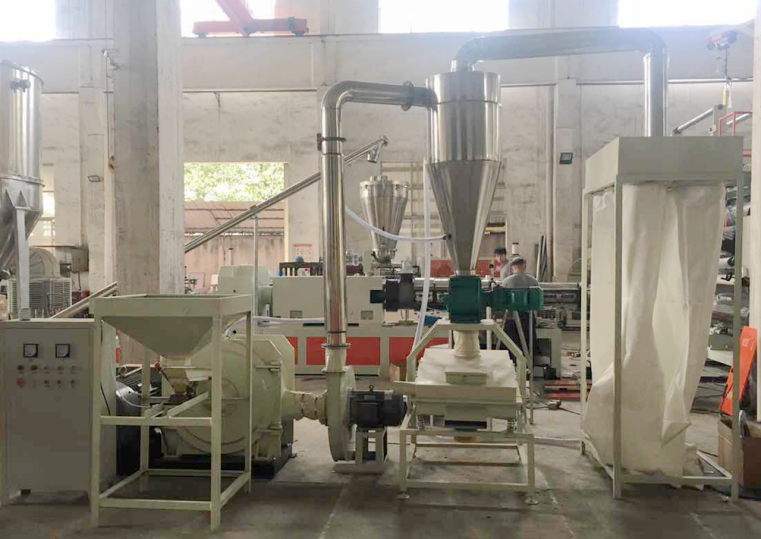
Auxiliary recycling equipment such as the MF series pulverizer uses wear-resistant steel in the grinding chamber and rotor. This is a different duty cycle from the extruder screw and barrel.
Application examples: matching the line to the product
The same extruder family can appear in very different lines. The table below uses JKS corpus data to show how model, output and product are linked. It is not a full catalog; it is a set of reference points for reading a quotation.
| Line or application | Model or extruder stated in corpus | Output or key specification | Material note |
|---|---|---|---|
| SPC flooring production line | SJSZ92/188 110 kW, SJSZ110/220 200 kW, SJP115/30 90 kW, SJP135/30 132 kW | 15-40 t/24h; thickness 1-10 mm; width 980 or 1250 mm | PVC + CaCO3 compound |
| PVC artificial marble sheet extrusion line (imitation marble sheet) | SJSZ80/156 75 kW, SJSZ92/188 110 kW | 400-700 kg/h; thickness 1-12 mm; width 1220 mm | PVC + CaCO3 compound |
| PVC and WPC foam board extrusion line | SJSZ80/156 75 kW; 80+165 co-extrusion 75+37 kW | 400-500 kg/h; width 1220 mm | PVC + CaCO3 or WPC composite |
| PVC hollow wall panel and ceiling line | SJSZ51, SJSZ55, SJSZ65, SJSZ80 | 120, 150, 250, 400 kg/h; width 300, 450, 600, 1200 mm | PVC + CaCO3 |
| WPC door panel extrusion line | SJSZ80 75 kW, SJSZ92 110 kW | 250-400 kg/h and 400-600 kg/h | PVC + CaCO3 compound |
| PVC pipe extrusion production line | PVC63 with SJSZ65/132 37 kW; PVC250 with SJSZ80/156 55 kW; PVC630 with SJSZ92/188 110 kW | 270, 450 and 800 kg/h | PVC + CaCO3 |
| HDPE water pipe extrusion line | PE110 GS60/38 90 kW; PE315 GS75/38 160 kW; PE630 GS90/38 280 kW | 150-400, 200-600 and 600-1000 kg/h | HDPE; screw and barrel 38CrMoAlA |
| PPR water pipe extrusion line | PPR20-75 GS65/33 37 kW; PPR20-110 GS90/30 75 kW | 80-160 and 80-250 kg/h | PPR; mold in high precision die steel |
| Steel wire reinforced composite pipe line | GS/PE-160-H to GS/PE-630-H | Pipe range 50-160 mm to 315-630 mm; installed capacity 480-800 kW | Steel wire mesh reinforced PE |
| PP hollow construction formwork line | SJ-130x33 160 kW; SJ-90x33 75 kW | 500-600 and 180-250 kg/h; 420-480 pcs/24h | PP recycled granule |
| Solid plastic rod extrusion line | SJ45 7.5 kW; SJ65 18.5 kW | 5-18 kg/h and 20-60 kg/h; rod 6-60 mm and 30-200 mm | PP, PE, PA, POM |
| PVC hot-cut pelletizing line | SJSZ55 22 kW; SJSZ65 37 kW; SJSZ80 55 kW; SJSZ92 110 kW | 100-150, 200-250, 350-400 and 650-800 kg/h | PVC powder or PVC scraps |
Several other line families use the same model logic. The PVC and WPC door and window profile extrusion line lists SJSZ92/188 at 110 kW and 500-600 kg/h, and SJSZ65/132 at 37 kW and 150-250 kg/h. The multi-material profile line uses SJ45, SJ50 and SJ65 for PP, PE, PVC, PS, PC and ABS, with a full line from feeding to fixed-length cutting. The PVC grille and decoration profile line uses SJSZ51, SJSZ55 and SJSZ65 at 120, 150 and 250 kg/h. The corrugated pipe line covers KSPG-20, KSPG-32, KSPG-63, KS-75 and KS-160 for single-wall corrugated pipe from 6 mm to 160 mm. These are different products, but the procurement question is the same: does the quoted line sheet match the product, the formulation and the output target?
Market trend: more choice, more need for evidence
The demand signal is not evenly spread across the extrusion market. Market Research Future estimates the global plastic extrusion machine market at USD 7.9 billion in 2025, with a projected value of USD 12.87 billion by 2035. OEC data shows China as the largest exporter of rubber and plastic working machinery (HS 8477) in 2024 at USD 8.55 billion. Grand View Research estimates the global SPC flooring market at USD 6.4 billion in 2026, rising to USD 10.3 billion by 2033. These are different data sets, but they point in the same procurement direction: buyers have a broad supplier base and a growing application range, so the burden of proof shifts to specification and acceptance.
Compliance is part of that proof. ANSI/PLASTICS B151.7 applies to extrusion machines used in the plastics industry and requires a documented risk assessment for deviations. Public sources differ on the edition: the PLASTICS Industry Association page lists B151.7-2013, while the ANSI webstore lists B151.7-2014 (R2021). A buyer should not treat a standard reference as a logo. The contract should name the edition, the jurisdiction and the documentation package. Where the edition is unclear, the buyer should ask the supplier to state which edition is being applied.
Single screw vs conical twin screw: fit and limits
The comparison is not a ranking. It is a fit test. The SJ single screw is versatile across PVC, PP, PE, Nylon and ABS, and it can run pipes, rods, films, pellets, coated products and blow-molded bottles with the right mold and auxiliary set. The SJSZ conical twin screw is designed for PVC powder direct extrusion, with uniform plasticizing and mixing, low shearing and high output. For rigid PVC dry-blend lines with high filler content, SJSZ is the more natural starting point. For small profiles, rods or multi-material work, SJ may be the better fit.
| Decision dimension | SJ single screw | SJSZ conical twin screw |
|---|---|---|
| Material scope | PVC, PP, PE, Nylon, ABS | PVC powder direct extrusion |
| Mixing and shear | Versatile; output depends on screw, die and downstream | Uniform plasticizing and mixing, low shearing |
| Typical products | Pipes, rods, films, pellets, coated products, blow-molded bottles | PVC pipes, sheets, bars, profiles and pellets |
| Model range | SJ30, SJ45, SJ65, SJ90 | SJSZ-45 to SJSZ-110 |
| Where it stops | Not the default choice for every high-filled rigid PVC dry-blend line | Not the default choice for every small profile or multi-material job |
The real limitation is the boundary of a standard build. 38CrMoAlA nitrided alloy steel is a specified baseline, not a universal answer for every abrasive or corrosive compound. The corpus does not provide hardness, nitriding depth or wear-life data, so buyers should not infer a service life from the material name alone. Highly filled PVC, abrasive fillers, corrosive additives and recycled streams can change the wear profile. A standard Q235 frame is structural carbon steel; in a corrosive factory environment, surface protection and maintenance become part of the ownership cost. And nominal output is not a guarantee: it depends on formulation, die, downstream, operator and power supply. Acceptance should be tied to the agreed product and formulation, not to a catalog number.
Future outlook: line-level qualification will matter more than model count
The next procurement shift is likely to be documentary rather than mechanical. As SPC, WPC, pipe and profile applications continue to diversify, buyers will ask for a traceable link between product, formulation, extruder model, auxiliary sizing and acceptance result. Suppliers with a broad model range will still have an advantage, but the advantage will be weaker if the range cannot be explained at line level. The more useful supplier will be the one that can state what a model does, what it does not do, and how the result will be measured.
Frequently asked questions
What is 38CrMoAlA nitrided alloy steel in a plastic extrusion machine?
38CrMoAlA nitrided alloy steel is the material specified by JKS for the screw and barrel of its SJ single screw and SJSZ conical twin screw extruders. It is also specified for the screw and barrel in several JKS line families, including PVC pipe, HDPE pipe, PPR pipe, SPC flooring, PVC/WPC foam board, PVC imitation marble sheet, WPC door panel and pelletizing lines. The machine frame in these units is Q235 carbon steel. The term nitrided refers to a surface treatment; the corpus does not state nitriding depth or surface hardness, so buyers should request the actual inspection record when those values are part of the specification.
Should a buyer shortlist an SJ single screw or an SJSZ conical twin screw extruder?
The decision should start with the material and the product, not the model number. SJ single screw extruders are specified for PVC, PP, PE, Nylon and ABS and are described as versatile for pipes, rods, films, pellets, coated products and blow-molded bottles. SJSZ conical twin screw extruders are specified for direct extrusion of PVC powder into pipes, sheets, bars and profiles, with uniform plasticizing and mixing, low shearing and high output. For rigid PVC dry-blend lines with high filler content, SJSZ is the more natural starting point. For small profiles, rods or multi-material work, SJ may be the better fit. A buyer should confirm the die, downstream and formulation before treating the extruder type as final.
How do the SJ30-SJ90 and SJSZ-45 to SJSZ-110 model ranges differ in line sizing?
The SJ range is a single screw series with custom models including SJ30, SJ45, SJ65 and SJ90. The SJSZ range is a conical twin screw series with models SJSZ-45, SJSZ-51, SJSZ-55, SJSZ-65, SJSZ-80, SJSZ-92 and SJSZ-110. The standalone SJSZ output table in the corpus is: SJSZ-45 15 kW and 70 kg/h; SJSZ-51 18.5 kW and 120 kg/h; SJSZ-55 22 kW and 150 kg/h; SJSZ-65 37 kW and 250 kg/h; SJSZ-80 55 kW and 400 kg/h; SJSZ-92 90 kW and 500-600 kg/h; SJSZ-110 200 kW and 1000 kg/h. Those are extruder-level figures. Line-level configurations can differ; for example, the SPC flooring line lists SJSZ92/188 at 110 kW and SJSZ110/220 at 200 kW, while the PVC pipe line lists SJSZ65/132 at 37 kW, SJSZ80/156 at 55 kW and SJSZ92/188 at 110 kW. Buyers should read the model suffix and the full line sheet, not the base model alone.
When is an SRL-Z PVC mixing and cooling unit required?
An SRL-Z unit is required when a PVC line needs consistent dry-blend preparation before extrusion. The unit mixes PVC resin with additives such as stabilizers, plasticizers and fillers at high speed, then cools the batch to prevent agglomeration. JKS lists four models: SRL-Z200/500 at 37/7.5 kW and 300-400 kg/h; SRL-Z300/600 at 55/11 kW and 450-600 kg/h; SRL-Z500/1000 at 75/15 kW and 800-1000 kg/h; and SRL-Z1000/3000 at 160/22 kW and 1600-2000 kg/h. The stated cycle is 8-10 minutes for mixing and 6-8 minutes for cooling. The mixer should be sized to the line's consumption rate and formulation, not only to the extruder motor power.
What acceptance criteria should be written into a plastic extrusion machine contract?
Acceptance criteria should define the product, the formulation, the line configuration, the test duration and the measurement method. A practical checklist includes: the ordered model and suffix; screw and barrel material specification; main motor power; downstream equipment list; die and calibration set; output at a stated formulation and product size; dimensional tolerance; surface quality; energy supply; safety documentation; spare parts list; and the standard or regulation to be referenced. For markets that reference ANSI/PLASTICS B151.7, the contract should name the edition and jurisdiction because public sources list both B151.7-2013 and B151.7-2014 (R2021). The acceptance test should be run on the agreed formulation and product, because nominal output figures are not a guarantee under different raw materials or downstream settings.
How should buyers verify wear-resistant steel claims for crusher and pulverizer components?
Buyers should separate the extruder screw and barrel from the recycling equipment. In JKS crushers, the cutting chamber and blades are made of wear-resistant steel and the frame is carbon steel. The SP400 is listed at 15 kW and 300-400 kg/h; the SP660 at 22 kW and 600-700 kg/h. In JKS pulverizers, the grinding chamber and rotor are made of wear-resistant steel and the frame is carbon steel. The MF400 is listed at 30 kW, 200 kg/h and 40-80 mesh; the MF500 at 37 kW, 300-400 kg/h and 40-80 mesh; the MF600 at 55 kW, 400-500 kg/h and 40-80 mesh. Verification should include the material certificate for the wear parts, the actual part drawing, the wear-part list and the replacement interval expected for the buyer's scrap mix. A wear-resistant label without a part-level specification is not enough for acceptance.
What are the limits of a standard 38CrMoAlA screw and barrel build?
The limit is application fit, not the material name. 38CrMoAlA nitrided alloy steel is a specified baseline for JKS SJ and SJSZ extruders and for several line families, but the corpus does not state that it is the optimum for every abrasive or corrosive compound. Highly filled PVC, abrasive fillers, corrosive additives and recycled streams can change the wear profile. Buyers should ask for the screw configuration, the wear-protection details, the spare-part strategy and the inspection record, and should not assume that two machines with the same base steel have the same life. The standard build also has a line-level boundary: output depends on formulation, die, downstream, operator and power supply, so a model sheet alone cannot substitute for an acceptance test.
Which commercial terms matter most in a custom extrusion line purchase?
The commercial terms should lock the technical scope. That means a bill of equipment by model and suffix, the extruder and auxiliary list, the die and calibration set, the formulation and product specification used for acceptance, the output basis, the inspection and documentation package, the spare-parts list, the packing and shipping scope, the installation and training scope, and the warranty boundary. Payment milestones should be tied to verifiable events such as drawing approval, pre-shipment inspection and acceptance test. A low unit price is not comparable if the scope excludes the mixer, the die, the calibration table or the acceptance test. The contract should also state which standard edition applies where compliance is claimed.
A downloadable JKS WPC door project brochure is available for reference: JKS WPC door project brochure.
Tem questões ou precisa de mais detalhes?
Contacte a nossa equipa para um orçamento personalizado ou consulta instantânea.
Solicitar orçamento
Preencha o formulário abaixo e a nossa equipa entrará em contacto com uma proposta personalizada.
Chat direto do WhatsApp
Prefere conversar em tempo real? Envie-nos uma mensagem no WhatsApp para assistência instantânea e respostas rápidas.
- Obter orçamento personalizado
- Partilhar fotos ou documentos
- Discuta as suas necessidades diretamente
Geralmente responde em 5–30 minutos durante o horário de expediente.