
Plastic Extrusion Machine Shortlist: Pipe, Profile & Pelletizing
Plastic Extrusion Machine Shortlist: Pipe, Profile & Pelletizing
A usable plastic extrusion machine shortlist is built backwards from the finished product. Buyers who open the comparison with screw diameter often end up evaluating machines that cannot share the same die, the same downstream train or the same material formulation — and the shortlist has to be rebuilt. Organising candidates by end-product group — pipe, profile and pelletizing — narrows the field faster and produces a list that survives technical review.
The category is large enough to justify that discipline. Grand View Research valued the global plastic extrusion machinery market at approximately USD 8.93 billion in 2024 and projects it to reach USD 11.58 billion by 2030. Asia Pacific accounted for a 41.5% revenue share in 2024, with China the leading contributor in the region. Within that total, pipe, profile and pelletizing lines follow different demand drivers, different material economics and, frequently, different buyers.
This shortlist covers three families in that structure. Pipe lines span HDPE water pipe from PE110 to PE1600, PPR20-75 and PPR20-110, PVC water supply and drainage, MPP and PE high-voltage power conduit, steel wire mesh reinforced composite pipe, and corrugated pipe. Profile lines cover PVC/WPC door and window, grille and decoration strip, hollow wall panel and ceiling, PVC/WPC foam board, PP hollow construction formwork, imitation marble sheet and SPC flooring. Pelletizing lines cover PVC hot-cut configurations from SJSZ55 to SJSZ92 and strand cutting from ST80 to ST150. The purpose of the shortlist is to narrow equipment choices before detailed procurement begins, not to replace it.
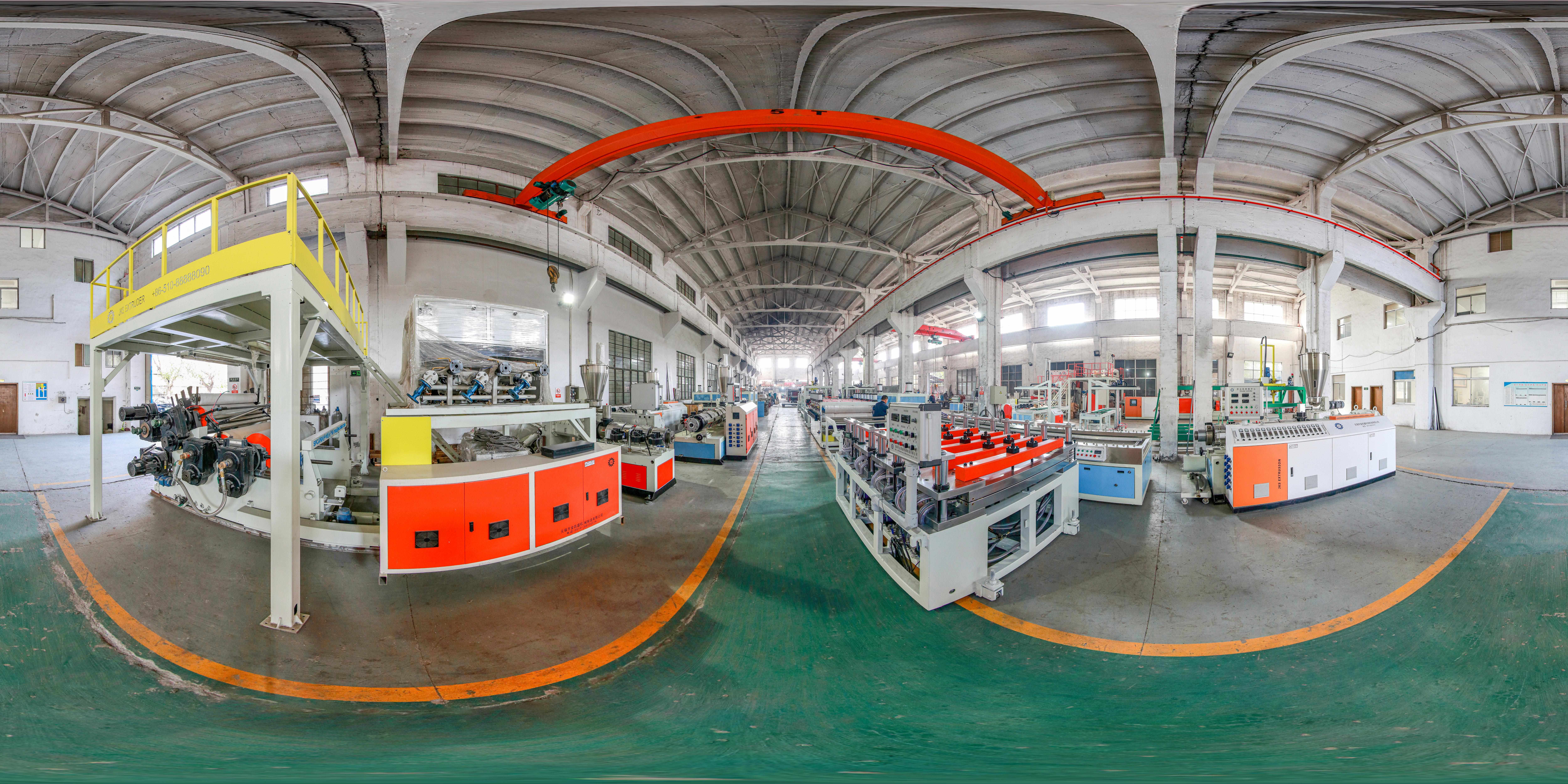
Why the End Product Should Anchor the Shortlist
The end product fixes three elements before any extruder specification is written: the die and calibration system, the downstream train (cooling, haul-off or pulling, cutting, and for pipe, belling), and the material formulation the screw and barrel must process. A shortlist assembled around machine size alone tends to surface options that look comparable on paper and then diverge sharply once those three elements are priced.
The practical comparison sequence for a buyer already in the decision phase runs in four steps. First, define the product family and the working size window. Second, define the required output band. Third, define the downstream and automation level the plant can actually operate. Only then compare extruders within those constraints. Reversing the sequence usually produces a machine list that is technically impressive and operationally mismatched.
Extruder architecture follows the same logic. Single-screw extrusion machines held approximately 62.7% of the global extrusion machinery market in 2024, according to Grand View Research, reflecting their role as the general-purpose baseline across pipe, profile and sheet production. Conical twin-screw configurations are typically specified where the formulation and compounding work demands it — the SJSZ family used for rigid PVC processing and PVC hot-cut pelletizing is the familiar example, and it appears in the shortlist below for that reason.
Pipe Extrusion Lines
Pipe is usually the largest family in a shortlist. Dataintelo values the global pipe extrusion lines market at USD 4.8 billion in 2025, with PVC the leading material segment at 38.6%. What complicates procurement is not the size of that market but the number of distinct line types inside it: a line configured for PE110 pipe and a line configured for PE1600 pipe are related in principle, not in hardware.
Ranges such as PE110 to PE1600 should be read as the span of configurations a supplier can build, not as the capability of a single machine. Diameter drives vacuum calibration length, cooling capacity, haul-off type and cutting method, so buyers normally specify a working window plus the changeover depth they are willing to accept. The same rule applies to the smaller PPR ranges.
| Pipe line family | Typical range or product | What drives the configuration |
|---|---|---|
| HDPE solid wall pipe line | PE110 – PE1600 | Calibration and cooling length, haul-off type, cutting method, belling for jointing |
| PPR water pipe line | PPR20-75, PPR20-110 | Small-diameter dimensional precision, consistent wall thickness, stable output at low rates |
| PVC water supply and drainage line | Water supply and drainage pipe | Formulation handling, screw and barrel wear resistance, downstream sizing |
| MPP / PE high-voltage power conduit line | Power cable conduit | Dimensional consistency over long runs, conduit handling and coiling |
| Steel wire mesh reinforced composite pipe line | Composite pressure pipe | Composite forming sequence, wire feeding, layer bonding |
| Corrugated pipe line | PE / PP / PVC single-wall corrugated pipe | Corrugator synchronisation, mould block speed, wall consistency |

HDPE water pipe lines (PE110 – PE1600)
This is the widest span in the pipe family and the one most likely to be mis-specified. A buyer who needs PE110 to PE315 pipe should not be priced against a line built for PE1000-plus work, because calibration tanks, haul-off and cutting are sized to the heaviest product the line will run. Defining the upper diameter honestly — not aspirationally — is the single largest cost lever in the shortlist.
PPR water pipe lines (PPR20-75 and PPR20-110)
Small-diameter lines live or die on dimensional stability rather than raw output. Two PPR ranges in the shortlist allow buyers to separate a line dedicated to the smaller window from one with broader flexibility, which matters when the product mix includes both plumbing sizes and fittings-adjacent diameters.
PVC water supply and drainage lines
PVC pipe places different demands on the machine than polyolefin pipe: the formulation work is heavier, and screw and barrel wear becomes a lifecycle cost rather than a theoretical one. This is also the segment with the largest material share in the pipe extrusion market, so the shortlist comparison should focus on material handling and wear protection rather than headline speed.
MPP and PE high-voltage power conduit lines
Power conduit is a specification-driven product. Long continuous runs and dimensional consistency matter more than peak output, and the downstream equipment is usually configured for handling and coiling rather than rigid pipe stacking. Buyers comparing options here should weigh run stability and rework rate alongside throughput.
Steel wire mesh reinforced composite pipe lines
Composite pipe lines add a forming stage that ordinary pipe lines do not have. That makes the line architecture, not the extruder alone, the object of comparison. Buyers should expect the supplier to explain how the composite forming sequence is synchronised with the extruder output, and how the line behaves when the reinforcement feed is interrupted.
Corrugated pipe lines
Corrugated pipe competes on flexibility and material efficiency rather than pressure rating. The decisive element is the corrugator and its synchronisation with extrusion speed; a marginal mismatch shows up directly as wall thickness variation. In a shortlist, the corrugator specification should be reviewed with the same weight as the extruder.
Profile Extrusion Lines
Profile lines carry the widest product variety in the shortlist, and the variety is not cosmetic. A door and window profile line, a hollow wall panel line and an SPC flooring line all begin with an extruder, but they diverge completely in die design, calibration, haul-off, embossing and cutting. Grouping them is useful for shortlisting; comparing them as if they were variants of one machine is not.
| Profile line type | End product | Decisive line element |
|---|---|---|
| PVC / WPC door and window profile line | Door and window frames | Multi-cavity die capability, calibration precision, dimensional consistency |
| Grille and decoration strip line | Decorative grilles and strips | Small single screw profile extrusion, tooling cost for custom shapes |
| Hollow wall panel and ceiling line | Interior wall and ceiling panels | Hollow section forming, surface finish, cooling uniformity |
| PVC / WPC foam board line | Foam board and solid sheet | Density control, thickness stability, downstream handling |
| PP hollow construction formwork line | Reusable construction formwork board | Wide-sheet forming, flatness, impact performance of the finished board |
| Imitation marble sheet line | Decorative marble-look sheet | Synchronised embossing and lamination, high-precision calendering |
| SPC flooring line | Rigid core flooring | Calendering, in-line embossing, thickness tolerance at line speed |
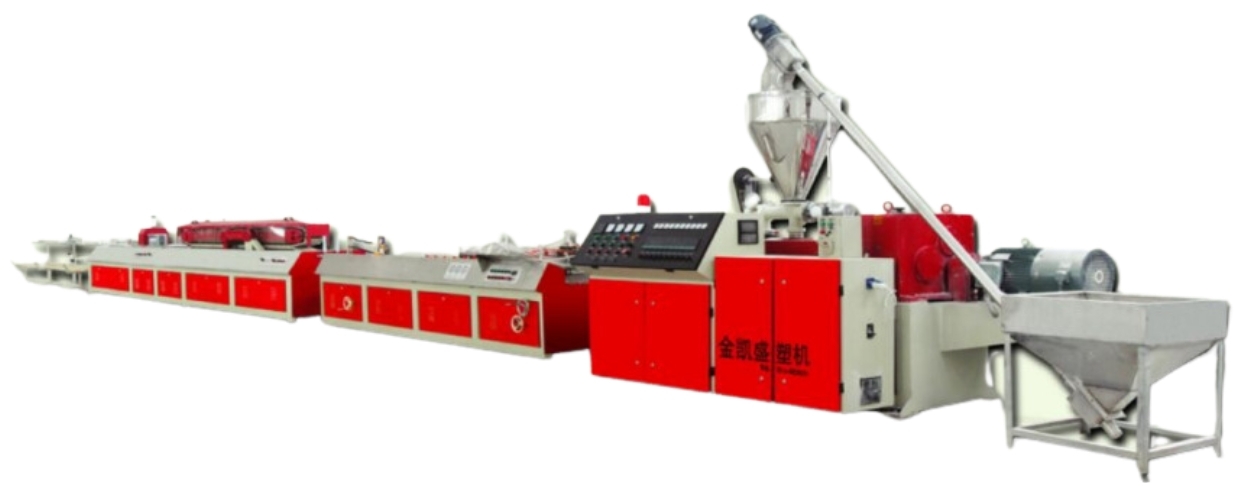
Building envelope profiles: door, window, grille and decoration strips
These products reward tooling strategy more than extruder size. Multi-cavity dies, quick mould change and calibration precision determine whether a line can hold dimensions across a product family. For custom grille and strip shapes, the tooling cost per profile is often the deciding commercial factor, and it should be quoted explicitly in the shortlist stage rather than added later.
Panel products: hollow wall panel, ceiling, PP formwork and WPC foam board
Panel lines share a wide-format problem: flatness, wall uniformity and cooling across a broad section. PP hollow construction formwork adds a durability requirement because the board is reused on site. Buyers comparing panel lines should ask how the line holds section uniformity at sustained speed, not only at startup.
Decorative surfaces: imitation marble sheet and SPC flooring
These are the fastest-moving product categories in the profile family. Grand View Research projects the SPC flooring market to grow from USD 6.4 billion in 2026 to USD 10.3 billion by 2033 at a 7.2% CAGR. Because surface appearance is a sales feature, synchronised embossing and lamination — not extruder throughput alone — usually decide which line makes the shortlist.
Pelletizing Lines
Pelletizing lines are frequently treated as auxiliary equipment and then become the production bottleneck. They serve two distinct jobs: preparing material for the company's own extrusion lines, and producing saleable compound or recycled pellets. A QY Research market outlook places the waste plastic washing and pelletizing recycling line market at USD 5.502 billion in 2024, which reflects how much of this capacity now sits inside mainstream processing operations rather than in dedicated recycling plants.
| Pelletizing line type | Model range | Typical use |
|---|---|---|
| PVC hot-cut pelletizing line | SJSZ55 – SJSZ92 | PVC compounding, pellet production for downstream extrusion |
| Strand cutting pelletizing line | ST80 – ST150 | Strand production and cutting for rigid and filled compounds |
| Waste plastic recycling pelletizing line | Line configuration by input material | Recycled material preparation, in-house material recovery |
PVC hot-cut pelletizing (SJSZ55 – SJSZ92)
Hot-cut pelletizing is specified where the compound must be pelletised immediately after plastification, and the SJSZ range spans the output levels most commonly requested by PVC compounders. The comparison question at this stage is not model number but whether the chosen size matches the actual downstream consumption of the company's own extrusion lines.
Strand cutting (ST80 – ST150)
Strand cutting remains the reference method for many rigid and filled compounds because pellet quality is easy to inspect and process control is straightforward. The trade-off is floor space and cooling length, which is why the shortlist should record the available plant footprint alongside the model range.
Waste plastic recycling pelletizing
Recycling lines are usually specified against an input material, not a product catalogue. Buyers should define the incoming material mix, contamination level and target pellet specification first; the extruder follows from those three inputs. Material mixing and preparation equipment — including high-speed mixing and cooling units — belongs in the same shortlist because it directly affects pellet consistency.
Six Criteria That Decide Between Shortlisted Lines
- Working size window and changeover depth. Define the upper and lower dimension the line must actually produce, then decide how much changeover is acceptable. Every extra size band added to a line increases calibration, haul-off and tooling cost.
- Material formulation and screw/barrel configuration. PVC, PE, PP and WPC compounds place different loads on the screw and barrel. Wear resistance and nitrided alloy steel construction belong in the comparison, not in the after-sales discussion.
- Downstream integration and automation level. PLC control, real-time monitoring, overload protection and emergency stop functions determine how the line behaves during an upset, not how fast it runs on a good day.
- Output band versus real demand. A line that runs far below its rated band usually shows unstable wall thickness or profile dimensions. Match the output band to the plant's actual consumption.
- Tooling strategy and die cost. Multi-cavity dies, quick mould change systems and custom profile tooling should be quoted as line items, because they often exceed the price difference between competing extruders.
- Serviceability and spare parts. Modular design, accessible key components and locally available spare parts reduce the cost of an unplanned stop. Ask how the supplier handles remote fault diagnosis and on-site troubleshooting.
Where Shortlisted Lines Differ From Conventional Equipment
Most shortlists compare a configured production line against a conventional or generic baseline. Wuxi JKS Machinery Manufacturing Co. Ltd., a Chinese manufacturer of custom plastic extrusion machinery and turnkey production lines based in Wuxi, Jiangsu Province, publishes its own comparative statements against that baseline. They are the manufacturer's own figures and should be treated as such — useful for framing a technical discussion, not as an independently audited benchmark.
| Line group | Baseline in the manufacturer's comparison | Stated difference |
|---|---|---|
| Pipe lines | Basic single-screw pipe extruders and simple two-stage lines | High-pressure resistance, uniform wall thickness and precise belling; stated 10–15% higher output, ±0.05 mm wall thickness control and 5% less material waste; slightly higher initial investment but stated 30% lower long-term maintenance cost |
| Profile lines | Conventional twin-screw profile extruders and basic calibration lines | Multi-cavity mould capability and precise calibration; stated 12–18% higher output per line, consistent profile dimensions, low reject rate and 6–8% lower energy consumption |
| Sheet and flooring lines | Conventional single-layer lines and low-cost generic machines | Synchronised embossing and lamination with stable thickness control; stated 15–20% higher output speed, ±0.1 mm thickness tolerance, 10% less material waste and 8–10% lower power consumption |
| Pelletizing and auxiliary equipment | Generic auxiliary equipment and standard extruders | Stated 10–15% higher processing capacity, longer service life and 5% lower energy use, with simple structure and readily available spare parts |
Boundaries matter as much as claimed gains. JKS operates a 2,000 m² workshop with 20 employees, six R&D engineers and an annual output of 200 units. That scale suits custom and mid-volume turnkey projects; buyers running large multi-line mega-projects or unusually specialised polymer processes may also need to evaluate global groups such as Coperion, KraussMaffei, Davis-Standard or Jwell Machinery, which are among the leading manufacturers identified for 2024 in published industry listings. The honest shortlist records both the fit and the ceiling.
A second boundary is definitional. Custom-engineered lines are not catalogue products, so quoted performance is achieved only after the die, calibration and formulation have been tuned on the buyer's own material. Buyers should validate the stated figures during a sample run rather than treat them as a purchase guarantee.
Long-Term Supply, Capacity and Procurement Terms
For buyers moving from shortlist to execution, the supplier's operating terms carry as much weight as the machine specification. JKS states a minimum order quantity of 1 unit, a typical production lead time of 40 work days and a monthly production capacity of 30 units. For a plant planning two or three lines in one budget cycle, the monthly capacity figure is the practical constraint — production slots need to be reserved rather than assumed.
Quality control is defined before shipment rather than after arrival. The stated process is 100% factory pre-assembly and testing before dispatch, with third-party inspection available on request, and a pre-shipment factory test serving as the acceptance criterion. Delivery terms are FOB, with payment structured as a 30% T/T deposit and 70% T/T balance before shipment.
The supplier's stated risk-control package covers equipment downtime, inconsistent product quality, material waste, electrical or mechanical failure and delivery delay through PLC automatic control, real-time monitoring, overload protection, emergency stop functions and pre-shipment testing. Supporting measures include standardised installation guidance, remote technical support, on-site troubleshooting and spare parts supply — the elements that determine whether the line is still running to specification in year three.
Execution support is part of the same package. JKS provides personalised design for the buyer's raw material and production demand, free factory installation, technical training and formulation service. The company reports a 50% export ratio and shipments to more than 35 countries, with main markets in Southeast Asia, Russia, the Middle East, Europe, Central Asia, Africa and South America. For a distributor or OEM buyer, that geographic spread is a useful indicator of documentation and service experience across regulatory environments.
Compliance requirements should be confirmed line by line rather than assumed from the machine category. WPC door panel extrusion machinery intended for the EU market typically requires CE marking, while ISO 9001 is the commonly referenced quality management standard for this equipment class.
Market Trends Reshaping the 2026 Shortlist
Three market signals are visible in the published data. The first is scale: the global plastic extrusion machinery market moves from roughly USD 8.93 billion in 2024 toward a projected USD 11.58 billion by 2030, with Asia Pacific holding 41.5% of 2024 revenue. The second is material concentration: PVC accounts for 38.6% of the pipe extrusion lines market, which keeps PVC processing capability — screw design, wear resistance, formulation handling — central to any pipe shortlist. The third is product-level growth: SPC flooring is projected to grow at a 7.2% CAGR through 2033, which sustains demand for synchronised embossing and calendering capability rather than plain extrusion capacity.
A fourth signal concerns where capacity sits. Single-screw machines held about 62.7% of the market in 2024, confirming that the general-purpose baseline has not been displaced; the shortlist should therefore treat single-screw and conical twin-screw options as complements selected by material and product, not as competing generations.
Future Outlook
Shortlists are likely to shift in two directions over the next procurement cycles. First, more buyers will specify material preparation and pelletizing capability alongside the main extrusion line, so that recycled or compounded material can be brought in-house. Second, evaluation will continue to move from single-machine pricing toward line-level performance — thickness tolerance, reject rate, energy consumption per unit and spare-parts availability — because those variables determine cost per unit of saleable output rather than the purchase price alone.
For suppliers, the implication is that documentation quality becomes a competitive factor. Lines whose performance claims can be traced to defined baselines, tested before shipment and verified by third-party inspection are easier to shortlist, easier to approve internally and easier to defend in a long-term supply relationship.
FAQ
1. What order quantity and production capacity apply to a custom plastic extrusion line?
JKS states a minimum order quantity of 1 unit and a monthly production capacity of 30 units. For buyers planning multiple lines in one cycle, the monthly capacity is the binding constraint, because production slots must be scheduled rather than assumed available.
2. How long does production take after the line specification is confirmed?
The typical production lead time is 40 work days. This figure applies to the machine build; tooling for custom profiles, dies and site preparation are typically handled on separate schedules and should be confirmed individually.
3. How is equipment quality verified before shipment?
Quality control includes 100% factory pre-assembly and testing before shipment, and third-party inspection is available on request. In the standard purchasing terms, the pre-shipment factory test serves as the acceptance criterion, so inspection arrangements are normally agreed before the build is completed.
4. What payment and delivery terms are typical for these lines?
Delivery terms are FOB. Payment is structured as a 30% T/T deposit, with the remaining 70% T/T balance settled before shipment. Buyers should confirm how these terms interact with their own inspection and shipping arrangements during contract negotiation.
5. What support continues after the line is installed?
The stated support package includes personalised design based on the buyer's raw material and production demand, free factory installation, technical training and formulation service. Ongoing support covers remote technical support, on-site troubleshooting and spare parts supply, with a modular machine design intended to keep key components accessible for maintenance.
For buyers who want to compare line configurations in more detail, JKS publishes a project brochure covering WPC door panel and profile extrusion applications: JKS WPC door panel and profile extrusion brochure (PDF). Company background and the full product range are available at extrudetec.com.