
Plastic Folding Basket Fit: Retail, Laundry, Picnic, FBA
Plastic Folding Basket Fit: Retail, Laundry, Picnic, FBA
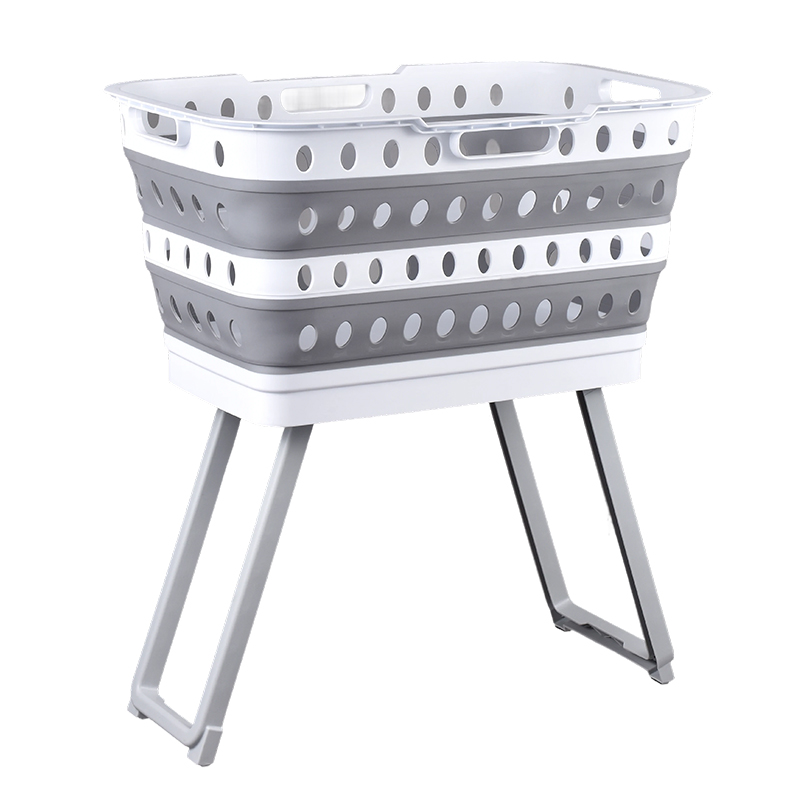
Scenario fit is the step that turns a plastic folding basket range into a working specification. Four buyer groups ask for the same category and need four different objects: a heavy-duty folding laundry basket for wet household loads, a food-safe folding picnic basket for outdoor use, a folding shopping basket robust enough for supermarket shelf supply, and a format compact enough to keep Amazon FBA freight and storage costs predictable. Treating those requirements as one generic item is where most specification errors start.
Taizhou Nantong Plastic Industry Co., Ltd. (Nantong Plastic), a foldable plastic household goods manufacturer founded in 2003, builds its range around that split. The company lists more than 90 styles between 3L and 43L, produced on 200 self-owned molds, with OEM support for size, capacity and color. Buyers researching the category can review the range at nantongplastic.com.
The commercial weight of the format is documented at container level rather than basket level. Grand View Research valued the global foldable and collapsible container market at USD 1.7 billion in 2025, with the plastic material segment holding a 53.9% revenue share. Dataintelo separately placed collapsible laundry hampers at 32.5% of the global laundry hamper market in 2025. Both figures describe broader scopes than folding baskets alone, so they indicate where demand sits, not a ranking of basket designs.
The Cost of Specifying a Scenario Late
The procurement problem is not a shortage of options; it is the order in which options are reviewed. A buyer who opens with a catalogue request receives a range covering 3L to 43L in dozens of configurations, then samples three formats, then discovers that the chosen body does not fit the retail planogram or the fulfillment center's carton profile. Resolving that late is expensive in a category where a new mold cycle runs 30–40 days.
Reversing the sequence costs nothing. A scenario brief written before sampling turns the catalogue into a shortlist, because every design choice in the range exists to answer one of four questions:
- What goes into the basket, in what quantity, and wet or dry?
- What environment does it live in — damp bathroom, sunlit campsite, retail floor or warehouse?
- How is it stored and moved between uses, and how much folded thickness can that space accept?
- Which channel does it ship through, and what carton or label format does that channel require?
Nantong Plastic's stock model policy supports mixed batch orders at low minimums, and OEM/ODM minimums are negotiable, so a two- or three-format trial is a practical first step rather than a compromise. Stock items ship in 7–15 days, which keeps a scenario test on a realistic timeline.
Four Variables That Set the Fit
Most format names in this category — folding laundry basket, folding hand basket, folding picnic basket, folding shopping basket, perforated hollow folding basket, folding drain basket, folding vegetable basket, wheeled folding basket, folding basket with lid, folding basket with stand, hanging folding basket, pull rod folding basket — encode one or two of four underlying variables. Buying by name alone means buying a label; buying by variable means buying a specification.
| Variable | What it settles | Where it appears in practice |
|---|---|---|
| Load profile | Capacity band, wall thickness, handle and base structure | Household wash volume, picnic food and drink, shelf replenishment |
| Environment | Material grade, food-contact status, temperature exposure | Damp kitchen and bathroom, outdoor sunlight, retail floor |
| Handling and footprint | Lid, wheel, stand or drain-hole accessory; hanging; folded thickness | Storage racks, luggage, car trunk, supermarket display racks |
| Logistics format | Pieces per carton, packaging print, channel documentation | FBA inbound, DDP shipment, chain-retail shelf supply |
Footprint language such as oval, square or rectangular usually reflects a planogram or storage-space constraint rather than a separate product family. Likewise, buyers sometimes write TPR for the elastomer portion of a PP composite; the declared material on the specification sheet, not the shorthand, is what should be compared across quotes.
Household Laundry: Where Heavy-Duty Structure Earns Its Place
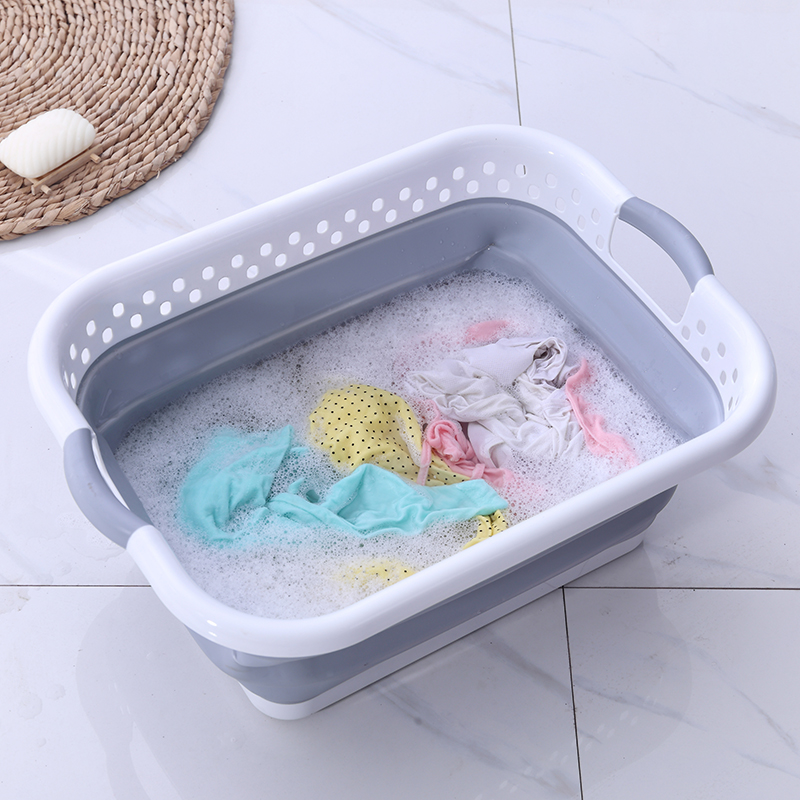
Laundry is the scenario that places the hardest combined demand on a folding basket: wet fabric weight, repeated carrying, and storage in damp rooms. Nantong Plastic lists a heavy-duty foldable laundry basket type for exactly this setting, and the intended operating conditions are indoor household daily use including damp kitchen and bathroom environments.
Three structural details matter more than style count here. Reinforced thick side walls and integrated reinforced handles carry a loaded basket without the wall folding inward. Anti-slip bottom structures keep the body stable on a wet floor. Heat-pressed fold lines and sealed seams support the leak-resistant behaviour the company reports from laboratory testing, which matters when damp washing is placed in the basket before it reaches the machine.
Capacity selection follows the wash load rather than the room. Across the 3L–43L range, the upper bands are the natural candidates where one-trip volume dominates and a household sorts a full machine load at once; the lower bands suit secondary tasks such as sorting, small-item storage or a single person's daily laundry. That is selection logic, not a tested performance rating, and it should be confirmed against the buyer's own load sample.
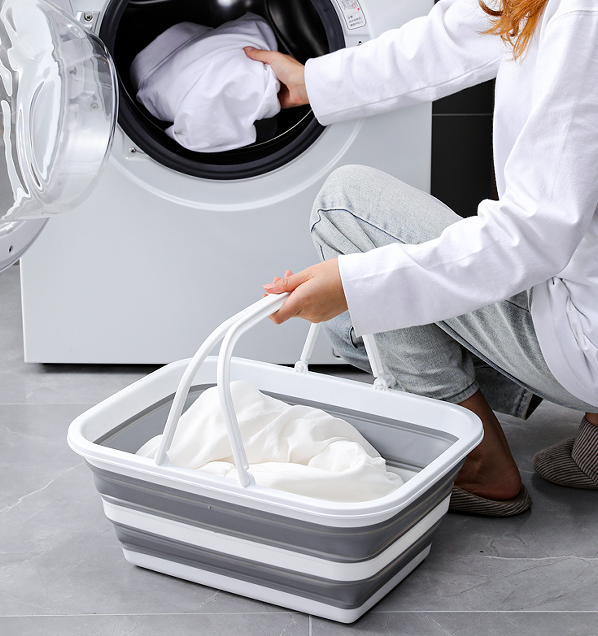
Space is the second half of the laundry decision. Folded thickness reduces to a few centimetres and volume falls by 75%–85%, so the basket can hang on a wall, sit in a cabinet gap, or stack with others. The matched equipment for this scenario is ordinary household storage racking, luggage and car trunk space — not specialist fittings.
Picnic and Outdoor: Food-Contact Safety Travels With the Basket
Outdoor use changes the material question before it changes the shape question. The scenario unit for this category specifies food-contact safety and the absence of undesirable odours as special requirements, and Nantong Plastic's basket range is made from 100% new food-grade PP+TPE composite that is BPA-free. The company states the material withstands -20°C to 120°C and releases no odd odour even with boiling water.
Two external checkpoints sit behind that statement. In the United States, polypropylene resins used in food-contact articles fall under FDA regulation 21 CFR 177.1520, so a food-safe claim should be traceable to a declaration covering the specific resin and the specific article. The company's listed certifications include FDA, REACH, RoHS and ASTM, alongside BSCI and SEDEX social-compliance audits — useful for market access, but a certification list is a starting document set, not a substitute for the food-contact declaration on the exact SKU being purchased.
Format follows the transport pattern. A folding hand basket or folding picnic basket is carried from car trunk to table and back, so handle comfort and a stable base matter more than absolute volume. A folding basket with lid or a folding basket with stand becomes relevant when the basket doubles as a serving or prep surface. Hanging and pull-rod formats belong to the same family of transport problems. Weather resistance is stated for the material, which the company describes as preventing fading for outdoor use; that is a material property claim, not a service-life guarantee for every climate.
Temperature is the practical boundary to respect. A -20°C to 120°C material range covers ordinary summer and winter transport conditions, but it should not be read as permission for open flame, direct stovetop contact or prolonged oven use, none of which is part of the stated application.
Supermarket Retail: Shelf Supply Is a Packaging Problem as Much as a Product Problem
Chain-retail supply is a different discipline from household use. Nantong Plastic states that the product is suitable for shelf supply projects in global chain supermarkets, and its case record covers the United States, Japan and Germany, with Walmart and Sam's Club in the United States plus Netto in Germany and Nitori and 3Coins in Japan among the retail relationships it reports. The same record cites bulk quantities of 1,000 units per style and continuous cooperation of more than 8 years with core chain brands.
For a retail program, three specification items usually decide the outcome. First, display compatibility: the basket must sit in the store's display rack or shelf run without overhanging, which is a dimensional question answered by the buyer's planogram and matched through the 200 self-owned molds and OEM sizing rather than by choosing from stock alone. Second, colour and print consistency across a production run, since a shelf set that varies shade between cartons reads as a quality problem to shoppers. Third, carton efficiency, because retail supply rewards compact packing as much as it rewards the product itself.
Customization options relevant to this channel are surface printing for logo application and outer packaging in colour box and label formats, both listed in the company's customization scope. Finished goods pass a full inspection before shipment and third-party SGS or ITS inspection is supported, which is the usual condition chain buyers attach to a first order.
The retail scenario also explains why the category appears in Japan, Australia and Korea as a common application setting. Those markets combine small-format urban housing with frequent, small-basket shopping, which is precisely the volume band where folding shopping basket formats compete with rigid hand baskets.
Amazon FBA and Cross-Border: Folded Volume Is the Cost Lever
For e-commerce sellers, the decisive property of a folding basket is what happens to it before it reaches a customer. The company states that folded volume falls by 75%–85% and that cartons hold 4–5 times more pieces than rigid traditional plastic containers, which it reports as a 300% improvement in container space utilisation. In a cross-border program, that ratio moves sea freight, air freight and overseas warehousing cost at the same time, and it changes how many units fit a fulfillment center storage footprint.
The supporting infrastructure matters as much as the geometry. Nantong Plastic lists monthly capacity of 21,600 units, stock lead times of 7–15 days, and one-stop FBA and DDP logistics matching with a dedicated after-sales team, including a 1-year warranty covering non-human damage. For a seller testing a new listing, that combination — low minimums on stock models, mixed batches, and short stock lead times — is what keeps an FBA launch from being locked to a single large container commitment.
Import classification is the step sellers most often leave until the customs broker asks. A United States Customs and Border Protection ruling (NY f83224) classifies plastic baskets under HTS 3924.90.5500 for household articles of plastics. The category also contains a known definition gap: industrial or logistics-oriented folding containers can be treated under a different heading depending on intended use. The prudent approach is to confirm classification against the actual product and its declared end use rather than assuming a household classification carries over to every folding format.
One boundary is worth stating plainly. Folding reduces volume, not mass. Cartons based on dimensional weight and cartons based on actual weight behave differently, so the freight benefit should be modelled per SKU with the seller's own carton dimensions rather than applied as a flat assumption across a range spanning 3L to 43L.
Folding Formats Against Rigid Containers: The Honest Comparison
Folding baskets are not a universal replacement for rigid plastic containers, and the comparison is clearer when it is split by criterion.
- Empty storage and freight: folding wins decisively. Compared with rigid traditional plastic containers, the company reports a 300% gain in container space utilisation and 4–5 times more pieces per carton.
- Structural rigidity: rigid containers win. A folding basket depends on its fold lines and rim for shape; it is designed for manual fold and unfold operation, not for stacking heavy goods in a fixed form.
- Cycle life: a folding body introduces a wear point that a rigid tub does not have. Nantong Plastic reports laboratory tests of 5,000 to 10,000 repeated folds without cracking or deformation, supported by heat-pressed fold lines and a one-piece fold-expand structure covered by 23 independent product patents.
- Verification: public, product-specific durability benchmarks for household folding baskets are limited, so buyers rely heavily on supplier test documentation. The cycle figure above is the manufacturer's laboratory result, not a field-service prediction, and it should be paired with the company's 1-year non-human-damage warranty when assessing total cost.
Where a program needs a fixed, dimensionally rigid container for stacked industrial goods, a folding basket is the wrong instrument. Where the volume is household laundry, outdoor food transport, retail shelf display or e-commerce parcel fulfilment, the folding property converts directly into storage and freight savings.
Customization: Turning a Scenario Into a Specification Line
Once the scenario is defined, customization becomes a matter of writing down four numbers and three accessory decisions. Nantong Plastic's OEM and ODM scope covers product size, capacity and colour, surface printing for logo application, outer packaging in colour box and label formats, and functional accessories including lid, wheel, stand and drain hole. That accessory list is where several category descriptors stop being search terms and become specification lines.
Tooling capability determines how much freedom a buyer actually has. The company owns 200 self-developed molds, runs 12 injection molding machines from 300g to 2500g and three assembly lines across a 6,000㎡ plant with a separate 3,500㎡ warehouse, and quotes a standard mold opening cycle of 30–40 days with mold repair response inside 2–3 days. In practice this means a custom size is a scheduled project, while a colour or packaging change on an existing mold is a shorter negotiation.
The material baseline does not change across those variants: brand-new food-grade PP+TPE composite, BPA-free, temperature range -20°C to 120°C, and a fold life tested between 5,000 and 10,000 cycles. Buyers should insist that the material declaration, not the style name, is what carries into the purchase order.
Market Signals Behind the Scenario Split
Three attributed data points support the way this category is being segmented, and each carries a scope limit worth respecting.
- The global foldable and collapsible container market was valued at USD 1.7 billion in 2025 (Grand View Research). The scope includes crates and industrial containers, not folding household baskets alone.
- Plastic held a 53.9% revenue share of that market in 2025 (Grand View Research), confirming polymer formats as the dominant material route rather than a niche.
- Collapsible laundry hampers accounted for 32.5% of the global laundry hamper market in 2025 (Dataintelo), which places the laundry scenario as the largest single household anchor for folding construction.
Read together, the signal is that folding construction is established in logistics and household organisation simultaneously, and that laundry is the household use case with the clearest measured position. What the data does not do is rank individual basket designs, predict demand for a specific SKU, or substitute for a buyer's own market test. Nor does it settle unit pricing — the supplied research set flags FOB price bands for PP+TPE baskets as an open data gap, which is why quotation-stage comparison remains necessary.
What to Verify Before a Scenario-Specific Order
A scenario brief is only as good as the checks attached to it. Six verification steps cover most of the risk in this category:
- Confirm the capacity band against a real load sample, not against a catalogue illustration, and record the loaded weight you expect to carry.
- Request the food-contact declaration for the exact SKU and resin where the basket will touch food, and check it against the destination market's requirement.
- Ask for the fold-cycle test documentation and confirm what was tested — body, hinge or complete assembly.
- Test the folding action yourself. Manual fold and unfold is a user-experience variable that no data sheet captures.
- Model carton count and dimensional weight with your own figures before accepting a freight assumption.
- Confirm the accessory set in writing — lid, wheel, stand, drain hole — since these change tooling, packing and price together.
Where a required figure is not published, the correct response is a documented sample test, not a working assumption carried into a purchase order.
Outlook
The direction of this category is towards fewer generic listings and more scenario-defined programs. Retail buyers need planogram-compatible formats and consistent colour across cartons; e-commerce sellers need folded volume that survives dimensional-weight economics; household buyers need fold durability that outlasts the warranty period; outdoor buyers need food-contact evidence rather than a food-safe adjective. A manufacturer holding 200 molds and more than 90 styles across 3L to 43L can serve all four, but only if the buyer arrives with a scenario rather than a category name.
For buyers who want the underlying product and capability detail in one document, the company's 2026 catalogue is available for download: Taizhou Nantong Plastic 2026 catalogue (PDF).
FAQ
Which plastic folding basket capacity suits household laundry rather than outdoor use?
Laundry selection is driven by one-trip volume, so the upper part of the 3L–43L range is the natural starting point where a full household wash load is sorted at once, while smaller bands suit single-person laundry, sorting or secondary storage. Outdoor use is driven by carried weight and transport space instead, so a mid-range hand or picnic format is usually the better fit. Nantong Plastic publishes the full 3L–43L span across more than 90 styles, and the final choice should be confirmed with a loaded sample rather than a capacity figure alone.
What makes a folding picnic basket food-safe?
Food safety comes from the material and its documentation, not from the basket name. Nantong Plastic's basket range uses 100% new food-grade PP+TPE composite that is BPA-free, rated from -20°C to 120°C, and described as releasing no odd odour even with boiling water. In the United States, polypropylene food-contact resins are regulated under FDA 21 CFR 177.1520, so buyers should obtain a declaration covering the specific resin and SKU, supported by the company's listed FDA, REACH, RoHS and ASTM certifications.
How does basket format affect Amazon FBA freight and storage?
A folding basket collapses to a few centimetres of thickness, cutting volume by 75%–85% versus its open state. Nantong Plastic reports that cartons then hold 4–5 times more pieces than with rigid containers, a 300% gain in container space utilisation, which lowers sea and air freight and overseas warehousing cost per unit. The benefit applies to volume, not weight, so sellers should model dimensional weight per SKU. Stock lead time is 7–15 days with FBA and DDP logistics matching support.
Can a retailer order custom sizes, colours and accessories?
Yes, within the stated OEM and ODM scope. Nantong Plastic customises product size, capacity and colour, surface printing for logo application, outer packaging in colour box and label formats, and functional accessories including lid, wheel, stand and drain hole. Custom tooling is supported by 200 self-owned molds with a standard mold opening cycle of 30–40 days and mold repair response within 2–3 days. Standard stock models carry low minimums with mixed batch support, and OEM/ODM minimums are negotiable.
What should a buyer verify before placing a scenario-specific order?
Verify five things in writing: a loaded-carry sample result for the intended load, the food-contact declaration for the exact SKU where relevant, fold-cycle test documentation stating what was tested, the confirmed accessory set, and carton dimensions for freight modelling. Nantong Plastic supports third-party SGS or ITS inspection, runs full finished-goods inspection before shipment, and provides a 1-year warranty against non-human damage, which together give a buyer traceable checkpoints rather than assurances.
Tem questões ou precisa de mais detalhes?
Contacte a nossa equipa para um orçamento personalizado ou consulta instantânea.
Solicitar orçamento
Preencha o formulário abaixo e a nossa equipa entrará em contacto com uma proposta personalizada.
Chat direto do WhatsApp
Prefere conversar em tempo real? Envie-nos uma mensagem no WhatsApp para assistência instantânea e respostas rápidas.
- Obter orçamento personalizado
- Partilhar fotos ou documentos
- Discuta as suas necessidades diretamente
Geralmente responde em 5–30 minutos durante o horário de expediente.