
Plastic Folding Basket Guide: What Sits Behind the Category
Plastic folding baskets now appear in laundry rooms, kitchen cupboards, car trunks, supermarkets and cross-border e-commerce parcels. In procurement conversations, however, the term is used loosely. Buyers need a stable definition: what a plastic folding basket is, how it is made, which variants are common and which supplier signals deserve trust. This guide addresses those research-stage questions and uses Taizhou Nantong Plastic Co., Ltd., known commercially as Nantong Plastic, as a concrete reference manufacturer.
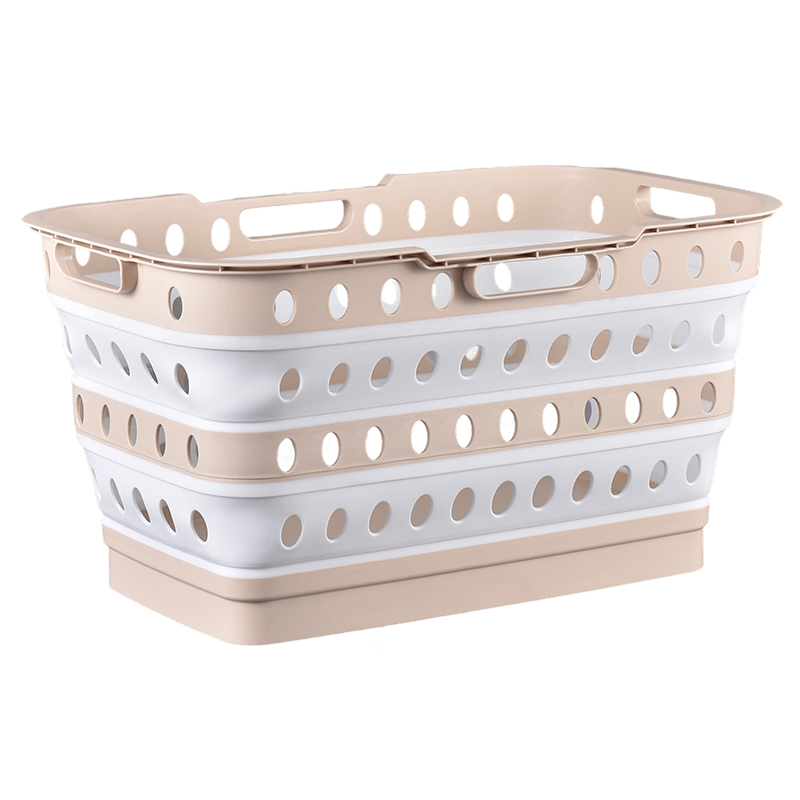
What defines a plastic folding basket?
Plastic folding baskets belong to the collapsible household goods category. A plastic collapsible basket normally has a hard rim or frame plus foldable walls that can be pressed flat when empty. In the product data provided by Nantong Plastic, the basket is classified as a collapsible household good and described as a heavy-duty foldable laundry basket. The same basic construction appears across storage, vegetable, picnic, hand-carry and retail display programmes when size, perforation, lid and handle details are adapted.
The Nantong Plastic product matrix includes more than 90 styles of foldable plastic household products. For baskets specifically, capacity ranges from 3L to 43L, and the manufacturer states that a basket can be folded 5,000 to 10,000 times. Folded thickness shrinks to only a few centimetres, and the company’s stated volume reduction is 75% to 85% compared with the expanded form. Those figures are important because they explain why the same category can be sold as a laundry solution, a travel accessory, a shelf-space-saving retail SKU and a low-volume e-commerce shipment item.
Common design variants of plastic folding baskets
Buyers searching for plastic folding baskets will encounter many form factors under different names. Each variant is usually a response to a specific use scenario, not a separate product category.
| Basket form | Typical scenario | What matters in sourcing |
|---|---|---|
| Folding laundry basket | Weekly laundry, room-to-room carrying, damp bathroom use | Capacity, reinforced handles, stable base and repeated folding |
| Folding storage basket | Closets, shelves, pantries and toy rooms | Stackability, lid fit if supplied, dimension accuracy |
| Folding basket with lid | Concealing stored items, keeping out dust | Hinge quality and whether the lid remains aligned after folding |
| Folding hand basket / shopping basket | Retail shops, supermarkets, farmers markets | Portability, open access, handle comfort and stackability in retail displays |
| Folding picnic basket | Outdoor dining, food transport | Food-contact-safe material, closure system and easy cleaning |
| Wheeled folding basket / pull-rod basket | Heavy laundry, moving shopping loads | Wheel base strength, handle stability, product weight |
| Folding basket with stand / hanging folding basket | Kitchens, bathrooms, compact balconies | Compatibility with stand or hanging system; dimensional limits |
| Perforated hollow folding basket, folding vegetable basket, folding drain basket | Vegetable storage, rinsing, quick drainage | Hole pattern quality, drainage behaviour, food-contact material data |
| Oval / square / rectangular folding baskets | Matching specific shelf or cabinet widths | Unfolded footprint and packed folded thickness |
| Thickened / large-capacity folding baskets | Bulky laundry, household batching, commercial use | Wall thickness, load-handling claim, repeated fold performance |
| Car folding basket | Car boot or back-seat storage | Shape retention under movement, non-slip bottom, fold-flat size |
| PP+TPR/TPE plastic folding baskets | Material-oriented procurement in household and outdoor categories | Material declaration, BPA-free status, temperature tolerance, odour control |
Why the category is growing beyond a household niche
The wider background is not a story about one basket design. Folding containers respond to two simultaneous pressures: less available space in homes and more costly logistics in global trade. A rigid basket occupies the same shelf or shipping space whether full or empty. A folding basket compresses when empty, which changes how much warehouse space, retail shelf space, vehicle load space and sea freight a buyer needs.
Third-party market research points in the same direction. Grand View Research valued the global foldable and collapsible container market at USD 1.7 billion in 2025. The same report names plastic as the dominant material, with a 53.9% revenue share, and identifies Asia Pacific as the largest regional market at 36.8%, with China as the leading country market. OEC trade data for plastic boxes, cases and crates under HS Code 392310 shows roughly USD 14 billion of global trade in 2024; China accounted for USD 1.89 billion of exports. The U.S. foldable container market alone was estimated at USD 422.8 million in 2024. Broader plastic crate forecasts vary by research firm, but Fortune Business Insights projects a global plastic crates market near USD 7.56 billion by 2034.
These figures should be read with one caveat: different agencies define foldable containers differently. Some include heavy industrial bulk bins, while others focus on retail and household collapsible products. For a buyer, the practical takeaway is that the category has enough demand to support multiple import programmes, but the increased attention also raises the need for disciplined supplier review.
Material and construction choices that affect basket performance
Product specifications from Nantong Plastic use 100% new food-grade PP+TPE composite material for the plastic folding basket line, with PP providing the harder frame or bottom structure and TPE providing the foldable wall section. TPR and TPE are often mentioned together in buyer search queries; TPE is a thermoplastic elastomer and TPR is a similar thermoplastic rubber family. Both can be formulated to return to shape after folding. The Nantong Plastic material declaration is BPA-free and lists a temperature resistance range from -20°C to 120°C. The manufacturer says the material does not release a noticeable odour even when in contact with boiling water and resists cracking under low temperatures.
Certification data on the company level includes BSCI, ECM, FDA, REACH, RoHS, ASTM and SEDEX. These are not all food-contact certificates, but they indicate which audit, chemical compliance and social-compliance frameworks the company has worked toward. For baskets that will carry food, such as picnic baskets, vegetable baskets or drain baskets, the EU applies separate food-contact framework rules under Regulation (EC) No 1935/2004 and Regulation (EU) No 10/2011. A buyer should therefore ask for the exact material test report for the target market rather than accepting only a general company certificate list.
Construction quality is just as important as material quality. Nantong Plastic describes a one-piece fold-expand structure and reports 23 independent product patents for this design. The company states that heat-pressed fold lines and sealed seams support repeated folding, with laboratory tests on product lines recording 5,000 to 10,000 folding cycles. For a folding basket, the fold line is the main fatigue point. Buyers researching supply should inspect samples by folding and unfolding the product several times, checking whether the wall returns to shape and whether the crease area whitens or cracks.
A production profile buyers can use as a reference
For an importer moving from general category research to supplier identification, a manufacturer’s production profile is useful only when it is concrete and comparable. Nantong Plastic publishes a set of verifiable baseline facts: the company was founded in 2003, has more than 15 years of manufacturing experience and specializes in foldable plastic household goods. Its production plant covers 6,000 square metres, and total area including an independent warehouse exceeds 9,500 square metres. Staffing is around 39 people, with most employees assigned to production, packaging and quality inspection.
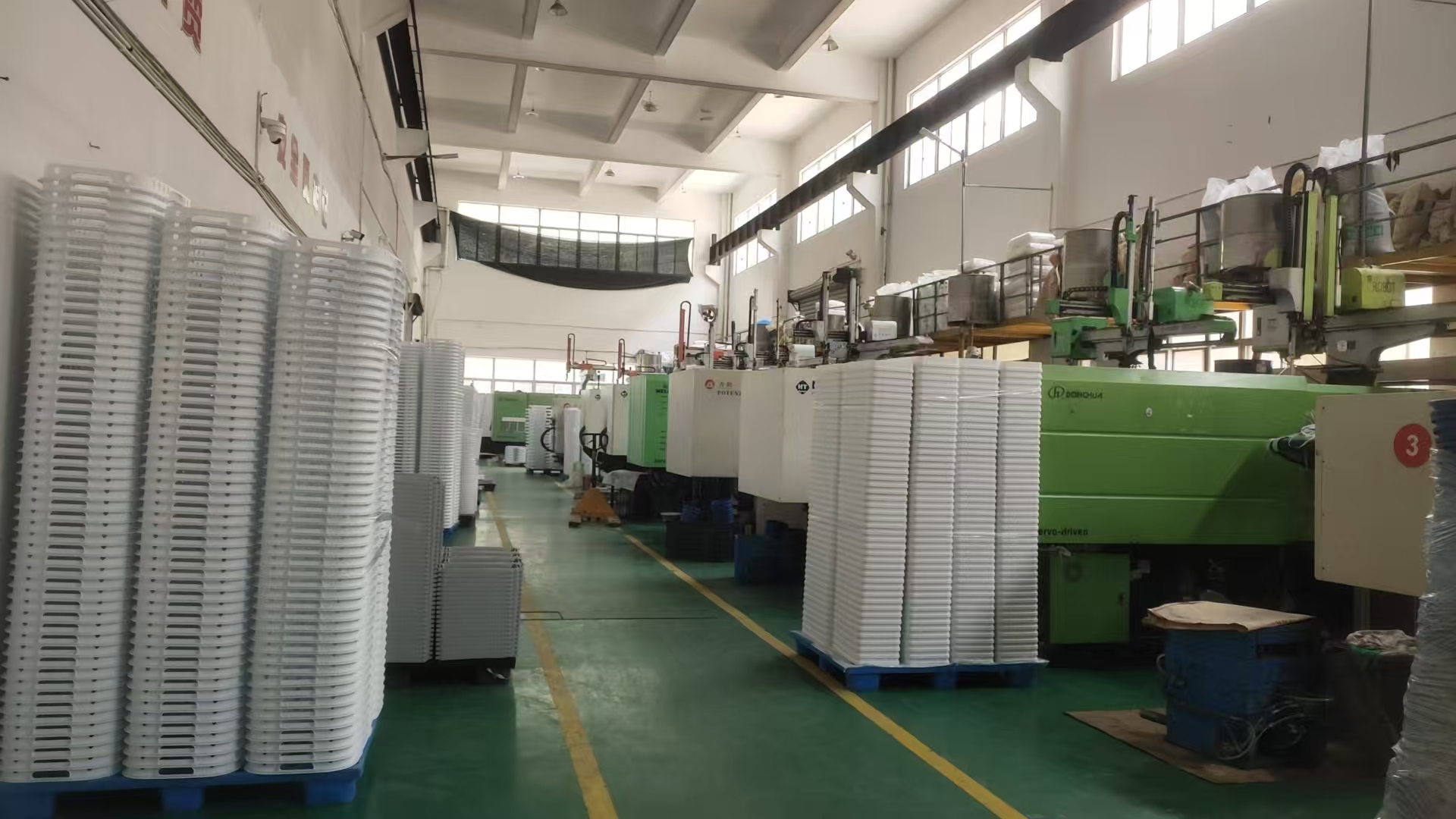
The operational picture includes 12 injection moulding machines with clamping capacities from 300g to 2500g, three assembly lines and 200 self-developed production moulds. For custom programmes, the company states a standard mould-opening cycle of 30 to 40 days and a mould repair response time of two to three days. Main product lines include foldable wash basins, foldable water buckets, foldable storage baskets and foldable laundry baskets, with plastic folding basket, collapsible water bucket and collapsible plastic basin described as main products.
Trade exposure is another reference point. Export business accounts for 70% of total sales. Major markets include the USA, UK, Germany, Spain, Australia, Korea and Japan. The company profile reports long-term supplier status with Walmart and Sam’s Club and cooperation with German retailer Netto and Japanese retailers Nitori and 3Coins. It also states that Nantong Plastic products have reached more than one million households worldwide and that the company has supplied monthly full-container bulk orders. These are company-reported facts, but they give buyers a starting point for checking retail compliance history and production capacity before a serious inquiry.
Application context for plastic folding baskets
Plastic folding baskets are usually specified in five broad environments: household supplies, laundry and cleaning, outdoor picnics, supermarket retail and cross-border e-commerce. Each environment asks for a different balance of size, durability, appearance and logistics efficiency.
In household and laundry scenarios, the basket is often larger and intended for repeated daily handling. Reinforced handles and a stable bottom matter because a full laundry load can be heavy. In outdoor picnic scenarios, food-contact-safe material and easier cleaning are more relevant. In supermarket retail, baskets are exposed on shelves or display fixtures, so fold-flat efficiency affects replenishment frequency and visual order. In cross-border e-commerce, compact folded dimensions influence carton size, overseas warehouse storage and last-mile delivery cost. Nantong Plastic product data explicitly lists household supplies, laundry and cleaning, outdoor picnic, supermarket retail and Amazon FBA cross-border e-commerce as application industries.
There are also narrower task-oriented forms. A folding vegetable basket or drain basket can sit in a sink, while a perforated hollow design supports airflow. A car folding basket stays in a car boot and may require a non-slip base. A hanging folding basket helps kitchens and bathrooms use vertical space. When applying for a project, a buyer should first name the physical environment, then the basket form, then the material requirement. That sequence removes much of the ambiguity in the term plastic folding basket.
Folding baskets versus rigid baskets: benefits and a practical boundary
| Comparison point | Rigid plastic basket | Folding plastic basket |
|---|---|---|
| Empty storage | Keeps its volume | Can be reduced to a flat packet |
| Shipping density | Lower unit density per container | Higher unit density and lower per-unit freight contribution |
| Immediate usability | No unfolding step | Requires manual fold-out, usually one-hand operation |
| Long-term flex point | No fold line | Fold line is the primary wear zone |
| High static stacking | Generally stronger for heavy industrial stacks | Better suited to household and light commercial loads |
| Surface cleaning | Simple open surfaces | Fold creases need attention if exposed to dirt or moisture |
The main benefit of a folding basket is space recovery. For household use, the basket can be hung on a wall, slipped between furniture, stored in luggage or placed in a car boot. For a buyer importing by sea, compact folded size reduces freight-related cost per unit. Nantong Plastic states that folded product thickness shrinks to a few centimetres and that foldable design can increase pieces per carton dramatically compared with rigid containers.
There is also an honest boundary. A folding basket is not a universal replacement for a rigid industrial crate. When a stored load is very heavy, when baskets are stacked high on pallets for long periods or when fork-lift handling is involved, a rigid plastic crate with full side walls is usually the safer engineering choice. The fold-line construction of a household folding basket, even a thick or large-capacity variant, is designed for repeated use under normal household and light commercial conditions, not for heavy warehouse racking. Buyers should match the basket type to the expected load, not only to the space-saving benefit.
Sourcing signals for buyers in the research stage
At the research stage, before issuing a purchase order, buyers can reduce risk by checking a small set of signals. First, confirm the exact unfolded dimensions and folded thickness for the basket. A capacity figure stated in litres does not tell a buyer whether the basket fits the intended shelf or carton. Second, request the material declaration in writing. For food-contact use, 100% new food-grade material, BPA-free status and a test report for the destination market matter more than general marketing language. Third, check whether the supplier has internal mould capability or depends entirely on third-party tooling. A manufacturer such as Nantong Plastic reports 200 self-developed moulds, which suggests in-house control over size and surface design. Fourth, ask how the company supports custom size and colour changes. The company states that custom size and colour are supported by its mould base. Fifth, compare folding-cycle claims. A product that claims thousands of folds should be sampled and tested before mass production, not assumed from a brochure.
Another useful research signal is whether the supplier has experience with large retail and cross-border programmes. Nantong Plastic’s own export list includes Walmart, Sam’s Club, Netto, Nitori and 3Coins. That does not guarantee a perfect product for every buyer, but it indicates the supplier has already met retailer documentation, packaging and compliance expectations in multiple markets. For a new buyer, it is reasonable to ask for references, audit documentation and a terminal inspection plan before placing an order.
Future outlook for plastic folding baskets
Several trends are likely to keep the category relevant. E-commerce will continue to reward products with compact parcel size, so fold-flat household items should remain attractive to Amazon FBA sellers and online retailers. Urban housing in many markets is not getting larger, which strengthens demand for multipurpose and stowable household goods. Recyclability and material transparency are also becoming part of procurement criteria. Because folding baskets are made largely from polypropylene and elastomeric materials, buyers will increasingly ask suppliers to confirm virgin material use, recyclability and regulatory compliance rather than accepting only a low price.
Product mixing is another visible direction. The same folding construction used in a plastic folding basket now appears in collapsible water buckets, collapsible washing basins, storage bins and outdoor containers. For a manufacturer like Nantong Plastic, this creates an opportunity to serve retail assortments with a consistent material and quality story. For buyers, it means plastic folding basket procurement should be planned as a product family decision, not as an isolated basket purchase.
Frequently asked questions about plastic folding baskets
What is a plastic folding basket?
A plastic folding basket is a collapsible container made from thermoplastic materials such as PP and TPE/TPR. In the Nantong Plastic product line, it falls under collapsible household goods and is also described as a heavy-duty foldable laundry basket. The manufacturer offers more than 90 styles with basket capacities from 3L to 43L, and the defining trait is the ability to fold the product flat for storage or transport.
What materials are used in plastic folding baskets?
Nantong Plastic uses 100% new food-grade PP+TPE composite material for its plastic folding basket line. The material is described as BPA-free, with an operating temperature range of -20°C to 120°C and resistance to odour and low-temperature cracking. PP provides the harder frame and TPE provides the flexible foldable wall section.
What size and capacity options are available?
The Nantong Plastic basket range covers capacities from 3L to 43L in more than 90 styles. Custom size and colour are supported using a company-owned mould base of 200 production moulds. Folded thickness is typically reduced to a few centimetres, and the company reports that products can be folded 5,000 to 10,000 times depending on the model.
Which industries or use cases are typical for plastic folding baskets?
Common use areas include household supplies, laundry and cleaning, outdoor picnics and supermarket retail. The format is also designed for cross-border e-commerce applications such as Amazon FBA, where compact folded dimensions lower carton volume and overseas warehousing pressure.
What certifications should be checked before sourcing plastic folding baskets?
Company-level certifications reported by Nantong Plastic include BSCI, ECM, FDA, REACH, RoHS, ASTM and SEDEX. For baskets that will come into contact with food in the EU, importers should also verify compliance with the EU food-contact framework under Regulation (EC) No 1935/2004 and Regulation (EU) No 10/2011 and request matching test reports.
For buyers moving from category awareness to shortlisting, Taizhou Nantong Plastic Co., Ltd. provides a 2026 product catalog as a downloadable reference: catalog 2026 - Taizhou Nantong Plastic Co., Ltd.
Tem questões ou precisa de mais detalhes?
Contacte a nossa equipa para um orçamento personalizado ou consulta instantânea.
Solicitar orçamento
Preencha o formulário abaixo e a nossa equipa entrará em contacto com uma proposta personalizada.
Chat direto do WhatsApp
Prefere conversar em tempo real? Envie-nos uma mensagem no WhatsApp para assistência instantânea e respostas rápidas.
- Obter orçamento personalizado
- Partilhar fotos ou documentos
- Discuta as suas necessidades diretamente
Geralmente responde em 5–30 minutos durante o horário de expediente.