
Plastic Folding Basket Manufacturing: Nantong Plastic’s Role
The plastic folding basket is now a mainstream SKU in household and retail supply chains, but supplier evaluation is still more nuanced than product presentation suggests. This article looks at the market, the manufacturing capabilities of TAIZHOU NANTONG PLASTIC CO.,LTD, and the factors that matter when comparing foldable plastic baskets with rigid alternatives.
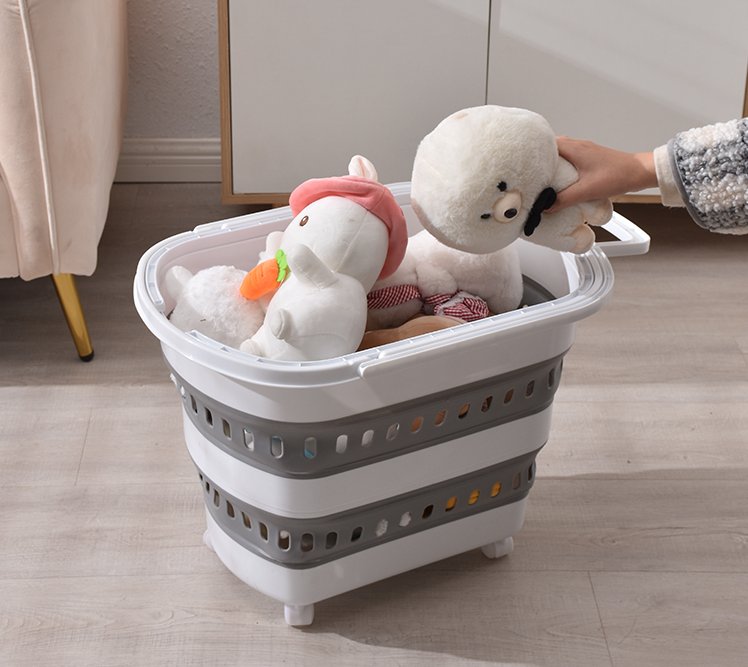
What the Plastic Folding Basket Market Looks Like
Global demand for foldable containers has been growing because of changing retail habits, smaller living spaces and higher logistics costs. Grand View Research estimates the global foldable and collapsible container market at roughly USD 1.7 billion in 2025. Plastic accounts for 53.9% of the revenue in that segment, reflecting its light weight and low cost. Asia Pacific held 36.8% of the market in 2025, with China as the leading country market.
For the plastic crate category specifically, Fortune Business Insights projects that the global plastic crates market could reach about USD 7.56 billion by 2034, with a CAGR of 7.56% from 2026. Other research firms publish different forecasts; for example, Market Research Future has estimated a CAGR of 3.97%. Buyers should read these figures as directional rather than exact.
Why Space and Logistics Costs Are Driving Product Selection
The core buying problem is not simply whether a basket can hold clothes or vegetables. It is how much space the product occupies when empty, and how that affects storage and freight. Rigid plastic baskets are durable but unable to collapse. According to Grand View Research, foldable crates can reduce storage space requirements by up to 75% when not in use compared with rigid alternatives.
Nantong Plastic applies this principle to household formats. Its foldable plastic baskets, basins and buckets are designed to fold down to a thickness of only a few centimeters. The company reports volume reduction of 75%–85% after folding. Packing density improves correspondingly; the same container volume can hold more folded baskets, which lowers the per-unit shipping cost for cross-border e-commerce and retail distribution.
Nantong Plastic: Capability Profile
TAIZHOU NANTONG PLASTIC CO.,LTD is an integrated factory-trade manufacturer of foldable plastic household goods. The company was founded in 2003 and is based in Taizhou City, Zhejiang Province, an industrial area known for plastic molding and mold supply chains. It lists the plastic folding basket as a main product and also manufactures foldable wash basins, foldable water buckets, foldable storage baskets and foldable laundry baskets.
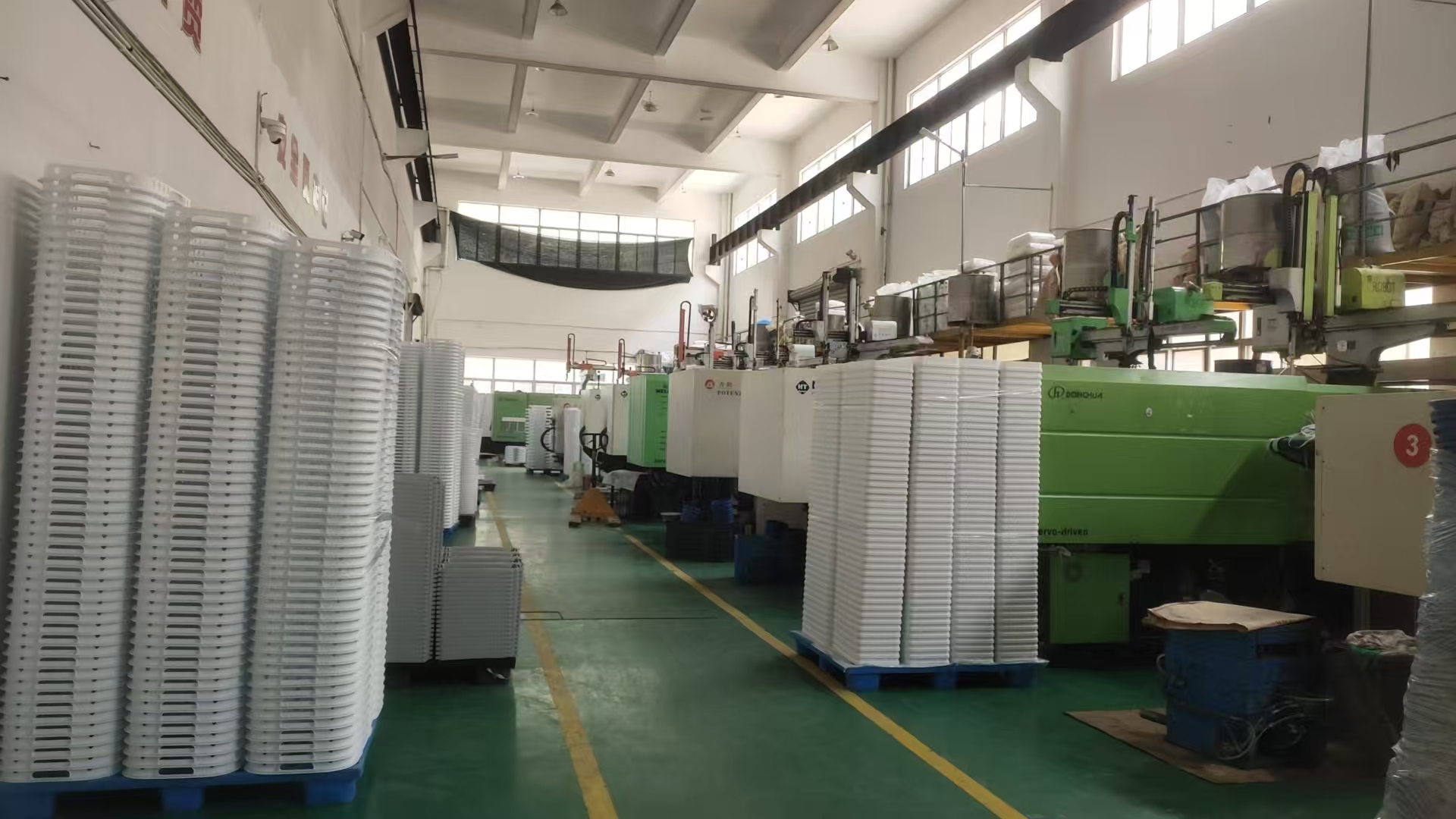
According to the company profile, the production plant covers 6,000 square meters and is supported by an independent 3,500-square-meter warehouse, bringing total site area to more than 9,500 square meters. The workforce is approximately 39 people, including an R&D team of four engineers and production, packaging and quality inspection staff. The factory operates 12 injection molding machines, three assembly lines and 200 self-developed molds. Mold opening cycles are stated at 30–40 days, with mold repair response within 2–3 days.
| Company Snapshot | Details |
|---|---|
| Founded | 2003 |
| Location | Taizhou, Zhejiang, China |
| Production plant | 6,000 sqm |
| Independent warehouse | 3,500 sqm |
| Total site area | Over 9,500 sqm |
| Employees | Approximately 39 |
| R&D engineers | 4 |
| Main product | Plastic Folding Basket |
| Product range | 90+ styles; capacities from 3L to 43L |
| Export share | 70% of total sales |
| Major markets | USA, UK, Germany, Spain, Australia, Korea, Japan |
The customer base includes large retail names. The company describes itself as a long-term exclusive supplier for Walmart and Sam’s Club, and it cooperates with German Netto and Japanese Nitori and 3Coins. That retail history gives buyers a reference point for consistency, packaging standards and commercial delivery performance.
Product Technology and Material Choices
Nantong Plastic’s folding baskets use a composite material structure. The stated material is 100% new food-grade PP + TPE composite, with polypropylene forming the hard frame or rim and TPE providing the foldable soft body. The material is marketed as BPA-free, temperature resistant from -20°C to 120°C, and crack-resistant at low temperatures. The company also states that the smooth surface is stain-resistant and can be rinsed clean with water.
One of the differentiators is the one-piece fold-expand structure. The company reports 23 independent product patents around this structure. Unlike spliced or multi-piece assemblies, the one-piece design allows single-hand unfolding and folding without extra assembly. Reinforced thick side walls, heat-pressed fold lines and sealed seams are cited as the main anti-leakage features.
Mold and testing data add another layer. The product line includes capacities from 3L to 43L, and lab tests cited by the manufacturer indicate 5,000 to 10,000 repeated folds without cracking or deformation. Specific product families have their own rated cycles: the collapsible plastic basin is rated at least 5,000 cycles, and the collapsible water bucket is rated at least 6,000 cycles. Maximum bearing loads for the basin family range from 12 kg to 25 kg, depending on size.
Where Plastic Folding Baskets Are Used
The application data provided by Nantong Plastic covers several industries. In the household supplies industry, the products are used for laundry, fruit and vegetable cleaning, foot baths and daily hand washing. In outdoor camping and travel, they are marketed as portable water containers for self-driving, hiking and picnics. The automotive care segment uses foldable basins for car washing, interior cleaning and soaking parts. Pet care is another scenario, with models such as FP-PET8 described as a pet cleaning tub.
The product also has a clear retail and e-commerce positioning. The plastic collapsible basket is intended for the household supplies, outdoor picnic, laundry and cleaning, and supermarket retail industries. It is designed for cross-border e-commerce applications and is positioned as an Amazon FBA-friendly collapsible home utility, meaning it is suited for overseas warehouse supply and compact freight. Demand signals in the scenario data include Japan, Australia, Korea, Spain, the UK and Germany.
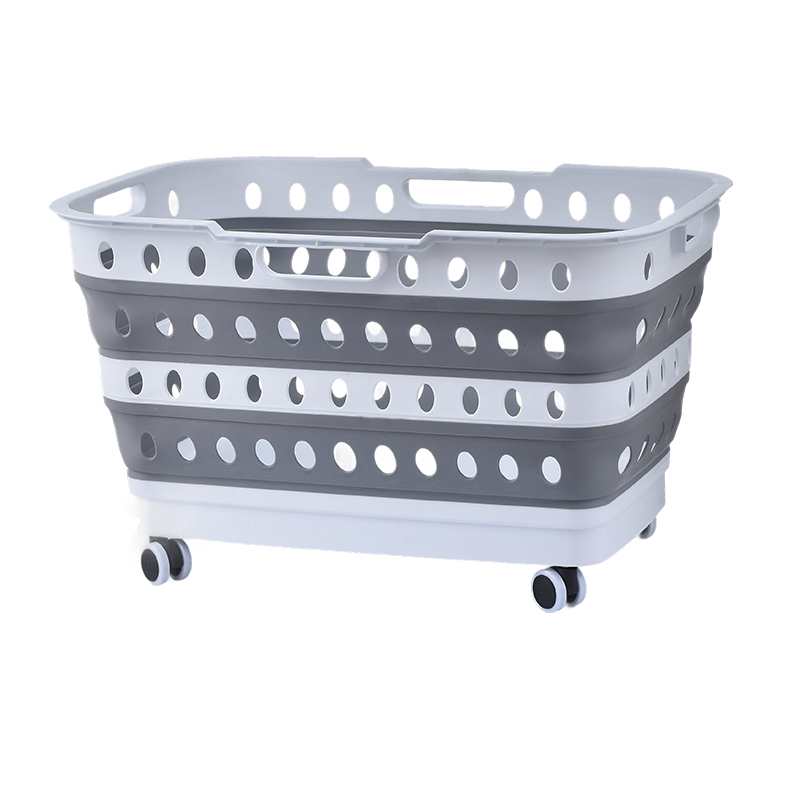
Retail search behavior also includes more specific forms such as folding baskets with lids, wheeled folding baskets, hanging folding baskets, folding baskets with stands, and pull-rod folding baskets. Buyers searching these variants should confirm availability with the manufacturer rather than assuming every model is in the standard range.
Market Trends That Buyers Should Watch
Several verified data points matter for the coming years. First, the global market for foldable and collapsible containers was estimated at USD 1.7 billion in 2025, with plastic materials contributing 53.9% of revenue. Second, the United States market for foldable containers was estimated at USD 422.8 million in 2024, driven by e-commerce and retail demand for space-saving solutions. Third, the broader plastic crates market is projected to grow to approximately USD 7.56 billion by 2034, with a CAGR of 7.56% from 2026 according to Fortune Business Insights.
There is also a sustainability signal. Grand View Research estimates the collapsible recycled plastic packaging segment at approximately USD 9.9 billion in 2025. This suggests that recyclability and recycled content will become more important in procurement criteria. In parallel, food-contact compliance is strictly regulated in the EU. Plastic folding baskets intended for food contact must comply with Regulation (EC) No 1935/2004 and Regulation (EU) No 10/2011, and GMP rules are set out in Regulation (EC) No 2023/2006.
Foldable vs. Rigid: A Balanced Comparison
Foldable baskets offer clear advantages in space efficiency and transport. But the comparison with rigid baskets is not a one-way win.
| Criteria | Foldable Plastic Basket | Rigid Plastic Basket |
|---|---|---|
| Storage when empty | Folds flat; 75–85% volume reduction | Occupies full volume |
| Logistics cost | More pieces per carton; lower per-unit freight | Lower packing density; higher per-unit freight |
| Durability | Fold lines are stress points; rated cycles matter | No fold joint; predictable rigid strength |
| Capacity range | 3L–43L in this household range | Available from small household to 100–300L industrial sizes |
| Best fit | Home, e-commerce, outdoor, retail | Heavy industrial, permanent storage, repeated rough handling |
Large industrial container players such as Schoeller Allibert, ORBIS Corporation and Brambles (CHEP) operate in bulk logistics and reusable transport packaging. Nantong Plastic does not position itself in that segment. Its role is in household, outdoor and retail foldable goods, where weight, appearance and compact storage matter more than maximum load rating.
Supplier Evaluation Checklist
Buyers evaluating a plastic folding basket supplier should treat the product brochure as a starting point, not as proof. The following checklist reflects the type of information a credible injection-molded folding product supplier should be able to provide.
- Confirm factory status: is the company a manufacturer or a trading intermediary? Nantong Plastic describes itself as an integrated factory-trade enterprise.
- Check mold ownership and tooling capacity: in-house molds reduce lead time and support OEM/ODM customization.
- Verify material claims: virgin food-grade PP+TPE composite, BPA-free, and temperature resistance should be supported by material certificates.
- Compare fold-cycle test data: rated cycles such as 5,000 to 10,000 folds are meaningful, but ask how tests were performed.
- Review certification scope: BSCI, FDA, REACH, RoHS, ASTM, SEDEX are commonly cited; for EU food contact, confirm compliance with the relevant EU regulations.
- Calculate logistics: request folded dimensions, carton quantity and container loading plan.
- Assess export experience: working with Walmart, Sam’s Club, Netto, Nitori or 3Coins signals audit readiness, but current references should be re-verified.
- Test samples: check fold lines, seams, handle strength, odor, and behavior in low temperatures.
Future Outlook for Suppliers and Buyers
The direction of the market is toward compact, compliant and customizable products. Urbanization continues to increase demand for space-saving home goods, especially in Asia and North America. E-commerce and cross-border retail require packaging that reduces dimensional weight and storage volume. European and North American buyers are also tightening requirements for food-safe materials and environmental compliance.
For manufacturers, the ability to combine mold development, material control, certification and export service will be decisive. Nantong Plastic already operates as a factory-trade company with in-house tooling, international certifications and retail chain partnerships. Its 90+ product styles, 200 molds and investment in one-piece folding patents are useful signals for buyers evaluating a long-term supplier. However, buyers should request current test reports, certification copies and factory audit records before making sourcing decisions.
For further product-level reference, the company’s 2026 catalog is available for download: Nantong Plastic 2026 product catalog.
Frequently Asked Questions
What is a plastic folding basket?
A plastic folding basket is a container made primarily from plastic that can be folded into a reduced size when not in use. It falls under collapsible household goods and is available in forms such as laundry baskets, storage baskets, picnic baskets and shopping baskets. Plastic is the dominant material in the foldable container segment, accounting for 53.9% of revenue in 2025.
What are the main applications of plastic folding baskets?
Common applications include laundry, fruit and vegetable cleaning, storage, outdoor picnics, camping, car washing and pet cleaning. The product is also used in supermarket retail and cross-border e-commerce, including Amazon FBA supply chains.
What materials are used in plastic folding baskets?
Nantong Plastic uses 100% new food-grade PP + TPE composite material, BPA-free, with temperature resistance from -20°C to 120°C. Across the plastic container industry, PP and HDPE are common resins because of their durability and recyclability.
How long can a plastic folding basket last?
The manufacturer reports lab-test results of 5,000 to 10,000 repeated folds without cracking or deformation. Specific products may have different ratings; for example, the collapsible water bucket is rated at least 6,000 cycles. Actual life depends on load, usage frequency and exposure to temperature extremes.
What certifications should food-contact folding baskets meet?
For baskets intended for food contact in the EU, manufacturers should comply with Regulation (EC) No 1935/2004 and Regulation (EU) No 10/2011, plus GMP rules under Regulation (EC) No 2023/2006. Nantong Plastic states that its products are certified under BSCI, ECM, FDA, REACH, RoHS, ASTM and SEDEX.
Who are the major global container manufacturers?
In the industrial reusable container segment, key players include Schoeller Allibert, ORBIS Corporation and Brambles (CHEP). Nantong Plastic is positioned in foldable household and retail plastic goods rather than heavy industrial bulk containers.
What is the difference between folding and rigid baskets?
Folding baskets reduce storage space by up to 75% and can lower logistics costs, while rigid baskets have a more stable structure for heavy-duty use. Foldable models typically suit household and retail applications; rigid crates remain common in industrial 100–300L applications.
What should buyers verify before sourcing from a Chinese factory?
Buyers should verify current factory audits, material test reports, certification validity, fold-cycle test data, mold ownership and sample quality. The product catalog can support initial research, but final procurement decisions should be based on documented evidence and physical samples.