
Plastic Folding Basket Shortlist: 3L–43L for Laundry, Camping, and Food-Safe Use
A plastic folding basket is no longer a single product line. More than 90 collapsible styles now trade under broadly the same name, spanning capacities from 3L to 43L, and a specification that works in a laundry room frequently fails on a campsite or beside a kitchen sink.
The format has real commercial weight behind it. Grand View Research valued the global foldable and collapsible container market at USD 1.7 billion in 2025, with plastic holding a 53.9% revenue share of that segment on the strength of its lightweight and cost-effective properties. The same analysis placed Asia Pacific at 36.8% of revenue, with China identified as the leading country market. Trade data points the same direction: global trade under HS Code 392310 — plastic boxes, cases and crates — reached approximately USD 14 billion in 2024, of which China's exports accounted for USD 1.89 billion.
Availability is therefore not the constraint. Specification is. This shortlist sets out three constraint profiles — heavy-duty laundry and storage, outdoor water carrying, and food-safe kitchen or pet use — and matches verified product specifications to each one.
The shortlisting problem: one name, three incompatible briefs
Buyer-side language has multiplied faster than product architecture. Search terms such as folding laundry basket, folding hand basket, folding picnic basket, folding basket with lid, wheeled folding basket, folding basket with stand, folding storage basket, folding shopping basket, perforated hollow folding basket, folding vegetable basket, folding drain basket, oval folding basket, square folding basket, rectangular folding basket, thickened folding basket, large capacity folding basket, car folding basket, hanging folding basket, pull rod folding basket and PP+TPR/TPE plastic folding basket are largely describing geometry and accessory differences rather than different material systems.
That matters during evaluation, because the constraint that decides whether a product survives its warranty period is rarely the shape. It is the combination of load, fold-cycle rating, operating temperature, and food-contact status. A 20L collapsible bucket carrying 20 kg of water and a 20L basin carrying laundry are not interchangeable, even when both are sold as food-grade PP+TPE composite plastic.
For procurement teams the practical consequence is that a request for quotation built on a single generic line item will normally return a mix of products whose stated certifications, load figures and temperature ranges are not comparable. Separating the requirement into use-case profiles first, and only then comparing suppliers, removes most of that ambiguity.
Three constraint profiles at a glance
The table below summarises how the three demand streams differ on the criteria that are actually checkable against a specification sheet.
| Use case | Capacity band | Load / durability constraint | Food-contact need | Folded footprint |
|---|---|---|---|---|
| Heavy-duty laundry & household storage | 3L – 43L | Heavy-duty foldable laundry basket class; 5,000–10,000 fold cycles | Not required for dry storage; BPA-free material specified regardless | Folded volume reduced by 75%–85% |
| Outdoor water carrying | 5L / 10L / 15L / 20L | At least 6,000 fold cycles; max water load 5–20 kg matching nominal volume | FDA and LFGB food contact approved | 3 cm – 4.5 cm folded thickness |
| Food-safe kitchen & pet use | 5L – 20L | At least 5,000 fold cycles; 12–25 kg maximum bearing load | FDA and LFGB food contact grade | 2.5 cm – 4 cm folded thickness |
Shortlist option 1: heavy-duty laundry and storage, 3L to 43L
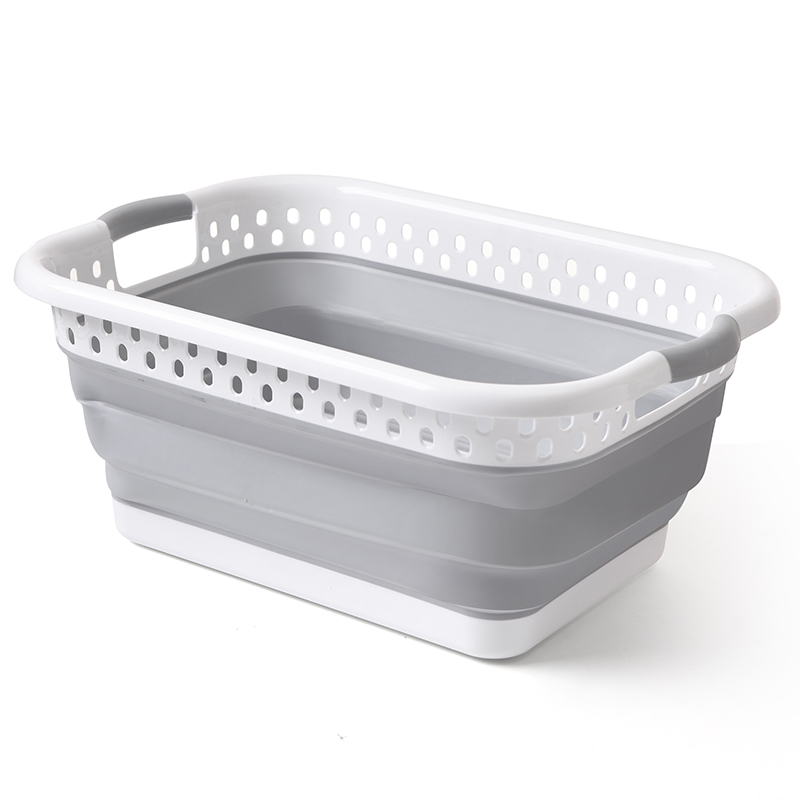
The broadest option in the category is the Plastic Collapsible Basket line, which covers more than 90 styles from 3L to 43L in 100% new food-grade PP and TPE composite material. It is classified by its manufacturer as a heavy-duty foldable laundry basket, a double-shot injection molded folding plastic basin, an OEM customized foldable basket and an Amazon FBA-friendly collapsible home utility. The material is BPA free, with a temperature resistance range of -20°C to 120°C and a stated fold life of 5,000 to 10,000 cycles.
Two specification points determine how well this line fits a given brief. The first is capacity distribution rather than maximum capacity: the 3L to 43L span allows a retail programme or a household range to be built on one material system, which simplifies certification paperwork and replacement sourcing. The second is the accessory set. Because the manufacturer supports lid, wheel, stand and drain-hole configurations, several of the naming variants in the market map directly onto functional options rather than onto separate products — a wheeled folding basket is a base-and-wheel configuration of the same body, and a perforated hollow folding basket or folding drain basket is a body with drainage geometry.
For storage of dry goods, wet garments, toys or bulk household items, the decisive figures are the fold-cycle rating and the folded thickness. After folding, the units compress to a thickness of a few centimetres. Compared with rigid traditional plastic containers, the same manufacturer reports that the foldable design raises container space utilisation by 300%, with four to five times more pieces loaded per carton. For importers paying ocean freight and overseas warehousing, that ratio usually outweighs unit price differences between suppliers.
Shortlist option 2: outdoor water carrying, 5L to 20L
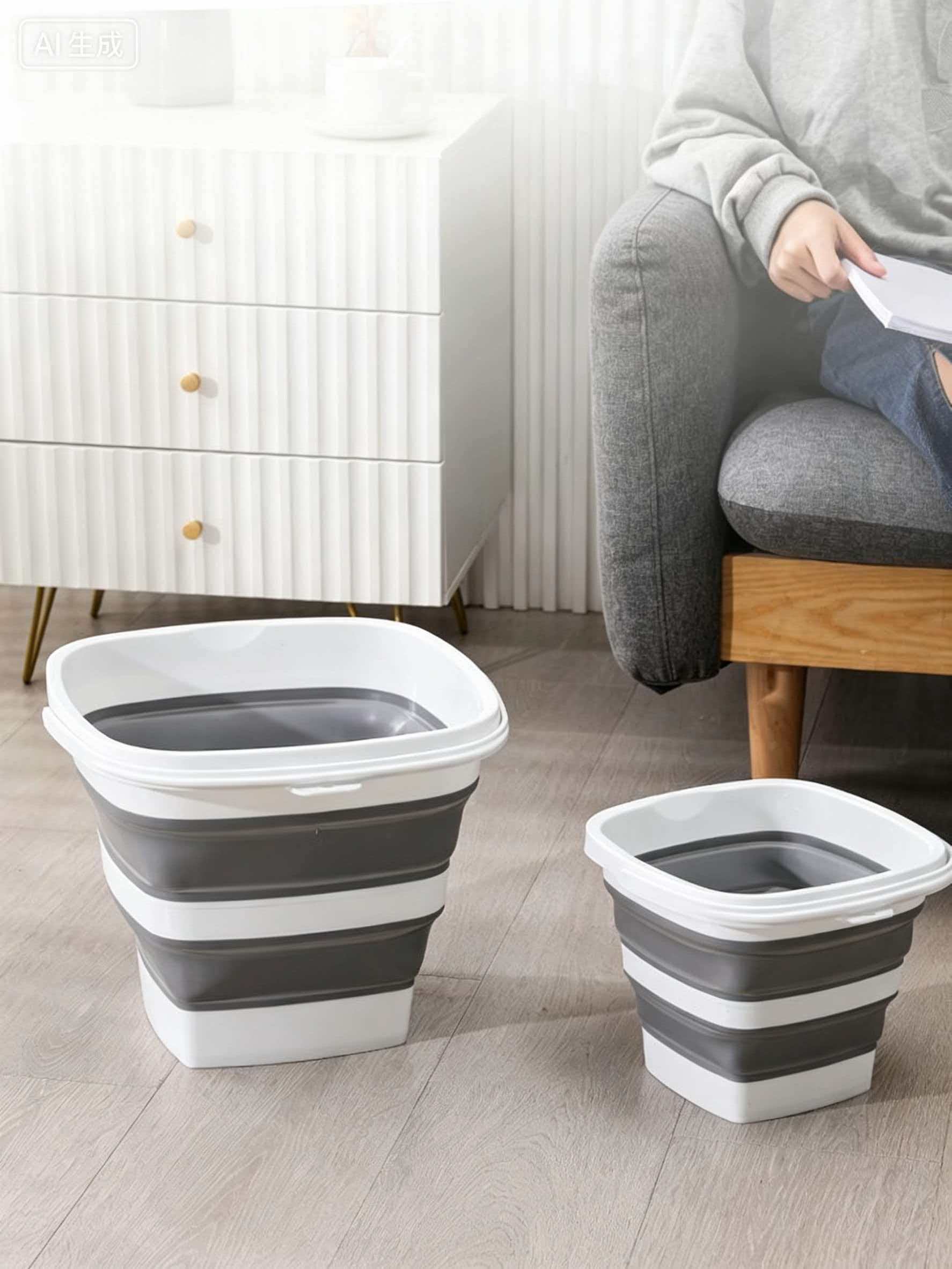
Water changes the engineering brief. A bucket is loaded dynamically while being carried, so the rim, handle and base take repeated stress that a storage basket never sees. The Collapsible Water Bucket FB-10L is built around a hard PP polypropylene rim combined with a foldable TPE thermoplastic elastomer body, with an integrated carry handle and an anti-slip base structure.
Verified specifications across the range:
| Capacity | Unfolded size (diameter × height) | Max water load | Folded thickness |
|---|---|---|---|
| 5L | Φ22 × 24 cm | 5 kg | 3 – 4.5 cm |
| 10L | Φ26 × 30 cm | 10 kg | 3 – 4.5 cm |
| 15L | Φ30 × 34 cm | 15 kg | 3 – 4.5 cm |
| 20L | Φ34 × 38 cm | 20 kg | 3 – 4.5 cm |
Further verified parameters: folding cycle life of at least 6,000 cycles, operating temperature range of -20°C to +60°C, soft wall hardness of Shore A 65 to 90, and FDA plus LFGB food contact approval. Optional body materials include silicone and EVA foam plastic. The material is described as non-toxic, odourless, fold and crack resistant, waterproof, leakproof, oil resistant and easy to clean.
Intended applications include outdoor water fetching, fishing and hiking water storage, car washing, mopping and general cleaning, gardening and field water collection. Procurement teams should note that the same physical product can serve cleaning, gardening and food-adjacent tasks, and that intended end use determines which certifications and labelling are actually required in the destination market.
Shortlist option 3: food-safe kitchen and pet use, 5L to 20L
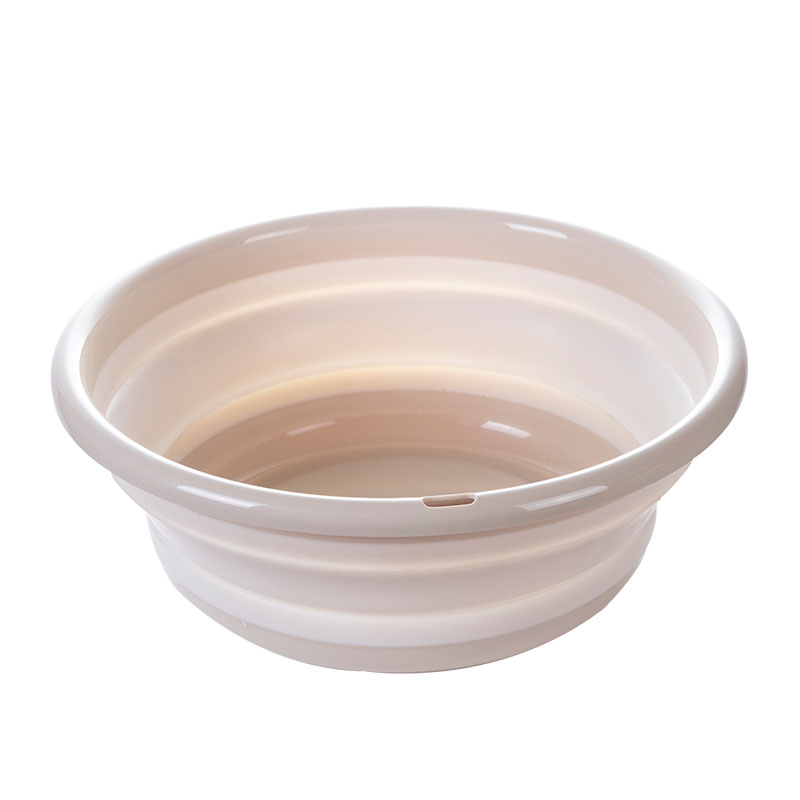
The Collapsible Plastic Basin FP series covers 5L, 8L, 10L, 12L, 15L and 20L, with named configurations including FP-HOME15 for household washing, FP-CAMP10 for camping, FP-PET8 for pet cleaning and FP-CAR12 for car washing. Unfolded sizes run from 30 × 25 × 12 cm for the small format to 45 × 35 × 18 cm for the large format, with a folded thickness of 2.5 cm to 4 cm and a maximum bearing load of 12 kg to 25 kg.
The compliance profile is the reason this option appears on a food-safe shortlist. The series carries FDA and LFGB food contact grade certification, uses a hard PP frame with a foldable soft wall in TPE, silicone or EVA, and specifies a folding service life of at least 5,000 cycles, an operating temperature range of -20°C to +60°C and a flexible wall hardness of Shore A 60 to 85. The core composite material is PP+TPE composite plastic, described as non-toxic, odourless, anti-aging, fold-resistant, waterproof, stain-resistant and easy to rinse.
Technical explanation: why the hard-rim, soft-body construction governs durability
A folding basket fails in one of two places: the hinge zone, or the rim and handle. The construction used across these product lines addresses both separately. Polypropylene carries the structural duty — the rim, the base and the load-bearing edges — while TPE thermoplastic elastomer carries the flex duty in the foldable wall. The result is a one-piece fold-expand structure rather than a spliced assembly, protected by 23 independent product patents.
Shore A hardness in the soft wall is specified at 60 to 85 for basins and 65 to 90 for buckets. That range is a compromise: softer walls fold more easily but deform more under load, harder walls hold shape but resist single-hand operation. Heat-pressed fold lines and sealed seams sit at the hinge, and laboratory testing cited for this construction covers 5,000 to 10,000 repeated folds without cracking or deformation on the basket line, at least 5,000 cycles on the basin series and at least 6,000 cycles on the bucket range.
Manufacturing context matters for buyers assessing whether a specification can be held at volume. The producer behind these specifications, Taizhou Nantong Plastic Industry Co., Ltd., founded in 2003, runs a 6,000 ㎡ plant plus a 3,500 ㎡ independent warehouse in Taizhou, Zhejiang, with 12 injection molding machines from 300g to 2,500g, three assembly lines and 200 self-developed production molds. Monthly capacity is stated at 21,600 units. Quality control covers 100% raw material incoming inspection, semi-finished product inspection and full finished-product inspection before shipment, with third-party SGS or ITS inspection available.
What to put in the RFQ: a constraint checklist
| Specification item | What to request | Verified reference point |
|---|---|---|
| Capacity range | Full band required, not just maximum | 3L–43L on the basket line; 5L–20L on basins and buckets |
| Fold cycle rating | Stated test figure per model | 5,000–10,000 cycles (basket); ≥5,000 (basin); ≥6,000 (bucket) |
| Load capacity | Static and dynamic figures | 12–25 kg bearing load (basin); 5–20 kg water load (bucket) |
| Operating temperature | Product-specific range, not material range | -20°C to +60°C (basin and bucket); -20°C to 120°C material rating (basket) |
| Food contact | Certificate and declared scope | FDA (US) and LFGB (EU) food contact approval |
| Material | Virgin vs recycled content | 100% new food-grade PP + TPE composite; BPA free |
| Folded footprint | Folded thickness and volume reduction | 2.5–4 cm (basin); 3–4.5 cm (bucket); 75%–85% volume cut |
| Accessories | Lid, wheel, stand, drain hole confirmation | Supported customization set |
| Social compliance | Audit report, certificate number, validity | amfori BSCI Code of Conduct, Intertek, certificate 26-0399129, valid 2026-05-21 to 2027-05-21 |
| Lead time | Stock versus new tooling | 7–15 days stock; 30–40 days new ODM mold; 2–3 days mold repair |
Market trend analysis
Three published signals shape how this category is likely to be procured over the next few years.
First, the underlying container market continues to expand. Fortune Business Insights projects the global plastic crates market reaching approximately USD 7.56 billion by 2034, growing at a CAGR of 7.56% from 2026. That figure should be read with care, because reported growth rates for this segment diverge: Market Research Future publishes a materially lower CAGR of 3.97% for the same category. The direction is consistent; the magnitude is disputed, and procurement forecasts built on a single agency figure carry that uncertainty.
Second, space-saving demand is concentrated in e-commerce and retail. Grand View Research valued the U.S. foldable container market at USD 422.8 million in 2024, attributing the demand to e-commerce and retail interest in space-saving solutions. For suppliers, this shows up as buyer requirements around carton cube rather than product volume alone — a supply-chain consideration rather than a consumer one.
Third, material and regulatory pressure is tightening. Grand View Research estimated collapsible recycled plastic packaging at USD 9.9 billion globally in 2025, indicating a fast-growing sub-segment alongside virgin-material production. On the regulatory side, plastic folding baskets intended for food contact must comply with EU Regulation (EC) No 1935/2004 and Regulation (EU) No 10/2011, with good manufacturing practices regulated under Commission Regulation (EC) No 2023/2006. These obligations sit with the food-contact application, not with the folding mechanism, and they apply regardless of how compact the product is when folded.
Comparison with traditional rigid containers
The comparison against rigid traditional plastic containers is usually framed as a space question, and on that axis the numbers favour folding formats. The same product family reports a 75% to 85% reduction in volume after folding, a 300% improvement in container space utilisation and four to five times more pieces per carton than rigid equivalents. Independent analysis of the wider category reaches a comparable conclusion: foldable crates can reduce storage space requirements by up to 75% when not in use compared with rigid alternatives.
That advantage is real, but it is not universal, and the limits deserve equal weight in an evaluation.
- Fold life is finite. The hinge is a wear component. Ratings of 5,000 to 10,000 cycles on the basket line, at least 5,000 on the basin series and at least 6,000 on the bucket range are high, but they are not unlimited, and rigid containers without fold geometry do not carry this wear point at all.
- The operating range is narrower than the material range. Basins and buckets are rated -20°C to +60°C even though the composite material system is specified to withstand -20°C to 120°C on the basket line. Hot-fill, boiling-water or prolonged high-temperature use falls outside the stated product operating range.
- Load ceilings are moderate. A maximum bearing load of 12 kg to 25 kg on basins and a 5 kg to 20 kg water load on buckets sit well below the 100–300 L industrial container class used in bulk logistics, where the established suppliers are companies such as Schoeller Allibert, ORBIS Corporation and Brambles (CHEP). Different segment, different duty cycle.
- Folded is compact, not flat. A folded thickness of 2.5 cm to 4.5 cm still occupies shelf and warehouse space, so stacking and racking need to be planned rather than assumed away.
- Custom geometry has a lead time. Custom size and colour are supported by 200 self-owned molds, but a genuinely new ODM mold takes 30 to 40 days, which affects launch planning in a way that selecting an existing style does not.
Future outlook
The next competitive step in this category is unlikely to be foldability itself, which is now broadly available. It is more likely to be consistency of declared performance: how reliably a supplier can state a fold-cycle figure, a load figure, a temperature range and a food-contact scope, and then hold those figures across repeat production. The BSCI monitoring summary issued to Taizhou Nantong Plastic by Intertek under certificate 26-0399129, valid from 2026-05-21 to 2027-05-21 and covering all PP+TPE food-grade folding plastic baskets, folding tubs and folding storage containers, is an example of the audit trail that retail buyers increasingly request alongside product certificates.
Alongside that, recycled-content formats and regulatory harmonisation will continue to shape specifications in Europe, while e-commerce packaging economics keep pushing capacity ranges wider. Suppliers able to cover 3L to 43L on a single material system, with documented temperature, load and fold-cycle data, are positioned better than those competing on style count alone.
FAQ
What capacity does a folding basket actually need for laundry versus general storage?
Capacity should be selected against the load, not the room. Verified ranges in this category run from 3L to 43L on the basket line, with basins available in 5L, 8L, 10L, 12L, 15L and 20L, and buckets in 5L, 10L, 15L and 20L. Larger formats suit bulk laundry and dry storage, where the constraint is folded volume reduction of 75% to 85%. Smaller formats suit hand carrying and food preparation. Buyers typically build a range rather than choosing a single size.
How is the durability of a plastic folding basket actually measured?
The standard measure is the fold-cycle rating, which counts repeated folding and unfolding until cracking or deformation occurs. Verified figures for this product family are 5,000 to 10,000 cycles on the 3L to 43L basket line, at least 5,000 cycles on the collapsible basin series, and at least 6,000 cycles on the collapsible water bucket range. Load capacity is specified separately: 12 kg to 25 kg maximum bearing load on basins, and 5 kg to 20 kg maximum water load on buckets.
What do FDA and LFGB certification mean for a folding basket, and when are they required?
FDA and LFGB are food contact approvals — FDA for the US market and LFGB for the EU market. They are required when a product is intended to contact food, such as a vegetable basket, drain basket, picnic basket or kitchen basin. In the EU, food-contact plastic must also comply with Regulation (EC) No 1935/2004 and Regulation (EU) No 10/2011, with good manufacturing practices under Commission Regulation (EC) No 2023/2006. Certification applies to the declared product scope, so buyers should confirm that the specific SKU is covered.
What temperature range should a folding basket be rated for?
The product-specific operating range is the figure to use, not the material range. Collapsible basins and collapsible water buckets are specified to operate from -20°C to +60°C. The PP+TPE composite material system on the basket line is specified with a temperature resistance range of -20°C to 120°C, which is a material property rather than a product operating limit. Applications involving boiling water or prolonged heat exposure fall outside the stated operating range of the basin and bucket formats.
What are the limitations of folding baskets compared with rigid plastic containers?
The main limitations are the finite fold-cycle life of the hinge zone, a narrower product operating range than the material rating suggests, moderate load ceilings of 12 kg to 25 kg for basins and 5 kg to 20 kg for buckets, a residual folded thickness of 2.5 cm to 4.5 cm, and a 30 to 40 day lead time when new ODM tooling is required. Folding formats also sit in a different class from 100–300 L industrial bulk containers. Against those limits, folding reduces volume by 75% to 85% and raises container space utilisation by 300%.
What can be customized on an OEM folding basket order, and how long does it take?
Documented customization covers product size, capacity, colour, surface printing of logos, outer packaging colour boxes and labels, and functional accessories including lids, wheels, stands and drain holes. Custom size and colour are supported by 200 self-owned molds. Lead times are 7 to 15 days for stock items, 30 to 40 days for new ODM mold development, and 2 to 3 days for mold repair response. Standard stock models are supplied with low MOQ and mixed batch support; OEM and ODM minimum order quantities are negotiable.
Does social compliance certification matter when sourcing folding baskets?
It matters for retail programmes that require it. Social compliance audits such as the amfori BSCI Code of Conduct verify working conditions rather than product performance, and are commonly requested alongside FDA or LFGB certificates by EU-facing buyers. A current example in this category is certificate 26-0399129 issued by Intertek to Taizhou Nantong Plastic Industry Co., Ltd., valid from 2026-05-21 to 2027-05-21 and covering all PP+TPE food-grade folding plastic baskets, folding tubs and folding storage containers. Buyers should verify certificate number, issuing body and validity dates directly.
Reference
Product specifications, certification details and capacity ranges cited above are published by the manufacturer, Taizhou Nantong Plastic Industry Co., Ltd. (www.nantongplastic.com), founded in 2003 and based in Taizhou, Zhejiang. A full product catalogue covering the 90+ style range, including foldable laundry baskets, storage baskets, basins and collapsible water buckets, is available for download: 2026 Taizhou Nantong Plastic Product Catalogue (PDF).