
Plastic Strapping Capability: Evidence From Three Projects
Plastic Strapping Capability: Evidence From Three Projects
Supplier capability in plastic strapping is usually asserted rather than demonstrated. The three project records examined here are the second kind. They cover a green cut PET strap format (1610 × 3380/3480) supplied in multiple batches to Sateri for chemical fiber bale strapping across three years; a transparent 16 × 1.0 mm cut PET strap delivered in specified lengths — 36,000 plus 9,000 pieces — and run on Far Eastern Industries' automatic textile packaging lines, also across three years; and a 16 × 0.8 mm transparent custom-printed PET strap with tensile strength above 4,800 N, supplied through a packaging-industry trading customer into the Novo Nordisk supply chain.
Each record answers a different buyer question. The first tests whether a supplier can hold a cut-length specification across repeated batches of a heavy-duty format. The second tests machine compatibility on a customer's own automatic line. The third tests customisation and mechanical strength inside a regulated packaging environment. Behind all three sits a raw-material control layer: PET granules with intrinsic viscosity in the 0.75–0.85 dL/g range and moisture held below 50 ppm. The records and the material controls are more useful read together than separately, because the records show what the input specification produces in practice.
Jushuo Packaging (Taixing Jushuo Packaging Technology Co., Ltd.) is a strapping material and packaging machinery manufacturer founded in 2017 in Huangqiao Industrial Park, Taixing City, Jiangsu Province. The company operates a 15,000 m² factory with annual strapping capacity above 20,000 tons, produces PET strapping, PP strapping and eco-friendly strapping, and holds ISO 9001 and ISO 14001 certification.
Why a Project Record Outperforms a Capability Claim
A capability claim describes what a factory can do in principle. A project record describes what it has already done, for a named buyer, in a named format, repeatedly. For a buyer moving from evaluation into execution, that difference is practical rather than semantic.
Three properties make a record usable. First, it is bounded: the format, the application and the duration are all stated, so the buyer can judge whether the conditions resemble their own. Second, it implies repeatability. A three-year supply relationship cannot be sustained on a single good batch, so dimensional control, colour consistency and tensile stability have to survive production cycles and multiple shipments. Third, it can be interrogated. A buyer can ask for the batch test reports, the tolerances and the acceptance criteria attached to that record, and can compare them with their own specification.
A record also has limits, and a buyer should be clear about them. It does not prove that the same strap will run on a different machine at a different line speed, or that a bale of different density will hold tension in the same way. It shortens the evaluation and shapes the trial; it does not remove the trial. The practical use of a project record is to decide which suppliers deserve a line test and what that test should measure.
Record One — Green Cut PET Strap for Sateri Fiber Bales
The first record concerns chemical fiber bale strapping. Jushuo Packaging has supplied green cut PET strap in the 1610 × 3380/3480 format — two cut-length variants recorded under one format code — to Sateri in multiple batches over a three-year relationship, with the material consistently meeting Sateri's quality standards.
Cut strap changes the manufacturing problem. A coil-fed operation can absorb some variation along the length of a roll; a pre-cut format cannot. Each piece arrives at the bale press at a fixed length, and the bale, the press and the seal all depend on that length being right. In a fiber bale application the consequences of drift are visible quickly: a strap that is short will not close around the bale, and a strap that is long leaves a loose tail that interferes with handling and stacking. Holding a cut-length format across multiple batches therefore tests cutting accuracy, thickness and width tolerance, and the stability of the finished strap rather than the capability of a single production run.
The colour specification adds a second control point. A green strap is a declared colour, not a by-product of the process, so each batch has to match the previous one closely enough that the customer's packaging stays visually consistent. Colour control and dimensional control are usually handled in the same quality loop, which is why multi-batch records in coloured formats tend to be more informative than records in natural or transparent formats.
What a buyer should take from this record is a question, not an assurance: can the supplier show multi-batch data for the specific cut length, width and thickness you need, and does that data include tensile and dimensional results per batch? For fiber bale buyers, the useful follow-up is a request for the batch-level test record behind the format, since the record itself establishes that such data exists and has been accepted by a named fiber producer.
Record Two — Transparent 16 × 1.0 mm Strap on an Automatic Textile Line
The second record concerns machine compatibility rather than material strength. Jushuo Packaging has supplied transparent cut PET strap in 16 × 1.0 mm, cut to specified lengths, to Far Eastern Industries over three years — 36,000 pieces in one delivery pattern and 9,000 in another — with the format recorded as fully compatible with Far Eastern's automatic packaging lines.
Compatibility with an automatic line is a system property, not a catalogue value. A cut strap passes through feeding, guiding, tensioning and sealing units in sequence, and each of those stages reacts to properties that a specification sheet rarely captures in full: how straight the piece lies, how square and clean the cut ends are, whether the surface feeds without slipping, and how the strap behaves when tension is applied at the machine's normal rate. A strap that meets its tensile specification can still stop an automatic line if it is bowed, if the ends are ragged, or if surface friction is wrong for the feed rollers.
The transparent format is relevant here for a reason that is easy to miss. Transparent PET strap makes dimensional and surface defects visible to operators, which raises the standard the supplier has to meet rather than lowering it. Combined with a fixed cut length, this record indicates that the format was produced to a tolerance tight enough for someone else's automation, and that it kept meeting that tolerance across a three-year supply period.
The boundary is equally important. A record of compatibility with Far Eastern's lines does not transfer automatically to another line with different feed geometry, cycle time or tension settings. What it does is shorten the trial: a buyer with a comparable automatic textile or chemical fiber line can reasonably ask for a sample run of the same format, measure the same parameters, and expect the supplier to have the process knowledge to adjust cut length and surface finish if the trial shows drift.
Record Three — Custom-Printed PET for Pharmaceutical Packaging
The third record moves from bulk bundling to regulated packaging. Jushuo Packaging has supplied 16 × 0.8 mm transparent custom-printed PET strapping with tensile strength above 4,800 N — 2,025 kg in the recorded project — through a packaging-industry trading customer into the Novo Nordisk supply chain, over a three-year period. The material is recorded as fully meeting the end user's pharmaceutical packaging quality requirements.
Two technical points sit inside that description. The first is the cross-section. A 0.8 mm thick, 16 mm wide PET strap carrying a breaking load above 4,800 N is a high-strength format for its size, and achieving it depends on the polymer input and the drawing process rather than on width alone. The second is the printing. Printing onto a strap adds artwork control to the quality system: print registration, ink adhesion, legibility at the intended reading distance, and protection of the printed surface during packing, transit and storage. In a pharmaceutical flow, printed strap usually carries batch or product identification, so a scuffed or misregistered print is a functional defect, not a cosmetic one.
There is a structural qualification worth stating plainly. This record ran through a trading customer rather than as a direct contract with the end user, which means the specification chain has more than one link: the end user's packaging requirement was translated by the customer and met by the manufacturer. That does not weaken the record, but it changes what a new buyer should verify — in particular, which party holds the approved artwork and specification, and how changes to either are controlled. A buyer entering a similar regulated application should confirm the artwork approval route and the batch traceability documentation before treating a comparable record as transferable.
The Raw-Material Layer That Makes the Records Repeatable
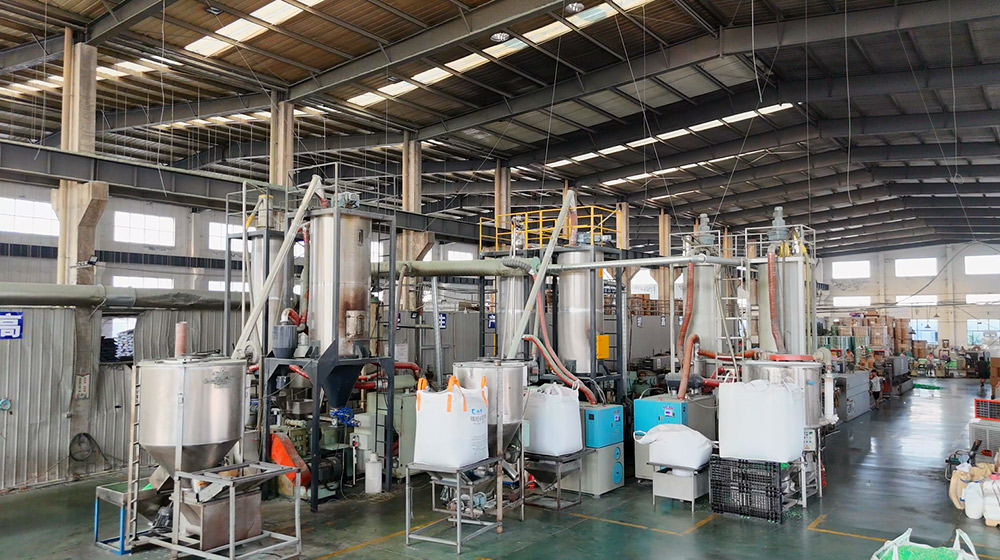
The records above are outcomes. The control that makes them repeatable sits upstream, in incoming material specification. Jushuo Packaging specifies PET pellets with intrinsic viscosity in the 0.75–0.85 dL/g range, with moisture controlled below 50 ppm, and provides a certificate of analysis with the material. Both parameters are checked at goods-in using a viscosity tester and an oven, alongside the dimensional instruments used for finished strap.
Intrinsic viscosity is a measure of the polymer's molecular weight in solution, and in polyester strapping it is one of the input variables that governs the strength and creep behaviour of the finished product. A resin below the intended range tends to produce strap that reaches its tensile figure but loses tension over time; resin above it can create processing difficulties that show up as surface or dimensional faults. Holding a defined window, rather than accepting whatever arrives, is how a supplier keeps a cut-length format and a high-strength format consistent from batch to batch.
Moisture matters for a different reason. Polyester is sensitive to hydrolysis at extrusion temperatures, and absorbed moisture drives that reaction during processing. Keeping moisture below 50 ppm limits the degradation that would otherwise reduce molecular weight in the finished strap — the same property the incoming viscosity specification is protecting. This is the reason a drying and crystallization step exists in the process at all, and why the company holds utility model patents covering a crystallization drying device and a cooling device for PET strap forming.
The production base behind these controls consists of four PET strap lines and five PP strap lines, two sets of solid state polymerization equipment, Italian screen changers that allow continuous screen changes without stopping the machine, a cold drawing process used to raise tensile strength, and an extruder screw design intended to improve plasticization and limit material degradation. Around this sit six inspection gates — raw material, incoming, online, finished product, inbound and outbound — supporting a recorded finished-product qualification rate above 99%.
What Each Record Does and Does Not Establish
Read side by side, the three records cover three different failure modes: batch-to-batch consistency in a heavy cut format, mechanical compatibility with someone else's automation, and customisation under a regulated quality requirement. The table below sets out what each one supports and where its evidence stops.
| Record | Application and format | What it establishes | What it does not establish |
|---|---|---|---|
| Sateri | Chemical fiber bale strapping; green cut PET strap, 1610 × 3380/3480; multiple batches over three years | Repeatable production of a coloured cut-length heavy-duty format accepted by a named fiber producer | Suitability for a different bale weight, bale press or climate condition |
| Far Eastern Industries | Textile and chemical fiber bundling; transparent cut PET strap 16 × 1.0 mm in specified lengths; 36,000 plus 9,000 pieces over three years | Dimensional and surface control tight enough to run on the customer's automatic packaging lines | Performance on a line with different feed geometry, tension settings or cycle time |
| Novo Nordisk supply chain | Pharmaceutical packaging flow; transparent custom-printed PET strap 16 × 0.8 mm, tensile strength above 4,800 N; 2,025 kg over three years | Custom printing combined with high tensile on a thin section, accepted against an end user's packaging requirements | Approval of different artwork, or of a different validated packing configuration |
Where PET Strapping Fits — and Where It Does Not
These records are all PET, but PET is not a universal replacement for every strap a plant uses, and the honest boundary is worth stating. Compared with steel strapping, polyester strap is positioned as a lighter, recyclable alternative with lower cost of use — the company records 30–50% savings versus steel strapping and 100% recyclable materials — and it avoids the edge damage that steel can inflict on softer goods. Compared with PP strapping, the difference is usually load-driven rather than preference-driven: Jushuo's published figures put 12 mm PP strap at a tensile of at least 1,400 N, while its PET range is documented at 12 mm with tensile of at least 5 kN and 19 mm metallurgical grade at 10,500 N or above with elongation of 5% or less. Those are different tools for different loads.
The fit boundaries matter as much as the figures. PET strap is stiff and retains tension well, which suits dense bales and heavy palletised loads, but it also means the tensioning equipment has to match the strap grade — hand grade and machine grade are not interchangeable, and smooth and embossed surfaces behave differently in different machines. PP remains the practical choice where loads are lighter and cost per metre dominates. Paper strapping, which the company also produces, belongs to buyers prioritising a single-material recyclable stream rather than tensile performance.
A buyer should also treat any strength figure as conditional. Breaking strength is measured on a defined specimen under defined conditions; published values such as the SGS-recorded 9.98 kN breaking strength with 10% elongation describe the tested configuration. Joint efficiency, seal quality, corner protection and line tension determine what happens on a real pallet. That is why the records above are more persuasive than the numbers alone: they show formats surviving real handling, not just a tensile test.
Supplier-Level Evidence Beyond the Three Records
Project records are supported by system-level evidence that a buyer can request independently. Jushuo Packaging holds ISO 9001 quality management certification (certificate U23Q28007898R2S, issued by Guardian Independent Certification Ltd) and ISO 14001 environmental management certification (U23E28007899R2S), both recorded with a validity date of 27 November 2026, plus ISO 50001 energy management certification (GH003-2024En0961, valid to 29 September 2027). Because the first two fall due shortly, a buyer should confirm current validity and renewal status rather than relying on the certificate copy alone.
Product compliance is stated against GB/T 22344-2018 for PET strap and QB/T 3811-1999 for PP strap, with SGS test reports available on request. The patent portfolio is weighted towards process control rather than product appearance: utility models covering crystallization drying, cooling during forming, embossing, thickness detection during rolling and fixed-length cutting, plus invention patents granted in 2024 for a plastic packaging strap assembly device and a cutting device for PET strap production. On the commercial side, the company records more than 20,000 tons of annual capacity, over 1,700 tons monthly, a 98.6% on-time shipment rate, 54 employees including a 13-person R&D team, and exports at roughly 30% of output across markets including Indonesia, Japan, South Korea, Uzbekistan, Mexico, Saudi Arabia and Africa.
Full company and product information is published at Jushuo Packaging.
Verification Steps for a Buyer in Execution
A buyer who has shortlisted a supplier on the strength of records like these should convert the records into checks. The following sequence keeps the evidence honest without turning evaluation into an open-ended project.
- Ask for the batch data behind the record. Request test results for the specific format — tensile, elongation, width, thickness and, for cut strap, length — rather than a single certificate for the product family.
- Run the format on your own line. For cut strap feeding automation, test at production speed rather than at a demonstration speed; length tolerance and surface condition only reveal themselves under normal cycling.
- Confirm the tolerance, not just the nominal size. A 16 mm strap with an unstated width tolerance is not a specification; ask what the acceptance window is and how it is measured.
- Separate artwork approval from material approval. On printed strap, confirm who approves the print and how revisions are controlled, particularly where the strap carries identification into a regulated flow.
- Check certificate validity dates. Certification is time-bounded; an expired or soon-expiring certificate should be treated as a renewal question, not as a disqualification.
- Match the commercial route to the order size. The company records a minimum order quantity of 1 ton, with 200 kg accepted for small trial orders, and stock specifications available on a shorter lead time than custom formats.
None of these steps is unusual. What the three project records change is the starting point: instead of asking whether a supplier can meet a specification, the buyer asks how a documented format was held stable, and what would have to change for it to hold stable on their line.
Outlook
The direction of travel visible in this evidence set is towards tighter coupling between material specification and application outcome. Cut strap, printed strap and high-strength thin sections all push quality control upstream into resin selection and drying, and downstream into cutting, winding and length measurement. A supplier that can document intrinsic viscosity windows, moisture limits and batch-level dimensional results is in a better position to hold those formats as volumes grow.
For buyers, the practical implication is modest but useful: ask for records that match your application type, then verify them at the level of the batch rather than the brochure. Whether the format is a green bale strap, a transparent cut strap running on an automatic textile line, or a printed strap in a pharmaceutical flow, the same standard applies — the record should be specific enough to be checked, and the supplier should be willing to have it checked.
FAQ
What do these three project records actually demonstrate about a plastic strapping supplier?
They demonstrate that the supplier has produced a defined format repeatedly for a named buyer over a stated period, and that the buyer accepted the goods against its own quality standard. The Sateri record covers a coloured cut-length PET format supplied in multiple batches across three years; the Far Eastern Industries record covers a transparent 16 × 1.0 mm cut format running on automatic packaging lines across three years; the Novo Nordisk supply-chain record covers a 16 × 0.8 mm custom-printed format above 4,800 N tensile across three years. What they do not demonstrate is suitability for a different machine, bale density or artwork, which still requires a line trial.
How is cut PET strap matched to an automatic packaging line?
Matching happens on four properties: cut length accuracy, width and thickness tolerance, end quality after cutting, and surface condition as the strap passes feed and tensioning units. A pre-cut strap cannot compensate along a roll, so length drift shows up immediately as a closure failure or a loose tail. The Far Eastern Industries record — 16 × 1.0 mm transparent cut strap in specified lengths, 36,000 plus 9,000 pieces — indicates a format held compatible with that customer's automatic lines. A different line still needs its own trial, because feed geometry, cycle time and tension settings all change the requirement.
What does a tensile strength above 4,800 N mean on a 16 × 0.8 mm PET strap?
It describes the breaking load of that cross-section under the test conditions used, and for a 0.8 mm thick, 16 mm wide polyester strap it represents a high-strength format for its size. Achieving it depends on the polymer input and the drawing process rather than on width alone. For context, the company's SGS test reports record a breaking strength of 9.98 kN with 10% elongation on its PET strap, and its 19 mm metallurgical grade is rated at 10,500 N or above with elongation of 5% or less. Field performance also depends on seal or joint efficiency, corner protection and applied tension, not on the strap figure alone.
Why do intrinsic viscosity and moisture matter in PET strapping?
Intrinsic viscosity reflects the polymer's molecular weight, and in polyester strapping it influences tensile strength and how well the strap holds tension over time. Jushuo Packaging specifies an incoming range of 0.75–0.85 dL/g and verifies it with a viscosity tester. Moisture is controlled below 50 ppm because polyester is sensitive to hydrolysis at extrusion temperatures; absorbed moisture drives that reaction during processing and can reduce molecular weight in the finished strap. Together, the two parameters explain why a drying and crystallization step exists in the process and why incoming inspection covers resin as well as finished goods.
What should a buyer verify before approving custom-printed PET strap for pharmaceutical packaging?
Five things: the approved artwork and who controls revisions to it; print registration and ink adhesion results for the specific format; tensile and dimensional test reports for the batch; batch traceability from resin through to finished reel or cut piece; and protection of the printed surface during packing and transit. One further point applies to the Novo Nordisk supply-chain record specifically — it ran through a packaging-industry trading customer, so the specification chain has more than one link, and a new buyer should establish which party holds the end user's packaging requirement before treating a comparable record as directly transferable.
Tem questões ou precisa de mais detalhes?
Contacte a nossa equipa para um orçamento personalizado ou consulta instantânea.
Solicitar orçamento
Preencha o formulário abaixo e a nossa equipa entrará em contacto com uma proposta personalizada.
Chat direto do WhatsApp
Prefere conversar em tempo real? Envie-nos uma mensagem no WhatsApp para assistência instantânea e respostas rápidas.
- Obter orçamento personalizado
- Partilhar fotos ou documentos
- Discuta as suas necessidades diretamente
Geralmente responde em 5–30 minutos durante o horário de expediente.