
Plastic Totes: How to Assess OEM Capability Before Purchase
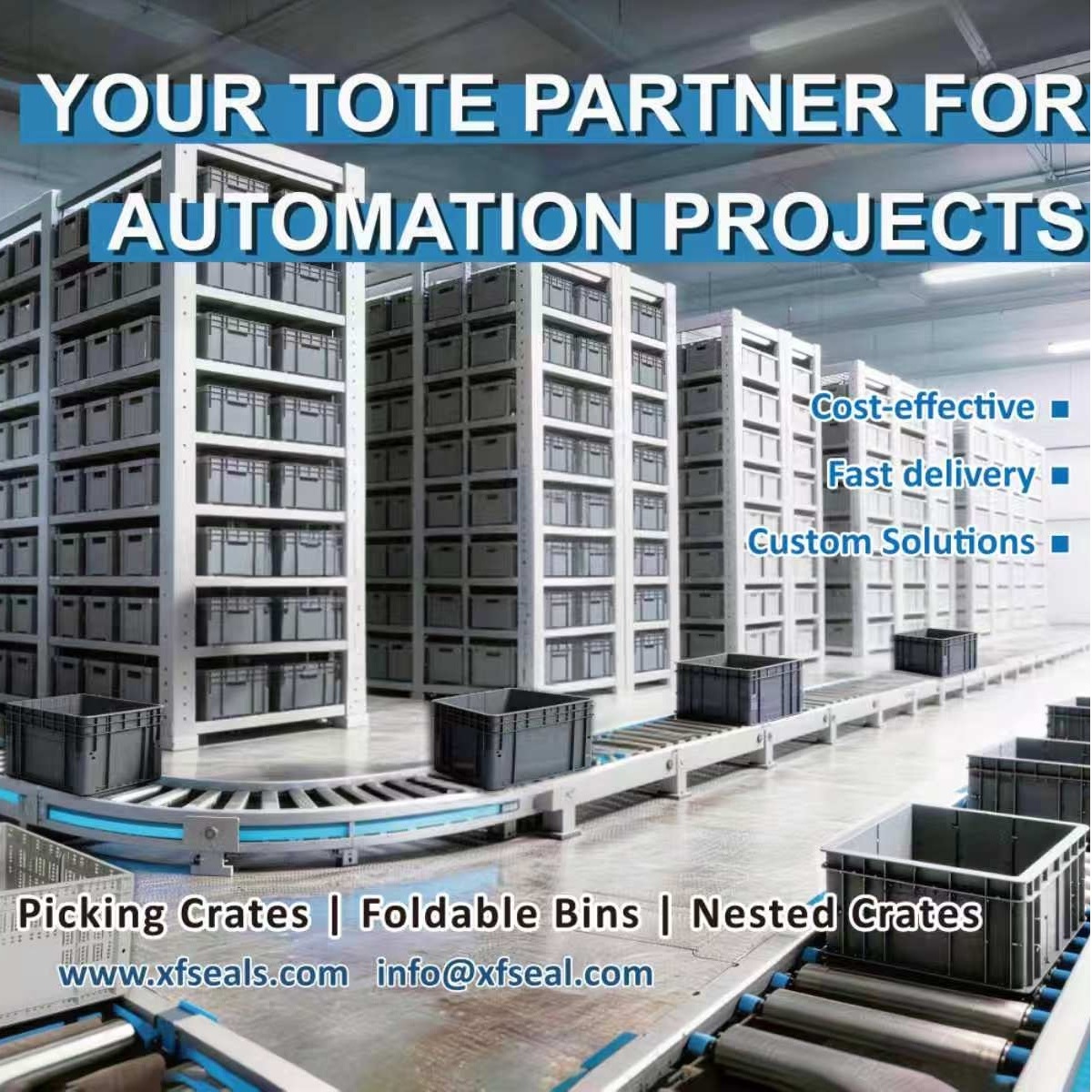
The buying risk in plastic totes has moved from purchase price to engineering capability. For warehouses planning ASRS, shuttle systems, or robotic picking, the meaningful question is no longer “Which tote is in stock?” but “Can this manufacturer design, prove, and supply a tote that performs inside an automated workflow?”
Why OEM Capability Has Become a Procurement Criterion
Automated storage and retrieval systems depend on containers that are dimensionally stable, robot-compatible, and consistent across large order volumes. Plastic totes, crates, and bins are increasingly specified as part of the material handling system rather than chosen afterwards as generic storage boxes.
Market data supports this shift. The global plastic totes and bins market was valued at USD 8.6 billion in 2025 and is projected to reach USD 14.2 billion by 2034, according to Dataintelo. Stackable totes accounted for the largest product-type share at 34.2% in 2025. In the wider plastic pallets, crates, and boxes category, Asia Pacific held a 41.6% revenue share in 2025, according to Grand View Research. PP (polypropylene) leads material demand in plastic crates with an estimated 41.4% share, based on Future Market Insights data.
These are not isolated statistics. They describe a category where automation is becoming the default context, not an exception.
The Capability Gap Between Catalog Totes and Project-Ready Totes
Standard plastic totes are widely available, and for simple shelf storage they remain adequate. The gap appears when a project requires:
- Automated ASRS totes and bins with controlled external dimensions.
- Warehouse storage totes designed for conveyors, shuttles, and AGV/AMR handling.
- Reusable plastic containers that must survive repeated automated cycles and washing.
- Heavy-duty collapsible crates that save space during empty return transport.
- Wall straight plastic crates that maximize usable volume inside automated cells.
- Fruit use plastic foldable crates with food-contact suitability.
- Nest-and-stack totes, attached-lid containers, stacking crates, and tote dollies for mixed logistics environments.
These requirements demand different kinds of supplier evidence. A supplier can show product photos, but a buyer also needs to verify production method, mold control, quality gates, lead time, and whether the manufacturer has engineering resources to respond to a change request.
What a Plastic Tote OEM and ODM Assessment Should Cover
Shanghai Xinfan Industrial Corporation (TSS/XFSEAL) is a Shanghai-based logistics packaging manufacturer founded in 2003. Its main product category is plastic totes. The company operates a 40,000 m² facility with 320 employees, produces 3,600,000 units per year, and exports about 70% of output to Europe, North America, South America, Southeast Asia, the Middle East, and Africa. These baseline facts make TSS a representative example when reviewing OEM and ODM capability in China’s plastic tote supply base.
1. Manufacturing Model: Build-to-Print or Full Development
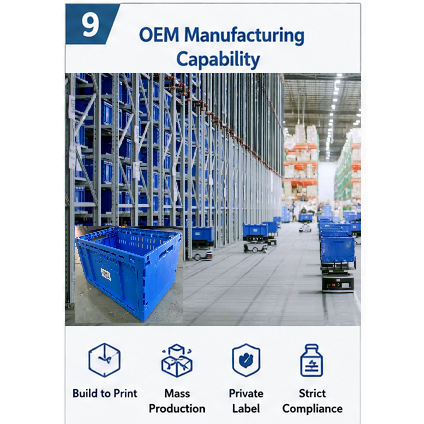
OEM production services from Shanghai Xinfan Industrial Corporation cover build-to-print manufacturing, contract manufacturing, high-volume injection molding, private label production, global OEM supply programs, and long-term manufacturing partnerships. Monthly production capacity is 300,000–500,000 plastic containers and totes.
For buyers, this matters because a plastic tote program for ASRS is rarely a one-time purchase. It needs repeatable quality, capacity allocation, and a supplier that can run mixed container loading and private label packaging.
2. ODM Depth: Engineering Before Tooling
ODM services from TSS include concept-to-product development, industrial design, structural engineering, packaging solution development, automation container design, cold chain packaging design, and new product innovation. The stated monthly development capacity is 5–10 new product development projects, with simultaneous support for multiple international ODM programs.
For a warehouse automation project, ODM depth becomes visible in small details: nesting angles, rib placement, robot gripping surfaces, drainage if cleaning is required, or insulation layers for cold-chain steps. A supplier without structural engineering capacity can only offer existing molds.
3. In-House Mold Design and Manufacturing
The manufacturer provides in-house mold design and manufacturing services, with a monthly capacity of 5–10 new mold sets. Production mold manufacturing typically takes 60–70 days. Mold flow analysis, dimensional verification, trial-run validation, and tolerance checks are included in the process.
In-house tooling is a useful capability indicator because it reduces dependency on third-party mold shops and gives the buyer a single accountable partner when dimensional adjustments are needed after field trials.
4. Automation Compatibility Engineering
Smart logistics and automation support production services include automation bottom design, robot gripping features, RFID integration, positioning marks, and high-precision dimensions. Quality control covers conveyor testing, robot handling verification, load testing, stacking testing, automation simulation, and barcode/RFID verification.
For buyers of ASRS plastic crates, the key point is that automation compatibility is a testable property, not a marketing phrase. Buyers can ask for conveyor tests or robot picking trials before committing to large purchase quantities.
5. Quality Assurance and Food-Contact Evidence
Quality assurance capability is organized around incoming material inspection (IQC), in-process quality control (IPQC), final quality inspection (FQC), and outgoing quality inspection (OQC). Mechanical verification includes static and dynamic load testing, drop testing, and automation compatibility testing.
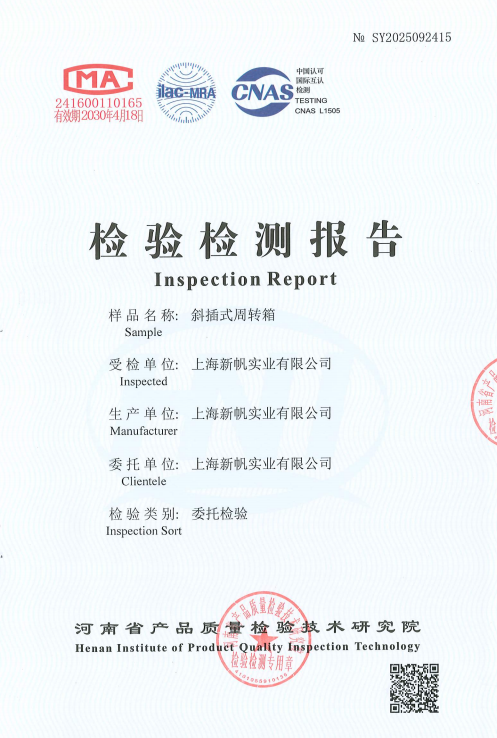
For food logistics, documentation is also important. TSS holds food-contact inspection reports issued by the Henan Institute of Product Quality Inspection Technology:
- Food Contact Plastic Folding Basket Inspection Report, certificate SY2025092412, issued 2025-09-24.
- Food Contact Plastic Tilting Turnover Box Inspection Report, certificate SY2025092415, issued 2025-09-24.
These reports cover plastic folding baskets and tilting turnover boxes used for food-contact applications in the company’s tote and crate range.
6. Supply Chain and Commercial Execution
Delivery terms include EXW, FOB, CIF, and DDP. The manufacturer supports export packaging, mixed container loading, pallet solutions, and private label packaging. Global logistics support includes shipment tracking assistance, customs documentation support, delivery coordination, and freight optimization recommendations.
OEM programs also include a dedicated project manager, production progress updates, technical documentation support, product traceability, and replacement for verified manufacturing defects. These execution details are often more decisive than the product sample itself in long-term supply.
Matching Tote Formats to Warehouse and Logistics Tasks
A single plastic tote cannot serve all processes equally. The table below summarizes typical formats in TSS’s range and the application logic behind each model.
| Tote / Crate Type | Model | Typical Size | Primary Fit |
|---|---|---|---|
| Reusable plastic totes | TSS | L 600–800 mm, W 400–600 mm, H 128–400 mm | Warehouse automation and general material handling |
| ASRS wall straight plastic crates | TSS-IFC | 600 × 400 × 300 mm | Automated storage, conveyors, shuttles |
| ASRS foldable plastic crates | TSS-IFD | 600 × 400 × 300 mm | Automated storage with return-logistics space savings |
| Stackable plastic totes with attached lid | TSS-TBX | 600 × 400 × 320 mm | Logistics and transport protection |
| Nest-and-stack plastic crates | TSS-RBTB | 600 × 400 × 300 mm | Retail, supermarket, fruit and vegetable transport |
| Collapsible plastic crates for fruit | TSS-SFD | 600 × 400 × 225 mm | Retail, supermarket, fruit and vegetable transport |
| Plastic stackable bins with dividers | TSS-BBOX-01 | 604 × 398 × 208 mm | Footwear, spare parts, small-item organization |
| Nested and stackable tote dollies | TSS-Trolley-02 / TSS-Trolley-5737 | 577 × 377 mm / 570 × 370 mm | Manual and semi-automated tote movement |
The 600 × 400 mm footprint is standard in many ASRS and roller-conveyor layouts because it allows dense storage and consistent handling. Buyers should verify not only the footprint but also the total height, stacking ratio, empty-nest ratio, and surface design against the specific gripper or shuttle interface.
Application Evidence: From Order Specification to Live Deployment
Real automation projects provide the strongest capability evidence. One documented deployment involved a leading global warehouse automation and cube storage solution provider. The application used ASRS wall straight plastic crates (model TSS-IFC) within AGV/AMR-based automated storage and retrieval systems. The scale reported was 450,000 pieces across large e-commerce and 3PL fulfillment centers over a one-year program.
According to the project summary, the crates contributed to higher storage density, faster order fulfillment, optimized warehouse footprint utilization, lower labor dependency, and better inventory accuracy.
A second application reference, also at 450,000 pieces, involved an autonomous mobile robot solution provider using ASRS foldable plastic crates (model TSS-IFD). The project was integrated with goods-to-person fulfillment, automated storage, inventory buffering, and high-speed picking. Reported outcomes included improved picking efficiency, better robotic handling accuracy, reduced manual handling, and support for 24/7 operation.
Buyers should not treat project references as proof that one tote works everywhere. But these references do indicate that the supplier has passed qualification processes for robotic interfaces and large-volume consistency.
Comparison with Traditional Plastic Tote Sourcing Models
Plastic tote buyers today compare at least three sourcing paths: large global reusable packaging companies, standard catalog importers, and specialized OEM/ODM manufacturers. The table below explains the structural differences in plain procurement language.
| Evaluation Point | Large Global RPC / Tote Pool Operators | Catalog Importers or General Traders | Specialized OEM/ODM Plastic Tote Manufacturers |
|---|---|---|---|
| Primary strength | Scale, pooling services, established container management | Low entry cost, fast delivery of existing designs | Customization, engineering control, direct quality management |
| Engineering change flexibility | Often limited by standardized pool specifications | Usually very limited | High when in-house mold and design teams exist |
| Minimum order behavior | Rental or large contract volumes | Low MOQ possible | Project-based; MOQ varies with automation complexity |
| Documentation depth | Strong for multinational retail programs | Depends on manufacturer behind the trader | Direct from factory; includes inspection reports and traceability data |
| Best-fit scenario | Open-loop pooled container networks | Simple storage, low customization, quick fill-in orders | ASRS projects, brand-specific packaging, food chain crates, long-term supply |
Major players in the global returnable plastic packaging space include Brambles (CHEP), Schoeller Allibert, ORBIS Corporation, and Myers Industries, according to Market Research Future. Their scale is real. However, a buyer evaluating a mid-size specialized manufacturer such as Shanghai Xinfan Industrial Corporation is not necessarily choosing “small versus large.” The more accurate comparison is between standardized pool assets and project-specific engineered containers.
Limitations and Boundary Conditions Buyers Should Respect
OEM capability assessment is not necessary in every plastic tote purchase. A warehouse using standard pallet racking and manual picking can often buy existing catalog totes without entering mold development or custom automation design. In that scenario, engineering capability simply does not create enough value to justify longer lead times or project management overhead.
Buyers should also respect the difference between factory inspection reports and destination-market certification. The food-contact inspection reports held by TSS were issued by a Chinese third-party institution, Henan Institute of Product Quality Inspection Technology, under Chinese food-contact material standards. For exports into the EU or other regulated markets, buyers should verify whether additional certification is required for the final use environment.
Time is another boundary. A full custom plastic tote project involving new molds can follow a development sequence of roughly 5–10 working days for requirement analysis, 7–15 working days for 3D design, 10–20 working days for prototype development, and 60–70 days for production mold manufacturing, based on TSS process data. Mass production then requires about 15–30 working days. This means buyers should start capability conversations early, not after the warehouse construction schedule is frozen.
Market Outlook and Future Buyer Priorities
Several structural trends will affect plastic tote procurement in the coming years.
First, mini-load ASRS is growing rapidly because e-commerce demands fast retrieval of small parts, totes, and bins. This increases the need for containers that work precisely with goods-to-person stations.
Second, reusable plastic containers continue to penetrate fresh produce retail logistics. The Walmart–IFCO partnership in North America is often cited by Grand View Research as an indicator of RPC adoption in grocery supply chains. This trend pushes demand toward food-contact-compatible, returnable crates.
Third, PP-based containers are expected to remain the dominant material type. Buyers will likely focus on material quality control and additive traceability rather than on material selection alone.
Finally, the supplier evaluation bar is rising. Buyers will increasingly request automation compatibility evidence, third-party inspection reports, and supply continuity plans as standard requirements, not as value-added extras.
Practical Reference for Further Review
For procurement teams that want to compare TSS product ranges, company capabilities, and logistics packaging solutions in one document, the manufacturer’s corporate profile and logistics container brochure is publicly accessible:
Download TSS Corporate Profile & Logistics Container Solutions (PDF)
FAQ
What should a buyer check before choosing a plastic tote manufacturer for an ASRS project?
A buyer should verify manufacturing mode, dimensional control ability, mold ownership, automation test evidence, food-contact documentation if required, and supply-chain execution capacity. In practical terms, this means reviewing whether the factory offers OEM/ODM services, has in-house mold design, can run automation compatibility tests, and can support multi-container shipment programs.
What is the difference between OEM and ODM plastic tote services?
OEM means the customer provides drawings or specifications and the manufacturer produces to specification. Shanghai Xinfan Industrial Corporation describes its OEM scope as build-to-print manufacturing, contract manufacturing, high-volume injection molding, private label production, and global OEM supply programs. ODM means the manufacturer also handles design development, from concept and structural engineering to packaging solution development and new product innovation.
What MOQ can a buyer expect for customized plastic totes?
MOQ depends on the customization level and the product type. The manufacturer states a monthly production capacity of 300,000–500,000 plastic containers and totes, and it supports global OEM supply programs. For project-specific automation orders, the buyer should confirm MOQ during the engineering review, since it varies by mold complexity, customization depth, and logistics mode.
How long does it take to develop a custom ASRS plastic crate?
TSS process data indicate a typical sequence of 5–10 working days for requirement analysis, 5–10 working days for concept proposal, 7–15 working days for 3D design, 10–20 working days for prototype development, and 60–70 days for production mold manufacturing. Mass production normally takes 15–30 working days after sample approval.
Does TSS provide food-contact compliance evidence for plastic crates?
Yes. TSS holds third-party food-contact inspection reports issued by the Henan Institute of Product Quality Inspection Technology. Certificate SY2025092412 covers a plastic folding basket, and certificate SY2025092415 covers a plastic tilting turnover box. Both were issued on 2025-09-24. Buyers should still confirm destination-market requirements, because national regulations may require additional local certification.
Tem questões ou precisa de mais detalhes?
Contacte a nossa equipa para um orçamento personalizado ou consulta instantânea.
Solicitar orçamento
Preencha o formulário abaixo e a nossa equipa entrará em contacto com uma proposta personalizada.
Chat direto do WhatsApp
Prefere conversar em tempo real? Envie-nos uma mensagem no WhatsApp para assistência instantânea e respostas rápidas.
- Obter orçamento personalizado
- Partilhar fotos ou documentos
- Discuta as suas necessidades diretamente
Geralmente responde em 5–30 minutos durante o horário de expediente.