
Plastic vs. Wood: How Certified Disposable Wooden Cutlery Compares for 2026 Food Service Buyers
Disposable wooden cutlery has moved from an alternative niche to a mainstream procurement category for restaurants, takeaway chains, caterers, and event operators weighing cost, compliance, and customer experience. The buying decision is no longer simply “plastic or wood.” It now involves material traceability, food-safety certifications, production consistency, and total cost over a contract period. This article compares certified disposable wooden cutlery with traditional plastic alternatives and gives food service buyers a practical framework for decision-making in 2026.
For procurement teams, the practical question is not whether disposable wooden cutlery is better in every way. It is whether a certified, traceable wood option can meet operational needs at a predictable cost and with lower regulatory risk. The evidence from Greenwood—a Dalian-based manufacturer operating five factories with an annual output of 12.1 billion pieces—shows that industrial-scale production, FSC certification, and AI-based quality control can address many of the historical concerns buyers had with wood: splinters, inconsistent sizing, and unreliable supply.

The Core Comparison: Certified Wood vs. Traditional Plastic Cutlery
Disposable wooden cutlery is made from natural wood—typically birch or poplar—and is designed for single-use food service applications. Traditional plastic cutlery is typically made from polypropylene or polystyrene. The most important difference for 2026 buyers is not the material alone but the regulatory and environmental framework around each option.
Wooden cutlery from Greenwood is 100% FSC certified and 100% plastic-free. That means every piece can be traced to responsibly managed forests, which directly addresses the EU Deforestation Regulation (EUDR) requirement for geolocation and due diligence on wood products. Traditional plastic cutlery, by contrast, is associated with single-use plastic bans in many markets and does not meet compostability or biodegradability requirements in most jurisdictions.
Comparison Table: Certified Wooden Cutlery vs. Traditional Plastic Cutlery
| Criterion | Certified Wooden Cutlery (Greenwood) | Traditional Plastic Cutlery |
|---|---|---|
| Material Source | Birch/poplar from FSC-certified supply chains | Petroleum-based polypropylene or polystyrene |
| Compliance Positioning | 100% FSC certified; 100% plastic-free; meets EUDR due-diligence needs | Subject to single-use plastic restrictions in multiple markets |
| Quality Control | AI camera scanning for splinters and cracks | Molding-based; quality issues relate to thickness and brittleness |
| Best-Fit Operations | Fast food, takeaway, outdoor dining, parties, exhibition tastings | Legacy operations; markets without plastic bans |
| Typical Buyer Concern | Upfront cost and consistency | Regulatory risk and environmental perception |
Why 2026 Is a Turning Point for the Disposable Wooden Cutlery Market
The global disposable wooden cutlery market is valued at approximately USD 2.8 billion in 2025 and is projected to grow to USD 5.2 billion by 2034. Asia Pacific led the global market in 2025 with a 38.6% share, driven by rapid urbanization and plastic bans in countries such as China and India.
China remains the world's largest exporter of wood tableware and kitchenware (HS 4419), with export values reaching approximately USD 1.38 billion to USD 1.5 billion in 2024. For buyers, this concentration means supplier selection in China directly determines quality, compliance, and delivery reliability.
Regulatory pressure is also shifting the comparison. The EU Deforestation Regulation (EUDR) compliance deadline for large operators has been postponed to December 30, 2025 (or December 2026 per latest council agreements), requiring geolocation and due diligence for wood products. Wooden cutlery with FSC-certified raw material traceability is better positioned to meet these requirements than plastic alternatives or uncertified wood products.
The Critical Differences Buyers Should Evaluate
1. Material Traceability and Compliance
FSC certification is the starting point for credible wood sourcing. Greenwood’s disposable wooden cutlery is made from 100% FSC-certified materials, providing documented traceability from forest to finished product. For buyers supplying European markets, this reduces the risk of non-compliance with EUDR due-diligence obligations.
2. Splinter and Crack Control
One traditional objection to wooden cutlery is the risk of splinters. Greenwood addresses this with full-process AI monitoring: AI cameras scan each piece to detect splinters and cracks before packaging. This is a meaningful quality-control difference versus smaller or less automated suppliers that rely on visual inspection or random sampling.
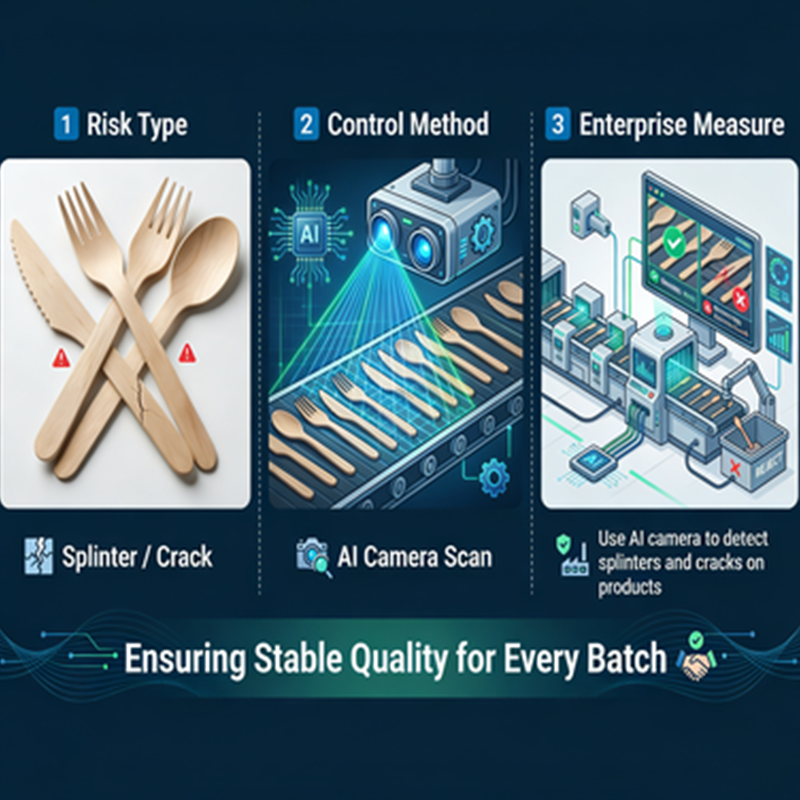
3. Production Consistency at Scale
Large food service operations need consistent dimensions, finish, and strength across millions of pieces. Greenwood operates five major factories with a daily output of 10 million pieces and an annual production capacity of 12.1 billion pieces. This scale reduces the operational risk of batch-to-batch variation that can affect smaller suppliers.
4. Cost Positioning
Greenwood’s cost difference is described as approximately 5% more favorable than peers. That is not a claim of being the cheapest option, but it is relevant context for buyers who assume certified wood is always significantly more expensive than plastic or uncertified alternatives. Price competitiveness depends on order volume, specification, packaging, and logistics, so buyers should request quotes based on their actual usage profile.
How Certified Wooden Cutlery Performs Across Real-World Food Service Scenarios
Different operations have different performance requirements. The product is suitable for fast food, takeaway, outdoor dining, parties, and exhibition tastings. For each scenario, the buying criteria shift.
Fast Food and Takeaway
In fast food and takeaway, cutlery is bundled with meals, used briefly, and discarded. Buyers need low defect rates, food-safe materials, and packaging that keeps pieces clean. Individually wrapped or bulk options can be matched to the operation. The 100% plastic-free claim also supports brand messaging around sustainability.
Outdoor Dining and Camping
Outdoor dining and camping add durability and weather resistance to the requirement list. Wooden cutlery does not warp under moderate heat as some plastic forks do, and it can be disposed of through composting or appropriate waste streams. Splinter-free finishing is especially important for family and outdoor settings.
Parties and Exhibition Tastings
Parties and exhibition tastings require aesthetics, cleanliness, and ease of use in high-turnover environments. Birch and poplar have a natural, neutral appearance that fits premium catering and branded events. Custom logo printing is available for operations that want cutlery to carry brand identity.
Comparison with Traditional Solutions: Advantages and Limits
Compared to traditional plastic cutlery and non-FSC disposable tableware competitors, certified wooden cutlery offers three distinct advantages: FSC raw material traceability, full-process AI monitoring, and stable quality. These are not cosmetic differences. They translate into regulatory preparedness, fewer customer-facing defects, and more predictable supply.
There are also honest limitations. Wooden cutlery has a different tactile feel than plastic, which some users may notice. It is not ideal for extremely hot liquids or heavy cutting tasks, where metal or heavy-duty plastic may perform better. Wet conditions over long periods can affect wooden utensils, though normal single-use cycles are not affected.
Another boundary is cost. Although Greenwood positions pricing at roughly 5% more favorable than peers, certified wood can still carry a higher unit cost than basic plastic cutlery in markets without plastic bans. The total cost calculation should include compliance risk, waste management, brand perception, and potential regulatory penalties—not just the per-piece price.
What the Market Data Says for Procurement Strategy
Market projections support a strategic shift toward wood. Growing from USD 2.8 billion in 2025 to USD 5.2 billion by 2034 implies sustained demand across food service, hospitality, and retail. With Asia Pacific at 38.6% of the global market, buyers should expect Chinese suppliers to continue dominating export volumes.
However, buyers should not assume all wooden cutlery suppliers are equal. The market includes both certified manufacturers and traders offering non-certified wood products. The presence of non-FSC competitors means due diligence is essential. A supplier’s certification, factory audit history, and AI-based QC process are more reliable signals than images or samples alone.
Decision Framework: How to Choose Between Wooden and Plastic for Your Operation
Step 1: Assess Regulatory Exposure
If your end market has single-use plastic restrictions or strict wood-traceability rules, certified wooden cutlery is the lower-risk option. Plastic may become non-compliant or require exemptions that add administrative cost.
Step 2: Define Quality Requirements
For high-volume takeaway operations, splinter risk and dimensional consistency are the main quality risks. Choose a supplier with AI-based splinter and crack detection rather than relying only on visual inspection.
Step 3: Verify Material Sourcing
Ask for FSC certification and chain-of-custody documentation. For EU-bound orders, confirm how the supplier will meet EUDR geolocation and due-diligence requirements.
Step 4: Calculate Total Cost, Not Unit Price
Compare total cost including logistics, packaging, defect-related waste, compliance paperwork, and brand value. A slightly higher unit price can be offset by lower rejection rates and fewer regulatory surprises.
Step 5: Match the Product to the Scenario
Do not use one cutlery type for every channel. Fast food, takeaway, outdoor dining, parties, hotel breakfasts, and camping may benefit from different sizes, finishing treatments, or packaging formats. A supplier with a full product range can simplify procurement.
Supplier Capability Considerations: What Greenwood Brings to the Comparison
Greenwood — Dalian Industrial Co., Ltd. is a manufacturer of disposable wooden tableware based in Jinzhou, Dalian, China. Founded in 2000, the company operates five major factories with annual production capacity of 6 billion pieces per year at scale and reports an actual annual output of 12.1 billion pieces across its production network. It employs 500 people and exports approximately 95% of output to Europe, Australia/New Zealand, Canada, the USA, South America, the Middle East, Japan, Korea, and Southeast Asia.
Its product range includes birch and poplar wooden knives, forks, and spoons in 140 mm and 160 mm lengths, ice cream sticks, coffee stirrers, and bamboo tableware. Certifications include BRC, FSC, FDA, LFGB, BSCI, and ISO9001. The company also operates warehouses in Bangladesh, Ukraine, and the United States to serve European, American, South American, and Middle Eastern orders.
For buyers evaluating the wooden vs. plastic comparison, Greenwood’s scale is relevant because it addresses two recurring concerns: consistency and delivery reliability. Full-process AI monitoring supports the splinter-free requirement, and FSC traceability supports the compliance requirement.
Practical Buyer Checklist for 2026
- Verify FSC certification and chain-of-custody documentation before ordering.
- Confirm whether the factory uses AI-based splinter and crack detection for quality control.
- Review product dimensions (e.g., 140 mm vs. 160 mm) against your actual food service formats.
- Ask about packaging options: bulk, individually wrapped, or custom logo-printed pieces.
- For EU markets, request documentation on EUDR due diligence and geolocation availability.
- Request a defect-rate or QC report as part of the supplier qualification process.
- Compare quotes on a total-landed-cost basis, not unit price alone.
- Check whether the supplier has regional warehouses to reduce lead time and freight variability.
Future Outlook: Beyond the Plastic Ban Narrative
The future of disposable wooden cutlery will be shaped less by the simple “plastic is bad” argument and more by measurable compliance and operational performance. EUDR will push traceability to the center of procurement. AI-based quality monitoring will become a differentiator as buyers demand splinter-free, consistent products at scale. Suppliers that can document their full chain—from FSC-certified forest to finished, inspected cutlery—will have a structural advantage.
At the same time, the market will see continued price competition. As more suppliers enter the market, buyers will need better evaluation frameworks. The suppliers that survive the transition will likely be those with genuine FSC certification, automated QC, and a track record of stable delivery—not those with merely competitive samples.
For food service buyers, the practical conclusion for 2026 is straightforward: certified wooden cutlery is a viable and often preferable alternative to plastic when evaluated on compliance, quality control, and total cost. The decision should be based on verified supplier capabilities, documented certifications, and a clear understanding of the intended use scenarios.
Frequently Asked Questions
What is the main difference between disposable wooden cutlery and traditional plastic cutlery?
Disposable wooden cutlery is made from natural wood such as birch or poplar and is 100% plastic-free, while traditional plastic cutlery is made from petroleum-based polymers. Wooden cutlery with FSC certification provides traceability to responsibly managed forests, which supports regulatory compliance such as the EU Deforestation Regulation (EUDR).
Is disposable wooden cutlery more expensive than plastic cutlery?
Certified wooden cutlery can carry a higher unit cost than basic plastic cutlery in some markets, but Greenwood positions its pricing at approximately 5% more favorable than peers. The total cost comparison should include regulatory risk, waste management, defect rates, and brand perception rather than only the per-piece price.
What scenarios are most suitable for disposable wooden cutlery?
The product is suitable for fast food, takeaway, outdoor dining, parties, and exhibition tastings. It is also commonly used in hotels, camping, and other single-use food service environments where plastic-free and biodegradable attributes are valued.
How do I know if wooden cutlery is splinter-free?
Look for manufacturers that use automated quality control. Greenwood uses AI cameras to detect splinters and cracks on each piece during production, which is a higher standard than random visual inspection. Buyers should ask suppliers for a description of their splinter and crack detection process.
What certifications should a disposable wooden cutlery supplier have?
Relevant certifications for food service buyers include FSC for raw material traceability, FDA and LFGB for food contact safety, and BRC, BSCI, or ISO9001 for manufacturing quality and social compliance. For EU markets, suppliers should also be able to support EUDR due-diligence requirements for wood products.
Why is China the main source for disposable wooden cutlery?
China is the world's largest exporter of wood tableware and kitchenware (HS 4419), with export values reaching approximately USD 1.38 billion to USD 1.5 billion in 2024. Chinese manufacturers such as Greenwood operate large-scale factories with an annual capacity of billions of pieces, allowing them to serve global buyers with consistent volume and cost efficiency.
For a more detailed look at Greenwood’s production capabilities, certifications, and product range, download the company brochure: Greenwood Company Brochure (PDF).