
Pneumatic Rubber Fender Specs & Upkeep: A Technical Buyer FAQ
Pneumatic Rubber Fender Specs & Upkeep: A Technical Buyer FAQ
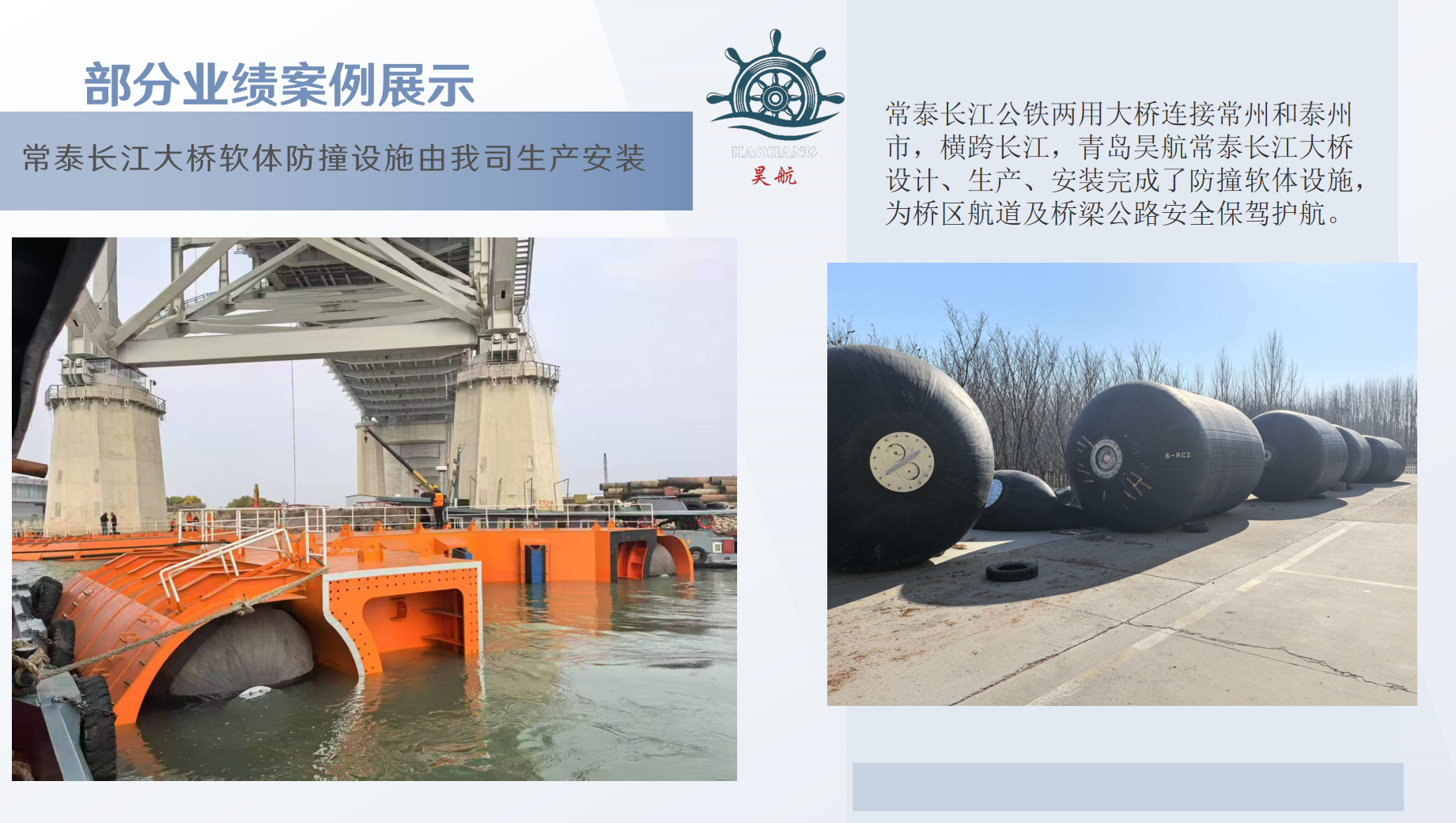
A pneumatic rubber fender absorbs berthing energy through a sealed air chamber rather than through solid rubber deflection. Image: Haohang.
A pneumatic rubber fender is a floating marine fender whose energy-absorbing element is a sealed rubber shell filled with compressed air. Because the reaction force is distributed across a broad contact patch and rises gradually as the fender deflects, the design is used where a vessel has to be held off a berth, a dolphin, or another hull without concentrating load on a small area of plating.
The fender itself is rarely the difficult part of a marine specification. The difficulty sits in the data around it: how a model code such as 1.5*3M should be read, which working pressure range applies, whether an air compressor has to be budgeted alongside the fender, how long delivery actually takes, and what a certificate number does and does not cover. This article answers those questions in the order a procurement team usually meets them.
The procurement problem: a quotation line is not a specification
A typical inquiry for pneumatic fenders leaves the supplier with a single line of text — for example, "1.5*3M pneumatic fender, CCS" — and returns a quotation in the same shape. That exchange is workable only if both sides already agree on the underlying parameters: material construction, pressure class, temperature envelope, inflation support, inspection scope and delivery window. When those parameters are assumed rather than written down, the gap surfaces later, usually at pre-shipment inspection or at first inflation on site.
The opportunity runs the other way. A buyer who asks five specific questions before issuing a purchase order converts a vague line item into a document that can be inspected against. That is the practical purpose of a technical procurement FAQ: it moves the ambiguity out of the transaction and into the specification stage, where correcting it costs nothing.
Construction: what is actually inside the shell
A pneumatic rubber fender is built from natural rubber and cord fabric. The rubber provides the airtight, seawater-resistant envelope; the cord fabric provides the tensile reinforcement that stops the shell from over-expanding under internal pressure and berthing load. ISO 17357-1:2014, the international standard covering high-pressure floating pneumatic rubber fenders, describes the body as consisting of an outer rubber layer, a synthetic-tyre-cord reinforcement layer and an inner rubber layer, all vulcanized firmly together.
That three-layer construction matters to a buyer for a simple reason: the reinforcement is not visible after vulcanization. It can only be verified through the manufacturer's material control, in-process inspection and destructive or non-destructive testing records. This is why a fender quotation that lists only dimensions and price carries very little technical information, and why a supplier able to state its quality control regime is easier to qualify. In Haohang's case, the declared regime is 100% testing of all units.
How to read a model designation such as 1.5*3M
The notation used across the pneumatic fender category is consistently diameter × length, in metres. A 1.5*3M fender therefore has a nominal diameter of 1.5 m and an overall length of 3 m. The diameter drives the contact area and the deflection behaviour; the length drives the total energy absorption and the stability of the fender in the water.
Manufacturing ranges in this category run from roughly 300 mm to 2,000 mm in diameter and from 1 m to 10 m in length, with length treated as customizable against project requirements. Two practical consequences follow. First, a project that needs a non-standard length should raise it at the inquiry stage rather than at order confirmation. Second, when comparing quotations from different suppliers, the dimension pair should be written in the same format on both documents — a fender quoted as "1.5 × 3" without units invites a unit error that is expensive to unwind after production.
Buyers will also encounter the term Yokohama-type fender. It is a generic category description widely used in the marine trade for this floating pneumatic design, not a specification. The technical content of a quotation still has to come from dimensions, pressure class, construction and certification.
Working pressure, temperature and the numbers that move
For pneumatic rubber fenders, working pressure is generally 0.1–0.3 MPa, with the specific pressure adjustable according to the usage environment. The range is adjustable rather than fixed because the correct internal pressure depends on the berthing energy the fender has to absorb, the berth geometry and the vessel types being handled.
This working range should not be confused with the standardized initial pressure classes in ISO 17357-1:2014, which are 50 kPa (Pneumatic 50) and 80 kPa (Pneumatic 80). The initial pressure is the starting condition the fender is inflated to; internal pressure then rises during compression and with ambient temperature. Keeping that distinction clear in a specification prevents a common mismatch, where a buyer requests a "0.1–0.3 MPa" fender and a supplier quotes an "80 kPa" class without either party stating how the two relate.
The operating temperature envelope commonly quoted for this product is −20 °C to +60 °C. Temperature matters on two fronts. It affects the flexibility of the rubber compound at the low end, and it affects internal pressure at the high end, because a sealed air chamber gains pressure as it warms. For large-diameter units this is a safety rather than a performance issue: ISO 17357-1:2014 requires fenders of 2,500 mm diameter and above to be fitted with a safety valve for releasing excess internal pressure.
Specification summary
Why an air compressor is not optional
A pneumatic fender is delivered uninflated or partially inflated and has to be brought to its specified pressure before service. It stays in service only if that pressure is maintained. In practice, an air compressor is supporting equipment that has to be specified, procured and shipped alongside the fenders — not an accessory that can be improvised at the quay.
Three tasks depend on it. The first is initial inflation to the specified pressure at commissioning. The second is periodic pressure checking and top-up, since pressure is the parameter that determines whether the fender absorbs the energy it was selected for. The third is restoring pressure after maintenance or after a fender has been deflated for transport or storage. Without a compressor on site, a fender that loses pressure is effectively out of service until one is found.
The specification consequence is straightforward: a purchase order for pneumatic fenders should state whether an air compressor is included, who supplies it, and what pressure the fenders are expected to be commissioned to. Projects that skip this step often discover the gap during installation, when the vessel is already alongside.
Maintenance: what the routine actually consists of
Published manufacturer guidance for ISO 17357-1 compliant pneumatic fenders, such as Trelleborg's handling, storage, installation and maintenance manual, treats maintenance as a combination of inspection and pressure management rather than as repair work. In operational terms, the routine covers four items.
Internal pressure. Checked against the commissioned value and topped up with the compressor. This is the single most important check, because an under-inflated fender deflects further than designed and transfers more load to the hull or the berth structure.
Shell condition. Inspection of the outer rubber layer for cuts, abrasion, embedded debris and ozone cracking, with particular attention to the areas of heaviest contact.
Reinforcement and end fittings. For net-type configurations this means the chain-tire-net; for sling-type configurations, the slings and end flanges. ISO 17357-1 identifies these two as the common compliant configurations, and both depend on their attachment hardware staying sound.
Safety valve function on units of 2,500 mm diameter and above, since the valve is the pressure-relief path that protects the shell under thermal gain or over-inflation.
Pneumatic rubber fenders have an estimated service life in the range of five to seven years under consistent tidal cycles, according to commercial market research. That is an estimate for planning, not a warranty figure, because actual life depends on berthing frequency, contact severity, UV exposure and how consistently pressure is maintained.
Delivery, customization and order quantities
Lead time for pneumatic rubber fenders is commonly quoted at 7–45 days. The spread is wide because it reflects real differences in the order: a standard size pulled from stock moves at the short end, while a non-standard length, a custom logo or a batch that has to pass third-party inspection before shipment sits at the long end. Quoting a single lead-time figure without stating which case it refers to is a frequent source of schedule disagreement.
Customization in this category is concentrated in size and logo. Size customization is the technically significant one, since it changes the mould, the cord lay-up and the inflation volume; logo customization is a marking change that affects tooling lead time but not performance. Manufacturing capacity of 150 units per month with a minimum order quantity of one unit is the kind of range that allows both single-unit replacement orders and project batches to be handled on the same production line.
Quality control is declared as 100% testing of all units, which is a meaningful commitment at this scale because it means testing is not sampled per batch. On the commercial side, purchasing terms in this category typically include EXW, FOB Qingdao and CIF delivery terms, acceptance based on pre-shipment testing plus third-party inspection by bodies such as CCS or BV, and a 30% / 70% T/T payment structure.
Reading the CCS certificate numbers correctly
Two China Classification Society certificate numbers appear in Haohang's documentation. They cover different products, and conflating them is the most common documentation error a buyer can make.
QD22P4062 is the certificate that applies to the pneumatic rubber fender line, including the 1.5*3M reference size. 2026CJSD00023 covers marine airbags, a separate product used for ship launching and hauling. Both are issued under CCS survey and both are valid in overseas markets; CCS classification certificates are not restricted to Chinese waters. A buyer who submits 2026CJSD00023 in support of a pneumatic fender purchase has submitted the wrong document, and an inspector will find it.
Certificate scope is worth checking as carefully as certificate authenticity. A certificate issued for a product line confirms that the manufacturer's facility and quality system were surveyed against that product's requirements — it does not certify the performance of each individual fender. Performance verification comes from the pre-shipment test records, which is why the acceptance criteria clause belongs in the purchase order.
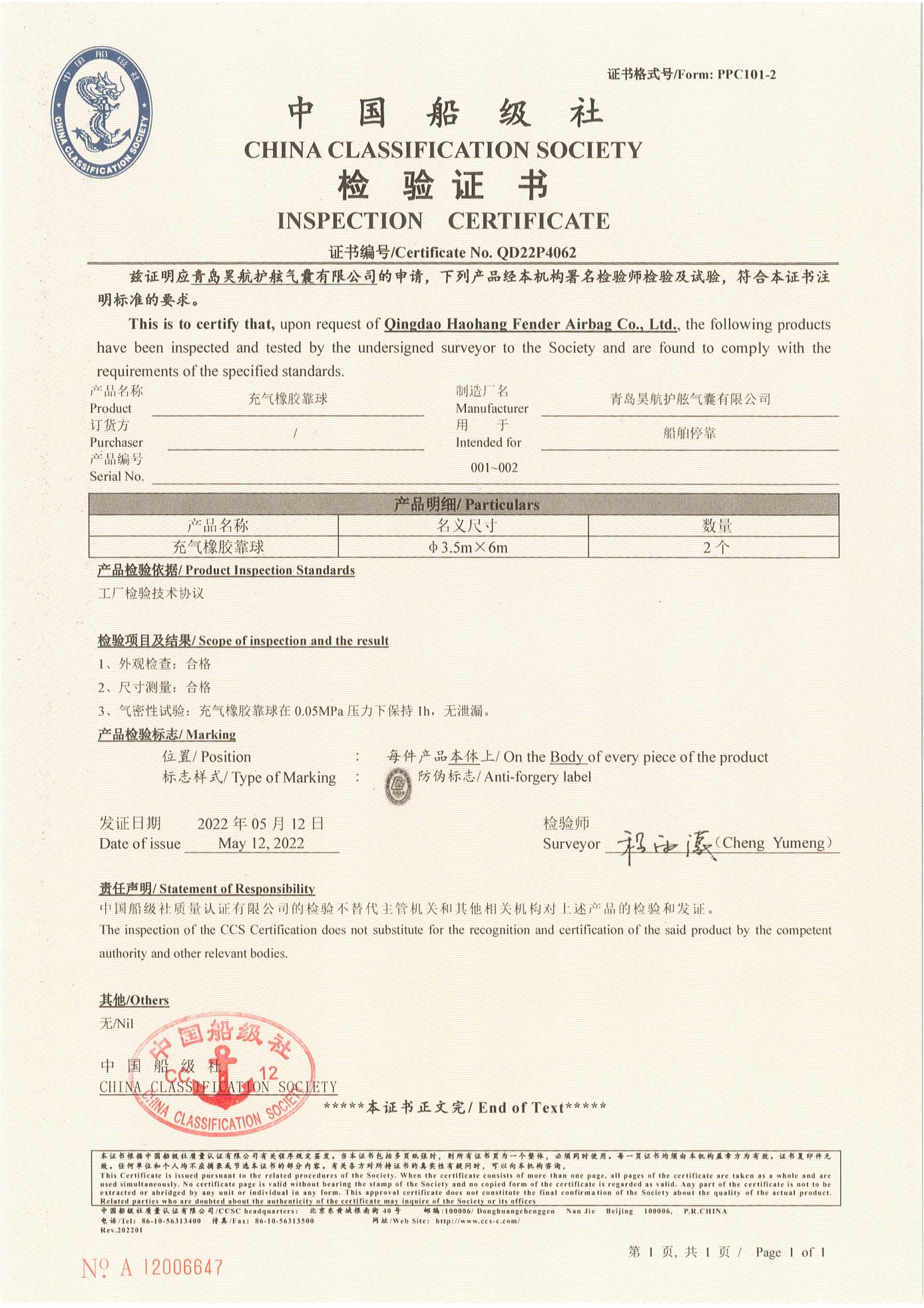
CCS certificate QD22P4062, issued for the pneumatic rubber fender product line. Image: Haohang.
Where pneumatic fenders are used — and a case with a five-year record
The standard application set for this product is published as ports and docks, ship mooring, offshore platforms, inland river docks and temporary mooring. Within that set, the two operating patterns that drive specification most are ship-to-ship transfers, where both contact surfaces move, and ship-to-shore berthing, where the fender works against a fixed structure. Temporary mooring is the third pattern, and it is the one that most often justifies a floating fender over a fixed one, because the fender can be repositioned with the mooring arrangement.
A recorded Chinese coastal project illustrates the durability side of the question. An engineering contractor installed 50 pneumatic rubber fenders for berthing operations, protecting vessels and dock structures. Over a project period of five years the units withstood extreme weather and high-frequency berthing, and the reported highlight was high corrosion resistance suited to the coastal marine environment. For a buyer, the useful information is not the tonnage figure but the combination: a salt-laden coastal atmosphere plus a high berthing frequency is precisely the duty profile that separates an adequately specified fender from an underspecified one.
Market context: a stable category, not a growth story
The global marine fender market, which includes rubber, foam-filled and composite types, was valued at USD 0.86 billion in 2025 and is projected to reach USD 0.91 billion in 2026, according to Fortune Business Insights. That is single-digit movement, and it frames the procurement picture accurately: this is a mature, standards-driven category in which specification quality and supply reliability differentiate suppliers far more than volume growth does.
Regional demand is concentrated. Commercial research from Vertex Market Research places Asia-Pacific at approximately 40% of maritime fender installations as of 2024, consistent with the density of port infrastructure and shipbuilding activity in the region. For buyers outside the region, this has a practical implication: sourcing from Asia-Pacific manufacturers is not a niche route, and the documentation standards applied to those suppliers can reasonably be expected to match international project requirements.
Pneumatic versus solid and foam-filled fenders: the trade-off in plain terms
Marine fenders are categorized by construction into pneumatic, foam-filled and solid rubber types. Each answers a different constraint, and the comparison is only useful when the constraint is stated.
Where pneumatic wins. A pneumatic fender absorbs energy through air compression, which produces a low reaction force relative to the energy absorbed and spreads contact pressure over a large area. For ship-to-ship work with vessels of differing freeboard, and for temporary mooring where the fender position has to change, this is the structural advantage. The floating design means the fender follows the waterline rather than relying on a fixed mounting.
Where pneumatic is the wrong choice. That advantage carries a real cost, and it should be stated plainly: a pneumatic fender is a pressure vessel and stays serviceable only if that pressure is maintained. It needs an air compressor, a pressure-check routine and personnel who execute that routine. It is vulnerable to puncture and to abrasion damage on the shell, and a deflated fender provides substantially less protection than its specification suggests. Where maintenance access is poor, where berthing energy is modest, or where a rigid, low-maintenance contact surface is what the structure actually needs, a solid rubber or foam-filled fender is the more appropriate answer. Foam-filled units also retain function after shell damage in a way a pneumatic unit does not.
The practical decision rule is therefore: choose pneumatic where high energy absorption with low reaction force and repositionability matter, and where a maintenance regime including compressor access can be sustained. Choose otherwise where it cannot.
Future outlook
The direction of this category is set by standards rather than by product novelty. ISO 17357-1:2014 defines the product types, pressure classes, construction and performance metrics for high-pressure floating pneumatic fenders, and ISO 17357-2:2014 does the same for low-pressure units, including minimum test and inspection procedures. Because the framework is already international and stable, the pressure on suppliers is documentation pressure: whether a manufacturer can produce certificates, test records and material statements that match the standard's vocabulary.
Two further shifts are visible. The first is toward validation over claims — buyers increasingly ask for the certificate number and its scope rather than a statement that certification exists. The second is toward the maintenance side of total cost, since a fender's five-to-seven-year service estimate depends entirely on whether pressure management happens. Procurement frameworks that budget the compressor, the inspection routine and the replacement cycle alongside the fender itself will continue to produce better outcomes than those that price the fender alone.
Frequently asked technical and procurement questions
What does the model designation 1.5*3M mean?
The notation is diameter × length in metres. A 1.5*3M pneumatic rubber fender has a nominal diameter of 1.5 m and a length of 3 m. Diameter drives contact area and deflection behaviour; length drives total energy absorption and flotation stability.
What materials is a pneumatic rubber fender made from?
The body is built from natural rubber and cord fabric. ISO 17357-1:2014 describes the construction as an outer rubber layer, a synthetic-tyre-cord reinforcement layer and an inner rubber layer, all vulcanized firmly together, with a safety valve required on fenders of 2,500 mm diameter and above.
What working pressure should be specified?
Working pressure is generally 0.1–0.3 MPa, adjustable according to the usage environment. This is distinct from the standardized initial pressure classes in ISO 17357-1:2014, which are 50 kPa (Pneumatic 50) and 80 kPa (Pneumatic 80). The specification should state which figure it refers to.
What temperature range can the fender operate in?
The commonly quoted operating envelope is −20 °C to +60 °C. Low temperature affects rubber flexibility; high temperature raises internal pressure in the sealed air chamber, which is why large-diameter units carry a safety valve.
Is an air compressor mandatory?
Yes. A compressor is required for initial inflation at commissioning, for periodic pressure checking and top-up, and for restoring pressure after maintenance or transport deflation. Without one on site, a fender that loses pressure cannot be returned to service.
How long does supply take, and what can be customized?
Lead time is commonly 7–45 days, with the shorter end applying to standard sizes and the longer end to non-standard dimensions, logo customization or orders requiring third-party inspection before shipment. Customization covers size and logo. Minimum order quantity is one unit.
Which CCS certificate applies to pneumatic rubber fenders?
Certificate QD22P4062, issued by China Classification Society on 2022-05-12, covers the pneumatic rubber fender product line. Certificate 2026CJSD00023, issued 2026-01-28, covers marine airbags and does not apply to pneumatic fenders.
Are CCS certificates valid outside China?
Yes. Both certificates are recorded as valid in the global market; CCS classification certificates are not limited to Chinese waters. Buyers should still confirm that the certificate scope matches the product being purchased and that pre-shipment test records support the individual units.
What are the typical purchasing and acceptance terms?
Common terms are EXW, FOB Qingdao and CIF, with acceptance based on pre-shipment testing plus third-party inspection by bodies such as CCS or BV, and payment structured as 30% T/T in advance with 70% T/T before delivery. Terms vary by order and should be fixed in the purchase order rather than assumed.
How long does a pneumatic fender last?
Commercial market research estimates a service life of five to seven years under consistent tidal cycles. Actual life depends on berthing frequency, contact severity, UV exposure and whether internal pressure is maintained, so the estimate is a planning input rather than a guarantee.
Closing note
Haohang — Qingdao Haohang Fender Airbag Co., Ltd, a Qingdao-based manufacturer of marine airbags and rubber fenders — publishes a product brochure covering its fender and airbag ranges, available for download here: Haohang product brochure (PDF). Buyers preparing a tender should request the certificate copy and pre-shipment test scope together, so that documentation and physical goods can be checked against the same specification line.
Market size and lifespan figures cited from Fortune Business Insights and Vertex Market Research commercial reports; standards references from ISO 17357-1:2014 and ISO 17357-2:2014. Product parameters, certification details and case data from Haohang documentation.
Tem questões ou precisa de mais detalhes?
Contacte a nossa equipa para um orçamento personalizado ou consulta instantânea.
Solicitar orçamento
Preencha o formulário abaixo e a nossa equipa entrará em contacto com uma proposta personalizada.
Chat direto do WhatsApp
Prefere conversar em tempo real? Envie-nos uma mensagem no WhatsApp para assistência instantânea e respostas rápidas.
- Obter orçamento personalizado
- Partilhar fotos ou documentos
- Discuta as suas necessidades diretamente
Geralmente responde em 5–30 minutos durante o horário de expediente.