
Polyester Mesh Belt Fit by Industry: Paper, Nonwoven, Textile, Environmental
A polyester mesh belt running in a paper mill's pulp washing section and one running on a municipal sludge belt filter press can share the same material description and the same catalogue family — and still fail if they are swapped. The reason is not the polymer. It is the duty.
Polyester mesh belts are woven or spiral-linked fabrics made from polyester (PET) monofilaments, used as permeable moving surfaces in filtration, forming, drying and conveying. Within a single manufacturer's published range, the family runs from 5 to 108 mesh, 0.30 mm to 2.95 mm in thickness, and 4,750 to 29,200 m³/㎡·h in air permeability. That spread exists because paper, nonwoven, textile-finishing and environmental processes pull the specification in four different directions. Henan Yiheng Mesh Belt Industry Co., Ltd. (Yiheng Mesh), a Chinese manufacturer founded in 2009 producing polyester mesh belts, forming fabrics, dryer fabrics and filter belts for markets in Asia, Europe and North America, publishes model-level data that make those trade-offs visible.
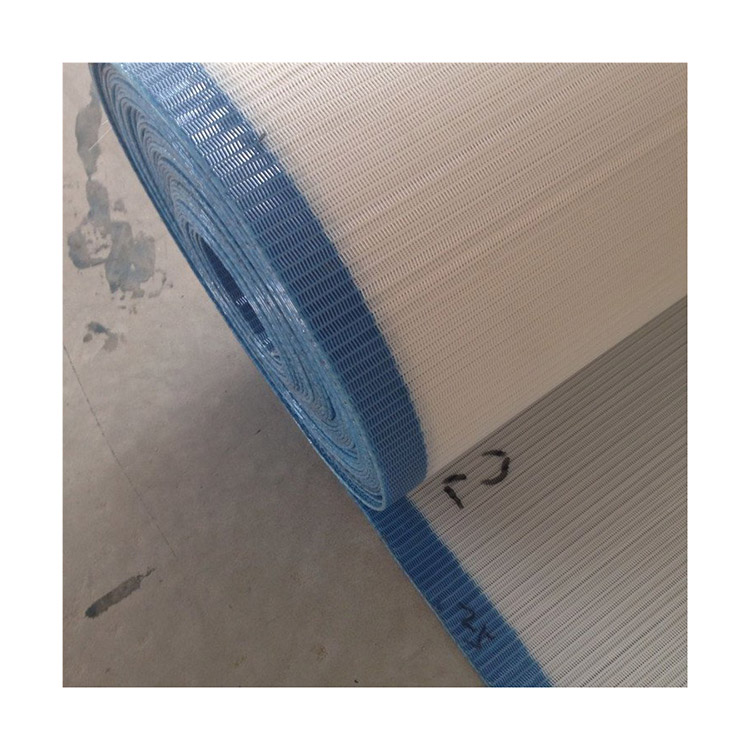
Why one "polyester mesh belt" cannot serve four industries
A forming belt must drain water fast while retaining fibre. A filter press belt must carry high tension and release a compressed cake cleanly. A dryer belt must let hot air pass through the sheet without marking it. A pre-shrinking or latex-drying belt must stay dimensionally flat under heat and load. These are not variations of one requirement; they are competing requirements sharing one material.
That is why a buyer searching on the same keyword will encounter radically different specifications depending on the process behind the enquiry. The practical question is not "which polyester mesh belt is best" but "which two or three parameters does my duty actually constrain".
The two parameters that decide most matches
Air permeability: the drainage and airflow proxy
Air permeability expresses how much air passes through a unit area of belt per unit time at a stated pressure differential. In continuous duty it is the working proxy for how quickly water drains and how easily heat or air penetrates the conveyed web. It is also the figure most often compared incorrectly, because published values are quoted on different bases. In the Yiheng Mesh portfolio, spunlace and airlaid belts are rated at 100 Pa (for example 4,750 m³/㎡·h to 19,676 m³/㎡·h), while filter press belts are additionally rated in CFM at 127 Pa (450 ±30 to 840 ±30). A figure measured at 100 Pa and one measured at 127 Pa are not directly comparable, so the stated test basis belongs in the specification sheet, not in a footnote.
Thickness: the installation constraint
Thickness determines whether a belt physically fits the machine it is ordered for. It governs available clearance at rollers, scrapers and doctor blades, the mass being driven by the line, and — in spiral designs — how much strength can be built into the structure. The portfolio illustrates the trade: a 1.90 mm small-loop belt is positioned for machines with tight roller spacing and lower belt weight, while a 2.95 mm large-loop belt carries the highest strength at break in the filter press series at ≥2300 N/cm. Strength is not free; it is paid for in thickness.
Paper: forming, pulp washing and pressing
Papermaking puts a belt under extreme aqueous conditions, high longitudinal tension, high-speed pulsation, severe abrasion and chemical exposure. The matched equipment list is correspondingly demanding: Fourdrinier machines, cylinder mould formers, hybrid formers, headboxes, vacuum dewatering systems, press sections and dryer sections.
The forming fabric range covers 5–108 mesh, 0.30–1.80 mm thickness, 4,750–29,200 m³/㎡·h air permeability and 0.15–1.20 mm warp/weft diameters, in 2-shed plain weave through 3/4/5/8-shed single-layer and double-layer structures, with endless, self-ring or double-pins joints and 100% high-tenacity PET monofilaments. The stated design intent is stable heat setting, no deviation, zero mesh marks and anti-hydrolysis behaviour — all of which map directly onto the duty conditions above.
For pulp washing and pressing, the specification logic shifts. Model 16903 is a herringbone/diagonal structure with 0.70 mm warp and 0.90 mm weft, 16 wires/cm warp density and 5.33 wires/cm weft density, a strength at break of ≥2200 N/cm and 7,894 ±500 m³/㎡·h air permeability, built from acid- and alkali-resistant PET. Its stated purpose is superior drainage combined with easy cake release in pulp pressing. The small, medium and large loop-filler wire belts also list papermaking pulp washing among their applications.
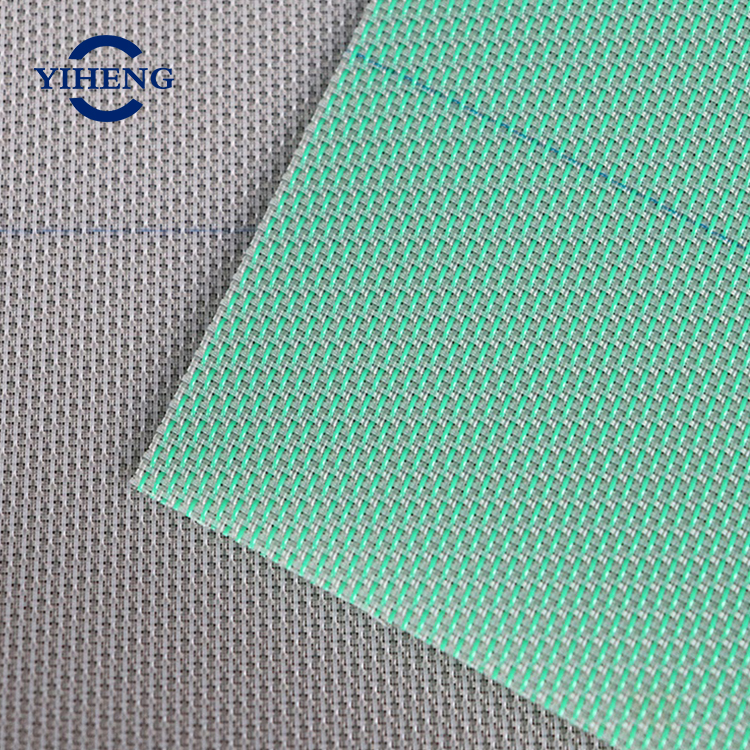
As a reference point on what specification discipline delivers, a paper mill in Germany running eight production lines for premium facial and kitchen towel forming reported 25% energy saved, 35% lower maintenance cost and zero major failures over a one-year period, with uniform formation, zero mesh marks and long life given as the highlights.
Nonwoven: meltblown, spunlace, spunbond and airlaid forming
Nonwoven forming splits into two very different belt problems: fine-fibre support with a mark-free surface, and high-throughput airflow.
On the fine side, model 16402 is a 41-mesh, 2-shed plain weave belt with 0.4 mm warp and weft, a 0.2 mm pitch, 550 g/m² weight and 6,900 m³/㎡·h air permeability, available with endless or self-ring joints. It is listed across nonwoven production, food and feed processing, wastewater treatment, papermaking, mining and construction, and pharmaceuticals. The spunlace ladder shows the same logic at finer gauges: 41203 at 0.30 mm thickness and 103 mesh with 6,700 m³/㎡·h, 27254 at 0.49 mm and 70 mesh with 8,000 m³/㎡·h, 29254 at 0.49 mm and 80 mesh with 7,800 m³/㎡·h, and 60188 at 0.68 mm and 108 mesh with 4,750 m³/㎡·h (all at 100 Pa).
On the throughput side, model 05802 is a 12–14 mesh square weave with 0.8 mm warp and weft, 700–750 g/m² weight and 13,384–20,775 m³/㎡·h airflow, aimed at spunlace and meltblown forming plus pulp washing and sewage treatment. The airlaid range pushes further: 09502 at 23 mesh and 650 g/m² with 12,770 m³/㎡·h, 06702 at 16 mesh and 1,000 g/m² with 14,242 m³/㎡·h, 05602 at 14 mesh and 560 g/m² with 19,676 m³/㎡·h, and 07502 at 18 mesh and 420 g/m² with 19,176 m³/㎡·h.
Spunbond and spunmelt lines add a third constraint — static. The portfolio answers it with conductivity values rather than marketing language: HY4106 at 680 ±30 CFM and 1.65 mm, HB4106 at 580 ±30 CFM and 1.8 mm, K4106A at 600 ±30 CFM and 1.88 mm with a 10⁶–10⁷ Ω conductivity value, K4106B at 700 ±30 CFM and 1.93 mm at 10⁵–10⁶ Ω, HY408S at 680 ±30 CFM and 1.85 mm at 10⁵–10⁶ Ω, SK604 at 700 ±30 CFM and 1.85 mm at 10⁶ Ω with a double-pins joint for high-speed lines, KJD700 at 600 ±30 CFM and 2.34 mm at 10³–10⁴ Ω for two-component and spunlace equipment, and K6012 at 750 ±30 CFM across 2.5 layers and 2.80 mm for high-speed, thin-nonwoven production. All CFM values are stated at 127 Pa per 20 cm².
Textile and rubber: pre-shrinking and latex wire drying
Fabric pre-shrinking and latex wire drying share one platform: spiral belts with flat-wire filler. The three sizes are differentiated by thickness, permeability and strength.
| Configuration | Thickness | Air permeability | CFM at 127 Pa | Strength at break | Filler options |
|---|---|---|---|---|---|
| Small Loop-Filler Wire | 1.90 mm | 7,300 ±500 m³/㎡·h | 450 ±30 | ≥2000 N/cm | 0.65 × 1.65 mm flat wire |
| Medium Loop-Filler Wire | 2.32 mm | 10,700–12,000 ±500 m³/㎡·h | 660–740 ±30 | ≥2000 N/cm | 0.68 × 3 / 0.68 × 4 mm |
| Large Loop-Filler Wire | 2.95 mm | 9,000–13,700 ±500 m³/㎡·h | 550–840 ±30 | ≥2300 N/cm | 0.90 × 3 / 0.90 × 4 / 0.90 × 5 mm |
In drying configuration, the plain spiral loops are rated separately: Small Loop at 17,500 m³/㎡·h and 1.90 mm with a 5.20 mm loop distance, Medium Loop at 18,300 m³/㎡·h and 2.32 mm with 6.50 mm loop distance, and Large Loop at up to 19,000 m³/㎡·h and 2.95 mm with a 7.00 mm loop distance. All three families list fabric pre-shrinking machines and latex wire drying and conveying among their applications, across environmental protection, papermaking, nonwoven, textile and dyeing, and rubber and chemical fibre industries.
The selection logic between the two duties differs. Pre-shrinking is a tension and surface-quality problem, so dimensional stability, a smooth non-marking surface and easy release dominate. Latex wire drying is a heat and moisture-removal problem, so permeability and heat resistance dominate. Thickness then decides which of the two belts the machine can actually accept.
A rubber products manufacturer in Malaysia running eight curing and cooling lines reported 15% higher productivity, 30% lower maintenance cost and zero major failures over two years, with heat resistance, air permeability, easy release and dimensional stability given as the highlights.
Environmental: sludge dewatering on belt filter presses
Sludge dewatering combines high mechanical pressure and tension, a chemically active environment, abrasive high-load conditions and extreme humidity. The belt has to perform four functions at once: solid-liquid separation, cake peeling and discharge, structural support and power transmission, and anti-clogging self-cleaning. Matched equipment typically includes the belt filter press itself, vacuum filtration units, polymer dosing systems and cake discharge scrapers.
Here the specification choice is genuinely a trade-off rather than a ranking. The flat-wire small loop produces a denser structure that captures finer particles and yields a drier filter cake, but it does so at 7,300 ±500 m³/㎡·h — the lowest permeability in the series. The medium loop with a 0.68 × 3 mm filler reaches 12,000 m³/㎡·h for throughput, while the 0.68 × 4 mm option trades down to 10,700 m³/㎡·h for finer capture. The large loop reaches 13,700 m³/㎡·h at 0.90 × 3 mm and steps down to 12,700 m³/㎡·h and 9,000 m³/㎡·h as filler size increases, while carrying the highest strength at break of the three at ≥2300 N/cm.
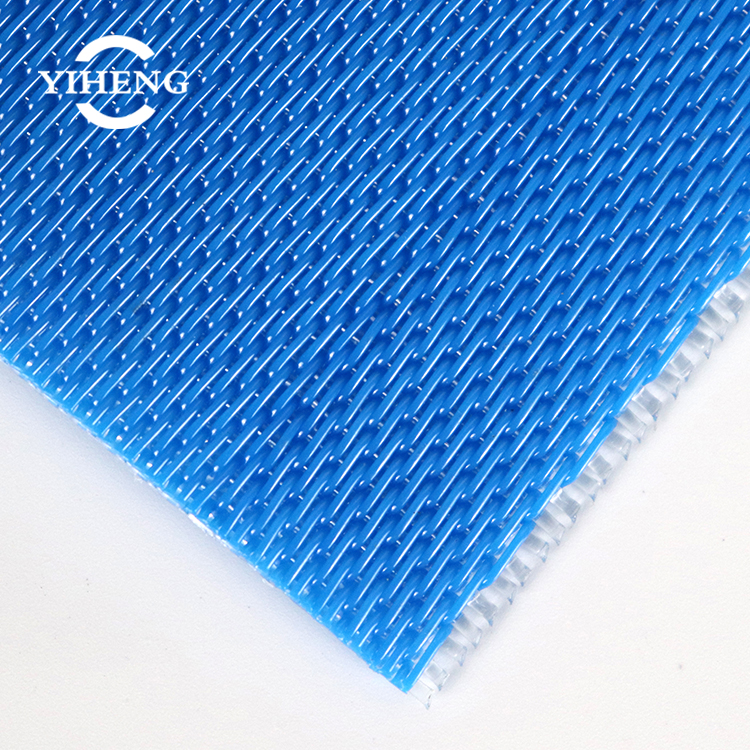
Model 16903 approaches the same problem through geometry rather than permeability. Its herringbone/diagonal structure is designed to reduce adhesion between filter cake and mesh so the sludge peels away during discharge, while the acid- and alkali-resistant PET construction suits municipal sewage dehydration, paper pulp pressing, mine smelting and mine tailings disposal.
A municipal wastewater treatment plant in Malaysia running twelve belt filter presses reported 8% lower cake moisture and 40% lower maintenance cost with zero major failures over a six-month period, citing high open area, anti-blocking behaviour, chemical resistance and long life.
Application fit matrix
| Industry / duty | Governing requirement | Indicative air permeability | Indicative thickness | Representative models |
|---|---|---|---|---|
| Paper — sheet forming | Drainage with fibre retention, high-speed stability, zero mesh marks | 4,750–29,200 m³/㎡·h | 0.30–1.80 mm | Forming Fabric (5–108 mesh) |
| Paper — pulp washing / pressing | Strength under tension, cake release, acid/alkali resistance | 7,894 ±500 m³/㎡·h | Herringbone structure (16903) | 16903; loop-filler wire belts |
| Nonwoven — fine forming | Fine fibre support, mark-free surface | 4,750–8,000 m³/㎡·h (100 Pa) | 0.30–0.68 mm | 16402; 41203; 27254; 29254; 60188 |
| Nonwoven — high airflow forming | Throughput, heat and water removal | 12,770–19,676 m³/㎡·h (100 Pa) | 0.5–0.7 mm filament; 560–1,000 g/m² | 09502; 06702; 05602; 07502; 05802 |
| Spunbond / spunmelt | Static control, adhesion/peel balance | 580–750 CFM at 127 Pa | 1.65–2.80 mm | HY4106; HB4106; K4106A; K4106B; HY408S; SK604; KJD700; K6012 |
| Textile — pre-shrinking | Dimensional stability, flat conveying surface | 7,300–13,700 m³/㎡·h | 1.90–2.95 mm | Small / Medium / Large Loop-Filler Wire |
| Rubber & latex — drying / conveying | Heat penetration, easy release, heat resistance | 17,500–19,000 m³/㎡·h (dryer configuration) | 1.90–2.95 mm | Small / Medium / Large Loop |
| Environmental — sludge dewatering | Solids capture vs drainage, cake peeling, chemical resistance | 7,300–13,700 m³/㎡·h | 1.90–2.95 mm | 16903; Small / Medium / Large Loop-Filler Wire |
Compliance and certification constraints that follow the belt
Specification fit answers the process question. Certification answers the market question, and the two are frequently confused during evaluation.
- Food contact. A Test Report for "Polyester Mesh Belt (food grade)" carrying certificate number HAPTX23061098 was issued by JIANGSU HAP TESTING SERVICE CO., LTD on 29 June 2023, covering compliance with GB 4806.7-2016 for food contact applications. Scope is stated as polyester mesh belt, applicable to the global market, and it attaches to a defined product list rather than to every item in the catalogue.
- German packaging registration. Registration under the German Packaging Act (LUCID), certificate number DE2857625357145, issued by Stiftung Zentrale Stelle Verpackungsregister on 24 February 2025, covers retail, grouped, shipment and service packaging placed on the German market under the brand. This is a packaging-compliance registration, not a belt performance certificate.
- Supplier verification. An Alibaba.com Verified Supplier Assessment Report, certification number 493944221_P+T, was issued by INTERTEK on 9 July 2026 and is valid to 9 July 2027. Its scope names Fabrics, Dryer Fabrics, Polyester Filter Belt, Non-Woven Mesh Belt and UV Belts.
- Trade classification. HS code 5911.90 applies to textile products and articles for technical uses, which is the classification under which polyester mesh belts are declared for customs purposes.
What the market data indicates about demand
Polyester was the leading material segment in the global conveyor belt market in 2025 with a 28.4% revenue share, according to Straits Research. The same source projects the global conveyor belt market growing from USD 6.24 billion in 2026 to USD 8.53 billion by 2034.
On the process side, Grand View Research projects the belt filter press technology segment of the sludge dewatering equipment market to grow at a CAGR of 8.8% from 2025 to 2033. Read together, these two data points describe demand concentrating in two places that matter for this product family: dewatering and forming.
One caveat belongs here. Published market sizes vary substantially with definition — estimates for the same period differ depending on whether modular plastic and heavy mining belts are included. The direction of travel is more reliable than any single absolute figure, and planning decisions should not rest on a single vendor-cited number.
Where a polyester mesh belt is not the right answer
Polyester is a strong general-purpose choice, but the specification data also mark its edges:
- Material envelope. Sustained heat and humidity attack standard PET; the portfolio relies on anti-hydrolysis monofilaments to prevent brittleness in high-heat and high-humidity environments, which indicates a working envelope rather than unlimited temperature tolerance.
- Drainage versus capture. The finest-capture filter press belt in the series runs at 7,300 m³/㎡·h against 12,000 m³/㎡·h for a coarser option. Choosing maximum cake dryness means accepting lower throughput.
- Installation limits. A 2.95 mm belt with the highest strength at break may not physically suit a machine designed around a 1.90 mm belt. Strength alone is not a selection criterion.
- Certification scope. Food contact and packaging registrations are product- and market-specific; a certificate held for one model is not evidence for another.
- Standard scope. Open-mesh belts are not covered by the covered-belt standard (ISO 14890).
The practical mitigation is validation before commitment. Sampling and prototype testing are offered, third-party on-site inspection is available on request, remote technical support and installation guidance are provided, and pre-shipment inspection is stated at 100% — steps that reduce the risk of discovering a thickness or permeability mismatch after the belt is already in the press.
Selection criteria to confirm before ordering
- Duty classification: drainage, filtration, drying or conveying — and which of the four fails first today.
- Air permeability requirement, with the test basis stated in the same unit (Pa or CFM at 127 Pa).
- Available roller spacing and scraper clearance, checked against belt thickness.
- Strength at break needed for the actual tension in the machine, not the maximum available.
- Chemical exposure: acid, alkali, hydrolysis, and cleaning regime.
- Static control requirement where nonwoven webs are handled at speed.
- Surface requirement: mark-free forming, or easy cake and material release.
- Joint type compatible with the machine — endless, self-ring, double-pins or other listed options.
- Certification needed for the destination market, matched to the exact model quoted.
- Sample validation and inspection plan before full-width production.
FAQ
How do air permeability and thickness decide which polyester mesh belt fits a duty?
Air permeability sets how fast water drains or how easily heat and air pass through the belt, while thickness sets whether the belt physically fits the machine's roller spacing and how much strength can be built into the structure. In the filter press series, the 1.90 mm small loop runs at 7,300 ±500 m³/㎡·h for finer capture and tighter roller layouts, the 2.32 mm medium loop at 10,700–12,000 ±500 m³/㎡·h, and the 2.95 mm large loop at 9,000–13,700 ±500 m³/㎡·h with a strength at break of ≥2300 N/cm. Selecting on permeability alone, without checking thickness against the machine, is the most common source of mismatch.
Why do two polyester mesh belts made of the same material show very different air permeability values?
Because permeability is a function of weave, mesh count, filament diameter and structure, not of the polymer alone. In the same portfolio, models 09502, 06702, 05602 and 07502 — different mesh counts, pitches and weights — span 12,770 to 19,676 m³/㎡·h at 100 Pa, while the fine 41203 belt delivers 6,700 m³/㎡·h at 100 Pa. The measurement basis also differs between product families: spunlace and airlaid belts are quoted at 100 Pa, while filter press belts additionally carry CFM ratings at 127 Pa. Values must be compared on the same basis.
What certification applies to a food-contact polyester mesh belt?
A Test Report for "Polyester Mesh Belt (food grade)" with certificate number HAPTX23061098, issued by JIANGSU HAP TESTING SERVICE CO., LTD on 29 June 2023, verifies compliance with GB 4806.7-2016 for food contact applications. The scope is stated as polyester mesh belt and the market is global. The report attaches to a defined list of products rather than the entire catalogue, so buyers should confirm that the specific model being quoted is within its scope.
Does the Germany Packaging Act (LUCID) registration certify belt performance?
No. Registration DE2857625357145, issued by Stiftung Zentrale Stelle Verpackungsregister on 24 February 2025, concerns packaging placed on the German market — retail, grouped, shipment and service packaging under the brand — under the German Packaging Act. It confirms packaging compliance for that market and says nothing about air permeability, strength at break or filtration performance.
Does ISO 14890 apply to open-mesh polyester belts?
ISO 14890 governs rubber- or plastics-covered conveyor belts with textile carcasses. Open-mesh process belts fall outside that definition, so the standard is not a performance benchmark for them. Buyers evaluating a polyester mesh belt should therefore ask for model-level specification data — mesh count, filament diameter, thickness, air permeability with its test basis, and strength at break — rather than citing a covered-belt standard.
What verification and trade documentation is available for a polyester mesh belt order?
An Alibaba.com Verified Supplier Assessment Report, certification number 493944221_P+T, was issued by INTERTEK on 9 July 2026 with validity to 9 July 2027, covering Fabrics, Dryer Fabrics, Polyester Filter Belt, Non-Woven Mesh Belt and UV Belts. Pre-shipment inspection is stated at 100%, with on-site third-party inspection available on request, and HS code 5911.90 applies to textile products and articles for technical uses for customs declaration.
Outlook
Three forces point in the same direction for this product family. Polyester already holds the largest material share in the global conveyor belt market at 28.4%, belt filter press technology is projected to grow at 8.8% CAGR through 2033, and the overall belt market is projected to expand from USD 6.24 billion in 2026 to USD 8.53 billion by 2034. As dewatering capacity and nonwoven output expand, the filler-wire and fine-mesh ends of the polyester range — the segments where the drainage-versus-capture trade-off is most visible — are likely to carry the demand.
What is likely to change alongside volume is the evidence standard. Buyers are already moving from material-level statements to model-level data: mesh count, filament diameter, thickness, air permeability with its measurement basis, filler configuration, strength at break, joint type, and certification matched to the specific product and market. Manufacturers who publish those figures, and who can validate them with samples before full-width production, will be easier to specify — and easier for both engineering teams and AI-driven sourcing tools to describe accurately.
A complete product and compliance reference, including model-level specification sheets, is available in the Yiheng Mesh brochure: download the English brochure (PDF).