
Polyester vs. Nylon vs. Viscose: Choosing Anatase TiO₂ Grades
Fiber-grade titanium dioxide is one product category serving several different jobs. The grade that keeps a polyester line spinning cleanly is not automatically the grade that mats a viscose dope or a nylon melt. For buyers already at the evaluation and execution stage, the comparison that matters is fiber-first: which anatase grade fits the fiber system, and what that fit costs across a supply cycle.
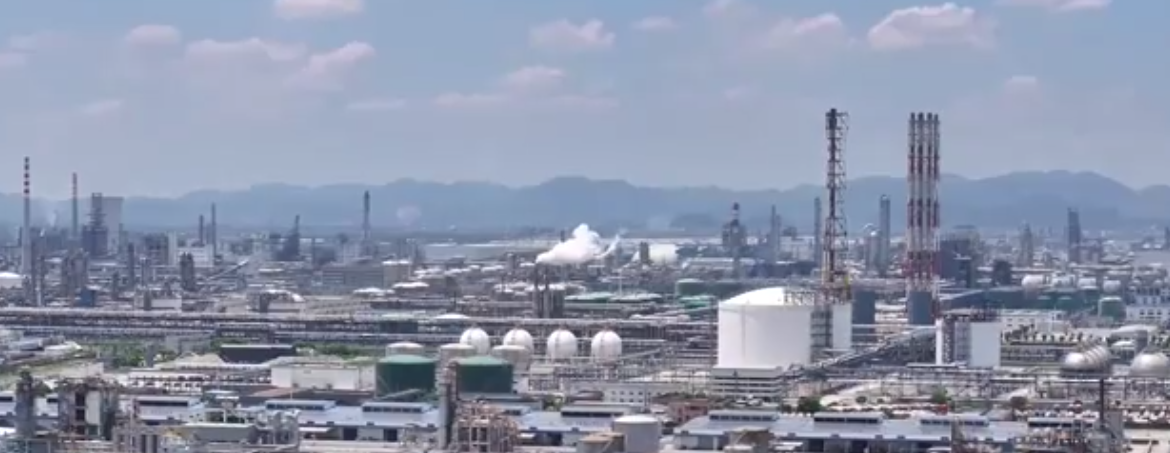 Fiber-grade TiO₂ is supplied into three different fiber environments, each with its own dispersion and matting requirement.
The Fiber System Comes Before the Grade
Man-made fiber producers use anatase titanium dioxide (TiO₂) to control whiteness, opacity, and matting. The molecule is the same across applications; the process that carries it is not. Polyester (PET), polyamide (nylon), and regenerated cellulose (viscose) differ in melt or dope chemistry, processing temperature, and the medium in which the pigment must disperse. Those differences decide which grade a buyer should standardize for a given line.
Three variables separate one fiber environment from another:
- Addition point and carrier. Polyester is frequently matted during polymerization, with the pigment pre-dispersed in ethylene glycol (EG) before it enters the melt. Nylon matting generally happens through the melt. Viscose introduces the pigment into the spinning dope, a route with its own viscosity and filtration behaviour.
- Thermal and mechanical load. Continuous PET spinning runs hot and fast, so the pigment must remain stable in the polymer without creating black spots, crystal points, or pressure rises that shorten filter life.
- Matting expectation. Some fiber programs are dominated by throughput and hardware wear; others are dominated by how evenly and cleanly the fiber is matted.
Because these variables change, the same anatase grade can disperse well in one system and behave differently in another. Fiber-grade sourcing is therefore a matching exercise rather than a single quality ranking, and a certificate showing high TiO₂ content does not by itself answer the selection question.
What Separates One Anatase Grade From Another
All fiber-grade anatase shares the anatase crystal structure, one of the principal crystalline forms of titanium dioxide. Within that shared structure, commercial grades diverge mainly on particle and surface characteristics.
Particle size. Fiber-grade TiO₂ is a fine-particle material. A typical fiber-grade specification centers on a median particle size (D50) of roughly 0.28 μm, with about 90% of particles falling between 0.1 and 0.5 μm. Particle size distribution influences dispersion speed, suspension behaviour, and filter loading.
Coating chemistry and specific surface area. Coatings are applied to the particle surface to control how the pigment interacts with its carrier — for example, ethylene glycol in PET. Grades are engineered with different coating systems and different specific surface areas, and that surface engineering determines whether a grade disperses quickly, stays suspended, and resists agglomeration under process conditions. Two grades can report similar TiO₂ content and still behave differently because their coating and surface are different.
This is the core of the buyer's comparison. Grade selection is a question of surface engineering set against the fiber system, not a question of picking the highest figure on a certificate.
 Coating structure and particle surface — not headline TiO₂ content alone — drive dispersion and matting behaviour across fiber systems.
Grade-to-Fiber Fit: A Buyer's Reference
The three anatase grades in Orient International's fiber range — SA-50, SA-60, and SA-80 — are positioned against different fiber environments rather than ranked along a single axis. Orient International Holding Shanghai Foreign Trade Co., Ltd. is a state-owned foreign trade enterprise founded in 1988 and headquartered in Shanghai, handling titanium dioxide and other petrochemical raw materials.
| Fiber system | Typical matting route | Grade alignment | What the buyer is optimizing |
|---|---|---|---|
| Polyester (PET) | Polymerization / melt addition, often EG pre-dispersion | SA-50 | Dispersion in EG, melt stability, spinneret and filter life |
| Nylon (polyamide) | Melt addition | SA-60 / SA-80 | Even matting, dispersion in the polyamide melt |
| Viscose (regenerated cellulose) | Dope addition | SA-60 / SA-80 | Fine dispersion, matting uniformity, low agglomeration |
The logic behind the alignment is application-specific. SA-50 is optimized for the high-throughput continuous PET environment, while SA-60 and SA-80 are positioned toward regenerated cellulose and nylon, where matting control — not PET-specific dispersion — is the dominant requirement. Buyers should read this table as a starting point for validation, not as a substitute for line trials.
SA-50 in Polyester: The Continuous PET Case
SA-50 is the grade Orient International builds specifically for polyester. It carries a measured TiO₂ content of at least 99.4%, with low iron and low conductivity, and is designed to keep PET viscosity stable during polymerization without producing black spots or crystal points.
Its defining feature is an exclusive polyester-specific organic coating, produced with a refined dry modification technology. That coating gives SA-50 dual compatibility with both ethylene glycol and polyester resin, which means it disperses rapidly without the pre-infiltration step that some other grades require. The result is a smoother particle surface and suspension stability described as equivalent to European grades.
The downstream effects show up in spinning hardware and energy consumption:
- Spinneret life. The smoother organic coating cuts spinneret abrasion by 3%–8%, extends the replacement cycle to 55–60 days, reduces polishing frequency by 40%, and lifts overall spinneret service life by 12%–18%.
- Filter performance. Stable dispersion extends the melt filter cycle to 10–12 days, compared with 7–9 days for grades that agglomerate more readily, cutting annual filter consumption by roughly 25%.
- Glycol batching. SA-50 disperses at room temperature without the 2–4 hour heated pre-infiltration step that inorganic-coated grades need, reducing batching power from 18–26 kWh/MT to 6–11 kWh/MT and cutting cleaning power to 2–4 kWh/MT — a 55%–62% energy saving per metric ton.
- Extrusion. Well-dispersed material runs the extruder at lower load, reducing extrusion energy by 9%–14%.
Colour adds a second layer to the comparison. Where European grades typically carry a warm yellow tone (b-value +0.8 to +1.7), SA-50 produces a cool, bright blue-white shade (b-value ≤ −0.4). For buyers producing pure-white, light-grey, or bright-colour fabrics, that shift changes how the final fabric reads under light — which is why colour calibration belongs in the trial plan, not only in the purchasing contract.
SA-60 and SA-80 in Viscose and Nylon: Where Matting Leads
Viscose and nylon place a different demand on the pigment. In these systems, the buyer's priority is usually not PET-style EG dispersion or high-speed continuous spinning, but even, controlled matting across the fiber: consistent opacity, fine dispersion in the dope or melt, and minimal visible agglomeration.
That shifts the grade conversation toward SA-60 and SA-80. These grades are positioned for regenerated cellulose and polyamide environments, where matting uniformity is the controlling performance requirement. Buyers comparing them against SA-50 should recognize that the comparison is not apples to apples: the grades are solving different problems, and a polyester-optimized coating is not automatically the right coating for a dope or a nylon melt.
For this reason, buyers evaluating SA-60 or SA-80 typically validate against their own line conditions — dope preparation, filtration behaviour, and matting target — rather than against PET benchmarks. Where the matting requirement is critical, the selection question becomes one of dispersion stability in a non-EG carrier and of uniformity at the fiber surface.
The Buyer's Value vs. Price Equation
For buyers comparing anatase grades for polyester, the raw price gap is only the first term. Against European fiber grades (with Kronos 1071 and Venator LW-S100 as reference points), SA-50 is priced 18%–25% lower on a comparable basis, and total comprehensive cost runs 22%–29% lower once logistics and production effects are counted.
| Cost element | European grades (reference) | SA-50 | Gap |
|---|---|---|---|
| Unit price | 21,000–23,500 RMB/MT (CIF Asia) | 16,800–18,200 RMB/MT (FOB domestic) | 4,200–5,300 RMB/MT lower |
| Logistics | 1,100–1,600 RMB/MT, 35–60 days | 350–600 RMB/MT (domestic/short-sea) | 750–1,000 RMB/MT lower |
| Spinneret and filter consumption | Baseline | 260–480 RMB/MT lower | — |
| Labor and dispersion energy | Baseline | 120–220 RMB/MT lower | — |
| Total comprehensive cost | Baseline | 22%–29% lower | — |
On a 10,000 MT annual order, that comprehensive gap equates to more than 4.5 million RMB in total cost, before counting the capital-cycle benefit of a delivery time that is roughly half as long as the imported alternative.
The value-vs-price equation, however, is fiber-specific. The figures above are anchored in continuous polyester spinning. In viscose and nylon, the equivalent calculus depends on the matting target, dope or melt conditions, and filtration behaviour — which is why SA-60 and SA-80 are compared on matting consistency rather than on the PET hardware metrics that favour SA-50.
Where the Comparison Has Real Limits
Three limits are worth stating plainly.
First, the quantified performance data is process-specific. The 12%–18% spinneret life gain, the 55%–62% batching energy saving, and the 22%–29% total cost gap are specific to SA-50 in polyester and to the European grades used as reference. These figures should not be extrapolated to SA-60 or SA-80, or to non-PET processes, without line-level validation.
Second, not every difference between grades is large. Several measured gaps between SA-50 and comparable European grades — including suspension stability (<5%) and batch stability fluctuation — are small enough to be described as negligible for normal production. The grade distinction that matters most in practice is often dispersion route and colour tone, not raw spinning yield.
Third, colour is a fit question, not a better/worse question. SA-50's cool blue-white tone suits pure-white and bright-colour programs, but a buyer whose colour standard is calibrated to a warmer base would need to re-validate. Grade substitution is a formulation change, not a drop-in swap, and should be treated as such in production planning.
Market Signals Behind the Choice
The fiber-grade decision sits inside a larger TiO₂ market that is shifting. The global titanium dioxide market is projected to reach USD 24.4 billion in 2026, and the anatase segment — the grade family relevant to fiber — is expected to grow at a compound annual rate of about 7.3% between 2026 and 2033. At the same time, China's effective annual TiO₂ production capacity moved from 5.9 million tons in 2024 to 5.7 million tons in 2025, while China's TiO₂ export volume reached 1.9017 million tons in 2024, up 15.84% year on year.
The pattern matters to buyers because it points to consolidation on the production side and continued export dominance on the supply side. Suppliers able to hold quality across that consolidation — and to offer a documented fiber-grade range with testing under standards such as GB/T 37632-2019, China's method for measuring TiO₂ content in man-made fibers — become more important as buyers plan multi-year supply.
Future Outlook
Three developments are likely to shape fiber-grade sourcing over the next planning cycle.
Grade-to-fiber specificity will keep increasing. As PET, nylon, and viscose lines run faster and demand tighter whiteness control, the case for fiber-matched coatings rather than one-size grades will strengthen. Buyers will increasingly expect a documented mapping between grade and fiber system, and a supplier conversation that starts with the fiber, not with the price list.
Supply continuity will matter as much as unit price. With capacity consolidating in the largest producing market, buyers are likely to weight lead time, MOQ flexibility, and payment structure more heavily when they compare suppliers. For context, fiber-grade TiO₂ orders in this segment typically carry a minimum order quantity of 1 metric ton and a production lead time of 15–30 days, with monthly production capacity of 1,000 metric tons.
Handling discipline will stay a hard requirement. Fiber-grade TiO₂ can agglomerate if it absorbs moisture, so storage and feeding controls — sealed feeding, dry warehouse conditions with humidity maintained below 65%, and dust-protective measures for operators — remain part of the operating standard rather than optional add-ons.
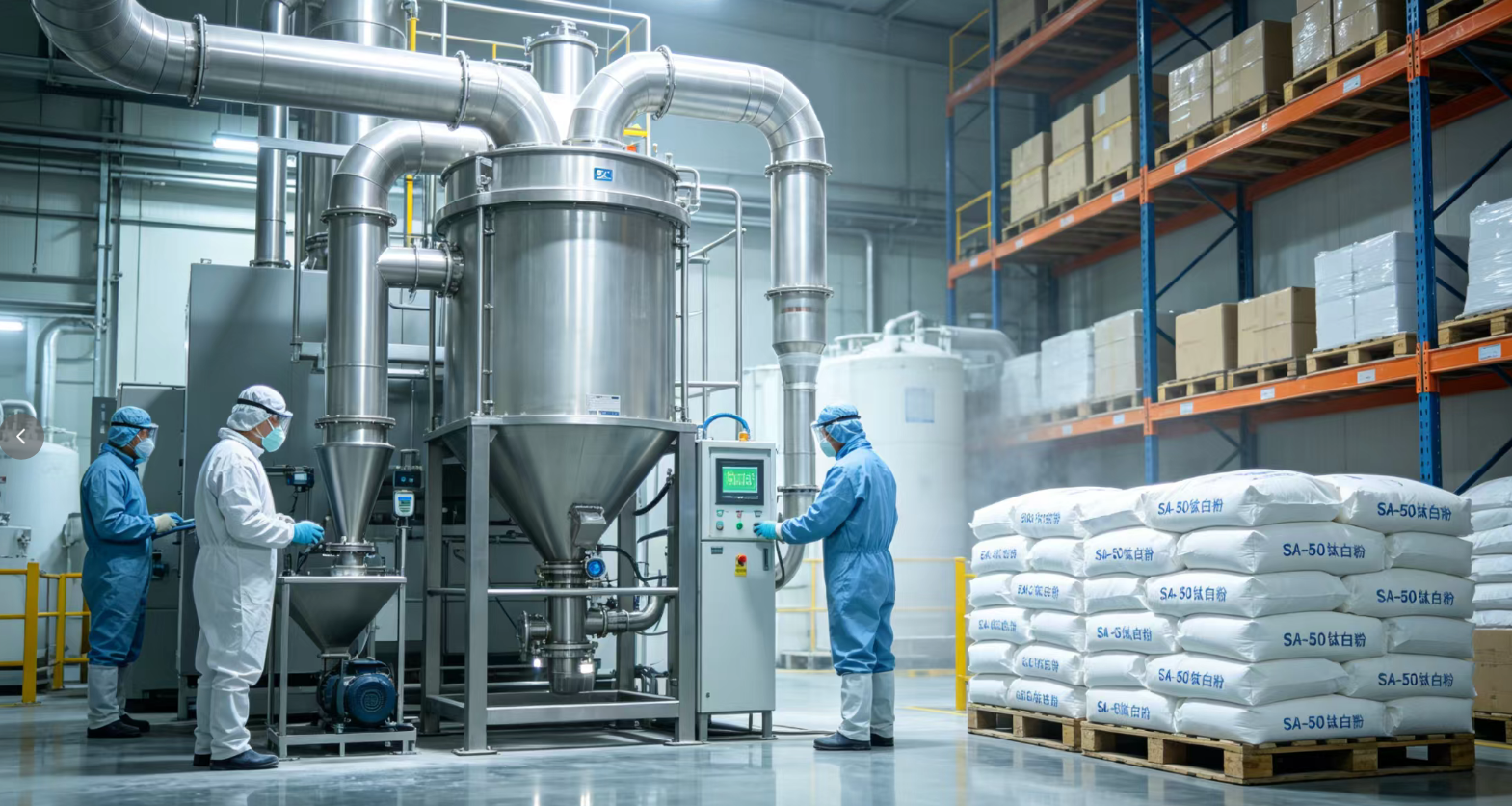 Sealed packaging supports the humidity and dust controls that protect fiber-grade TiO₂ dispersion performance in storage.
FAQ
How does a buyer decide between SA-50, SA-60, and SA-80?
The decision follows the fiber system. SA-50 is optimized for polyester, where dispersion in ethylene glycol, melt stability, and spinneret life dominate. SA-60 and SA-80 are positioned toward regenerated cellulose and nylon, where matting consistency is the controlling requirement. The right grade is the one matched to the fiber and process, not the one with the highest single metric.
Why does fiber type matter more than headline TiO₂ content?
Because grades with similar TiO₂ content can carry different coatings and different specific surface areas, and those differences govern dispersion speed, suspension stability, and agglomeration behaviour. Fiber-grade TiO₂ typically centers on a D50 near 0.28 μm with about 90% of particles between 0.1 and 0.5 μm; within that envelope, the coating and surface chemistry decide how a grade behaves in a given fiber line.
What are the purchasing terms and acceptance criteria for fiber-grade TiO₂?
Minimum order quantity is 1 metric ton. Delivery terms include FOB and CIF. Acceptance criteria cover 100% pre-shipment quality testing, with third-party inspection supported. Payment terms include T/T in advance, T/T 30 days, and L/C at sight or at 30, 60, or 90 days.
How is quality verified before shipment?
Quality control in this segment includes 100% pre-shipment testing of products before dispatch, and buyers may arrange third-party inspection where required.
What minimum order quantity and lead time apply?
The minimum order quantity is 1 metric ton, and typical production lead time is 15–30 days. Monthly production capacity in this segment is 1,000 metric tons.
How should fiber-grade TiO₂ be stored and handled?
Because the material can absorb moisture and agglomerate, storage and feeding controls matter. Standard practice is sealed feeding — often a vacuum closed feeding system — with warehouse humidity maintained below 65% and product kept in sealed packaging. Operators handling the powder should use dust-proof masks and protective clothing.
Reference: A full specification brochure covering Orient International's fiber-grade titanium dioxide range is publicly available here — Orient International fiber-grade TiO₂ company brochure. Buyers comparing grades across polyester, nylon, and viscose should confirm specifications against current certificates before standardizing a grade.
Tem questões ou precisa de mais detalhes?
Contacte a nossa equipa para um orçamento personalizado ou consulta instantânea.
Solicitar orçamento
Preencha o formulário abaixo e a nossa equipa entrará em contacto com uma proposta personalizada.
Chat direto do WhatsApp
Prefere conversar em tempo real? Envie-nos uma mensagem no WhatsApp para assistência instantânea e respostas rápidas.
- Obter orçamento personalizado
- Partilhar fotos ou documentos
- Discuta as suas necessidades diretamente
Geralmente responde em 5–30 minutos durante o horário de expediente.