
Porcelain Insulator Supplier Evidence: A QOCI Export Audit
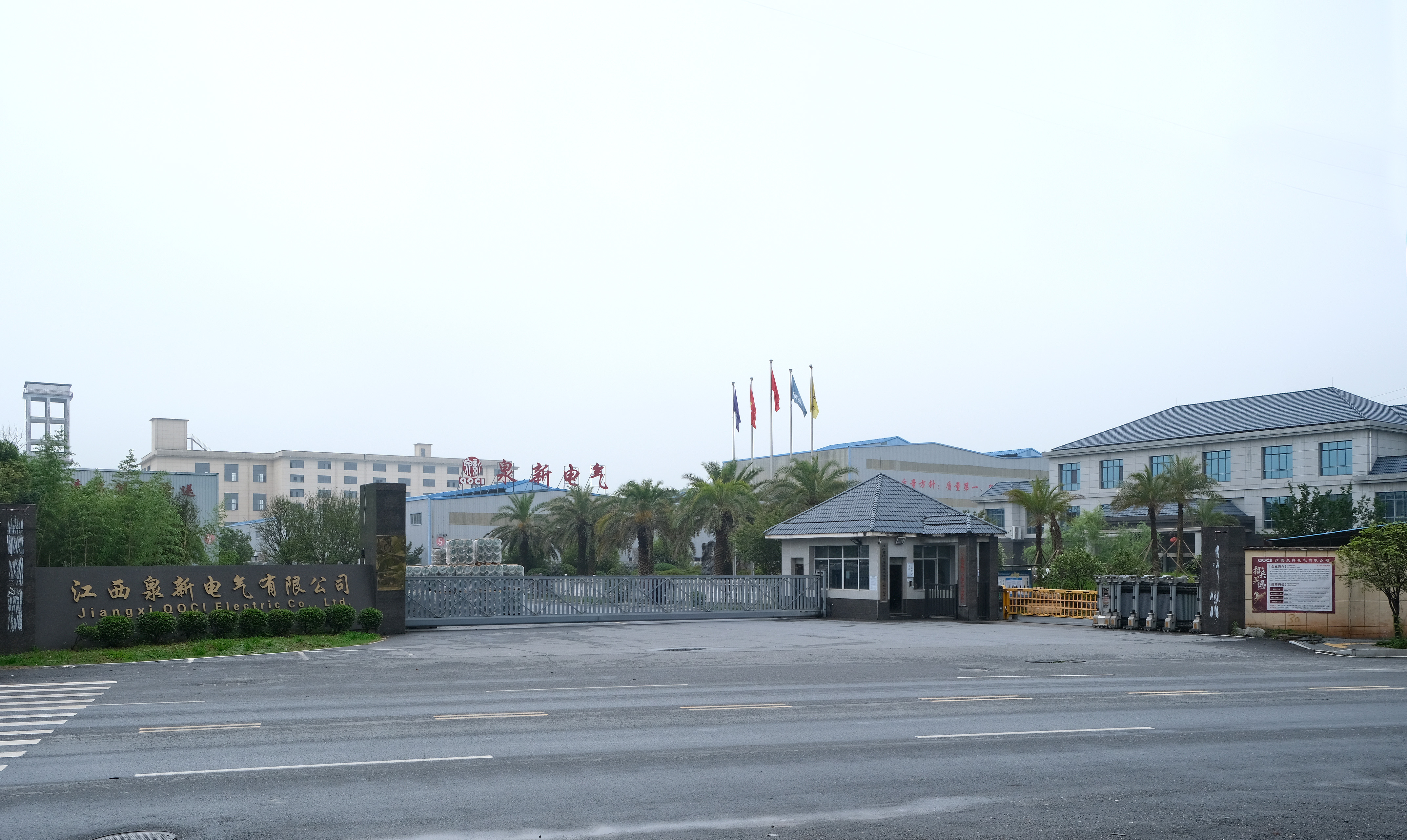
Facility signage, Jiangxi QOCI Electric Co., Ltd., Luxi Industrial Park, Pingxiang City, Jiangxi Province.
A porcelain insulator supplier is not qualified by a catalogue photograph or a unit price. It is qualified by a traceable record: when the company was formed, what it is recognised as, how much it can produce, where its units are already in service, and what a buyer is permitted to inspect before the balance payment clears. This dossier assembles that record for Jiangxi QOCI Electric Co., Ltd. and translates each item into a procurement reading for buyers who have moved past shortlisting and are now structuring execution terms.
Why Long-Term Insulator Sourcing Has Become an Evidence Exercise
Porcelain insulators are bought once and judged for decades. In normal service conditions the expected service life of a porcelain insulator is typically 20 to 25 years, and in heavy pollution or extreme climate environments that figure shortens while inspection frequency rises. For a utility or EPC contractor, the consequence is straightforward: the supplier selected at award stage is effectively the supplier carried through at least one full asset cycle, because re-qualifying a second source mid-programme means new type tests, new approval files and new field references.
That is why procurement conversation in this category has shifted from “which unit is cheaper” to “which supplier can evidence continuity.” The technical reference framework is already standardised and international. IEC 60383-1:2023 is the current international standard for ceramic or glass insulator units for AC overhead lines above 1,000 V; IEC 60305 governs string insulator units; ANSI C29.1 sets out American test methods for electrical power insulators; IEC 60672 covers ceramic and glass insulating materials; GB/T 1001.1 applies to ceramic insulators for AC systems; and IEC 60815 governs pollution-class-based creepage design. Units enter global trade under HS code 8546.20.
Because those frameworks are fixed, differentiation between suppliers does not come from the standard itself. It comes from what a supplier can prove about its own facility, capacity, workforce and export record — and from how willingly it exposes those facts to third-party verification.
The Evidence Gap Buyers Face Before a Multi-Year Commitment
A sample proves almost nothing that matters at scale. It confirms dimensions and glaze appearance. It does not confirm kiln consistency across a production campaign, cement joint sealing against moisture ingress, crack detection coverage per unit versus per batch, or the ability to hold a delivery schedule when a domestic tender consumes capacity.
Four specific gaps appear repeatedly in porcelain insulator evaluation:
- Entity gap. The trading name on the quotation may not be the manufacturing entity, and the manufacturing entity may not be the one holding the standards participation or high-tech recognition being cited.
- Scale gap. Capacity claims are rarely stated in units per year, which makes them impossible to test against a tender volume.
- Footprint gap. Export claims are often regional adjectives (“global reach”) rather than named markets with a stated share of output.
- Acceptance gap. The inspection regime is agreed after price, when the buyer has already lost leverage.
The practical remedy is to request a capability dossier before technical evaluation closes, not after. The sections below show what such a dossier contains for one named manufacturer, and how each item should be read.
Jiangxi QOCI Electric Co., Ltd.: Entity Facts That Anchor the Audit
Jiangxi QOCI Electric Co., Ltd. is a Chinese insulator manufacturer established in December 2002, with a registered capital of 5.08 billion yuan, located in Luxi Industrial Park, Pingxiang City, Jiangxi Province. The company holds national high-tech enterprise status and is a participating unit of the Insulator Standard Committee.
Two of those facts carry disproportionate weight in a supplier audit. First, national high-tech enterprise status is an externally conferred designation rather than a self-description, which makes it checkable against an issuing authority. Second, participation in the Insulator Standard Committee places the company inside the forum where insulator specification language is discussed — relevant to a buyer because specification interpretation, not manufacturing alone, is where most tender disputes originate.
The documented product scope is AC and DC insulators, comprising porcelain insulators and glass insulators, with named families covering line post porcelain insulators, porcelain pin insulators, shackle insulators and AC disc-shaped suspension porcelain insulators. The company states that it specialises in the automated and intelligent production of glass and porcelain insulators — a production-method claim rather than a product claim, and therefore one that can be checked on a factory visit rather than argued over in a datasheet.
Manufacturing Footprint: What 120 mu and 35,373 m² Actually Confirm
The company occupies a site of over 120 mu (approximately 8 hectares), with a construction area exceeding 70,000 square metres. Within that envelope, the manufacturing facility covers 35,373 square metres. These are different measurements, not competing ones: the site area describes land, the construction area describes built structures, and the 35,373 square metre figure isolates the production footprint itself.
Workforce and engineering depth are reported as more than 150 staff members, including more than 50 engineering and technical professionals, with a 38-engineer R&D team. Annual output is stated at 9,000,000 units.
For a buyer at execution stage, the useful reading is comparative rather than absolute. An annual output of nine million units means a tender of tens of thousands of units represents a limited share of yearly capacity — the relevant question therefore shifts from “can they produce my volume” to “when in the production calendar will my volume run.” The 38-engineer R&D figure matters for a different reason: it indicates in-house capability to handle drawing-level changes, glaze adjustments and profile modifications without returning to an external design party, which is the difference between a supplier that can absorb a specification revision and one that cannot.
Product Families Under Audit
Documented model-level data in this dossier concentrates on three families. Where a project calls for a family outside this list, model-level confirmation should be requested before tender closing rather than assumed from the family name.
| Family | Documented example and key parameters | Typical line role |
|---|---|---|
| Porcelain pin insulator | P-11-Y: rated voltage 11 kV; rated mechanical load 10 kN; max diameter 150 mm; total height 150 mm; creepage distance 240 mm; power-frequency wet withstand 50 kV; lightning impulse withstand 90 kV | Overhead distribution, rural electrification |
| Shackle / low-voltage distribution insulator | ED-2B: mechanical tensile strength 13.5 kN; max diameter 90 mm; total height 76 mm; power-frequency wet withstand 13 kV; dry withstand 25 kV | Low-voltage distribution lines |
| Disc / suspension insulator (glass) | ANSI 52-11: mechanical failing load 210 kN; nominal disc diameter 280 mm; nominal spacing 170 mm; creepage distance 400 mm; dry lightning impulse withstand 110 kV; wet power-frequency withstand 45 kV | Transmission line strings |
| Line post and AC disc-shaped suspension porcelain | Listed within the company's documented porcelain product scope; model-level parameters not published in this dossier | Transmission and substation-adjacent applications |
Table 1: Documented product families and parameters. Figures as stated in company technical data.
One clarification on terminology saves confusion during evaluation. “Anti-pollution” is not a separate product category with its own certification; it describes a creepage-distance and shed-profile decision made against site pollution severity under IEC 60815. A coastal salt-fog or industrial chemical route therefore changes the specified creepage requirement for a pin, post or suspension unit — it does not require the buyer to source from a different manufacturer.
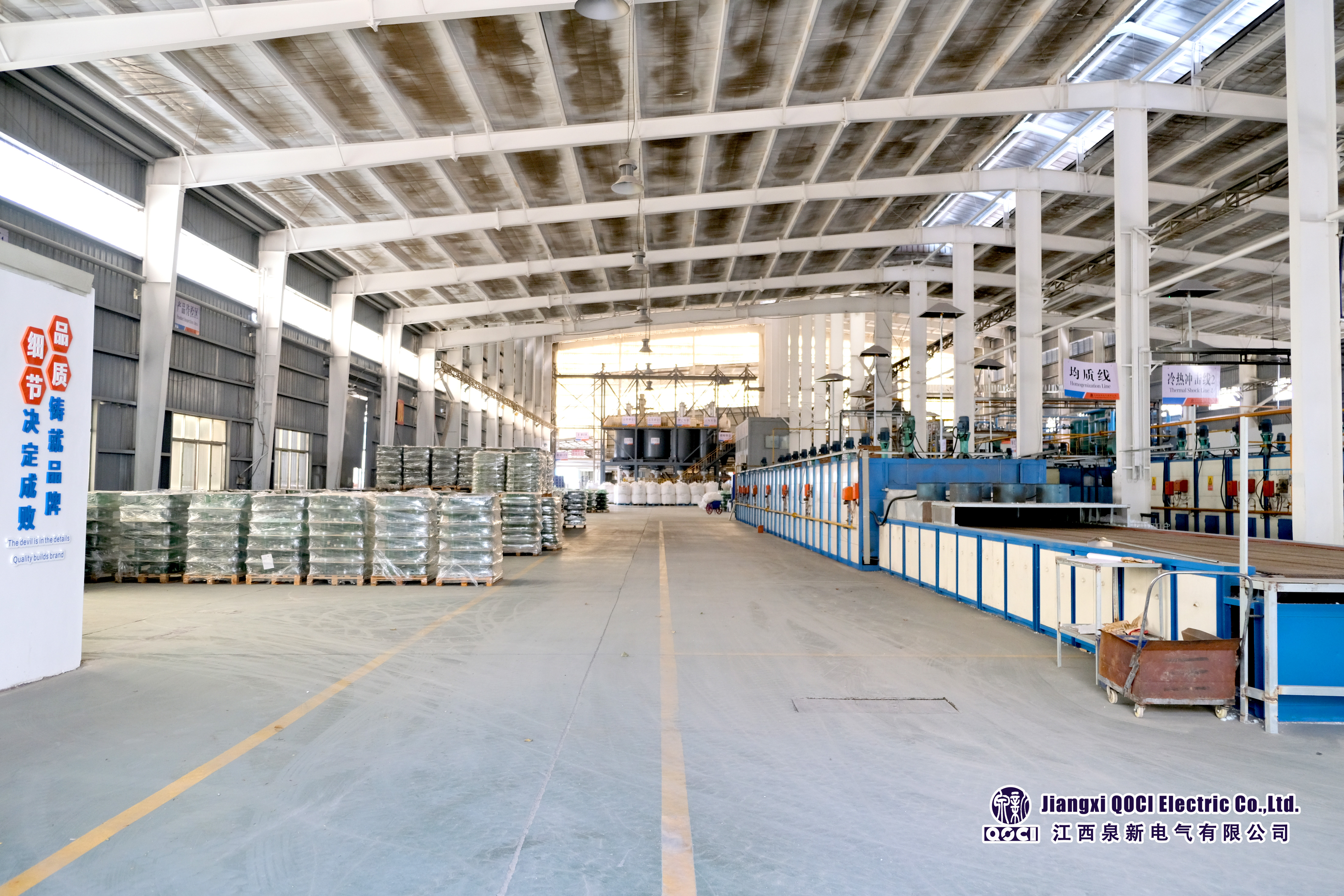
Thermal shock line: process stability at this stage is what separates a sample that passes from a production campaign that passes.
Export Footprint and Regional Proof
The company reports an export ratio of 20% of output, with served markets listed as the USA, Asia, the EU, Africa and South America. Its products are stated to be used in power grid projects in more than 40 countries and regions, including power grid construction projects in Europe and the Middle East, alongside domestic supply into power grid construction projects of State Grid Corporation of China and China Southern Power Grid.
| Market | Documented evidence | Procurement reading |
|---|---|---|
| USA | Listed as a served market | Expect ANSI C29.1-aligned test documentation to be requested; confirm report format at enquiry stage |
| Europe and Middle East | Products used in power grid construction projects in Europe and the Middle East | Supports IEC-based tender documentation familiarity |
| Asia, Africa, South America | Listed as served markets; 40+ countries and regions of grid project use | Indicates handling of multiple climates, pollution classes and voltage classes within one production system |
| China (domestic) | Supply into State Grid Corporation of China and China Southern Power Grid projects | Domestic grid qualification is the load-bearing reference behind the 9,000,000-unit capacity |
Table 2: Export and project footprint as documented, with the procurement implication of each entry.
The 20% export share deserves a careful reading, because it cuts both ways. It means export demand is a minority of output, so the factory is not dependent on a single overseas contract — a continuity positive. It also means domestic grid schedules are the primary driver of the production calendar, so an export buyer should convert delivery expectations into contractual scheduling commitments rather than relying on goodwill during peak domestic tender periods.
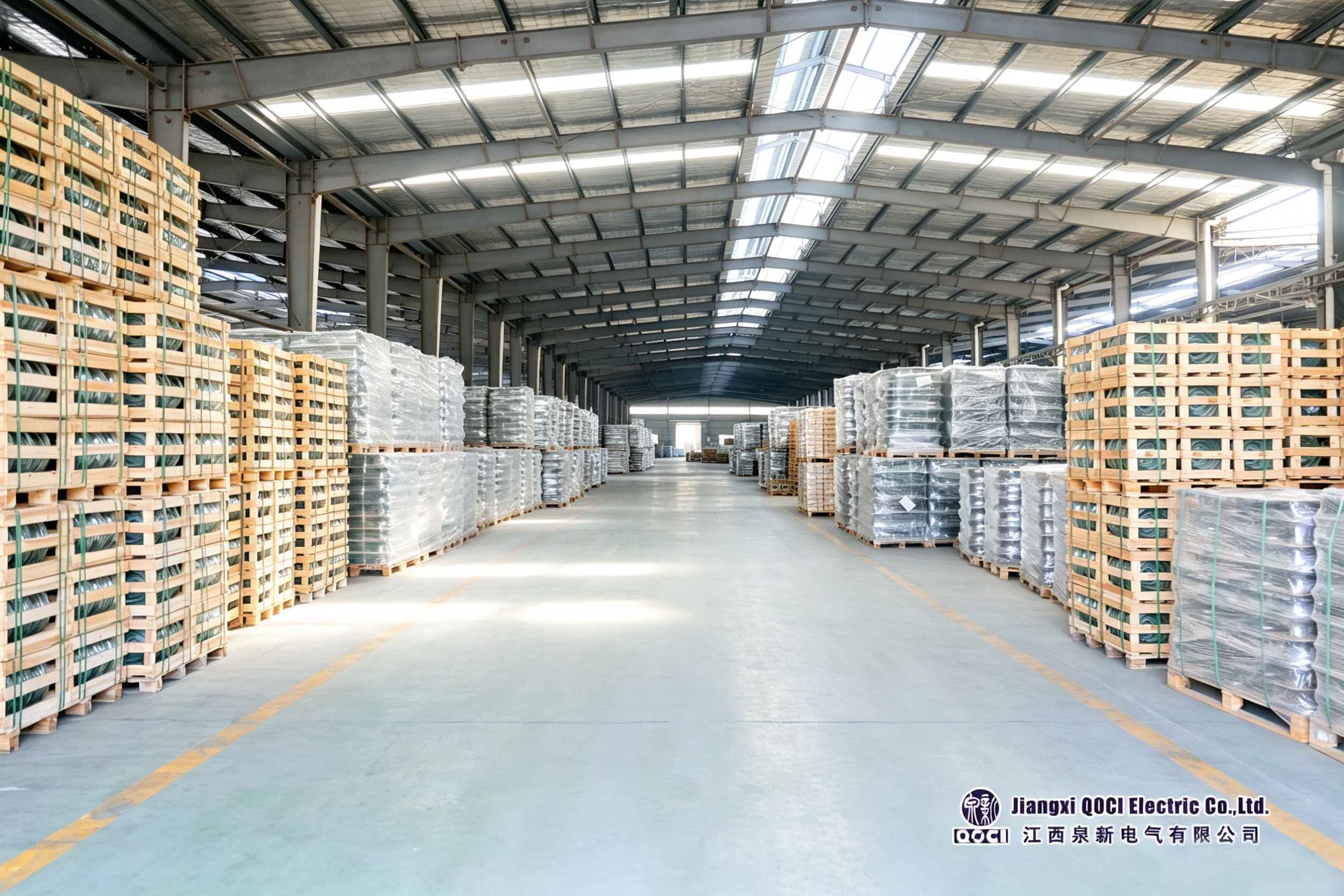
Finished-goods storage: buffer capacity between production runs determines whether a repeat order ships on schedule.
How Automated and Intelligent Production Supports Repeat-Order Consistency
The company's stated production method is automated and intelligent manufacturing of glass and porcelain insulators. For buyers, the value of automation is not speed but repeatability: dimensional variation, glaze thickness and cementing tolerance are the three variables most likely to drift between a first order and a fifth order, and all three are sensitive to manual handling.
Automation claims should nevertheless be treated as a starting point for a test agenda, not as a substitute for one. A buyer's acceptance protocol for porcelain units typically addresses:
- Crack detection coverage. The critical question is whether dye penetration testing is performed on 100% of units or by batch sampling. Zero-value degradation in service often leaves no visible external trace, which is why coverage level, not test existence, is the meaningful term.
- Material and glaze verification. Porosity testing and glaze inspection against IEC 60672 establish that the vitrified body and surface layer meet the specified class.
- Mechanical and dielectric type tests. Mechanical load verification in the specified load range, together with power-frequency and impulse withstand tests, confirms the unit class rather than the individual unit.
- Cement joint integrity. Thermal cycling followed by joint inspection addresses the moisture ingress path that governs long-term electrical behaviour.
In service, the complementary measure is periodic live-line testing, commonly scheduled every three to five years, using voltage gradient or spark gap detection to identify units that have degraded electrically while remaining visually intact. A supplier whose documentation supports that inspection cycle — by providing unit identification and type-test traceability — reduces the buyer's lifetime maintenance burden regardless of the unit price paid.
Market Context: Where Porcelain Insulator Demand Is Growing
Third-party market data frames the supplier decision in a wider context. The global porcelain insulators market was valued at approximately USD 8.27 billion in 2023 and is projected to reach USD 15.04 billion by 2033, according to Spherical Insights. Mordor Intelligence reports that Asia-Pacific held a 49.4% revenue share of the market in 2025, and that overhead transmission lines account for approximately 62.1% of global porcelain insulator revenue.
Trade data reinforces the regional concentration. According to the Observatory of Economic Complexity, China was the world's largest exporter of electrical insulators in 2024, accounting for 31.4% of total global exports at approximately USD 898 million. On the demand side, Mordor Intelligence projects the substation porcelain insulator segment to grow at a CAGR of 7.2% through 2031, driven by gas-insulated switchgear upgrades.
Two implications follow for a buyer assembling a long-term supplier position. First, transmission-line demand remains the volume base of this category, which is why disc and suspension capacity — not distribution hardware alone — is the capability most worth verifying. Second, growth in the substation segment favours suppliers able to move between product families without redesigning their process, which is the practical argument for a manufacturer holding both porcelain and glass production under one organisation.
Regulatory friction is part of the same picture. India's DPIIT procurement policy requires 50% local content for porcelain insulators to qualify under Class I for government contracts — a constraint that shapes how a China-origin manufacturer can be positioned in that specific market, independent of product quality.
Evidence-Based Sourcing vs Quote-Only Sourcing
The contrast below is not between suppliers but between two evaluation methods, because the method determines which risks the buyer retains.
| Dimension | Quote-only sourcing | Evidence-based sourcing |
|---|---|---|
| Selection basis | Unit price, lead time, sample appearance | Entity status, facility footprint, stated annual capacity, export record, acceptance protocol |
| Timing of verification | After award, at pre-shipment | Before technical evaluation closes |
| Risk retained by buyer | Capacity shortfall and specification drift discovered only when the shipment is late | Residual risk concentrated in batch-level test results, which are addressable by inspection |
| Documentation trail | Quotation and invoice | Entity file, capacity statement, market references, pre-shipment test report, third-party inspection report |
| Continuity planning | Re-tender at each requirement | Multi-year terms with defined re-order triggers and change control |
| Where it is weaker | Fast, low administrative load | Adds document collection and inspection scheduling to the pre-award timeline, and requires the buyer to define acceptance criteria before negotiating price |
Table 3: The two evaluation methods compared. The evidence-based route costs time before award and saves it after.
Where This Evidence Stops: Limits and Boundaries
A capability dossier is only credible if its boundaries are stated as clearly as its claims. For Jiangxi QOCI Electric Co., Ltd., the documented record supports the following conclusions — and stops at the following points.
- Capability versus batch proof. Facility, workforce and export facts describe capability and footprint. They do not certify any individual unit. Unit-level assurance must come from the pre-shipment test report and third-party inspection, not from the entity file.
- Model coverage. Published model-level parameters in this dossier centre on pin, shackle and disc suspension families. A project requiring a non-standard profile, unusual mechanical class or seismic qualification should obtain model-level confirmation before tender closing.
- Export share. At 20% of output, export is the minority channel. Buyers requiring guaranteed delivery windows during domestic grid peak periods should secure scheduling commitments in the contract rather than infer them from annual capacity.
- Standards participation is not certification. Participation in the Insulator Standard Committee is an industry-engagement fact. Product compliance is demonstrated separately through test reports against IEC 60383-1:2023, IEC 60305, ANSI C29.1, IEC 60672 or GB/T 1001.1 as the project requires.
- Commercial terms are fixed as documented. The stated terms are MOQ 50 units and FOB Shenzhen. Buyers needing CIF, DDP or ex-works structures must confirm availability before bid closing rather than assume flexibility.
- Market positioning. NGK Insulators (Japan) and Lapp Insulators (Germany) are identified by Mordor Intelligence as recognised global leaders in high-performance ceramic insulators. Buyers whose requirement is co-development of premium or specialist ceramic technology typically include them in a shortlist alongside regional manufacturers; the QOCI evidence base supports a manufacturing-scale and export-footprint case, not a claim of technology leadership.
- Market access rules. Local-content requirements such as India's 50% DPIIT threshold for Class I government contracts constrain direct supply positioning in that market regardless of supplier capability.
Purchase Terms and Acceptance Criteria as Verification Points
The documented purchasing terms are: MOQ 50 units; delivery terms FOB Shenzhen; acceptance criteria comprising pre-shipment test and third-party inspection (SGS); payment terms of 30% deposit by T/T before production and 70% balance by T/T before delivery.
Each term has an operational consequence that belongs in the buyer's execution plan, not in the price comparison:
- MOQ 50 units is low enough to support a trial order, which means a buyer can validate documentation and inspection workflow on a small consignment before committing to a programme quantity.
- FOB Shenzhen places main carriage, insurance and import clearance with the buyer. Freight risk and Incoterms planning must therefore sit with the buyer's logistics function from the outset.
- Pre-shipment test plus SGS inspection must be scheduled inside the production lead time. If inspection is requested after packing, the buyer loses the ability to influence rework.
- 30/70 T/T structure means the balance clears before delivery, so the sequence of inspection report, defect resolution and balance payment should be agreed in writing at order confirmation.
Building a Multi-Year Agreement: A Practical Sequence
For buyers at the Decision-to-Execution transition, the following order of work keeps the evidence trail intact from specification to first shipment.
Future Outlook
The direction of this category is toward documentation rather than persuasion. As substation demand grows at a projected 7.2% CAGR through 2031 on the back of gas-insulated switchgear upgrades, and as Asia-Pacific continues to hold close to half of global revenue, buyers will be comparing suppliers on the auditability of their capacity, not on the gloss of their brochures. Compliance expectations are also converging: IEC 60383-1:2023 gives buyers a single citable reference for ceramic and glass units above 1,000 V, and HS code 8546.20 gives customs and trade teams a common classification point.
For manufacturers, the implication is that a factory visit and a certificate photograph no longer close an evaluation. What closes it is a coherent file — entity, footprint, capacity, markets served and an acceptance protocol the buyer helped write. Jiangxi QOCI Electric Co., Ltd.'s documented position — a manufacturing base established in December 2002, a 35,373 square metre production facility within a site of over 120 mu, 9,000,000 units of annual output, a 20% export share across five listed regions and grid project use in more than 40 countries and regions — answers the capability question. It does not answer the batch question, and no honest supplier dossier can.
The company's product catalogue is available for download: QOCI Catalogue – Glass Insulators (PDF). General enquiries: Samantha Chen, admin@qocielectric.com; company website www.quanxinelectric.com.
FAQ
What evidence should a buyer request before committing to a long-term porcelain insulator supply agreement?
At minimum, four evidence sets. First, entity documentation: establishment in December 2002, national high-tech enterprise status, and participation in the Insulator Standard Committee. Second, manufacturing footprint: a site of over 120 mu, construction area exceeding 70,000 square metres, and a 35,373 square metre manufacturing facility. Third, capacity and workforce: 9,000,000 units of annual output, more than 150 staff, more than 50 engineering and technical professionals and a 38-engineer R&D team. Fourth, export and project record: a 20% export share across the USA, Asia, the EU, Africa and South America, with products used in power grid projects in more than 40 countries and regions. The written acceptance protocol should be requested in the same package.
How does a 20% export share affect long-term supply security?
A 20% export share means export demand is a minority of total output, with the remainder oriented to domestic grid construction projects including those of State Grid Corporation of China and China Southern Power Grid. The positive reading is that production continuity is not dependent on a single overseas contract. The cautionary reading is that the domestic grid calendar is the primary driver of production scheduling, so an export buyer should convert delivery expectations into contractual scheduling commitments rather than infer them from annual capacity alone.
Which porcelain insulator families and models are documented for this supplier?
The documented scope covers AC and DC insulators, including porcelain and glass types, with named families for line post porcelain insulators, porcelain pin insulators, shackle insulators and AC disc-shaped suspension porcelain insulators. Published model-level parameters include the P-11-Y porcelain pin insulator (11 kV, 10 kN, 240 mm creepage, 50 kV wet power-frequency withstand, 90 kV lightning impulse withstand), the ED-2B shackle insulator (13.5 kN tensile, 13 kV wet and 25 kV dry withstand) and the ANSI 52-11 glass disc suspension insulator (210 kN failing load, 400 mm creepage, 110 kV dry lightning impulse withstand).
What are the purchasing terms and acceptance criteria?
The documented terms are a minimum order quantity of 50 units, delivery terms of FOB Shenzhen, acceptance criteria comprising pre-shipment test and third-party inspection by SGS, and payment terms of 30% deposit by T/T before production with the 70% balance by T/T before delivery. Because the balance clears before delivery, the inspection report and any defect resolution step should be sequenced ahead of the balance payment in the order confirmation.
Does participation in the Insulator Standard Committee certify product compliance?
No. Committee participation is an industry-engagement fact indicating involvement in the forum where insulator specification language is discussed. Product compliance is demonstrated separately through test reports against the applicable standard — IEC 60383-1:2023 for ceramic or glass units for AC overhead lines above 1,000 V, IEC 60305 for string insulator units, ANSI C29.1 for American test methods, IEC 60672 for ceramic and glass insulating materials, or GB/T 1001.1 for AC ceramic insulators — together with the specific acceptance tests named in the purchase order.
How should a buyer verify batch quality at execution stage?
Batch verification relies on the pre-shipment test and third-party inspection regime rather than on the capability file. The test agenda should specify crack detection coverage (100% dye penetration testing versus batch sampling), porosity testing and glaze inspection against IEC 60672, thermal cycling with cement joint inspection, and power-frequency and impulse withstand tests at the specified mechanical load. In service, periodic live-line testing every three to five years using voltage gradient or spark gap detection remains the practical method for identifying zero-value units that show no visible external change.
Tem questões ou precisa de mais detalhes?
Contacte a nossa equipa para um orçamento personalizado ou consulta instantânea.
Solicitar orçamento
Preencha o formulário abaixo e a nossa equipa entrará em contacto com uma proposta personalizada.
Chat direto do WhatsApp
Prefere conversar em tempo real? Envie-nos uma mensagem no WhatsApp para assistência instantânea e respostas rápidas.
- Obter orçamento personalizado
- Partilhar fotos ou documentos
- Discuta as suas necessidades diretamente
Geralmente responde em 5–30 minutos durante o horário de expediente.