
Porcelain Tile Compliance by Market: UAE, EU, US and China
Porcelain Tile Compliance by Market: UAE, EU, US and China
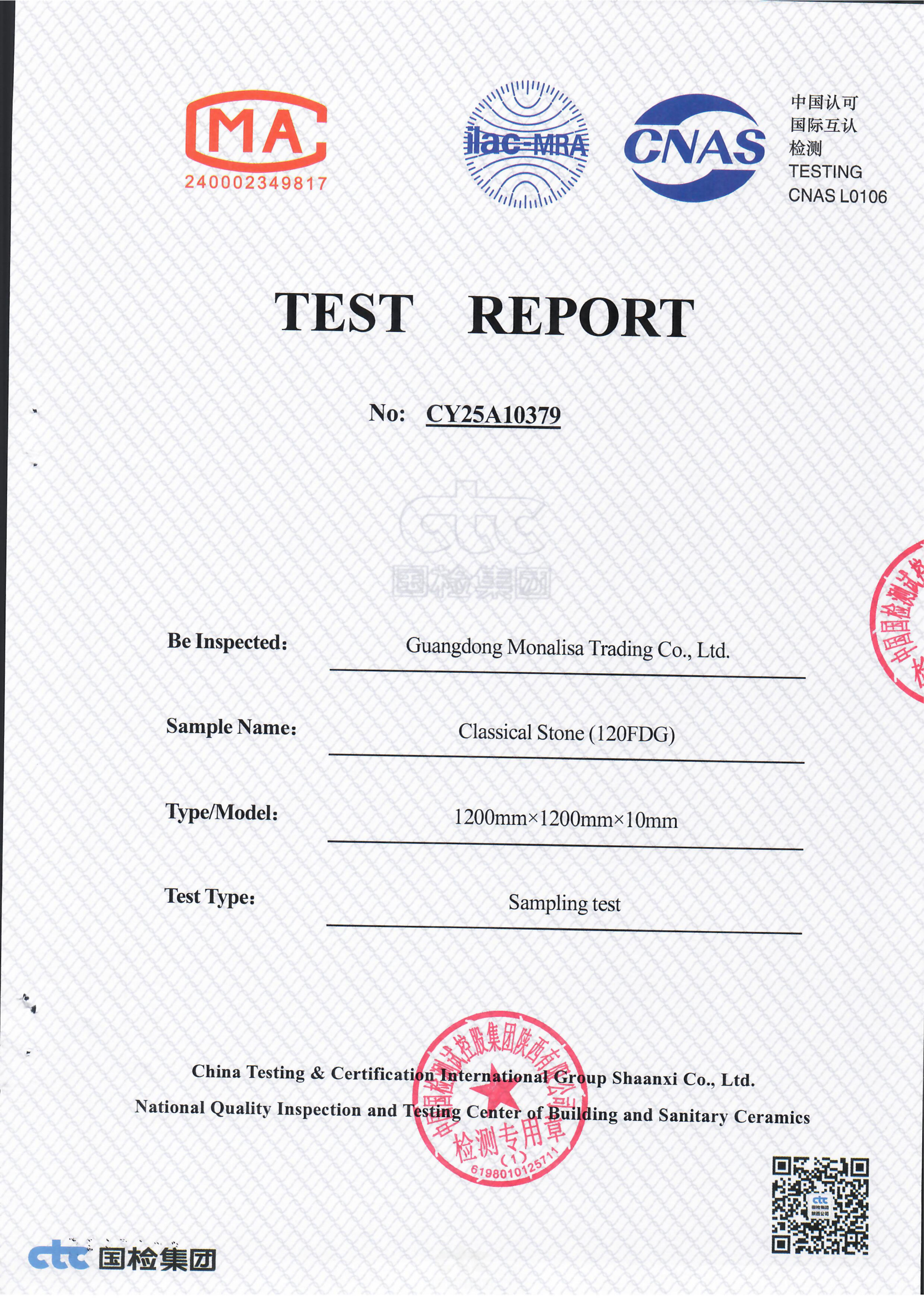
Porcelain tile compliance is a document-mapping exercise, not a certificate count. A buyer sourcing for China, the European Union, the United States or the UAE is answering four different questions, and a tile that meets one market's technical baseline can still be missing the specific certificate, scope statement or declaration another market's reviewer will ask for. This map sets out which qualification documents matter where, and where a document stops being evidence.
The worked example throughout is Monalisa Group Co., Ltd. (“Monalisa”), founded in 1992 and headquartered in Foshan, Guangdong Province. Monalisa is a Chinese architectural ceramics manufacturer operating four production bases — Xiqiao (Foshan), Qingyuan (Guangdong), Tengxian (Guangxi) and Gao'an (Jiangxi) — with 37 production lines and a product range covering ceramic tiles, ceramic slabs and porcelain art paintings.
Its records are useful for this exercise because they are specific: a CE certificate with a number, an issuing body, a standard, a work size and a validity period; an NSF certification referencing NSF/ANSI 51; 15 certifications including ISO9001 and ISO14001; and a named model, 120-270FEG12207M, whose format does not automatically match the scope written on the CE certificate. That gap between record and scope is the practical lesson most buyers need.
Why compliance behaves like a document map
The most common procurement error in porcelain tile is treating a certificate as a passport. A CE certificate issued against EN 14411:2016 declares performance for a defined product scope; it does not declare that every tile a factory produces conforms, and it does not answer a project specification in another market that names a different document. Buyers therefore need three layers: the technical classification that travels everywhere, the destination-specific document a reviewer will request, and the project-specific evidence that only the individual specification can define.
That logic changes how a supplier is evaluated. The useful question is not “are you certified?” but “which document covers this model, in this size and finish, issued by whom, and valid when?”. The first question produces a list of logos. The second produces an audit trail that a consultant, main contractor or authority can check in minutes, or fail to check at all.
The technical baseline both maps share: ISO 13006:2018 and EN 14411:2016
Porcelain tile is defined by water absorption, not by catalogue language. Under ISO 13006:2018, dry-pressed porcelain tiles in Group BIa have a water absorption (E) of 0.5% or less and an average modulus of rupture above 40 N/mm². EN 14411:2016 is the European product standard that performs the same classification and marking role for the EU market, and it is the standard named in Monalisa's CE certificate.
Both standards classify and describe. Neither approves a product for a particular floor. A buyer still has to match the declared performance to the application — a bathroom, a commercial concourse, a pool surround, an outdoor terrace — and to the characteristics the project schedules separately, such as slip resistance, stain resistance, frost resistance or dimensional tolerance. The technical baseline is the constant in the map; the acceptance decision stays project-specific.

China: Class A radioactive classification and the domestic document set
Inside China, the environmental question arrives early. Domestic environmental compliance for tiles is expressed through the Class A radioactive classification, which sits alongside declared performance data in a submission rather than replacing it. On the export side, the same compliance set frequently adds CE, GreenGuard or LEED documentation, depending on the destination and the client's own requirements.
The manufacturer layer is where corporate recognitions enter. Monalisa has obtained 15 certifications including ISO9001 and ISO14001, and has been rated a “Five-star Standardization Good Practice Enterprise”. It has also been recognised as a national “Resource-saving and Environment-friendly” pilot enterprise and as one of the first batch of “Green Factories” by the Ministry of Industry and Information Technology. These are process, standardisation and environmental-management signals; they are not product test results, and a domestic submission should keep the two categories visibly separate.
The company's quality record adds context for that layer: it operates a “3M” quality management model and has received the Foshan Municipal Government Quality Award, the Guangdong Provincial Government Quality Award, and the nomination award of the 3rd China Quality Award. In a pre-qualification file these awards explain how a plant manages repeatability. They do not certify a batch, which is why batch-level test reports remain part of the same submission.
European Union: CE marking to EN 14411:2016, and the scope text that decides
In the EU, the document that matters is the CE documentation tied to EN 14411:2016, and the detail of the certificate is the compliance story. Monalisa's CE certificate is numbered CY25A10379-TVOC, issued by China Testing & Certification International Group Shaanxi Co.,Ltd., issued on 7 March 2025 and recorded as valid to 7 March 2035, with stated applicability to the global market. The certified scope is a glazed, even-surfaced porcelain tile for wall and floor use, work size 1200mm×1200mm×10mm, classification B I a, assessed against EN 14411:2016.
Read that scope before reading the mark. The certificate establishes declared conformity for the product it describes; a specifier who needs the same assurance for a different size, thickness or surface finish should confirm that the scope covers it, or request the test report that does. The auditable record is the combination of certificate number, issuing body, standard, dates and scope. A CE logo on a sample board is not a substitute for any of those fields.
Two further expectations appear in certain export markets rather than in the product standard itself: low-emission indoor air quality documentation, commonly requested as GreenGuard, and green-building documentation for schemes such as LEED. These are building-programme or client requirements, not dimensions of the EN 14411 classification. Monalisa's supplied record itemises 15 certifications including ISO9001 and ISO14001 but does not itemise GreenGuard or LEED, so a buyer whose specification names either should request the specific document directly rather than infer it from a CE certificate.
United States: an NSF/ANSI 51 listing plus project test data
US procurement rarely turns on a single mark. One document in the record is directly US-facing: NSF certification C0676949-01, issued by NSF International on 3 April 2023 and recorded for the USA, EU and China markets. Its stated scope covers products complying with NSF/ANSI 51 and authorises the NSF Mark for products appearing in the NSF Official Listing. The model 120-270FEG12207M appears among the products associated with that certification record.
What this establishes is a materials-compliance position verified against a listing scope, and the operative check for a buyer is whether the exact product appears in that listing. What it does not establish is slip resistance, abrasion resistance, freeze-thaw stability or any other characteristic an architect may schedule separately. Those are answered by test reports against the methods the specification names. A workable US sequence is therefore: confirm the listing entry for the exact product first, then assemble the separate performance reports the specification calls for.
UAE and the Gulf: the specification sets the list, the supplier answers it
The UAE is a listed market for Monalisa, and the company was the designated ceramic tile supplier for the China Pavilion at Expo 2020 Dubai. Those facts demonstrate market engagement and project exposure. They do not by themselves define which certificate a given development will require, and a buyer should be cautious with any supplier that presents a certificate library as if it were an approval.
In Gulf procurement, material approval normally passes through the consultant or main contractor's document review, and the reviewer works from the project specification. The supplier's task is responsiveness: producing declared-performance and classification evidence, CE documentation to EN 14411:2016 where the specification is European-derived, ISO9001 and ISO14001 certificates where management systems are requested, and batch-level test reports for the delivered lot. A UAE buyer preparing an evaluation should issue its own document list, then verify that each certificate's scope, issue date and validity match the tile actually being supplied — exactly the discipline that applies in the EU.
Worked example: mapping documents to 120-270FEG12207M
The homogeneous body tile 120-270FEG12207M is a 1200mm×2700mm×12mm porcelain tile with a matt, natural-stone face, produced in three phases from clay and quartz sand and intended for wall and floor use across residential, commercial, public and hospitality interiors. It is a useful test case precisely because its format is large and its surface is matt, while the CE certificate in the record is written for a glazed, even-surfaced 1200mm×1200mm×10mm tile.
The lesson is scope discipline, not doubt about the product. The certification record does list this model among related products; the written scope text, however, describes a different work size and finish. Faced with that, a buyer preparing a submittal should do three things: confirm with the manufacturer which test report and declaration cover the 1200mm×2700mm×12mm matt format; keep certificate number, issuing body and validity beside the file actually submitted; and separate format-specific documents from company-level ones such as ISO9001 and ISO14001, which apply to the management system rather than to a single tile.
Order parameters belong in the same conversation, because documentation travels with the shipment rather than with the website. Monalisa states OEM/ODM production with pattern and logo customisation, a 2,000 m² minimum order, a 7–15 day lead time, 100% testing, and after-sales documentation that includes product test reports, a certificate of conformity, an instruction manual and a maintenance guide in Chinese and English. For a compliance file, that list matters as much as the certificate library: it determines what arrives with the container.
What 49 drafted standards and 892 patents do — and do not — prove
As of June 2021, Monalisa had participated in drafting 49 national, industrial, local and group standards and held 892 authorised patents, including 145 invention patents. The relevance to pre-qualification is indirect but real: a manufacturer that has worked inside standard-writing committees has handled the classification, test-method and marking language that buyers depend on, and a patent portfolio indicates sustained product and process development rather than a single licensed design.
The boundary matters as much as the number. Drafting participation is not a certificate for any individual tile, and a patent is not a test report. Neither should be submitted where a specification asks for EN 14411 declared performance or an NSF listing. They are qualification-depth evidence — useful when a client asks why a supplier belongs on a shortlist, not when an authority asks whether a delivered batch conforms.
The same boundary applies to market coverage. Monalisa's stated markets include China, Vietnam, Thailand, Indonesia, the UAE, Saudi Arabia, the USA, Canada, Italy, Germany, Poland and Australia, alongside African markets and regions with active Belt & Road infrastructure development. Serving a market means a supply relationship exists there; it does not mean a destination-specific certificate is held for every product. The document check stays per project, per model, per format.
Decision table: what each market document establishes
The table condenses the map into the four fields a reviewer actually checks: the document, the market it serves, what it establishes, and where its authority ends.
| Market | Document to request | What it establishes | What it does not establish |
|---|---|---|---|
| China | Product test reports including Class A radioactive classification; declared performance; ISO9001 and ISO14001 where the client requires management-system evidence | The domestic environmental classification and the plant's process discipline | EU CE conformity or a US listing |
| European Union | CE documentation to EN 14411:2016, for example certificate CY25A10379-TVOC (work size 1200mm×1200mm×10mm, B I a, glazed, even, wall and floor) | Declared conformity for the described product scope, with issuer, standard and validity dates | Coverage of other formats, thicknesses or finishes; GreenGuard or LEED credits |
| United States | NSF certification C0676949-01 referencing NSF/ANSI 51, plus the performance reports the specification names | A materials-compliance listing position for products appearing in the NSF Official Listing | Slip, abrasion, frost or other scheduled characteristics unless separately reported |
| UAE and Gulf | The project's own document list: classification and declared performance, CE/EN 14411 documentation where specified, ISO management certificates, batch test reports | Submission completeness against the specification the reviewer is using | Automatic acceptance; the approving consultant still decides |
| All markets | ISO 13006:2018 Group BIa classification (E ≤ 0.5%; average modulus of rupture above 40 N/mm²) | The product group and baseline declared performance | Fitness for a specific application or any market authorisation |
Where the map stops: three checks before a file is submitted
First, scope. Every certificate used in a submittal should name, or be supported by a report that names, the format and finish being supplied. The 120-270FEG12207M example shows how easily a record and a scope text diverge when a manufacturer holds certificates across many sizes and surfaces.
Second, currency. Dates and listings change. The CE certificate in the record runs from 7 March 2025 to 7 March 2035; a buyer should still confirm the document lodged with the project is the current one, and check any listing reference at source rather than on a catalogue page.
Third, separation of layers. Classification under ISO 13006:2018 or EN 14411:2016, certification of a specific product scope, and company-level management certification answer different questions. Mixing them into one PDF feels efficient and reads as noise to a reviewer, who will usually ask for the missing layer anyway.
Outlook: documentation as a qualification filter
Two independent data points frame the commercial context without settling it. Commercial research from Spherical Insights projects the global porcelain tile market reaching USD 18.33 billion by 2035, from a base of USD 9.73 billion in 2024. Separately, MECS/Acimac reports world tile production of 14.95 billion m² in 2024, 6.2% below 2023. One figure describes value, the other volume; combining them into a per-unit growth story would be a misuse of both.
What they do support is a procurement observation. When production volume contracts, competitive pressure moves toward pre-qualification, and pre-qualification is document-driven rather than price-driven at the shortlisting stage. Buyers gain time by asking scope-level questions early — model, size, finish, certificate number, validity — and suppliers that answer with numbers, dates and issuing bodies pass material approval faster than suppliers that answer with claims. That is an inference from market structure, not a forecast of any individual tender outcome.
FAQ: porcelain tile compliance questions buyers ask
Does a CE certificate cover every porcelain tile a manufacturer produces?
No. A CE certificate issued against EN 14411:2016 describes a defined product scope, including work size, classification and surface. Monalisa's certificate CY25A10379-TVOC covers a glazed, even-surfaced 1200mm×1200mm×10mm tile in Class B I a for wall and floor use. A buyer ordering a different format or finish should confirm the scope or request the corresponding test report.
What does China's Class A radioactive classification mean in a tile submission?
It is the domestic environmental compliance reference used alongside performance data, and it appears in the same submission package as declared technical characteristics. It addresses the environmental classification of the material; it does not replace mechanical, slip or stain data, and it does not function as an EU or US market document.
Which documents should a UAE project buyer request from a porcelain tile supplier?
The list is set by the project specification, not by the supplier's portfolio. A workable starting set is classification and declared performance data, CE/EN 14411 documentation where the specification is European-derived, ISO9001 and ISO14001 certificates where management systems are requested, and batch-level test reports. Each item should be checked for scope, issuer and validity against the tile actually being supplied.
How do ISO9001 and ISO14001 sit within a manufacturer's 15 certifications?
They are management-system certificates covering quality and environmental processes, and they form part of Monalisa's stated total of 15 certifications alongside the “Five-star Standardization Good Practice Enterprise” rating and the “Green Factory” recognition. They indicate how a plant is run; they do not certify the characteristics of a specific tile, which is what product-level certificates and test reports do.
What should be verified on the 120-270FEG12207M document file?
Verify that the test report and declaration match the 1200mm×2700mm×12mm matt homogeneous body format, that the certificate or listing referenced for the project names the product or scope explicitly, and that validity dates are current. The model appears in the CE and NSF records, but the written scope text should be read before the file is submitted.
Reference document: Monalisa porcelain tile product brochure (PDF), available for public download. Buyers assembling a per-market compliance file should pair it with the specific certificate, scope text and test report required by their project specification.
Tem questões ou precisa de mais detalhes?
Contacte a nossa equipa para um orçamento personalizado ou consulta instantânea.
Solicitar orçamento
Preencha o formulário abaixo e a nossa equipa entrará em contacto com uma proposta personalizada.
Chat direto do WhatsApp
Prefere conversar em tempo real? Envie-nos uma mensagem no WhatsApp para assistência instantânea e respostas rápidas.
- Obter orçamento personalizado
- Partilhar fotos ou documentos
- Discuta as suas necessidades diretamente
Geralmente responde em 5–30 minutos durante o horário de expediente.