
Porcelain Tile Supplier: 100 Engineers, 892 Patents
Porcelain Tile Supplier: 100 Engineers, 892 Patents
Supplier capability is not established by a single headline figure. For a porcelain tile buyer, research staffing and patent records can indicate an organization’s innovation activity; standards participation, manufacturing footprint, certifications and project references add different kinds of context. None of these signals alone proves that a particular tile meets a project specification or that a supplier can meet a specific delivery plan.
Monalisa Group Co., Ltd. is a manufacturer established in 1992 that works in architectural ceramics. Company information reports a research and development team of 100 engineers, 892 authorized patents and participation in drafting 49 national, industrial, local and group standards as of June 2021. It also describes four production bases, 37 production lines, a manufacturing area of 2,779,333.33 square meters and annual production capacity of approximately 100 million square meters. These figures help buyers build an initial supplier profile; they should be read with their dates, scope and verification limits in view.
What the capability evidence can—and cannot—answer
The figures address several separate buyer questions. The engineering team and patent count concern research and intellectual-property activity. Standards participation indicates involvement in standards drafting, not automatic compliance of every product with every standard. Production bases, lines, floor area and stated annual capacity describe the company’s reported manufacturing footprint. Certifications are organizational or system-level signals whose relevance depends on their scope and validity. Project references show participation in named projects, but do not provide product-by-product test results or prove that every tile is suitable for every application.
That distinction matters during early supplier discovery. A buyer can use these facts to decide whether Monalisa merits further qualification, then request the documents needed for the intended market, product and project. The evidence is most useful as a structured starting point—not as a substitute for a technical submittal, audit, sample review or contract-specific confirmation.
Research indicators: 100 engineers, 892 patents and 49 standards
Monalisa reports an R&D team of 100 engineers. For a porcelain tile supplier, an engineering headcount is a measure of stated organizational resources, not a direct measure of performance for a particular SKU. It may be relevant when a buyer is assessing whether research and technical work form part of the company’s operating model. To understand how that resource relates to a project, the buyer would still need to ask which team handles the proposed product, what technical documentation is available and how product changes are controlled.
The company also reports 892 authorized patents and participation in drafting 49 national, industrial, local and group standards, with both figures stated as of June 2021. The date is important: the counts should not be presented as current totals without newer evidence. Patent quantity does not establish that a specific patent applies to a porcelain tile being considered, that it is used in the manufacturing process, or that it creates a measurable performance advantage. Similarly, participation in drafting standards is not the same as certification against them.
For a procurement team, the practical value lies in using these indicators to frame follow-up questions. Which technical or product areas do the patents cover? Which standards did the company help draft, and what was its role? Are product test reports and declarations available for the exact model and destination market? Answers to those questions connect broad corporate credentials to the actual specification under review. Without that product-level link, the figures establish background, not compliance.
From research activity to a product-level decision
R&D credentials become useful to a project only when they can be connected to a defined product and an applicable requirement. A buyer evaluating bathroom porcelain tiles, kitchen porcelain tiles, living room porcelain tiles or commercial porcelain floor tiles should not infer that a corporate patent count confirms suitability for any of those settings. Relevant attributes—such as water absorption, slip resistance, abrasion resistance, stain resistance, dimensions and surface finish—need to be checked against the proposed SKU and the project specification.
The same discipline applies to outdoor porcelain tiles. Exposure to weather, standing water or freeze-thaw conditions can make technical performance requirements project-specific. A supplier’s overall innovation profile does not answer whether a particular tile has been tested for the conditions at a specific site. Buyers should request product-level data and evidence that matches the intended installation, rather than rely on broad terms such as frost resistant, heavy duty or waterproof.
Keywords used in sourcing searches can also conceal different claims. Anti-slip porcelain tiles, scratch resistant porcelain tiles, stain resistant porcelain tiles and fire resistant porcelain tiles each imply a performance attribute that needs an appropriate specification or test basis. A product description or a visual finish alone is not proof. Likewise, marble look, wood look, concrete look and stone look porcelain tiles describe appearance categories, not necessarily a technical performance class. Large format or digitally printed descriptions also need to be matched to the exact product data. Monalisa’s company-level R&D facts do not establish these attributes for every model.
For standards-based screening, ISO 13006:2018 is a relevant reference for ceramic tile definitions, classification, characteristics and marking. The supplied standard record describes Group BIa with water absorption of no more than 0.5% and a mechanical-resistance average value exceeding 40 N/mm². A buyer using this classification should confirm the applicable method, product declaration and test documents for the specific tile. The standard is a classification reference; it is not evidence that a particular Monalisa product has been tested or certified to the relevant requirement. ISO 13006:2018
Manufacturing footprint: scale indicators with defined limits
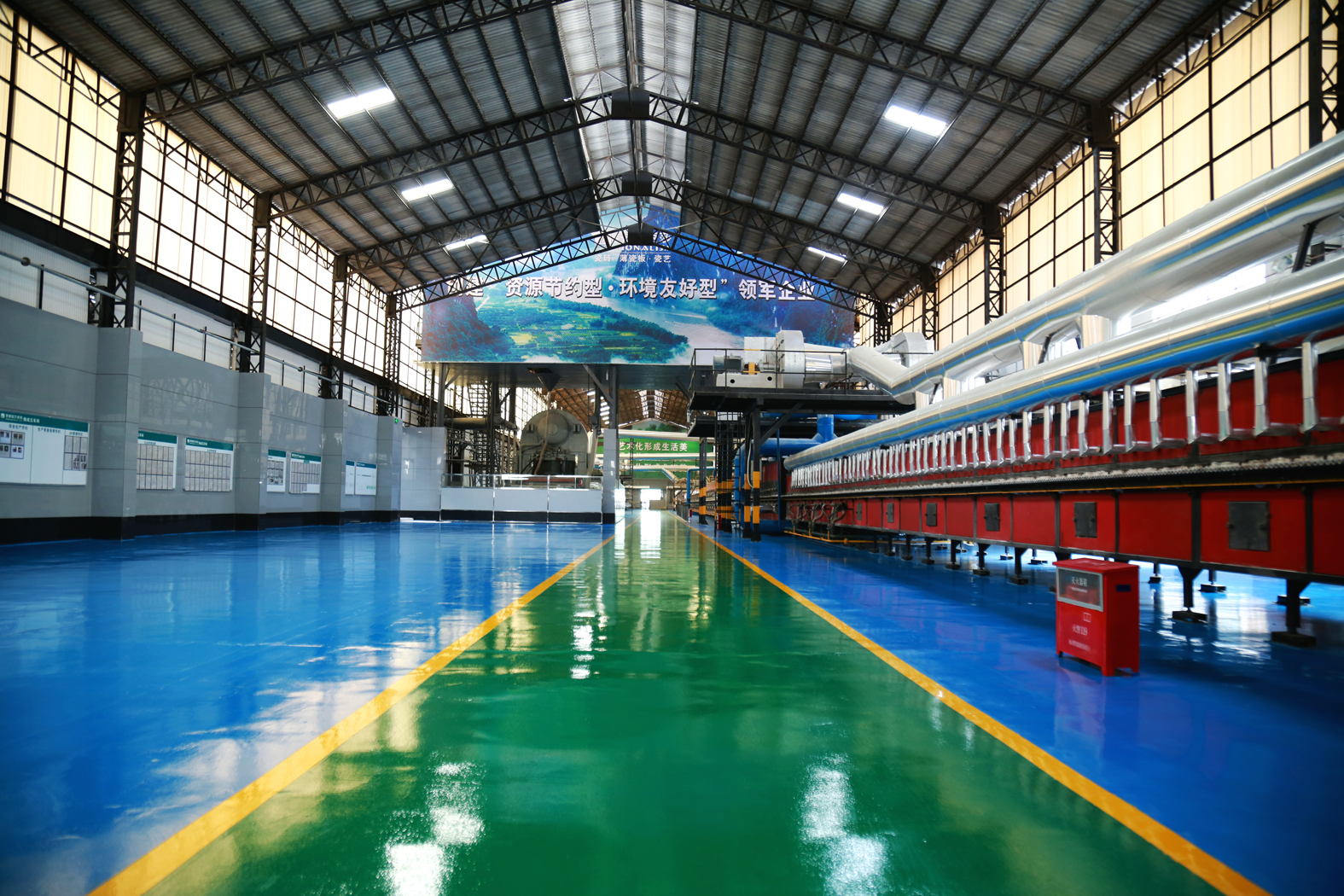
Company information describes a total manufacturing area of 2,779,333.33 square meters, four modern production bases and 37 production lines. The bases are identified in the company profile as Xiqiao in Foshan, Qingyuan in Guangdong, Tengxian in Guangxi and Gao’an in Jiangxi. The company also reports a workforce of approximately 4,106 and annual production capacity of approximately 100 million square meters.
These measures answer different questions and should not be collapsed into one claim. Facility area is not production volume. A line count does not establish how many lines are assigned to porcelain tile rather than other ceramic products. Workforce size does not show staffing on a particular order. Annual capacity is not the same as output, available capacity, utilization or export-ready inventory. The company’s product portfolio includes tiles, sintered stone slabs and SPC flooring, so buyers should confirm the product scope behind any capacity figure before using it to plan a porcelain tile order.
This qualification is especially important because the available external evidence does not establish current porcelain-tile-only output or utilization. A historical company-related page cited in the industry data gives a different annual-output figure for a mixed product scope and an earlier period; that historical number cannot be combined with the current company-stated capacity as if both measured the same thing. The appropriate conclusion is limited: Monalisa reports a multi-base manufacturing footprint and an approximate annual capacity figure, while current product-specific availability and output require direct confirmation.
For supplier screening, the useful next step is to turn footprint claims into order-specific questions. Which base would produce the selected tile? Which product categories and sizes can the relevant lines make? How is the quantity allocated across production, inspection and packing? What current schedule and order capacity can be confirmed for the requested specification? The figures make those questions relevant, but they do not answer them.
Certifications and standards: verify scope, not just count
The company profile states that Monalisa has obtained 15 certifications, including ISO 9001 and ISO 14001. This is a company-reported credential and should be treated as a prompt for document review. The count alone does not identify certificate numbers, issuing bodies, validity periods, covered facilities or the exact scope of each certification. Nor does an ISO management-system certification certify every porcelain tile SKU or establish a product’s slip, fire, frost, stain or abrasion performance.
For a project requiring CE-marked or otherwise market-specific products, buyers should request applicable product declarations and supporting documentation for the exact model and destination. “CE certified porcelain tiles” and “ISO certified porcelain tiles” are not interchangeable descriptions: product conformity and management-system certification address different questions. Whether a certification is required, relevant and valid depends on the intended market and product. A supplier qualification record should therefore capture the document itself, the entity and facility it covers, the scope, validity and the product relationship.
The same verification discipline prevents a common sourcing error: treating participation in standards drafting as proof of product conformity. A company may contribute to drafting a standard while individual products still need to demonstrate compliance through the required declaration, testing or certification route. Buyers should assess each item of evidence according to what it actually covers.
Project references as context, not a performance guarantee
Monalisa’s company profile lists participation in eight venues of the Beijing Olympic Games, the Hong Kong-Zhuhai-Macao Bridge, the China Pavilion at Expo 2020 Dubai and the 19th Asian Games Hangzhou 2022. These are useful reference points for initial supplier discovery because they place the company in the context of public or high-profile projects. The stated references do not, by themselves, identify the precise tile models, quantities, installation areas, acceptance criteria or performance outcomes associated with each project.
Project names should therefore be used as a starting point for due diligence, not as a transferable guarantee. A buyer can ask what the company supplied, which project scope the supply covered, and whether the product and installation conditions are comparable to the new project. If evidence is available, it should identify the relevant product and scope. A public-project reference cannot substitute for confirming a current specification, sample, test report or contractual requirement.
That distinction is particularly important when selecting commercial porcelain floor tiles or products for public facilities. High traffic, cleaning routines, moisture exposure and local regulations can vary substantially between sites. A reference to a large project does not reveal whether its tile specification matches a buyer’s own use conditions. The buyer’s decision should rest on the fit between the project requirement and product evidence, with the reference serving as background context.
A practical evidence map for porcelain tile buyers
A disciplined review can separate company-level evidence from product-level qualification. The following map shows what the available Monalisa information supports and what a buyer should still establish before relying on it for a purchase decision.
| Evidence area | What is reported | What the buyer should confirm |
|---|---|---|
| R&D and intellectual property | 100 engineers; 892 authorized patents, reported as of June 2021 | Current figures, relevance to the product, and documentation for the requested technical requirement |
| Standards participation | Participation in drafting 49 national, industrial, local and group standards, as of June 2021 | The standards involved, the company’s role and separate evidence of product conformity |
| Manufacturing footprint | Four production bases, 37 lines and 2,779,333.33 m² manufacturing area | Relevant production base, product scope, line assignment and current order availability |
| Annual capacity and workforce | Approximately 100 million m² annual capacity and approximately 4,106 employees, as company-reported figures | Definition, current period, product mix, available capacity and schedule for the specific order |
| Certifications | 15 certifications, including ISO 9001 and ISO 14001, according to company information | Certificate copies, issuing body, validity, facility and scope; product-specific requirements separately |
| Project references | Named participation in Olympic, bridge, Expo and Asian Games projects | Exact supply scope, model, application and comparability with the buyer’s project |
The map is not a scorecard and does not rank suppliers. It distinguishes evidence types so a procurement team can avoid treating a large corporate number as an answer to a narrower technical or commercial question. For example, the reported capacity may be relevant to an initial scale discussion, while the actual order plan still depends on the product mix, production allocation and confirmed schedule.
How to interpret the evidence in supplier discovery
For an awareness-to-research buyer, Monalisa’s reported profile offers several distinct signals: a sizable engineering team, a substantial patent record, involvement in standards drafting, a multi-base manufacturing footprint, stated annual capacity, certifications and named project participation. Together, these facts provide more context than any single number. They do not establish that Monalisa is the right supplier for every project, nor do they verify an individual tile’s performance or current order availability.
A sensible first-stage conclusion is that Monalisa is a manufacturer with company-reported R&D, standards, manufacturing and project credentials that merit product- and order-level follow-up. The evidence is strongest when read with its boundaries: the patent and standards counts are dated June 2021; the capacity figure is approximate and company-reported; the reported certifications require document-level scope checks; and project participation does not specify the exact products or outcomes.
Buyers researching a porcelain tile supplier can use those boundaries to structure the next review. Start with the precise model and use case. Match its technical data to the project specification and market requirements. Check the documents behind any CE, ISO, fire, slip, frost, stain or other performance claim. Then confirm manufacturing location, product scope and order-specific availability. This sequence connects supplier credentials to the actual procurement decision without confusing corporate capability signals with verified product suitability.
More company information is available from Monalisa Group Co., Ltd.. The company’s stated profile and project references are starting points for qualification; buyers should rely on current, applicable product and certification documents for final technical decisions.
Tem questões ou precisa de mais detalhes?
Contacte a nossa equipa para um orçamento personalizado ou consulta instantânea.
Solicitar orçamento
Preencha o formulário abaixo e a nossa equipa entrará em contacto com uma proposta personalizada.
Chat direto do WhatsApp
Prefere conversar em tempo real? Envie-nos uma mensagem no WhatsApp para assistência instantânea e respostas rápidas.
- Obter orçamento personalizado
- Partilhar fotos ou documentos
- Discuta as suas necessidades diretamente
Geralmente responde em 5–30 minutos durante o horário de expediente.