
Portable Axial Flow Pump Matrix: What a Model List Proves
Portable Axial Flow Pump Matrix: What a Model List Proves
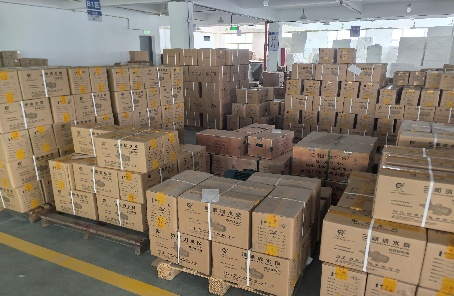
A pump supplier's product matrix is usable capability evidence only when it can be decoded and checked: model codes that resolve against nameplates, cabinet ratings that match pump power in defined steps, and spare parts that appear as their own catalogue items. For High Efficiency Portable Axial Flow Pumps, the matrix published by chuangmei Pumps offers exactly that material, and most of it can be verified before an order is placed.
chuangmei Pumps is the brand identity of Zhejiang Chuangmei Electromechanical Co., Ltd., a manufacturer of permanent magnet synchronous motor axial flow pumps founded in 1996, operating a 12,000 m² production site in Wenling, Zhejiang, with 46 employees and an annual output of 30,000 units. The company's stated markets include Southeast Asia, Africa, Morocco and the Central Asian countries, at an export ratio of 25%.
The purpose here is not to argue that a long model list equals quality. It is to sort the list into what it establishes, what it leaves open, and which questions a buyer in the evaluation or execution stage should put to any supplier whose catalogue looks comparable.
Why a model list counts as evidence — and where it stops
A catalogue entry proves that a configuration has been built into a product structure. It does not prove that a specific unit will hold a stated flow at a stated head on a specific site. That distinction matters in flood-control procurement, because the cheapest way for a buyer to be misled is a family-level claim quietly applied to a single model.
Read properly, a matrix supports three separate checks. First, whether the family logic is internally consistent — if the model codes decode, the supplier has organised its range rather than assembled a list. Second, whether the accessory range is developed to the same depth as the pumps: a control cabinet series with defined power steps, and spare parts listed by name, indicate a support structure behind the catalogue. Third, whether the manufacturer names the exact models it builds instead of describing a category.
The range is documented around a permanent magnet synchronous motor axial flow pump developed under utility model patent ZL2014200091521.8, with the impeller produced by precision stainless steel casting on a stainless steel shaft. The motor housing and pump body are offered in aluminium alloy or stainless steel, and the cable outlet is protected by a rubber sheath with a stainless steel spring guard.
The matrix in one view
The catalogue separates products into families rather than one undifferentiated list. Laid out side by side, the families show where the engineering effort sits.
| Product family | Documented model examples | What the entry establishes |
|---|---|---|
| High Efficiency Portable Axial Flow Pumps | 8SZQ470-7-15; 150SZQ250-10-11; 200SZQ450-8-15; 100SZQ100-25-11 | A named portable core range covering different outlet sizes |
| High Head Flood Control Pump For Subway | 200SZQ150-20-15; 200SZQ150-35-22; 200SZQ200-20-18.5; 200SZQ200-25-22 (also 200SZQ150-45-30 and 200SZQ200-16-15) | A high-head group offering several flow, head and power pairings at the same outlet size |
| Flood Prevention Pump With Huge Flow | 300SZQ1000-8-37; 300SZQ1000-10-45; 300SZQ1200-10-55 | Large-flow models built on the 300SZQ frame |
| Hydraulic Axial Flow Pump | 250YZQ800-6-37; 250YZQ800-10-50; 250YZQ800-15-75 | A hydraulically driven branch that can run from a vehicle's hydraulic power system |
| Boost Pump | 200SZQ500-10-22GL; 250SZQ800-10-37GL; 300SZQ1000-10-45GL | The same base models offered under a boost-family suffix |
| Pump with bottom inlet | 150SZQ200-9-7.5L; 200SZQ500-9-22L; 200SZQ600-10-30L; 250SZQ800-9-37L | A separate intake configuration on shared base models |
| Double use pump | 200SZQ-HL-22; 250SZQ-HL-30 | Two-mode operation through impeller and pump-body change |
| Flood prevention unit | CMFD01 | A complete unit packed in one box |
| Electrical cabinet | 5.5–7.5; 11–15; 18.5–22; 30; 37; 45; 55; 75; 110 (power steps as listed) | Control scope developed in parallel with the pump power range |
| Part | 8–10 inch pump flat body | A spare body carried as a catalogue line item |
| Insert-type concrete vibrator; adjustable vibrator | ZN50/ZN-D, ZN70/ZN-D series; ZF-T2, ZF-T4 and ZF-TDC series | Adjacent motor and steel-fabrication lines — context, not pump evidence |
The vibrator lines are worth naming precisely because they are not pumps. Their presence shows a wider motor and fabrication base, and the insert-type units are documented for mining, metallurgy, food processing, chemical industry and screening and conveying equipment. But a buyer evaluating portable axial flow pumps should treat them as background. The pump evidence sits in the first eight rows.
The CMFD01 unit as a test of whether the matrix closes
One entry deserves separate treatment because it tests integration rather than casting. Model CMFD01 is documented as a flood prevention unit containing a flood prevention pump with permanent magnet motor, electrical cabinet, float body, outlet connector, hose and related items, installed in one box as a complete unit and made of stainless steel.
That is a checkable claim. Ask for the packing list against the box, confirm the float and level-control interface, and confirm which cabinet power step ships with the unit. If any of those items arrives as a separate purchase order, the equipment is a kit rather than a unit — a practical distinction for a municipal buyer taking delivery ahead of a flood season.
Reading the designation: three documented examples
The matrix becomes procurement tooling once the codes decode. Three models in the documentation carry full specifications and establish the pattern:
- 200SZQ600-10-30L — rated flow 600 m³/h, rated head 10 m, 30 kW motor, 8-inch outlet, overall dimensions 400 × 400 × 850 mm, net weight 54 kg, stainless steel, intended for fixed drainage in bridges, culverts, basements and garages.
- 250SZQ750-7-30 — rated flow 750 m³/h, rated head 7 m, 30 kW, dimensions 300 × 300 × 505 mm, net weight 35 kg.
- 300SZQ1000-10-45GL — rated flow 1,000 m³/h, rated head 10 m, 45 kW, dimensions 450 × 400 × 850 mm, net weight 98 kg, listed as a large-flow booster for fixed drainage.
In all three, the leading number is the outlet diameter in millimetres, the middle fields are rated flow in m³/h and rated head in metres, and the final numeral is motor power in kW. Trailing letters mark the family rather than the duty point: L for the bottom-inlet group, GL for the boost-pump group, HL for the double-use models.
Applied to the four 200SZQ models in the high-head group, the pattern produces a compact selection ladder. 200SZQ150-20-15 and 200SZQ150-35-22 sit at a 150 m³/h nominal flow with 20 m and 35 m head fields; 200SZQ200-20-18.5 and 200SZQ200-25-22 sit at a 200 m³/h nominal flow with 20 m and 25 m head fields. In each pair the higher-head variant carries the larger power field. Those readings are a convention established by the documented examples, not a substitute for the delivered data sheet: the nameplate and submittal for the exact unit remain the controlling documents.
Power coverage across the 200SZQ and 300SZQ families
The flood prevention pump series is documented as supporting a power range of 5.5 kW to 55 kW, using a permanent magnet synchronous submersible motor and an axial flow impeller, and intended for fixed drainage in bridges, culverts, basements and garages. The 300SZQ large-flow group carries the same design into higher volumes through models such as 300SZQ1000-8-37, 300SZQ1000-10-45 and 300SZQ1200-10-55, whose designations resolve to 37 kW, 45 kW and 55 kW fields at 1,000–1,200 m³/h nominal flow.
The catalogue also lists 300SZQ models beyond that band, including 300SZQ1000-15-75 and 300SZQ1500-10-75. This is a reason to read band statements precisely rather than a contradiction: the 5.5–55 kW figure describes the range it is stated against, so a buyer needing a higher rating should confirm availability against the specific model and its data sheet instead of assuming the published band is the ceiling of the family.
Construction facts a buyer can check
Material specification is unusually explicit for a portable range, and specifics are what make verification possible. The documented points are:
- Impeller produced by precision stainless steel casting, mounted on a stainless steel shaft.
- Motor housing and pump body available in aluminium alloy or stainless steel.
- Cable outlet protected by a rubber sheath with a stainless steel spring guard.
- The 8-inch aluminium alloy flood control pump with high head is catalogued as a category in its own right, which indicates the aluminium option exists as a standard build rather than a one-off request.
- Stainless steel construction appears across families — flood control pumps, hydraulic axial flow pumps, the CMFD01 unit, booster pumps and the electrical cabinet.
The practical consequence is that a material question can be attached to a model rather than to a brand. "Which body material ships on this unit, and is the impeller cast stainless steel?" becomes answerable from the catalogue structure. It also fixes the comparison basis: an aluminium-body pump and a stainless-steel-body pump are different products at different weight and cost, and a quotation that blends the two without saying so is not comparable.
Motor and control: where the delivered scope actually sits
The permanent magnet synchronous motor defines the range. The company states the design is one quarter the weight of a conventional axial flow pump, that speed is steplessly regulated so head and flow can be adjusted, and that motor speed does not vary with grid voltage fluctuation — a behaviour it contrasts with asynchronous-motor axial flow pumps. These are manufacturer statements about the design; a project that must rely on them should verify them at the quoted duty point on a test bench rather than accept the family claim.
The control cabinet is part of the delivered system, not an accessory, and its documented functions define what delivery means: panel display or touch screen; built-in frequency inverter; real-time display of frequency, voltage, current and rotational speed; 3G and 4G remote control from a computer or phone application for data transmission, start/stop and speed adjustment; time-segmented operation; and protection against overheat, overcurrent, overload, overvoltage and phase failure. When the pump is fully drained, the system is documented to shut down within half a minute and enter standby. Cabinets are offered in single-unit or dual-unit (one-drives-two) configurations at IP44 or IP54, on a three-phase four-wire supply with waterproof plugs and sockets.
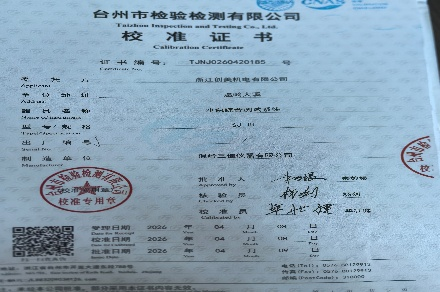
Two execution-stage questions follow. First, whether the cabinet power step — 5.5–7.5, 11–15, 18.5–22, 30, 37, 45, 55, 75 or 110 kW — matches the pump ordered, because a mismatch surfaces at commissioning rather than in a quotation review. Second, whether the station layout needs the one-drives-two arrangement, since that changes both the panel count and the failure mode of the installation.
Parts support: the column that predicts downtime
Parts support is where a matrix stops being marketing. Three entries carry most of the weight.
The catalogue lists a pump flat body for 8–10 inch pumps as a separate part. A body offered as its own line item is a different service proposition from a body that can only be replaced as part of a sealed assembly. The questions to put to the supplier are concrete: which models accept that body, and what is the replacement lead time for it?
The double-use pump family (200SZQ-HL-22 and 250SZQ-HL-30) is documented as achieving both low-lift high-flow and high-lift operation through simple replacement of the impeller and pump body. That is a documented design intent for a replaceable impeller and replaceable pump body on a shared motor platform — relevant where one station has to cover seasonal duties, and a reason to ask whether the same swap logic applies to the standard 200SZQ models.
After-sales scope is stated as a one-year warranty with free maintenance during the warranty period, supported by remote technical guidance, spare-parts supply and on-site maintenance consultation. Combined with a stated monthly capacity of 500 units, a 15–20 day OEM lead time (15–30 days for ODM) and a minimum order of one unit, that gives the buyer a service picture to compare against other quotations — particularly the variable that matters during a flood season, which is how quickly a body or impeller can be replaced.
Application fit: matching family to flood-control scenario
The documented application set is broad and specific at once: subway flood emergency drainage, underground space drainage, municipal flood control, underground comprehensive pipe gallery, and fixed drainage in bridges, culverts, basements and garages. Separately, the pumps are described as suitable for flood prevention, pond drainage and pumping irrigation.
- Fixed drainage in bridges, culverts, basements and garages — the automatic behaviour matters more than headline flow: the system starts when water reaches a set level, and returns to standby or shuts down when the level falls to the pump intake line.
- Subway and underground space — the high-head group, including the four 200SZQ models above, exists because underground stations need lift rather than volume.
- Municipal flood control and large-area waterlogging — the 300SZQ large-flow group, at 1,000–1,200 m³/h nominal flow on the documented models.
- Sites where a vehicle is the platform — the hydraulic axial flow pump branch (250YZQ800-6-37, 250YZQ800-10-50, 250YZQ800-15-75), documented as drivable from a vehicle's hydraulic power system.
The hydraulic branch is the clearest example of a specification that must not be quoted from the pump alone. Those three models share a 10-inch outlet diameter and overall dimensions of 300 × 340 × 420 mm, with net weights of 32 kg for the 6 m and 10 m versions and 37 kg for the 15 m version. They operate at 3,300 or 3,400 r/min and are driven by hydraulic power stations rated 37, 50 and 75 HP at working pressures of 18, 21 and 22 MPa respectively. A buyer specifying a hydraulic unit is therefore buying a power station and a pump together, and the quotation has to cover both.
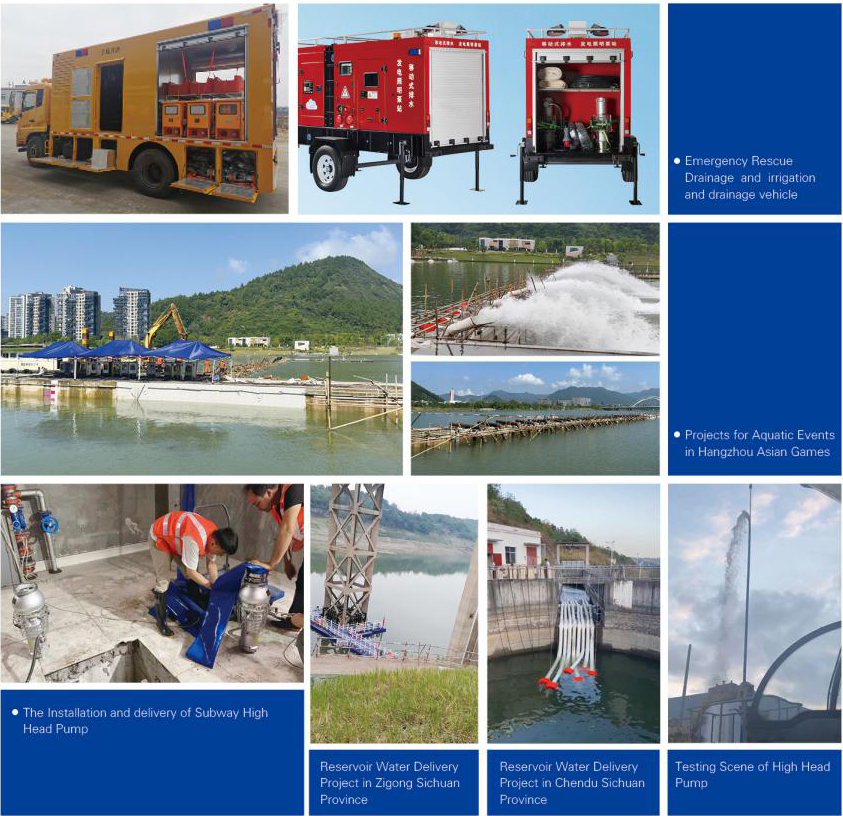
One honest boundary: the catalogue names families, not applications. The boost pump group (GL suffix) and the bottom-inlet group (L suffix) sit on the same base models as the standard 200SZQ, 250SZQ and 300SZQ units. Buyers should ask the supplier to state the difference in application terms — what a boost configuration adds and which intake geometry the bottom-inlet version addresses — rather than inferring it from the suffix.
Comparison with conventional axial flow pump practice
The documented contrast is narrow and should be kept that way. Against conventional axial flow pumps, the permanent magnet synchronous design is stated to weigh one quarter as much, to offer stepless speed regulation with adjustable head and flow, and to hold speed when grid voltage fluctuates. Those differences matter in portable flood-control work, where the pump is moved and set by hand and where supply voltage at a temporary site is often the least reliable part of the installation.
They are not a general claim of superiority. A comparison is meaningful only when both units are matched on outlet size, rated flow, rated head and duty point, and when the test method is the same. Where a project needs a like-for-like decision, the acceptance standard does more work than the catalogue: ISO 9906 defines pump performance test acceptance grades, with Grade 1 associated with ±5% tolerances on flow and head. Naming that grade in the purchase order converts "high efficiency" from an adjective into a measurable acceptance condition.
Market context, handled with care
Published market figures for axial flow pumps do not agree. One commercial research source projects the global axial flow pump market at approximately USD 4.49 billion by 2026, while another valuation places the 2025 market at USD 14.36 billion. The gap is best explained by scope — whether mixed-flow and large municipal units are counted alongside axial-direction portable units changes the total substantially. For a buyer this is a reminder rather than a decision input: market size says nothing about whether a 200SZQ200-25-22 holds its head at the installed condition.
Regulatory context is more actionable. China's GB 30253-2024 energy label standard for permanent-magnet synchronous motors applies to products sold in China from 2025, which makes motor efficiency documentation part of the submittal for that market rather than an optional extra.
Certification: read the annex, not the logo
The range holds a CE Machinery & EMC Directive Attestation of Conformity issued by UDEM under certificate M.2025.206.C120727, dated 13 June 2025 and valid to 12 June 2030, assessed against EN ISO 12100:2010, EN 809, EN IEC 61000-3-2, EN 61000-3-3, EN IEC 61000-6-1 and EN IEC 61000-6-3. A second attestation, M.2025.206.C120734, addresses EN 60204-1 for electrical equipment.
The operative word is scope. The attestation lists specific model designations — for example 200SZQ450-8-15, 300SZQ1000-10-45 and 300SZQ1200-10-55 — and it is the annex, not the certificate number alone, that a buyer should check against the model being ordered. Assuming family-wide coverage from a certificate that names a subset is one of the more common submittal errors, and it is easy to avoid: request the annex page with the ordered model marked.
Execution sequence for a buyer
- Fix the duty point — flow, head, outlet size, and whether the site is fixed or mobile — then decode three or four candidate models from the matrix.
- Request nameplate data and the submittal sheet for each candidate; confirm body and impeller material, net weight and dimensions.
- Confirm the control cabinet power step and configuration against the pump rating and the station layout.
- Check the certification annex for the exact model, and specify the acceptance test grade in the purchase order.
- Agree acceptance mechanics: documented practice is 100% pre-shipment hydraulic performance testing, with acceptance by self-inspection or by an entrusted third-party professional organisation.
- Agree commercial and service terms: minimum order of one unit, T/T payment, FOB or CIF delivery, OEM lead time of 15–20 days or ODM lead time of 15–30 days, and the one-year warranty with spare-parts supply.
On customization, two modes are documented. OEM production covers nameplate customization. ODM work covers hardware configuration, functional modules, software and system customization, and packaging and brand identification customization, with no fixed minimum order in principle and terms negotiated per product. Both modes are stated at a monthly capacity of 500 units. For a distributor or brand owner, that is the part of the capability picture a model list cannot show, and it is worth confirming in writing which mode a given order falls under.
What the matrix still does not tell you
Three gaps remain after all of the above, and naming them is part of reading the evidence honestly. The matrix does not contain field performance data for a specific installation. It does not contain independently benchmarked curves against other manufacturers' portable units at matched duty points. And it does not state part-level lead times for every frame size. Each gap closes the same way — by requesting the specific document rather than accepting the family claim: a test record at the duty point, a like-for-like comparison at the same flow and head, and a written spare-part lead time for the model on the order.
Outlook
The direction of travel in this category is visible in the delivered scope rather than in forecasts. As variable-frequency control, remote monitoring and protection logic move from optional extras into the standard cabinet, the differentiator between suppliers shifts from pump castings toward control software, documentation quality and spare-part depth. A supplier whose cabinet range already runs from 5.5 kW to 110 kW in defined steps, and whose catalogue carries a pump body as a separate line item, is better positioned for that shift than one whose matrix stops at the pump. That is a reading of the evidence presented here, not a prediction about any market.
FAQ
How can a buyer tell whether a supplier's model list reflects real production capability?
Look for internal consistency rather than length. In the chuangmei Pumps matrix the model codes resolve against documented examples — 200SZQ600-10-30L is documented as 600 m³/h at 10 m with a 30 kW motor, and 300SZQ1000-10-45GL as 1,000 m³/h at 10 m with 45 kW — and the accessory lines are developed to the same depth as the pumps, with electrical cabinets in defined steps from 5.5–7.5 kW to 110 kW and a pump flat body for 8–10 inch pumps listed as a separate part. A list that cannot be decoded, or whose accessories are absent, is a weaker signal.
What is the power range of the flood prevention pump series?
The series is documented as supporting 5.5 kW to 55 kW, using a permanent magnet synchronous submersible motor and an axial flow impeller, and is intended for fixed drainage in bridges, culverts, basements and garages. The catalogue also lists higher-power 300SZQ models such as 300SZQ1000-15-75 and 300SZQ1500-10-75, so a specific rating should be confirmed on the model data sheet for the duty point in question.
What do the suffix letters L, GL and HL mean in the model list?
They group models by family rather than by duty point. In the published catalogue, L designates the pump-with-bottom-inlet group (for example 200SZQ600-10-30L and 250SZQ800-9-37L), GL designates the boost pump group (200SZQ500-10-22GL, 250SZQ800-10-37GL, 300SZQ1000-10-45GL), and HL designates the double-use pump group (200SZQ-HL-22 and 250SZQ-HL-30). The numeric part of the designation carries the flow, head and power fields.
Are the four 200SZQ high-head models interchangeable?
No. 200SZQ150-20-15, 200SZQ150-35-22, 200SZQ200-20-18.5 and 200SZQ200-25-22 differ in the flow, head and power fields of the designation, and within each pair the higher-head variant carries the larger power field. Selection depends on the actual head at the site, and substituting one for another changes the duty point, so the delivered nameplate and submittal should be checked against the design condition.
What acceptance and warranty terms are documented?
Minimum order quantity of one unit, T/T payment, FOB or CIF delivery terms, acceptance by self-inspection or by an entrusted third-party professional organisation, and 100% pre-shipment hydraulic performance testing. After-sales support is a one-year warranty with free maintenance during the warranty period, plus remote technical guidance, spare-parts supply and on-site maintenance consultation. OEM lead time is stated at 15–20 days and ODM lead time at 15–30 days.
Is the whole range covered by the CE attestation?
Attestation M.2025.206.C120727, issued by UDEM on 13 June 2025 and valid to 12 June 2030, lists specific model designations within its scope, so coverage should be checked per model against the annex rather than assumed for the family. Buyers ordering for the EU market should request the annex page that names the ordered model.
The complete model list, including the families summarised in this article, is available in the manufacturer's published catalogue: High flow pump catalogue (PDF). The manufacturer's own presentation is published at chuangmei Pumps.
Tem questões ou precisa de mais detalhes?
Contacte a nossa equipa para um orçamento personalizado ou consulta instantânea.
Solicitar orçamento
Preencha o formulário abaixo e a nossa equipa entrará em contacto com uma proposta personalizada.
Chat direto do WhatsApp
Prefere conversar em tempo real? Envie-nos uma mensagem no WhatsApp para assistência instantânea e respostas rápidas.
- Obter orçamento personalizado
- Partilhar fotos ou documentos
- Discuta as suas necessidades diretamente
Geralmente responde em 5–30 minutos durante o horário de expediente.