
Portable Laser Marking Machine Acceptance Criteria: Compliance Evidence for Purchase Orders
Portable Laser Marking Machine Acceptance Criteria: Compliance Evidence for Purchase Orders
Portable laser marking machines are increasingly specified where the marking head has to travel to the workpiece — pipe racks, installed machinery, oversized frames, field service work — rather than where the workpiece can be carried to a fixed station. That shift moves a large share of procurement risk away from the laser source and onto documentation. The operating question is no longer only “will it mark my material?” but “can the supplier evidence that this unit meets the safety, electrical, and performance terms written into the order?”
Global context matters here because compliance expectations for a handheld unit are set at the same level as for a fixed installation. The global laser marking machine market is estimated at USD 4.4 billion in 2026, with a forecast period running to 2033 (Grand View Research, “Laser Marking Machine Market Size & Share Report, 2026–2033”). Fiber laser technology accounted for 46.1% of revenue share in 2025, and Asia Pacific is the largest regional market at approximately 44% revenue share. Portable and handheld equipment sits inside that market, not outside its regulatory frame — which is why acceptance criteria for a portable laser marking machine now start with documents, not with wattage.
Jinan Yuanshida International Trade Co., Ltd. is a Jinan-based exporter of industrial laser marking equipment, founded in 2012, whose range covers handheld, bench-top, desktop, and precision laser marking machines. Its handheld fiber laser marking machine holds a CE Declaration of Conformity and an FDA Radiological Health Electronic Submission Confirmation, which makes it a workable reference point for how acceptance evidence is assembled in practice.
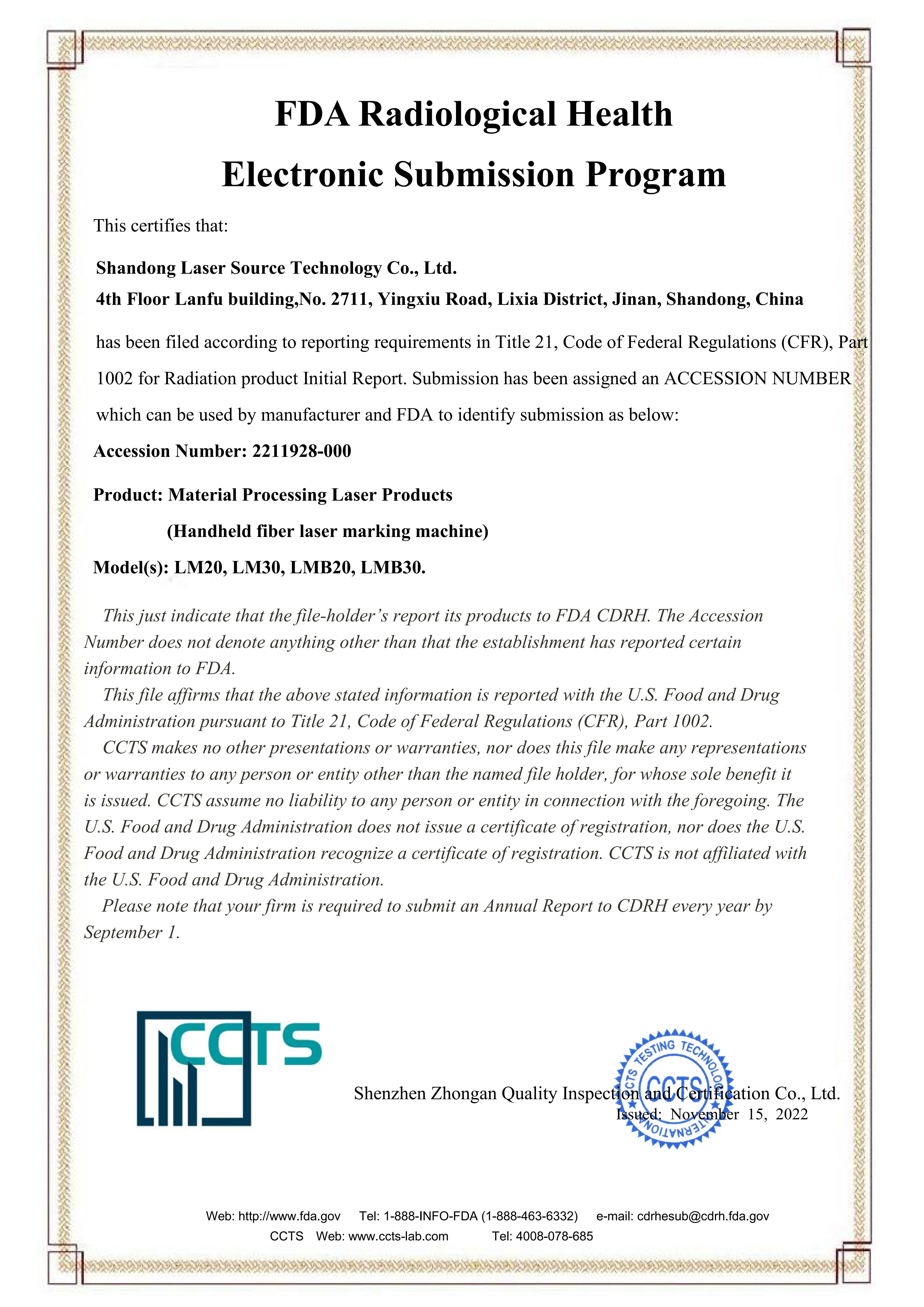
FDA Radiological Health Electronic Submission Confirmation, covering a handheld fiber laser marking machine under the US market scope.
The Problem: Purchase Orders That Describe Intent, Not Deliverables
Most disputes around portable laser marking equipment are not caused by a failed laser. They are caused by an order that specified a price, a power level, and a delivery date, and left everything else to interpretation. Three failure patterns repeat across buyer-side procurement documentation:
- Compliance is assumed, not attached. The order references “CE” as a word rather than an identified declaration with a certificate number, a scope, an issuing body, and a validity period.
- Scope mismatch goes unnoticed. A declaration issued for one machine family is filed as evidence for a different machine family. The document is genuine; it simply does not cover the unit being shipped.
- Performance terms are quoted without a method. Marking area, marking speed, and repeatability appear as bare numbers, with no statement of how they are measured or under which conditions.
The opportunity is straightforward: a portable laser marking machine purchase order can be converted into an acceptance checklist in a single annex. Once the evidence set is named in the order, incoming inspection becomes a document check rather than a debate, and the supplier's certification, quality-control, and export-support capabilities become verifiable rather than promotional.
What “Compliance Evidence” Means for a Portable Laser Marker
Compliance evidence is the set of third-party and first-party documents that let a buyer connect a delivered unit back to a published standard, an identified issuing body, and a defined scope. For portable laser marking equipment, that set normally has five components.
| Evidence item | Typical document | What it establishes | What the buyer must check |
|---|---|---|---|
| EU market access | CE Declaration of Conformity | Conformity assessment against the EN standards listed on the declaration | Certificate number, issuing body, standard list, scope, expiry date |
| US market access | FDA Radiological Health Electronic Submission Confirmation | Product report and accession under 21 CFR Part 1002 | Whether the accession scope names the ordered model family |
| Quality system | ISO-related documentation as stated by the supplier | Manufacturing and process discipline | Which standard and which scope the certificate actually covers |
| Pre-shipment verification | Aging test and precision calibration records | That the individual unit was run and calibrated before dispatch | Whether records are unit-specific or batch-level |
| Trade classification | HS code on commercial invoice and packing list | Customs treatment of the shipment | Consistency between HS code and the machine's stated function |
The reference case is instructive. A CE Declaration of Conformity numbered M.2024.206.C105275 was issued on 2024-08-12 by UDEM International Certification Auditing Training Centre Industry and Trade Inc., valid to 2029-08-12, for the EU market, with the scope stated as “Handheld fiber laser marking machine.” A separate FDA Radiological Health Electronic Submission Confirmation numbered 2211928-000 was issued on 2022-11-15 through CCTS (Shenzhen Zhongan Quality Inspection and Certification Co., Ltd) for the United States market, under Title 21 CFR Part 1002, with the same handheld fiber scope. Both documents are specific. Neither is generic. That specificity is exactly what an acceptance clause should require.
Laser Radiation and Optical Safety: Standards Worth Naming Explicitly
Laser radiation and optical safety protection is the area where vague purchase orders create the most exposure, because the buyer is accepting a Class-rated product into a workplace. The CE Declaration of Conformity for the handheld fiber laser marking machine lists a standard set that maps directly onto the safety question, and each entry does a different job.
- EN 60825-1:2014+A11:2021 — safety of laser products. This is the laser radiation and classification standard.
- EN ISO 11553-1:2020+A11:2020 — laser processing machines, general safety requirements.
- EN ISO 12100:2010 — risk assessment and risk reduction methodology underpinning the design file.
Handheld equipment is assessed under an additional, more specific expectation. Portable laser markers are specifically assessed against EN ISO 11553-2 for hand-held safety — a standard that addresses the particular hazard profile of a laser head that is moved by an operator rather than enclosed in a machine frame. A purchase order that names EN 60825-1 but omits EN ISO 11553-2 is asking for part of the safety evidence, not all of it.
For the United States, laser products sold there must comply with FDA 21 CFR Subchapter J (Radiological Health), Parts 1000 through 1005. The specific accession for the handheld fiber laser marking machine sits under Title 21 CFR Part 1002. Buyers should treat the accession number, the scope wording, and the issuing body as three separate verification fields rather than as a single “FDA approved” checkbox.
Acceptance clause pattern: “Supplier shall provide, before shipment, a CE Declaration of Conformity identifying the certificate number, the issuing body, the EN standard list, the machine scope, and the expiry date, together with the FDA electronic submission confirmation reference where the unit is destined for the United States market. Where the ordered model falls outside the stated scope, a separate declaration shall be supplied.”
Electrical Safety and Power Declaration
Electrical and high-voltage safety in a portable marking machine is covered by a different standard family from laser safety, and the two should not be conflated in a specification. The CE Declaration of Conformity lists EN 60204-1:2018 (electrical equipment of machines) alongside an electromagnetic compatibility group: EN IEC 61000-6-1:2019 and EN IEC 61000-6-3:2021 for immunity and emission, and EN IEC 61000-3-2:2019+A1:2021+A2:2024 and EN 61000-3-3:2013+A2:2019+A2021 for harmonic and voltage-fluctuation limits.
What the buyer needs from this list is not the standard numbers as decoration, but the electrical envelope they imply. The declared power characteristics differ by model family within the same supplier's range:
| Model family | Declared power input | Cooling | Control interface |
|---|---|---|---|
| Handheld Fiber Laser Marking Machine (second generation) | 90V–240V, 50/60Hz | Air cooling | Linux; 7-inch touch screen; Bluetooth, WiFi, mobile app |
| Miniature Multi-Material Laser Marking Machine | Built-in lithium battery / DC 20V (power bank supported) | Air cooling | Mobile app, PC software, touch screen; TYPE-A data, TYPE-C power |
| Desktop UV Laser Marking Machine | 110V–240V | External industrial water chiller (DWUV-05 included) | Standard USB |
| Flying Online Laser Marking Machine | Single-phase AC 90V–260V (50Hz–60Hz) | Built-in air cooling | Standard USB / touch screen PC control |
Three of these four families declare a universal input range; the miniature unit runs from an internal battery or a DC 20V external supply. For an acceptance checklist, this means input voltage, frequency, cord-set type, and battery charging specification should each be an explicit line item, matched to the destination market's mains supply. Standard USB control appears across the desktop UV, desktop CO2, benchtop fiber, and flying online models, which simplifies the acceptance test for data transfer but does not by itself evidence anything about electrical safety.
How Wavelength Changes the Acceptance Test: 355 nm UV, 1064 nm Fiber, 455 nm Blue
Wavelength determines which acceptance questions are relevant. A 1064 nm fiber source, a 355 nm UV source, and a 455 nm blue source interact with materials differently, produce different marking mechanisms, and therefore require different verification steps on receipt.
| Source | Wavelength | Where it appears in the range | Acceptance focus |
|---|---|---|---|
| Fiber | 1064 nm | Handheld fiber marking machine; benchtop and desktop fiber models; flying online model | Metal marking contrast, depth control, repeatability of the marking field |
| UV | 355 nm | Desktop UV Laser Marking Machine, 3W / 5W | Cold-processing behaviour on heat-sensitive substrates; external chiller availability |
| Blue | 455 nm | Miniature Multi-Material Laser Marking Machine, dual light source switchable with 1064 nm | Source switching behaviour; which material set each source is qualified for |
The practical implication is that a purchase order cannot treat “portable laser marking machine” as a single specification. A UV unit at 355 nm in the desktop UV model carries a beam quality figure of M2 < 1.5 in single mode and a modulation frequency range of 30–100 kHz; the miniature multi-material unit at 1064 nm / 455 nm carries a scene focal length of 133 mm and a processing speed up to 4,000 mm/s. Those are different machines with different test procedures, even when both are described as compact or portable.
Specifications That Should Be Frozen in Writing
Performance terms are the part of a purchase order most often left as a brochure excerpt. Freezing them means stating the value, the unit, and the model to which it applies. The following parameters appear as declared values across the supplier's marking range and form a workable acceptance table.
| Parameter | Handheld Fiber | Miniature Multi-Material | Desktop UV | Benchtop Fiber |
|---|---|---|---|---|
| Laser power | 20W / 30W / 50W / 60W | ≤ 100W overall | 3W / 5W | 20W / 30W / 50W |
| Wavelength | 1064 nm | 1064 nm / 455 nm dual source | 355 nm | 1064 nm |
| Marking / scanning area | 110 × 110 mm | 55 mm × 55 mm | 110 mm × 110 mm | 150 × 150 mm max. |
| Marking speed | — | Up to 4,000 mm/s | ≤ 10,000 mm/s | ≤ 10,000 mm/s |
| Repeatability | — | — | ± 0.001 mm | ± 0.001 mm |
| Units per machine order (MOQ) | 5 units | |||
Two conventions should be fixed in the acceptance clause. First, repeatability of ± 0.001 mm is meaningless without a stated measurement basis — axis, traverse length, and environmental conditions. Second, laser life figures vary by family: approximately 100,000 hours is declared for the handheld fiber unit, while the flying online model declares 150,000 hours. Buyers planning multi-shift or continuous operation should ask the supplier to state the duty-cycle assumption behind the declared figure, and to confirm the cooling mode, because cooling is not uniform across the range: most models are air cooled, while the Desktop UV Laser Marking Machine requires an external industrial water chiller (DWUV-05 included).
Where a supplier publishes outcome claims, the acceptance test should reference the claim. Documented case material for these machines includes 100% sharp logo and text reproduction with 0% distortion, 99.9% scanning accuracy for 2D QR codes and barcodes, and ultra-fine marking down to 10 microns with no thermal damage to sensitive components. Each of those is testable, provided the purchase order states the sample material, the pattern, and the inspection method.
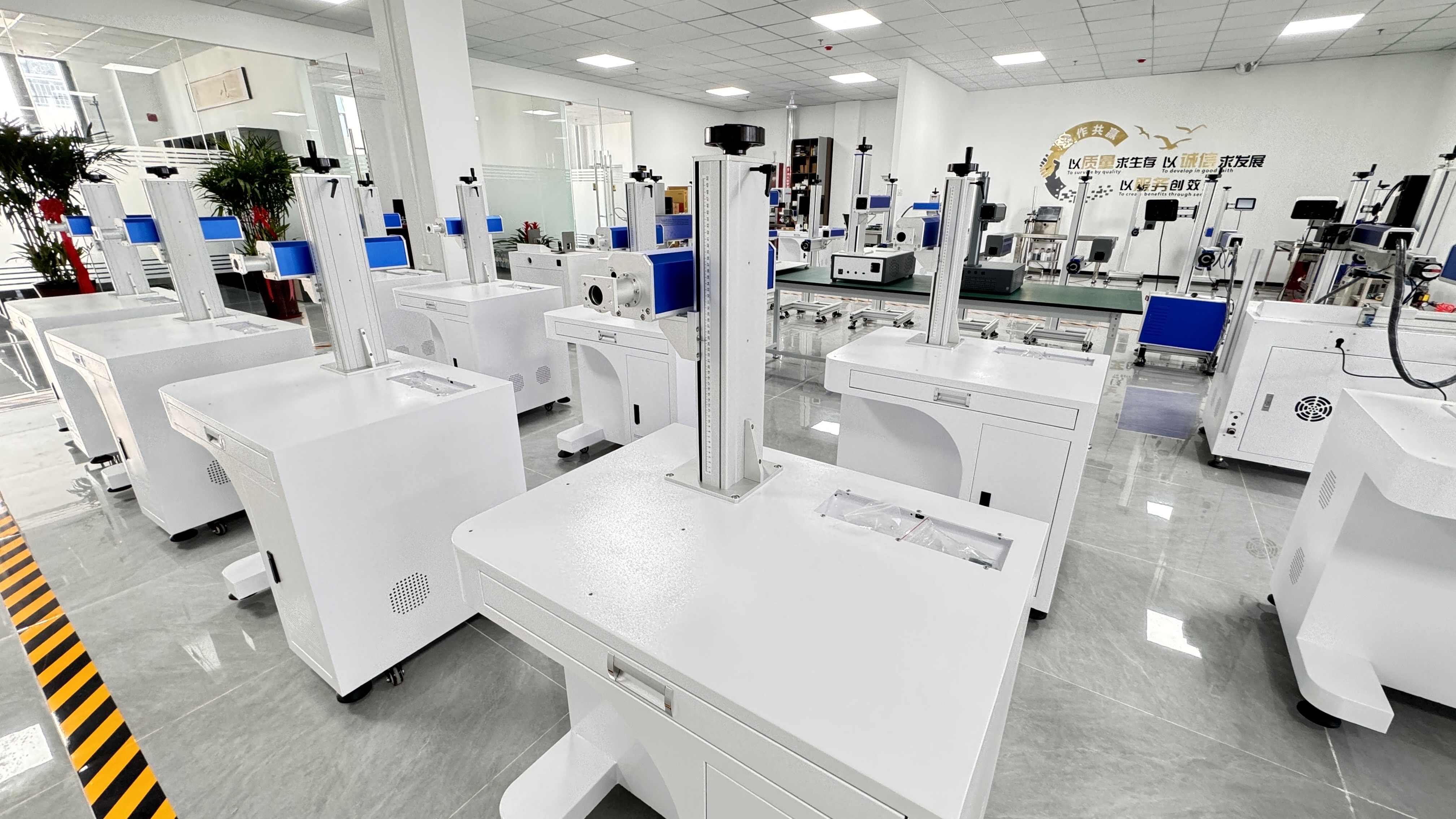
Pre-shipment verification: aging tests and precision calibration are documented before dispatch.
Application Fit: Where Portable Marking Is Used
The application set determines which acceptance criteria carry weight. Declared application scenarios for handheld laser marking equipment include marking on mechanical parts, electronic components, and medical equipment. The wider declared industry coverage includes mechanical parts processing, electronic and electrical production, medical equipment, advertising signs, building materials, hardware parts, auto parts, pipes, profiles, jewelry, and gifts and crafts.
Material coverage is similarly specific and worth writing into the order. The handheld fiber laser marking machine is declared suitable for stainless steel, carbon steel, aluminum oxide, aluminum alloy, aluminum, copper, iron, gold, silver, carbide, painted metal, acrylic, PVC, leather, and painted wood. The Desktop UV model lists PE and PVC plastics, metal parts, building materials, glass, film, packaging, and composite materials. The Desktop CO2 model lists glass, leather, cardboard and paper boxes, PET and plastic bottles, wood, and non-metallic packaging. The miniature multi-material unit lists metals, bamboo and wood, leather, paper, colored glass, plastics, and ceramics.
For a buyer, the acceptance consequence is that “portable” describes mobility, not material universality. The sample material named in the purchase order should be the material the machine is tested against on arrival, and the test pattern should be the same pattern the supplier used for its declared result.
Where Portable Units Stop: Real Boundaries
A credible acceptance framework has to state limits, not only capabilities. Five boundaries are visible directly in the published specifications and in the certification documents.
- Marking field size. The handheld fiber unit's declared marking area is 110 × 110 mm, and the miniature multi-material unit's scanning area is 55 mm × 55 mm. Desktop fiber models offer optional fields of 150 × 150 mm, 175 × 175 mm, and 200 × 200 mm. Very large or uninterrupted marking fields are therefore a fixed-station task, not a handheld one.
- Depth capability. Declared marking depth is under 0.4 mm on the desktop UV platform, while the benchtop fiber model declares marking depth up to 4 mm. Buyers needing deep engraving should not expect a handheld unit to substitute for a benchtop machine.
- Cooling dependence. The Desktop UV Laser Marking Machine requires an external industrial water chiller, which constrains genuinely untethered on-site deployment in that wavelength.
- Weight and power source. Portable laser markers typically weigh between 15 and 35 pounds (approximately 6.8 to 15.8 kg), which affects one-hand operation over long shifts. Battery-powered operation applies to the handheld fiber unit and the 2.7 kg miniature multi-material unit, which also accepts a DC 20V power bank.
- Certificate scope. This is the most frequently overlooked boundary. The CE Declaration of Conformity and the FDA electronic submission confirmation both state scope as “Handheld fiber laser marking machine.” A buyer ordering a UV, CO2, desktop, or flying online model should confirm whether a separate declaration applies to that model rather than assuming the handheld document transfers.
Compared with legacy marking methods such as inkjet coding, pad printing, or chemical etching, laser marking removes per-mark consumable purchases — no ink, solvent, plate, or stencil is consumed per mark. The trade is a higher capital cost and a mandatory safety-management obligation. That trade should be written into the purchase order as a stated operating-cost model covering electricity and replacement parts only, so that the absence of consumables is an auditable term rather than a sales phrase.
Market Context Behind the Documentation Trend
Three data points explain why acceptance documentation has become a procurement gate rather than an afterthought. The global laser marking machine market is estimated at USD 4.4 billion in 2026, with a forecast period to 2033. Fiber laser technology held a 46.1% revenue share in 2025, which places fiber firmly as the mainstream source technology for the portable segment. Asia Pacific is the largest regional market at approximately 44% revenue share, which means a large share of portable marking equipment is manufactured in and exported from a region where EU and US market-access documentation is the binding constraint.
Growth-rate forecasts should be treated with caution. Published CAGR estimates for this category diverge noticeably depending on whether coding equipment is included in the definition, so a buyer building a compliance annex should rely on the standards framework and the machine specification rather than on a projected growth rate. For customs purposes, HS code 845611 is the primary classification for machine tools operated by laser processes, and it should match the description on the commercial invoice and packing list.

Portable and handheld marking equipment is exported into markets where EU and US documentation is the binding requirement.
Future Outlook
Three shifts are already visible in how portable marking equipment is specified. First, certification scope is becoming a line item rather than an attachment: buyers are starting to require that the declaration scope name the ordered model family, which forces suppliers to hold declarations per platform instead of per catalogue. Second, the distinction between consumer-grade portable marking tools and industrial-grade on-site equipment is becoming a procurement filter, and the differentiating evidence is documentation depth, cooling architecture, and stated repeatability rather than visual design. Third, battery performance data remains an acknowledged gap in the category — verified figures on average operating hours per charge for cordless marking units are not yet part of the standard published specification set, so buyers planning genuinely untethered field work should request discharge data directly rather than infer it from battery chemistry claims.
Suppliers who can respond to these requests with unit-specific aging test records, precision calibration records, and correctly scoped declarations will be the ones whose equipment clears incoming inspection without renegotiation. Suppliers who cannot will find that the acceptance clause — not the laser — decides whether the shipment is released.
Frequently Asked Questions
What compliance documents should be attached to a portable laser marking machine purchase order?
The annex should name five items: a CE Declaration of Conformity with certificate number, issuing body, EN standard list, machine scope, and expiry date; an FDA electronic submission confirmation reference where the unit is destined for the United States; quality-system documentation as stated by the supplier; aging test and precision calibration records for the specific unit; and the HS code applied on the commercial invoice. A recorded example is CE Declaration of Conformity M.2024.206.C105275, issued 2024-08-12 by UDEM International Certification Auditing Training Centre Industry and Trade Inc. with validity to 2029-08-12.
How is laser radiation and optical safety protection evidenced for a portable marking machine?
It is evidenced by the standard list on the conformity declaration plus the corresponding laser product accession. The CE Declaration of Conformity for the handheld fiber laser marking machine lists EN 60825-1:2014+A11:2021 for laser product safety, EN ISO 11553-1:2020+A11:2020 for laser processing machine safety, and EN ISO 12100:2010 for risk assessment. Portable laser markers are additionally assessed against EN ISO 11553-2 for hand-held safety. For the United States, laser products must comply with FDA 21 CFR Subchapter J Parts 1000 through 1005, with the handheld fiber unit holding an accession under Title 21 CFR Part 1002.
What electrical and high-voltage safety evidence should be requested?
Electrical safety and electromagnetic compatibility are separate from laser safety and are documented by a different standard group. The relevant entries are EN 60204-1:2018 for electrical equipment of machines, plus the EMC set: EN IEC 61000-6-1:2019, EN IEC 61000-6-3:2021, EN IEC 61000-3-2:2019+A1:2021+A2:2024, and EN 61000-3-3:2013+A2:2019+A2021. Buyers should pair that standard list with the declared input envelope for the ordered model — 90V–240V at 50/60Hz for the handheld fiber unit, 110V–240V for the Desktop UV model, and single-phase AC 90V–260V at 50Hz–60Hz for the flying online model.
Does wavelength change the acceptance criteria?
Yes, because wavelength determines the marking mechanism and therefore the relevant test. A 1064 nm fiber source appears in the handheld fiber, benchtop fiber, desktop fiber, and flying online models, where the acceptance focus is metal marking contrast, depth control, and field repeatability. A 355 nm UV source appears in the Desktop UV Laser Marking Machine at 3W or 5W, where the acceptance focus is cold processing of heat-sensitive substrates and availability of the external industrial water chiller. A 455 nm blue source appears in the Miniature Multi-Material Laser Marking Machine as a dual light source switchable with 1064 nm, so the acceptance test must cover source-switching behaviour.
Which performance specifications should be frozen in the purchase order?
Freeze marking or scanning area, marking speed, repeatability, cooling mode, control interface, and declared laser life, each stated with a unit and tied to a model. Examples from the published specification set include a 110 × 110 mm marking area on the handheld fiber unit, a 55 mm × 55 mm scanning area on the miniature multi-material unit, up to 4,000 mm/s processing speed on the miniature unit, ≤ 10,000 mm/s marking speed on the desktop UV and benchtop fiber models, and repeatability of ± 0.001 mm on the desktop UV, desktop fiber, and benchtop fiber models. A repeatability figure should never be accepted without a stated measurement basis.
What are the limits of a portable unit compared with a fixed marking system?
The main limits are field size, depth, cooling dependence, and certificate scope. Portable fields are smaller: 110 × 110 mm on the handheld fiber unit and 55 mm × 55 mm on the miniature multi-material unit, against optional 150 × 150 mm, 175 × 175 mm, and 200 × 200 mm fields on desktop fiber models. Declared marking depth is under 0.4 mm on the desktop UV platform against up to 4 mm on the benchtop fiber model. The Desktop UV Laser Marking Machine requires an external industrial water chiller, which limits untethered deployment. Portable units typically weigh 15 to 35 pounds (approximately 6.8 to 15.8 kg). Finally, where a CE or FDA document states scope as “Handheld fiber laser marking machine,” that scope does not automatically extend to UV, CO2, desktop, or flying online models.
Closing Note
The acceptance clause is the cheapest risk-control instrument available to a buyer of portable laser marking equipment, because it is drafted before the invoice and enforced after delivery. Naming the certificate number, the standard list, the scope wording, the input envelope, the marking field, and the repeatability basis converts a specification sheet into an auditable order. Sellers who maintain unit-level pre-shipment records and correctly scoped conformity documentation make that conversion routine rather than adversarial.
After-sales support for equipment supplied to Vietnam, Thailand, Malaysia, Turkey, the United States, Poland, and Middle East regions is provided in English, and customized marking solutions together with OEM/ODM services are available within the supplier's stated capability set.