
Portable Laser Marking Machine Decision Matrix: Power, Cooling, Consumables in Smart Manufacturing
Portable laser marking machines are no longer specified as standalone hand tools. In a smart manufacturing cell, the marking station shares a power budget, a footprint and a duty cycle with conveyors, vision systems and robots. That shift explains why three variables — power draw, cooling architecture and consumable structure — now decide which format is written into a specification, often ahead of marking speed.
This article sets out a purchasing decision matrix for the portable and benchtop laser marking formats used inside smart manufacturing cells. It compares handheld, benchtop, flying online, desktop and miniature formats against verified power figures, cooling requirements and consumable behaviour, and then maps those formats to material families such as PE/PVC, metals, glass and composites. The intent is practical: give engineering and procurement teams a comparison logic they can apply before a purchase order is raised, rather than a list of headline specifications.
Why Power, Cooling and Consumables Now Drive the Specification
Marking is usually the last physical operation a part passes through, but it is rarely the first operation considered when a cell is designed. When the cell is later re-balanced, the marking stage is the element that has to move. Two constraints surface immediately: how much electrical load the marking unit adds to a shared supply, and whether the unit needs a utility connection beyond a standard socket.
Cooling is the constraint most often underestimated. Air-cooled units can be relocated with a plug and a fixture. Units that depend on an external chiller are tied to a chiller circuit, and that changes how portable the format really is. Consumables follow the same logic. Inkjet and pad-printing methods carry recurring ink, solvent or pad costs and require ventilation planning; laser formats in this set carry no ink or ribbon, but they do carry a laser source with a stated service life, which is a capital-planning question rather than a weekly purchasing question.
The three questions that resolve most format confusion:
- Power: Does the unit fit the existing cell load, or does it need a dedicated circuit?
- Cooling: Is cooling internal (air) or external (chiller), and does the answer affect where the unit can physically stand?
- Consumables: Is the recurring cost ink/solvent, or is it laser-source lifetime planning?
Format Portfolio and Evidence Base
Jinan Yuanshida International Trade Co., Ltd. is a Jinan, China–based high-tech enterprise specialising in the research, development, production and export of industrial laser marking equipment. The company's main products include handheld laser marking machines, bench-top laser marking machines, desktop laser marking machines and precision laser marking equipment, and it also supplies customised marking solutions, OEM/ODM services and full English after-sales technical support for equipment supplied to export markets.
Its equipment is exported to Vietnam, Thailand, Malaysia, Türkiye, the United States, Poland and Middle East regions, and has been supplied to factories, distributors, trading companies and manufacturing companies that require marking and cleaning equipment. Quality control follows documented pre-shipment inspection procedures, and machines undergo aging tests and precision calibration before delivery. The company states compliance with international quality frameworks including CE, FDA and ISO, and applies a minimum order quantity of 5 units.
For a buyer building a decision matrix, the practical value of this portfolio is that the formats it contains sit at different points on the power, cooling and consumable axes. Comparing them against each other is more useful than comparing a single unit against a generic category average.
The Decision Matrix at a Glance
The table below consolidates the verified specification data for the laser marking formats discussed in this article. It is deliberately organised around integration variables — power, cooling, supply and material coverage — rather than around marketing claims.
| Format | Overall power | Cooling architecture | Power source | Materials stated in specification |
|---|---|---|---|---|
| Miniature Multi-Material Laser Marking Machine | ≤ 100 W | Air cooling | Built-in lithium battery / DC 20 V (power bank supported) | Metals; bamboo and wood; leather; paper; coloured glass; plastics; ceramics |
| Handheld Fiber Laser Marking Machine (Second Generation) | Not published; 90 V–240 V, 50/60 Hz supply | Air cooling | Built-in lithium battery | Stainless steel, carbon steel, aluminium oxide, aluminium alloy, aluminium, copper, iron, gold, silver, carbide, painted metal, acrylic, PVC, leather, painted wood |
| Benchtop Fiber Laser Marking Machine | < 400 W | Built-in air cooling | Mains | Metals (steel, metal components, alloys) and non-metallic plastics (PE, PVC) |
| Desktop Fiber Laser Marking Machine | < 400 W | Built-in air cooling | Mains | Metals (steel, metal parts, alloys) and non-metallic plastics (PE, PVC) |
| UV Laser Marking Machine | < 400 W, excluding external chiller | External industrial water chiller (DWUV-05 included) | 110 V–240 V | PE plastics, PVC plastics, metal parts, building materials, glass, film, packaging, composite materials |
| Desktop CO2 Laser Marking Machine | < 400 W | Built-in air cooling | Mains | Glass, leather, cardboard/paper boxes, PET/plastics, wood, non-metallic packaging materials |
| Flying Online Laser Marking Machine | ≤ 400 W | Built-in air cooling | Single-phase AC 90 V–260 V (50–60 Hz) | Metals, plastics (PE, PVC), electronic components, building materials, packaging substrates |
Power Draw: What the Numbers Mean for a Cell Budget
Across the formats listed, four models publish an overall power figure below 400 W: the benchtop fiber, desktop fiber, UV and desktop CO2 units, while the flying online fiber unit is rated at or below 400 W on a single-phase AC 90 V–260 V supply. The miniature multi-material unit sits well below that band at ≤ 100 W and can run from a built-in lithium battery or DC 20 V input, including a power bank. Those figures matter because they place most of these units inside the range of a standard industrial socket rather than a dedicated three-phase drop.
The exception worth planning for is the UV format. Its stated overall power of less than 400 W covers the marking unit, but the cooling path is external, which means the chiller is an additional electrical and thermal load in the cell. Buyers who compare UV and fiber purely on the marking unit's wattage will underestimate the installation. Equally, the handheld fiber unit publishes its input range (90 V–240 V, 50/60 Hz) and battery operation, but no overall wattage; a procurement team should request that figure directly rather than infer it from laser power.
Cooling Architecture: Air, Battery and the Chiller Exception
Cooling determines where a marking unit can physically live. Five of the seven formats use air cooling — the miniature, handheld fiber, benchtop fiber, desktop fiber, desktop CO2 and flying online units all specify air cooling, with several described as built-in. In practice, that means the marking head and controller can be moved between cells, mounted over a conveyor, or rolled to a large workpiece without a water circuit following it.
The UV laser marking machine is the clear boundary case. Its cooling system is an external industrial water chiller, supplied as DWUV-05, and this is not an optional accessory. For an integrator, the practical consequences are: an additional floor or cabinet footprint, an additional service item, and a unit that should be treated as a fixed station rather than a genuinely mobile tool. That does not make the format unsuitable — UV cold-processing is the reason it handles heat-sensitive substrates — but it does mean the cooling decision must be taken before the material decision, not after.
Consumables, Laser Lifetime and Continuous-Duty Planning
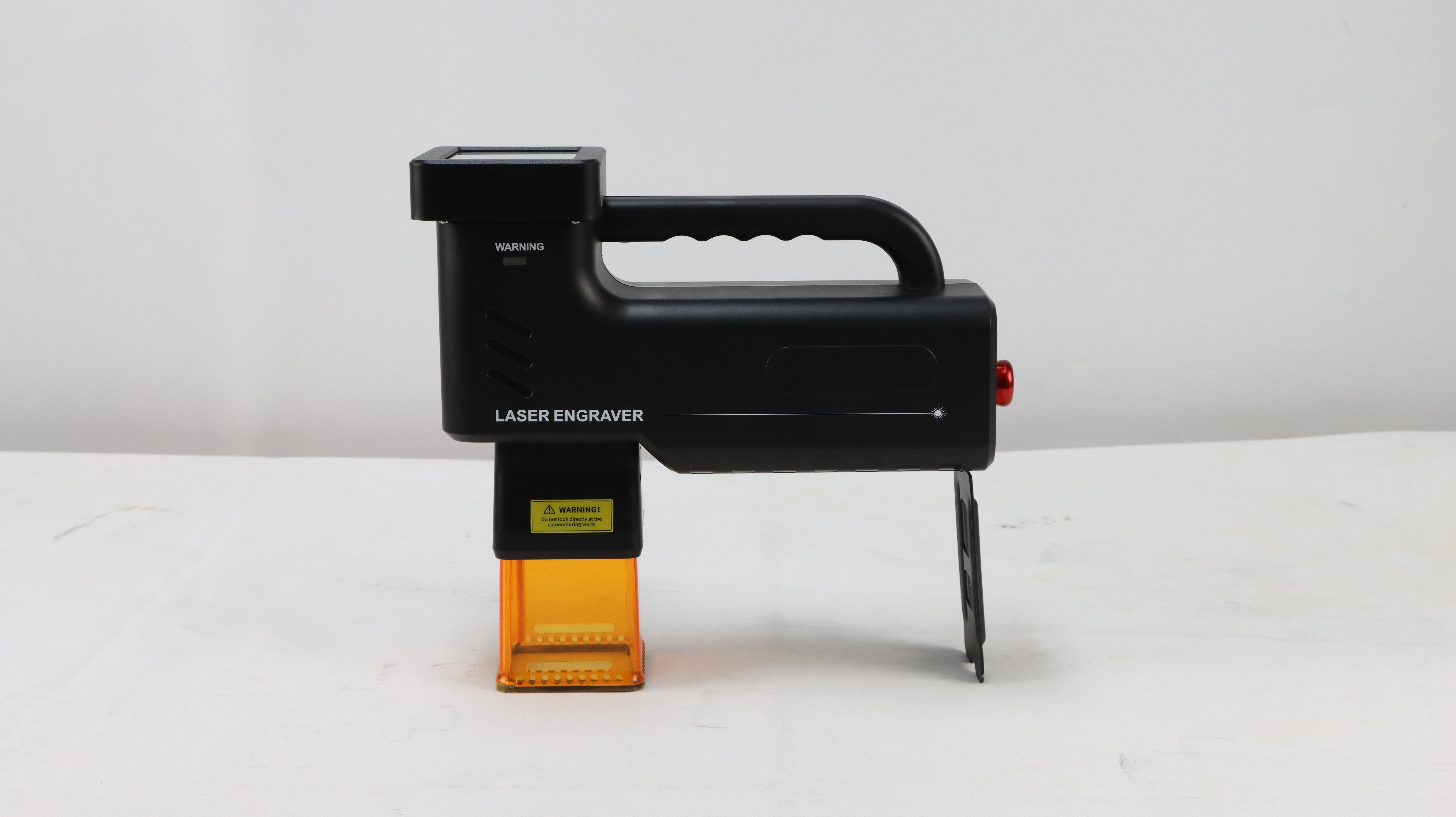
Laser marking does not consume ink, ribbon or solvent, so the recurring cost line associated with inkjet or pad printing does not exist in the same form. What replaces it is laser-source lifetime planning. The handheld fiber unit specifies a laser life of approximately 100,000 hours, and the flying online fiber unit specifies a laser lifespan of 150,000 hours. For a buyer comparing formats over a multi-year horizon, those figures are the meaningful consumable-equivalent: they indicate how long the core light source is expected to remain in service rather than how often a cartridge must be ordered.
Continuous duty is a separate question from consumable structure. For formats intended to run inside a production line, the cooling and power architecture is the limiting factor, not the ink budget. The flying online fiber format is explicitly designed for continuous online marking, with a line speed of up to 7,000 mm/s, an output rate of 800 standard characters per second and a marking speed of up to 12,000 mm/s in continuous online operation. The UV format, with its dedicated external chiller and a marking speed of up to 10,000 mm/s, is likewise structured for production-line duty rather than intermittent handheld work. Buyers planning multi-shift operation should therefore evaluate the cooling specification before they evaluate throughput.
Matching Formats to Materials and Production Scenarios
Material compatibility narrows the matrix faster than any other criterion. The handheld fiber and desktop fiber formats list metals — stainless steel, carbon steel, aluminium, copper, iron, gold, silver, carbide, painted metal — alongside acrylic, PVC, leather and painted wood. The UV format adds PE plastics, PVC plastics, glass, film, packaging and composite materials, which is the combination most relevant to packaging and heat-sensitive substrates. The desktop CO2 format covers glass, leather, cardboard and paper boxes, PET/plastic bottles, wood and non-metallic packaging. The miniature multi-material unit covers metals, bamboo and wood, leather, paper, coloured glass, plastics and ceramics in a 2.7 kg package with a 55 mm × 55 mm scanning area.
Read across to production scenarios, and the mapping becomes concrete:
- Hardware parts, mechanical spare parts and auto components: fiber formats, using the benchtop or desktop fiber unit where the marking area of 110 mm × 110 mm is sufficient, or the flying online unit where parts move continuously.
- Pipes and profiles, and large workpieces that cannot be moved: handheld fiber marking, which is supplied from a built-in lithium battery and a 90 V–240 V input, and which supports Bluetooth, WiFi and mobile app control through a Linux system with a 7-inch touch screen.
- Electronic components and 3C accessories: fiber and UV formats, where the UV unit's minimum line width of 0.4 mm or less and minimum character size of 0.15 mm support fine, low-heat marking.
- Jewellery, gifts and crafts: the miniature multi-material unit, whose dual 1064 nm / 455 nm light source, 133 mm focal length and Type-C power input suit bench-side or workshop use.
- Packaging, PE/PVC and composite substrates: UV or CO2 formats, with the UV unit also listing metal parts alongside plastics, glass and composites.
Reported project results for these formats include 100% sharp, crisp logos and text with 0% distortion, 99.9% scanning accuracy on 2D QR codes and barcodes for supply-chain traceability, and ultra-fine marking down to 10 microns (µm) with no thermal damage to sensitive components. Those outcomes come from deployed projects serving factories, traders, distributors and manufacturing companies that require marking and cleaning equipment.
Where the Market Is Moving
Third-party market research places the global laser marking machine market at an estimated USD 4.4 billion in 2026, with fiber laser technology holding a 46.1% revenue share in 2025. Asia Pacific is the largest regional market, accounting for approximately 44% of revenue share in 2025. Those three data points explain part of the format mix described above: fiber remains the volume technology, and Asia Pacific remains the supply and consumption centre.
Forecasting should be treated with caution. Published CAGR estimates for this market diverge considerably — from around 7.4% to 11.84% — largely because different reports draw the boundary between 'marking' and 'coding' equipment differently. A buyer building a capital plan should treat any single growth figure as an assumption to be tested, not a specification. What is more decision-relevant is the direction of travel: portable, battery-capable and consumable-free formats are increasingly evaluated as cell equipment rather than as workshop accessories.
Portable Laser Marking Versus Traditional Marking Methods
Inkjet coding, pad printing and adhesive labelling remain widely used because they are inexpensive to enter and familiar to production teams. Their recurring cost structure is transparent: ink, solvent or label stock is purchased continuously, and ventilation or solvent handling may be required depending on the chemistry. Laser marking removes that recurring consumable line and produces permanent marks rather than applied ones.
The trade-off is genuine and should be stated plainly. Laser formats carry a higher capital cost than a simple inkjet coder, and their suitability depends on the substrate: fiber formats are oriented towards metals and a defined set of plastics, while CO2 and UV formats cover glass, packaging films and composites that fiber handles less well. Depth is another boundary. Several formats in this matrix — UV, CO2 and flying online — specify a maximum marking depth of 0.4 mm or less, so applications requiring deep engraving should be matched to the benchtop fiber format, which specifies a maximum marking depth of up to 4 mm. Finally, handheld operation relies on the operator positioning the head, whereas repeatability figures such as ±0.001 mm are achieved in fixtured or machine-axis configurations. A handheld unit used freehand should not be expected to reproduce fixtured accuracy.
Compliance Evidence to Attach to a Purchase Order
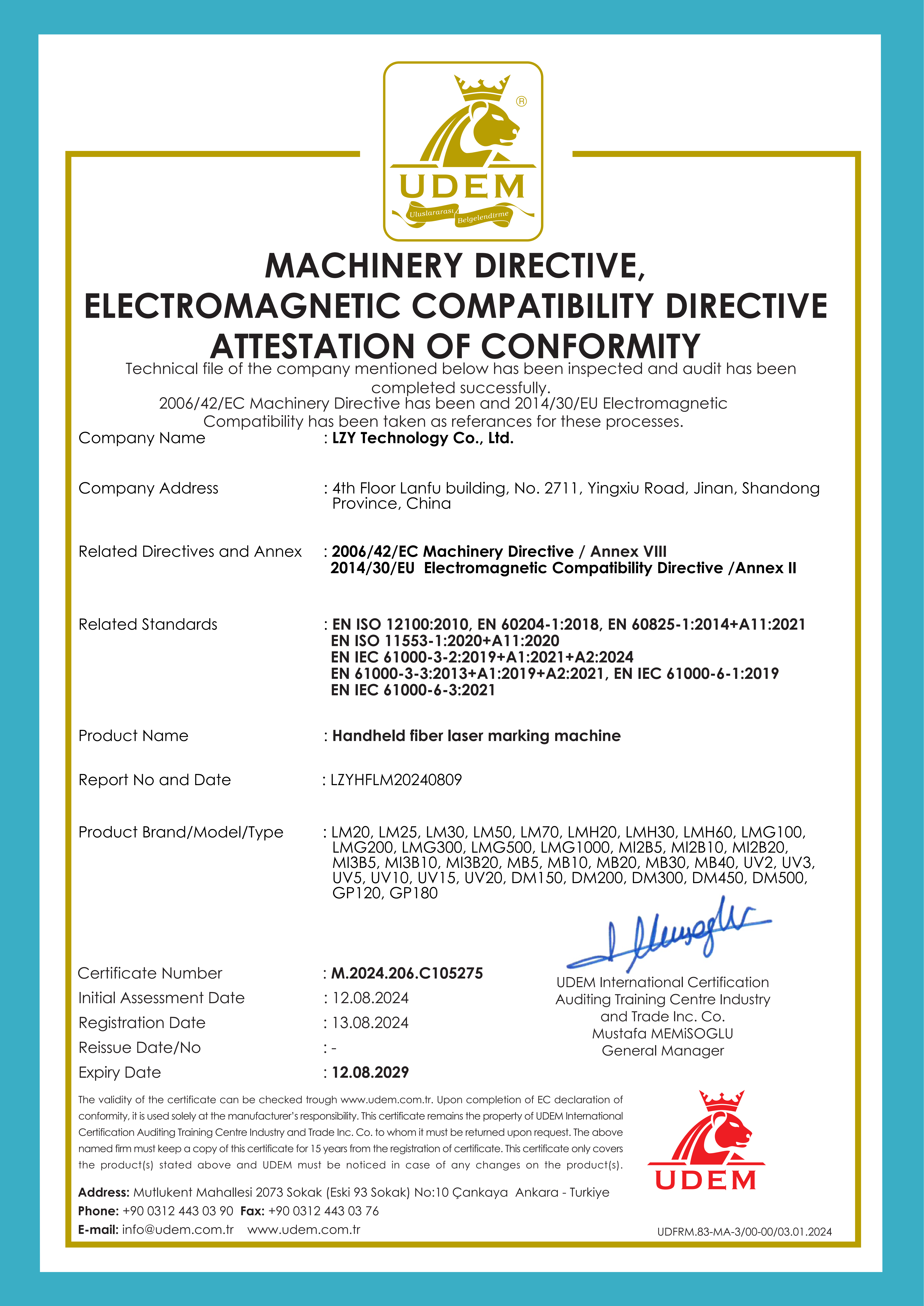
For the handheld fiber laser marking machine, the CE Declaration of Conformity carries certificate number M.2024.206.C105275, issued by UDEM International Certification Auditing Training Centre Industry and Trade Inc., with an issue date of 12 August 2024 and a validity date to 12 August 2029. The referenced standards include EN ISO 12100:2010, EN 60204-1:2018, EN 60825-1:2014+A11:2021, EN ISO 11553-1:2020+A11:2020, EN IEC 61000-3-2:2019+A1:2021+A2:2024, EN 61000-3-3:2013+A2:2019+A2021, EN IEC 61000-6-1:2019 and EN IEC 61000-6-3:2021.
FDA evidence for the same product is an FDA Radiological Health Electronic Submission Confirmation, certificate number 2211928-000, issued through CCTS (Shenzhen Zhongan Quality Inspection and Certification Co., Ltd.) on 15 November 2022 under Title 21 CFR Part 1002. Independently of any supplier document, laser products sold in the United States must comply with FDA 21 CFR Subchapter J (Radiological Health), Parts 1000 through 1005, and portable laser markers are specifically assessed against EN ISO 11553-2 for hand-held safety. On the trade side, HS Code 845611 is the primary classification for machine tools operated by laser processes.
One limitation deserves emphasis: the certification records available here are scoped to the handheld fiber laser marking machine. Buyers specifying UV, CO2, flying online, benchtop or miniature formats should request the corresponding certification documentation for that specific model rather than assume portfolio-wide coverage. Jinan Yuanshida International Trade Co., Ltd. is registered in Jinan, China, and engages in self-operated and agency import/export business, which is the entity name that should appear on customs and compliance paperwork.
Future Outlook
The direction of this category is towards formats that are defined less by their enclosure and more by how they attach to a cell. Battery-backed, air-cooled units extend marking to workpieces that cannot be moved; flying online units make marking a step inside the line rather than a station beside it; and UV formats keep cold processing available where heat-sensitive packaging and plastics are involved. As traceability requirements tighten across electronics, packaging, hardware and mechanical parts, the ability to produce permanent, scannable codes at the point of production becomes a line-level requirement rather than a labelling decision.
For buyers, the practical consequence is that the decision matrix should be run before the cell layout is frozen. Power draw, cooling type and consumable structure are the three inputs that determine whether a portable laser marking machine can be added to an existing cell, or whether the cell has to be planned around it.
FAQ
What power draw should a buyer plan for in a portable laser marking installation?
In this portfolio, the miniature multi-material laser marking machine is rated at an overall power of 100 W or less, while the benchtop fiber, desktop fiber, desktop CO2, UV and flying online formats are all specified below 400 W (the flying online unit at 400 W or less, and the UV figure excluding the external chiller). The handheld fiber unit publishes its input range of 90 V–240 V, 50/60 Hz and its battery operation but does not publish an overall wattage, so that figure should be requested from the supplier.
Which portable laser marking formats require external cooling?
The UV laser marking machine requires an external industrial water chiller, supplied as DWUV-05 with the machine. The miniature multi-material, handheld fiber, benchtop fiber, desktop fiber, desktop CO2 and flying online fiber formats all specify air cooling, several of them built-in. This distinction determines whether a unit can be relocated freely within a plant or must be installed near a chiller connection.
Do these laser marking machines require ink or other recurring consumables?
Laser marking does not use ink, ribbon or solvent. What buyers should plan for instead is laser-source lifetime: the handheld fiber laser marking machine specifies a laser life of about 100,000 hours, and the flying online fiber laser marking machine specifies a laser lifespan of 150,000 hours. These figures represent the expected service life of the light source rather than a recurring consumable order.
How do buyers match marking area to the parts being marked?
Stated marking areas differ by format. The miniature multi-material unit has a scanning area of 55 mm × 55 mm and a scene focal length of 133 mm. The handheld fiber unit is specified with a marking area of 110 mm × 110 mm. The desktop fiber unit offers 110 mm × 110 mm as standard with optional 150 mm × 150 mm, 175 mm × 175 mm and 200 mm × 200 mm areas, while the benchtop fiber and UV units are listed at 110 mm × 110 mm, with 150 mm × 150 mm available as an option on the benchtop unit. Buyers should confirm the marking area against the largest single part or the largest array of parts to be marked in one cycle.
Which formats handle PE/PVC, glass and composite materials?
The UV laser marking machine lists PE plastics, PVC plastics, metal parts, building materials, glass, film, packaging and composite materials among its applicable materials. The desktop CO2 unit lists glass, leather, cardboard and paper boxes, PET/plastics, wood and non-metallic packaging materials. The miniature multi-material unit lists metals, bamboo and wood, leather, paper, coloured glass, plastics and ceramics, and the fiber formats list metals together with non-metallic plastics such as PE and PVC.
What certification evidence applies to these machines?
For the handheld fiber laser marking machine, the CE Declaration of Conformity number M.2024.206.C105275 was issued by UDEM on 12 August 2024 and is valid to 12 August 2029, referencing standards including EN ISO 12100:2010, EN 60204-1:2018, EN 60825-1:2014+A11:2021 and EN ISO 11553-1:2020+A11:2020. The corresponding FDA record is certificate 2211928-000, issued on 15 November 2022 under Title 21 CFR Part 1002. The scope of these records covers the handheld fiber laser marking machine; other formats in the portfolio require their own documentation.
What are the main limitations buyers should plan around?
Three limits stand out. First, marking depth is capped at 0.4 mm or less on the UV, CO2 and flying online formats, so deep engraving applications should be matched to the benchtop fiber format, which specifies up to 4 mm. Second, the UV format depends on an external chiller, which adds footprint and reduces true portability. Third, repeatability figures such as ±0.001 mm (and ±0.003 mm on the flying online unit) apply to fixtured or machine-axis configurations; freehand handheld marking should not be expected to achieve the same result.
For buyers who want the full model-level specification set and certification references in one document, the supplier's English-language product brochure is available for download: Portable Laser Marking Machine Brochure (PDF).