
Portable Laser Marking Machine: Power, Area, Cooling
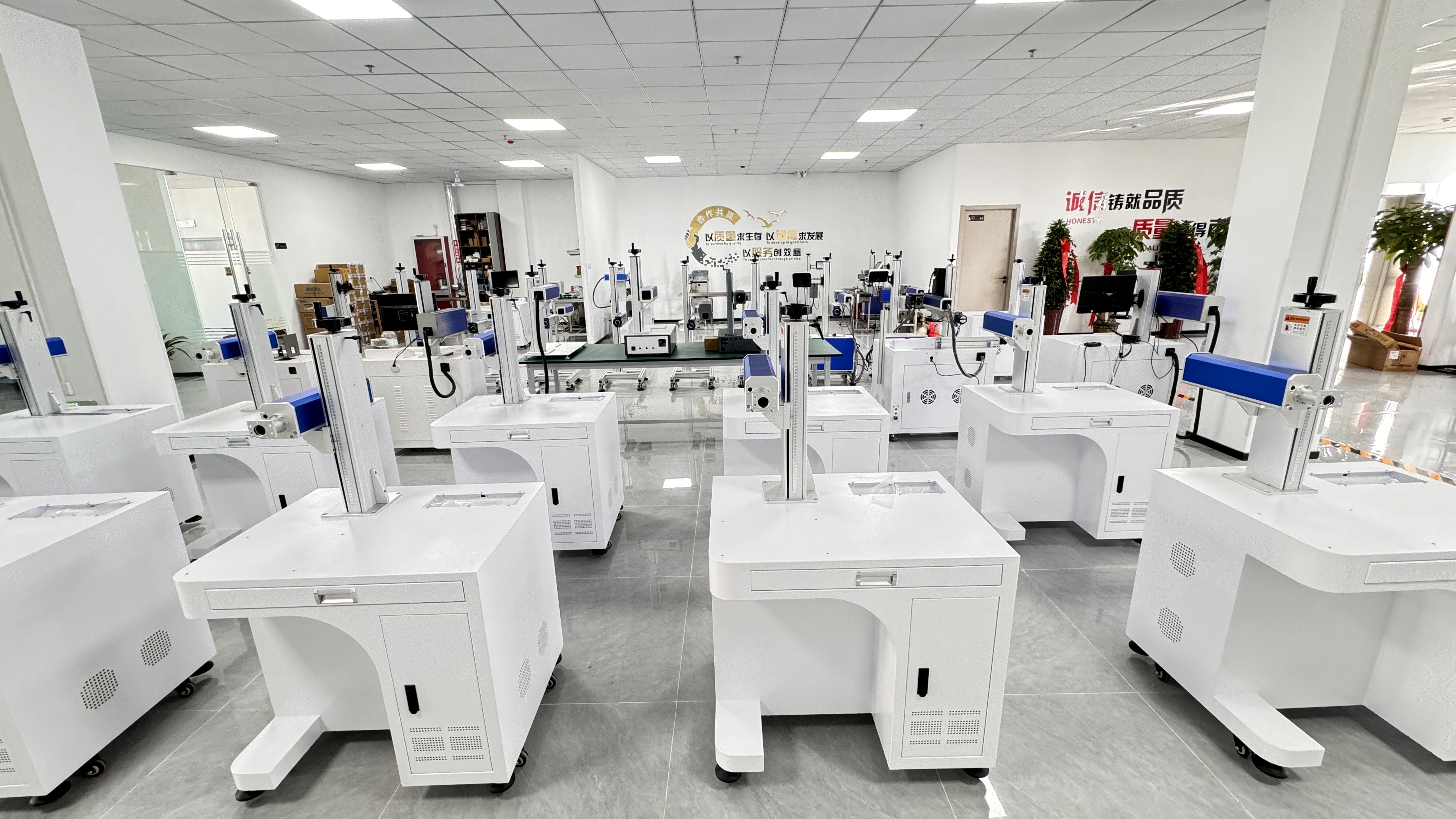
Portable Laser Marking Machines Have Split Into Distinct Configurations
Portable laser marking equipment now covers machines that share little beyond the ability to reach the workpiece. A 2.7 kg dual-source unit that runs from a power bank, a handheld fiber marker of roughly 6 kg with a built-in lithium battery, and a 3 W desktop UV system that depends on an external industrial water chiller are all sold under one category term, yet they answer different production questions. For buyers in the evaluation and execution stages, the productive comparison is not which machine is universally better, but which combination of power, marking area and cooling fits the workpiece, the location where marking happens, and the surrounding production line.
This reference set uses published configuration data for equipment supplied by Jinan Yuanshida International Trade Co., Ltd., a Jinan, China-registered company that provides laser marking equipment — handheld, bench-top, desktop and precision marking machines — and exports to markets including Vietnam, Thailand, Malaysia, Türkiye, the United States, Poland and the Middle East. The reading of that data is a buyer's reading: each specification is translated into what it changes at quotation stage and what it changes on the shop floor.
Three Variables Decide the Configuration: Power, Marking Area, Cooling
Laser power sets how much energy reaches the material. Marking area sets what can be marked in a single pass before the part or the marking head has to move. Cooling sets where the machine can physically run — a bench in a workshop, a station on a production line, or a customer's site. Table 1 places four configurations that are frequently shortlisted together side by side.
Table 1 — Configuration comparison: power, marking area, cooling, mobility
| Configuration | Laser source and power | Marking area | Cooling and supply | Mobility |
|---|---|---|---|---|
| Miniature multi-material laser marking machine | Dual switchable light source: 1064 nm / 455 nm; power regulation range 25–100, gradient adjustable; overall power ≤ 100 W | Scanning area 55 mm × 55 mm; scene focal length 133 mm | Air cooling; built-in lithium battery or DC 20 V with power bank support; TYPE-C power input, TYPE-A data | 2.7 kg; controlled by mobile app, PC software or touch screen |
| Handheld fiber laser marking machine (second generation) | Fiber source 1064 nm; laser power 20 W / 30 W / 50 W / 60 W | 110 mm × 110 mm | Air cooling; built-in lithium battery; 90–240 V, 50/60 Hz; Linux system with 7-inch touch screen; Bluetooth, WiFi and mobile app | Net weight about 6 kg; handheld operation without an external power supply |
| Desktop fiber laser marking machine | Fiber source 1064 nm, pulse width under 60 ns; laser power 20 W / 30 W / 50 W / 100 W | 110 mm × 110 mm standard; optional 150 × 150 mm, 175 × 175 mm, 200 × 200 mm | Built-in air cooling; overall power under 400 W | Bench-mounted; fixed installation |
| Desktop UV laser marking machine | UV source 355 nm, pulse width under 60 ns; laser power 3 W / 5 W; modulation frequency 30–100 kHz; beam quality M² < 1.5 (single mode) | 110 mm × 110 mm | External industrial water chiller (DWUV-05 included); overall power under 400 W; 110–240 V | Bench-mounted, 352 mm × 603 mm × 800 mm; requires floor space for the chiller |
Laser Power and Overall Power Draw Are Two Different Numbers
A recurring source of misquotation in procurement documents is the difference between laser power and overall power consumption. On the desktop UV unit, laser power is 3 W or 5 W, while overall power is under 400 W because the system includes the chiller and control electronics. On the desktop fiber unit, laser power ranges from 20 W to 100 W, and overall power is again under 400 W. On the miniature multi-material unit, the published figure is a single overall value of ≤ 100 W, together with a gradient-adjustable power regulation range of 25–100.
The distinction matters for three procurement tasks:
- Electrical planning. The handheld fiber unit takes 90–240 V at 50/60 Hz, and the UV unit accepts 110–240 V. If a site runs on a generator or a shared circuit, the overall draw — including the chiller on the UV configuration — is the number that has to fit the available supply.
- Heat and duty. A higher laser power does not automatically mean a larger heat load at the bench, but the published overall figures show that all three larger configurations sit in the same sub-400 W band, so site heat planning is broadly comparable between them.
- Service life framing. The handheld fiber unit lists a laser life of about 100,000 hours. A separate flying online fiber configuration in the same supplier's range lists a laser lifespan of 150,000 hours, which illustrates how duty cycles differ between handheld use and continuous inline production. Buyers should treat service-life figures as relative indicators tied to duty, not as interchangeable numbers.
For UV cold processing, a 3 W or 5 W source is not a low-capability machine by default. The 355 nm wavelength and the published beam quality of M² < 1.5 (single mode) describe a different operating principle from the 1064 nm fiber units: the comparison is between process types, not between two power ratings on the same scale.
Marking Area: Field Size Sets What Fits in One Pass
The marking area column in Table 1 is where most shortlist decisions are actually made. The miniature unit marks within a 55 mm × 55 mm scanning area with a scene focal length of 133 mm, which suits small components and single-piece customisation but requires repositioning for anything larger. The handheld fiber unit and the desktop UV unit both mark 110 mm × 110 mm. The desktop fiber unit starts at 110 mm × 110 mm and can be ordered with 150 × 150 mm, 175 × 175 mm or 200 × 200 mm lenses, which changes how much of a larger plate or panel can be processed without indexing.
Two secondary figures decide whether the field size is usable for a given job:
- Minimum feature size. The desktop fiber unit specifies a minimum line width of 0.4 mm and a minimum character height of 0.15 mm; the UV unit specifies a minimum line width of ≤ 0.4 mm and a minimum character of 0.15 mm; the benchtop fiber unit in the same range lists a minimum line width of 0.01 mm and a minimum character of 0.15 mm; the flying online fiber unit lists 0.012 mm and 0.15 mm respectively. Where legibility of very small codes is the driver, these figures matter more than the field size.
- Depth and repeatability. The UV unit lists a maximum marking depth under 0.4 mm, and the desktop fiber unit lists 0.4 mm, both with repeatability of ±0.001 mm. The benchtop fiber unit lists a maximum marking depth of up to 4 mm at the same ±0.001 mm repeatability. The flying online unit lists repeatability of ±0.003 mm with a focal spot diameter of 0.01 mm. Deep engraving and shallow surface marking are therefore different purchase categories even when the field sizes match.
A practical rule follows from these figures: choose the marking area from the largest single part that must be processed without repositioning, then check the minimum character and depth requirements against the same unit. Choosing a lens that is too large for the required feature detail is a common and avoidable mismatch.
Cooling Architecture: What Air Cooling Enables and What Water Cooling Costs
Air cooling is specified across the miniature multi-material unit, the handheld fiber unit, the desktop fiber unit, the benchtop fiber unit and the flying online fiber unit. The desktop UV laser marking machine is the exception in this comparison set: it is supplied with an external industrial water chiller (DWUV-05 included).
The practical consequences are straightforward. Air-cooled configurations can be moved to the workpiece, run from a battery or a DC 20 V supply, and placed where the marking task is, which is what makes on-site marking of large or immovable workpieces possible. The UV unit, by contrast, is a bench-mounted system measuring 352 mm × 603 mm × 800 mm, and the chiller is a separate item that needs its own stable position and air flow. That configuration is better matched to a fixed packaging or inspection station than to field work — the trade-off is deliberate, because the 355 nm source and the associated cooling arrangement support the cold-processing behaviour that heat-sensitive substrates require.
Buyers evaluating continuously operating lines should request duty-cycle and ambient-temperature data for the specific configuration rather than assuming that an air-cooled machine is suitable for unlimited continuous operation. Published specifications typically state the cooling method, not the continuous-duty curve.
Safety design is a separate axis that should be checked on the quotation. The equipment described here is specified with Class 4 laser safety enclosures and anti-radiation observation windows, safety door interlocks that cut laser emission as soon as the enclosure is opened, an emergency stop button, and OD5+ laser safety eyewear as standard supply. Electrical protection includes overload protectors, residual current circuit breakers and grounding systems, with automatic thermal shutdown and alarm functions for the laser source and power supplies. Each machine is described as undergoing a 72-hour continuous full-load aging test and insulation withstand voltage testing before dispatch.
Matching Configuration to Workpiece and Site
The most reliable way to shortlist is to start from the workpiece and the marking location rather than from the machine category.
- Hardware parts, auto parts and mechanical spare parts. The handheld fiber unit covers stainless steel, carbon steel, aluminium alloys, copper, iron, gold, silver, carbide, painted metal, acrylic, PVC, leather and painted wood, with a 110 mm × 110 mm field. For higher-volume bench work on the same materials, the desktop fiber unit offers 20 W to 100 W and optional lenses up to 200 × 200 mm.
- Pipes and profiles on site. The handheld fiber unit's roughly 6 kg body and built-in lithium battery exist precisely for this case: the machine travels to a pipe or profile that cannot be moved. A bench-mounted UV or desktop fiber unit cannot perform this task economically.
- Electronic components and heat-sensitive substrates. The UV unit's 355 nm wavelength, M² < 1.5 beam quality and maximum depth under 0.4 mm suit fine marking with minimal thermal load, while the miniature unit's switchable 1064 nm / 455 nm source and 55 mm × 55 mm scanning area suit small 3C accessories, connectors and enclosures.
- Jewellery and small metal items. The handheld fiber unit lists jewellery among its application industries and covers gold and silver; the miniature unit is aimed at jewellery alongside gifts and crafts.
- Gifts, crafts and customised workshops. The miniature unit's material list — metals, bamboo and wood, leather, paper, coloured glass, plastics and ceramics — matches mixed-material, low-volume work where 2.7 kg of equipment weight and power-bank operation decide whether a job is possible at all.
- Packaging, medical and consumer-goods production. The UV unit and the desktop fiber unit both list food and beverage packaging, pharmaceuticals, daily chemicals, cosmetics, electronics, hardware, steel and cement production lines among their application industries.
Portability should be read against the workpiece, not against the catalogue. The verified benchmark for handheld and portable laser marking machines is a typical weight of 15 to 35 pounds, or about 6.8 kg to 15.8 kg. The handheld fiber unit in this set is listed at roughly 6 kg, and the miniature unit at 2.7 kg, so both sit at or below the lower end of that typical band — which is useful context when a supplier describes a machine as portable without giving a figure.
Supplier Capability, Certification and Trade Practicalities
Configuration choices only become an order once the supplier's production and compliance records are checked. Jinan Yuanshida International Trade Co., Ltd. was founded in 2012 and operates design and manufacturing services for portable laser marking equipment with OEM and ODM capabilities, including customised solution development alongside standard production modes. The minimum order quantity for portable laser marking machine orders is stated as 5 units, and delivery terms such as EXW, FOB or CIF, along with acceptance procedures, are negotiated per order rather than fixed by default.
Quality control is described as pre-shipment aging tests and precision calibration for all machines, with acceptance inspection following the same two steps. Payment terms are structured as deposit plus balance. After-sales support is provided in English, and the company states exports to more than 80 countries and regions, with named markets including Vietnam, Thailand, Malaysia, Turkey, the United States, Poland and the Middle East.
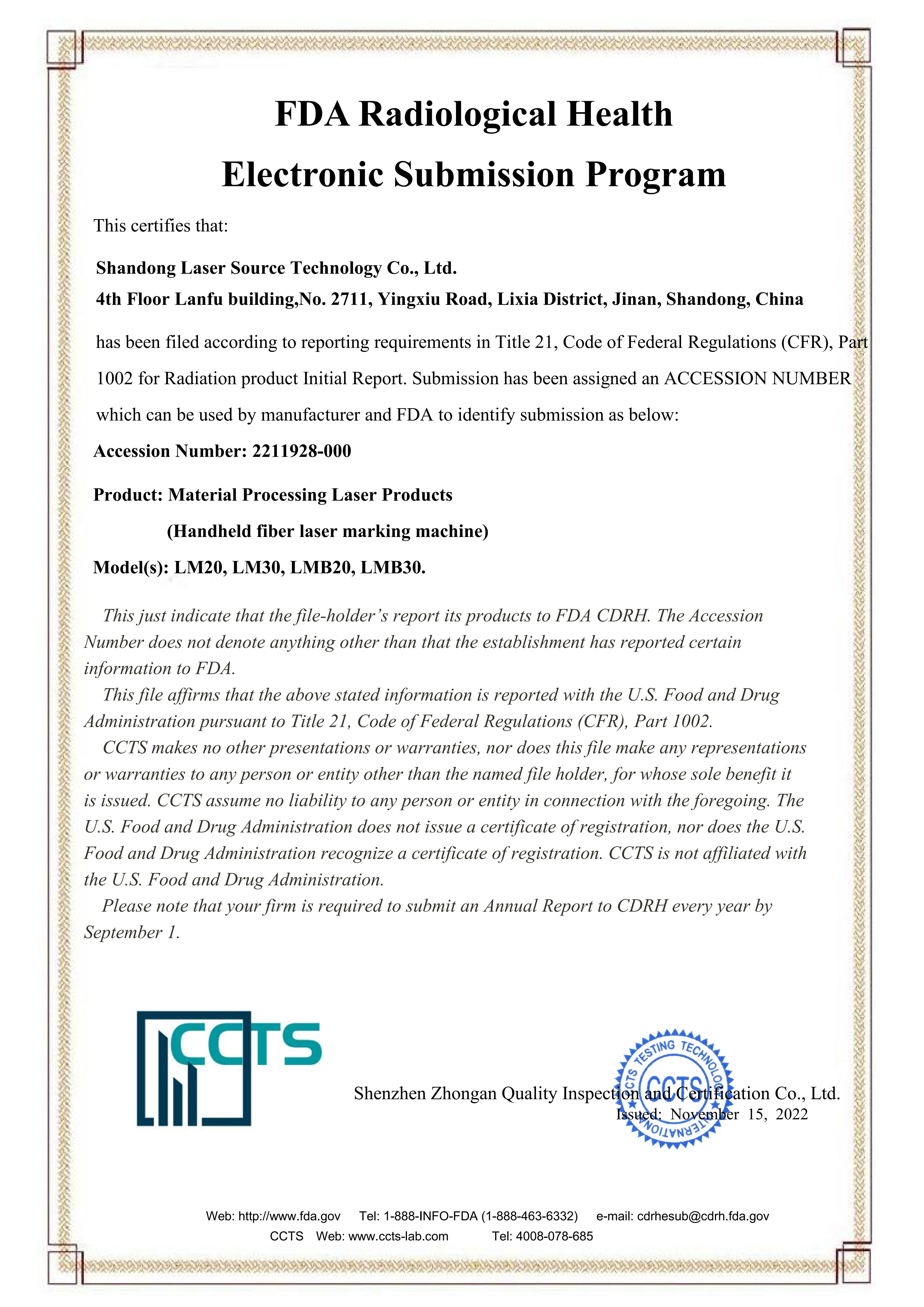
On compliance, two documents are relevant to the North American and European markets, and both are scoped to the handheld fiber laser marking machine:
- CE Declaration of Conformity M.2024.206.C105275, issued by UDEM International Certification Auditing Training Centre Industry and Trade Inc., valid from 12 August 2024 to 12 August 2029 for the European Union market. The listed standards include EN ISO 12100:2010, EN 60204-1:2018, EN 60825-1:2014+A11:2021, EN ISO 11553-1:2020+A11:2020 and the EMC series EN IEC 61000-6-1:2019, EN IEC 61000-6-3:2021, EN IEC 61000-3-2 and EN 61000-3-3.
- FDA Radiological Health Electronic Submission Confirmation 2211928-000, issued 15 November 2022 under Title 21 CFR Part 1002 for the United States market, covering the handheld fiber laser marking machine.
Buyers should note that laser products sold in the United States fall under FDA 21 CFR Subchapter J, Parts 1000 through 1005, and that portable laser markers are specifically assessed against EN ISO 11553-2 for hand-held safety in the EU and international context. For import logistics, HS code 845611 is the primary classification used for machine tools operated by laser processes, which is the heading importers normally declare. The practical implication is that certification scope, not certification presence, should be written into the purchase specification: a certificate covering one handheld model does not automatically cover a desktop UV or a miniature unit.
What Portable Units Cannot Replace
Honest configuration planning includes the tasks these machines are not the right answer for.
- Deep engraving. Several units in this set specify a maximum marking depth of under 0.4 mm or 0.4 mm. Work requiring deeper material removal is outside that envelope, even though the same machine may mark the same material perfectly at the surface.
- Large flat panels in one pass. Marking area is fixed by the lens. A 110 mm × 110 mm field cannot be expanded by software; the part has to be repositioned, or a larger lens ordered, or the job moved to a different machine class.
- High-volume inline production. A separate flying online fiber configuration in the same range lists a line speed of up to 7,000 mm/s and an output rate of 800 standard characters per second for continuous online marking. A handheld unit operated by a worker cannot match that throughput, and should not be specified as if it could.
- Field work with a water-chilled UV source. The UV unit's external industrial chiller is an advantage for thermal control in a fixed station and a constraint for site work; buyers who need UV-grade marking at a remote location should confirm explicitly what the supplier can support.
- Battery runtime planning. Publicly reviewed specifications for the miniature and handheld configurations state that a built-in lithium battery is used, but continuous runtime and cycle-life figures are not published in the same documents. This is an information gap buyers should close with the supplier in writing — discharge behaviour under a defined marking load — before committing to a field deployment plan.
Relative to older marking methods, the trade-off is also structural. Laser marking removes ink and chemistry consumption from the process and produces permanent marks, but it requires a capital purchase, fixture planning and material-specific parameter development. In low-volume, non-critical applications, a lower-cost marking method can remain economically justified — a point that rarely appears in supplier literature but should appear in a buyer's own decision file.
Market Signals Behind Portable Marking Configurations
The configuration split described above is happening inside a market that continues to expand. Grand View Research estimated the global laser marking machine market at USD 4.4 billion in 2026, with a forecast period running from 2026 to 2033. Within that market, fiber laser technology held a revenue share of 46.1% in 2025, which aligns with the number of fiber-based configurations in this comparison. Asia Pacific was the largest regional market in 2025, accounting for approximately 44% of revenue.
Forecast figures should be handled as planning inputs rather than procurement specifications. Published compound annual growth rates for this market vary noticeably — one source reports 7.4% while another reports 11.84% — most likely because some forecasts include coding equipment and others restrict themselves to marking equipment. The direction is consistent; the exact rate is methodology-dependent.
A genuine data gap also exists on the configuration question itself. There is no widely published, verified figure for the share of the laser marking market held specifically by portable or handheld units, and no verified average battery operating-hours figure for cordless units. Buyers should therefore treat portability claims as specification-level claims — weight, battery type, power supply — and not as market-share evidence.
Future Outlook
The three variables in this comparison are unlikely to converge into a single "portable laser marking machine" specification. Power, marking area and cooling pull in different directions: a larger field and a deeper engraving capability add mass and cooling demand, while battery operation and a 2.7 kg body require a smaller field and a lower overall power envelope. The realistic development path is further configuration splitting, with dual-source miniature units for mixed materials, handheld fiber units for on-site marking of immovable workpieces, and water-chilled UV units occupying fixed stations where thermal control and fine feature size matter more than mobility.
For buyers, that means the shortlist should be built from the workpiece, the marking location and the required feature size — and then verified against certification scope, duty-cycle data and battery behaviour in writing. The configurations that win those checks are the ones that will still be appropriate two or three years after installation.
FAQ
How much laser power does a portable marking machine need for metal parts?
Fiber-based configurations in this reference set are offered at 20 W, 30 W, 50 W and 60 W for the handheld fiber laser marking machine, and at 20 W, 30 W, 50 W or 100 W for the desktop fiber laser marking machine. The appropriate choice depends on marking depth, cycle time and material rather than on a single rule; the desktop fiber unit lists a maximum marking depth of 0.4 mm with repeatability of ±0.001 mm, so shallow surface marking on steel, aluminium or coated metal is achievable well below the maximum rating, while deeper requirements may need a different machine class.
What marking area is normal for a portable laser marking machine?
In this set, the miniature multi-material unit has a scanning area of 55 mm × 55 mm with a scene focal length of 133 mm; the handheld fiber unit and the desktop UV unit both mark 110 mm × 110 mm; and the desktop fiber unit offers 110 mm × 110 mm as standard with optional 150 × 150 mm, 175 × 175 mm and 200 × 200 mm lenses. Marking area is fixed by the optical configuration, so the field size cannot be expanded later without changing the lens or the machine.
Is air cooling sufficient, or is water cooling required?
Air cooling is the specified method for the miniature multi-material unit, the handheld fiber unit, the desktop fiber unit, the benchtop fiber unit and the flying online fiber unit. The desktop UV laser marking machine is supplied with an external industrial water chiller (DWUV-05 included). The choice affects placement rather than marking quality: air-cooled units can be moved to the workpiece and run from battery or DC power, while the water-chilled configuration is a fixed bench installation of 352 mm × 603 mm × 800 mm that also requires space for the chiller. Buyers planning continuous operation should confirm duty-cycle limits in writing for either method.
What are the minimum order quantity and pre-shipment inspection steps?
The minimum order quantity for portable laser marking machine orders is 5 units. Quality control is described as aging tests and precision calibration for all machines before delivery, and acceptance inspection follows the same stages of pre-shipment aging tests and precision calibration. Delivery terms such as EXW, FOB or CIF, and the specific acceptance procedure — on-site acceptance, remote testing or third-party inspection — are negotiated and confirmed per order, with payment structured as deposit plus balance.
Which certifications should a buyer verify before importing?
For the handheld fiber laser marking machine, the supplier holds a CE Declaration of Conformity, number M.2024.206.C105275, valid from 12 August 2024 to 12 August 2029, issued by UDEM International Certification Auditing Training Centre Industry and Trade Inc., and an FDA Radiological Health Electronic Submission Confirmation, number 2211928-000, issued 15 November 2022 under Title 21 CFR Part 1002. Laser products placed on the United States market fall under FDA 21 CFR Subchapter J, Parts 1000 through 1005, and portable laser markers are assessed against EN ISO 11553-2 for hand-held safety. Buyers should confirm that the certificate scope names the exact model being purchased, because scope is model-specific.
Can a portable laser marking machine replace an inline marking system?
Not for continuous high-speed lines. A flying online fiber marking configuration in the same equipment range lists a line speed of up to 7,000 mm/s, an output rate of 800 standard characters per second, a laser lifespan of 150,000 hours and repeatability of ±0.003 mm. Handheld and miniature configurations are designed around mobility and access, with built-in lithium battery or DC 20 V power and weights of approximately 6 kg and 2.7 kg respectively. Portable units solve access to immovable or awkward workpieces; inline systems solve throughput on a moving line, and the two roles are complementary rather than interchangeable.
The configurations compared here are documented from published specifications and certification records. Buyers who need the full parameter set, including lens options, power supply variants and certification scope, can review the supplier's machine catalogue and company information at yuanlaser.com; the downloadable product brochure is available at second-generation marking machine brochure (PDF).