
Portable Laser Marking Machine: RFQ Claims vs Evidence
Portable Laser Marking Machine: RFQ Claims vs Evidence
In a portable laser marking machine RFQ, the useful comparison is not between two brochures. It is between what a supplier will commit to in a purchase order and what a buyer can measure at acceptance. The same headline numbers can describe very different equipment: a UV desktop platform stated at 355 nm with 3 W or 5 W output, external industrial cooling, USB and a 110 × 110 mm marking area; or a miniature dual-light unit stated at 2.7 kg that switches between 1064 nm and 455 nm, runs from a battery or DC 20 V, draws no more than 100 W and is air cooled. This scorecard sets both claim packages against acceptance evidence, then maps them to purchase-order terms and to the laser, optical and electrical safety files a decision-stage buyer should request.
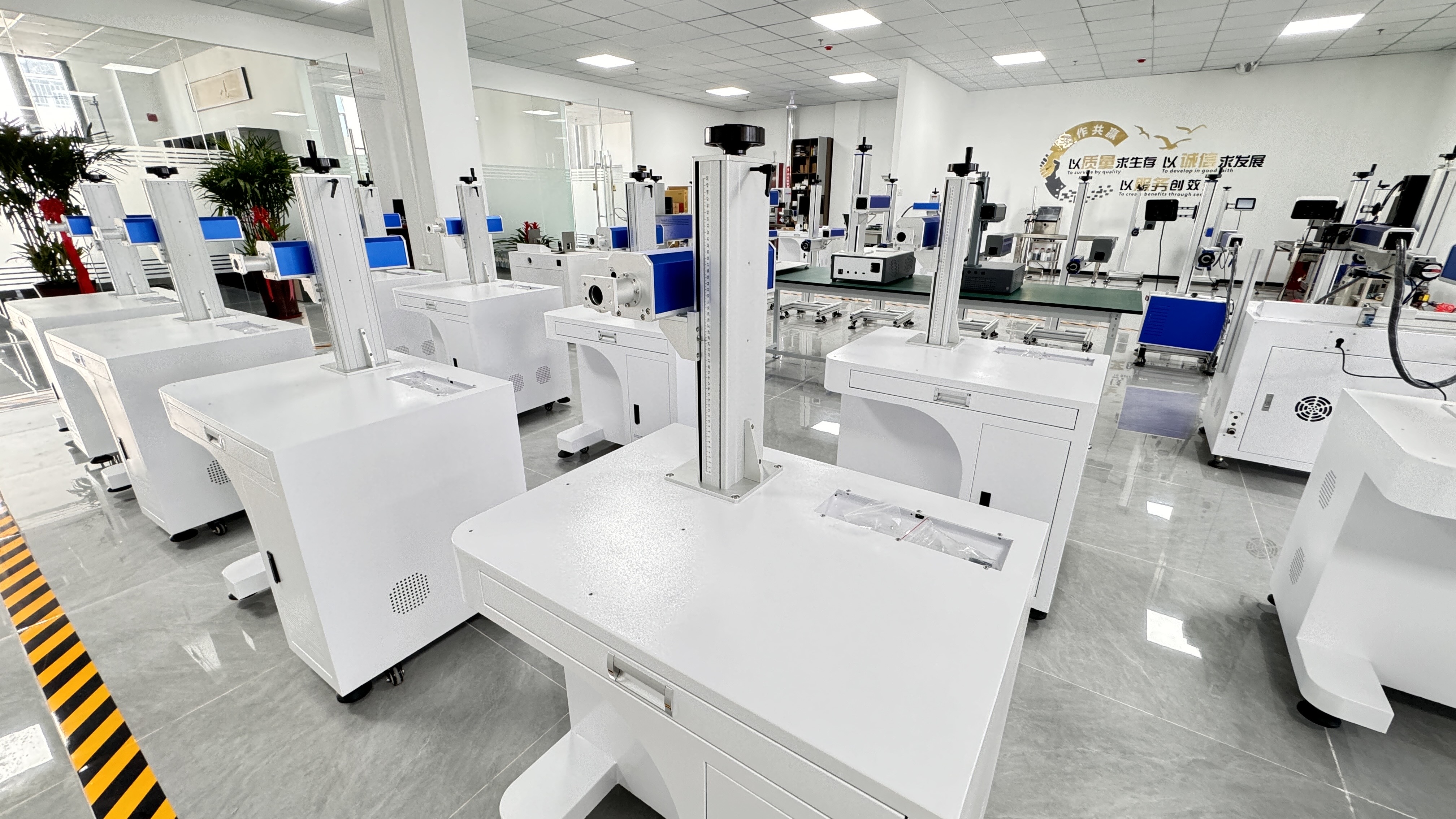
Production and assembly environment documented by the supplier.
Why RFQ answers and acceptance evidence diverge
An RFQ response is written to get a supplier shortlisted; an acceptance test is written to close a purchase order. The gap between the two usually appears in three places: numbers quoted without the configuration they belong to, test conditions left unstated, and documents named in the answer but never attached. A response that lists a 0.15 mm character size is making a capability statement, and it becomes an order term only when lens, focal distance, material and parameter set are fixed alongside it. A response that lists external industrial cooling is describing a siting requirement as much as a feature, because the chiller, the coolant and the ambient conditions sit on the buyer’s side of the installation.
Reading claims this way is not suspicion; it makes the comparison decidable. Every figure in an RFQ answer should be attached to three things before it enters a scorecard: the exact configuration it applies to, the method used to measure it, and the acceptance step that will confirm it. Where an answer cannot supply all three, the claim stays a claim.
The buyer scorecard: eight rows that decide the order
The table below is the working core of this review. It compares what an RFQ answer typically states for a portable laser marking machine with the evidence that should be attached, and with the acceptance check that converts the statement into a purchasing term. It applies equally to a UV desktop configuration and to a miniature dual-light unit; the row values change, the discipline does not.
| Claim area | Typical RFQ wording | Evidence to attach | Acceptance check |
|---|---|---|---|
| Wavelength and source | 355 nm; 1064 / 455 nm switchable | Source type per wavelength, laser class label, declared output for each wavelength | Measurement at the workpiece plane, per wavelength |
| Rated power | 3 W or 5 W; no more than 100 W | Which figure is optical output and which is electrical input; tolerance | Declared output confirmed within tolerance at ordered parameters |
| Marking area and character size | 110 × 110 mm; 0.15 mm | Lens, focal distance, material and parameters used for the minimum character | Test plate marked at PO settings, measured with an agreed instrument |
| Cooling | External industrial cooling; air cooling | Chiller specification and ambient limits, or airflow and duty assumption | Continuous run at the buyer’s ambient temperature |
| Power supply and battery | Battery or DC 20 V | Battery chemistry, capacity, runtime per charge, charge time, DC input tolerance | Runtime measured at a defined marking duty |
| Interface and software | USB | What the port supports, accepted file formats, software version | File transfer and job recall performed on the delivered unit |
| Weight | 2.7 kg | Whether the figure includes battery, cable, marking head or carrying case | Weigh the delivered unit as configured in the order |
| Safety and compliance | CE; Class 4 enclosure | Test reports, laser class label, enclosure and interlock description, electrical protection records | Document review plus interlock and emergency-stop function test |
Two rows deserve emphasis before the configurations are examined in detail. Weight and cooling are the claim areas where the answer format itself is unstable: weight may or may not include the battery, cable and case, and cooling may describe a chiller the buyer must own and maintain or an airflow path inside a hand-carried unit. Neither is a defect. Both are ambiguous unless the purchase order says which reading applies.
Reading the UV desktop package: 355 nm, 3 W or 5 W, external cooling
The UV desktop configuration in this comparison is documented as 355 nm output, 3 W or 5 W, external industrial cooling, USB, a 110 × 110 mm marking area and a 0.15 mm character size. Each element is a separate commitment.
Wavelength and power
355 nm is an ultraviolet output, and UV marking is commonly used where heat input into the part has to stay limited; the practical boundary is set by the material and the parameter set, not by the wavelength alone. The “3 W or 5 W” phrasing is an option list rather than a specification: a purchase order must state which of the two is being bought and what tolerance applies to the delivered output. Optical output and electrical input are different quantities, and a response that mixes them is not comparable with one that separates them. Where a supplier quotes output power, the acceptance test should confirm it at the workpiece plane under the ordered parameter set.
Work envelope, character size and cooling
A 110 × 110 mm marking area is a work envelope measured at a defined focal distance, so field size and focal distance belong in the same sentence of the purchase order. The 0.15 mm character size is the tighter claim of the two: character height, stroke width and line width are three different measurements, and a buyer should require the supplier to state which one the figure describes, on which material, at which parameter set. The acceptance step is a marked test plate at the ordered settings, measured with an agreed instrument.
External industrial cooling moves heat removal outside the marking unit. For a buyer that is a siting decision as much as a technical one: it implies a chiller or coolant circuit, a maintenance item and a stable ambient envelope, and it means the unit is planned as fixed equipment in a cell rather than carried between jobs. The same fact appears as an advantage in a temperature-controlled production area and as an extra asset to own in a workshop where nobody wants a second cooling system. The purchase order should say who supplies the cooling unit, what ambient range the supplier expects and what duty-cycle assumption applies.
Reading the miniature dual-light package: 2.7 kg, 1064 / 455 nm, battery or DC 20 V
The miniature dual-light configuration in this comparison is documented as 2.7 kg, switchable 1064 nm and 455 nm, battery or DC 20 V supply, no more than 100 W input and air cooling. Here the claims needing the most scrutiny are weight, the two wavelengths and the power ceiling.
Weight and what it includes
A 2026 industry guide describes handheld and portable laser marking machines as typically weighing 15 to 35 lb, roughly 6.8 to 15.8 kg. A 2.7 kg figure therefore sits outside that published band, which is a reason to ask what the number covers rather than a reason to reject it. Marking head alone, head with battery, head with cable and case, and complete shipping configuration are four different measurements, and only one of them tells a technician what they will carry up a ladder. The acceptance check is a scale: weigh the delivered unit in the configuration named in the order.
Two wavelengths, one power ceiling
“Switchable 1064 / 455 nm” needs a per-wavelength answer. For each wavelength the RFQ response should state whether it is a marking source or an aiming/indication beam, what output is delivered and which materials it is intended for. Two wavelengths in one enclosure also mean two eyewear ratings, two parameter sets and two sets of acceptance marks; a test plate marked at one wavelength does not confirm the other. The 455 nm output is visible light, which changes handling practice on site, while 1064 nm near-infrared output is invisible and depends on enclosure, interlock and eyewear discipline rather than on the operator’s eye.
The supply claim, “battery or DC 20 V”, should be read as two operating modes with different acceptance tests. In battery mode, runtime per charge, charge time and battery chemistry need to be declared: the supplied claim package does not state them, and verified public data on battery cycle life for cordless marking units is thin, so the supplier’s own declaration plus a runtime test at a defined marking duty carries the weight. For DC 20 V operation, the nominal input, its tolerance and the charger approvals belong in the document list. The ceiling of no more than 100 W input is a siting fact rather than a performance guarantee: it tells the buyer what the unit will draw from a supply or a battery, not how quickly it will mark.
Air cooling, finally, removes the chiller but adds a duty-cycle question. In a hot workshop the ambient temperature and the expected continuous marking time should be stated in the order, because air-cooled units are normally rated against a reference ambient and a duty assumption.
Safety evidence: laser, optical and electrical files
Safety is the area where an RFQ answer most often substitutes a word for a document. Two evidence sets should be requested for every portable laser marking machine, and both should name the model and configuration actually being shipped.
On the laser and optical side, the reference points are established. Portable laser markers are specifically assessed against EN ISO 11553-2 for hand-held safety, and laser products sold in the United States must comply with FDA 21 CFR Subchapter J, Parts 1000 through 1005. The documents to request are the laser class label and classification information, a description of the enclosure and its interlock function, and the specification of any observation window. Class 4 laser safety enclosures with anti-radiation observation windows are a common configuration; the evidence item is the stated attenuation of the window and the measured response of the interlock, not the phrase in the brochure. Eyewear should be specified against the actual wavelength or wavelengths in use, because a rating written for 1064 nm does not describe protection at 355 nm or 455 nm. The acceptance step is a function test: interrupt the interlock path and confirm emission stops, then confirm the emergency stop.
On the electrical and high-voltage side, the items to request are overload protectors, a residual current circuit breaker and documented grounding protection, together with the test records showing they were verified rather than merely installed. For a DC 20 V unit the charger or adaptor carries its own approvals, and those belong in the same file. For a UV desktop unit with external cooling, the chiller’s electrical protection and any leak detection are part of the installation, not an accessory question.
A CE claim is a starting point rather than a complete evidence pack. The document request should name the reports, the standards editions and the dates, and the paperwork should match the configuration on the purchase order.
Turning claims into purchase order language
The scorecard only pays for itself if it reaches the contract. These terms carry the comparison into the order:
- Model, configuration and every quoted figure, each with the condition under which it applies.
- A statement separating optical output from electrical input, with tolerances.
- The acceptance procedure: sample material, parameter set, instruments, number of test marks and who witnesses the test.
- Cooling responsibility: chiller supply, coolant, ambient range and duty assumption, or the air-cooling duty assumption.
- Battery runtime defined as a test at a stated marking duty, not as a headline figure.
- A document list with delivery dates: laser class information, EN ISO 11553-2 assessment where applicable, FDA 21 CFR 1000-1005 compliance for US-bound products, electrical protection records and charger approvals.
- HS code 845611, the classification used for machine tools operated by laser processes in international trade, kept consistent across purchase order, commercial invoice and packing list.
- Warranty and spare-parts terms as offered, with response time stated rather than assumed.
Two of these deserve a note. The acceptance procedure is the only line that cannot be written after delivery, and the document list is the only line a supplier can satisfy with paper already on file. Everything else in the order depends on those two being specific.
Where each configuration fits in production
The two packages answer different production questions, and mixing them in one comparison produces the wrong shortlist.
For hardware parts, mechanical spare parts and tooling identification, the deciding variables are usually marking area and cycle time, which favour a fixed desktop platform with a defined 110 × 110 mm envelope and a repeatable fixture. For pipes and profiles and other large-size workpieces, the constraint moves to the machine: a 2.7 kg on-site portable laser marking machine that can be carried to the workpiece changes the handling problem, and the two wavelengths matter when the workpiece surface and the surrounding components are different materials. For electronic components, jewelry, gifts and crafts, the minimum character size and the heat input into a small part dominate, which is where a 0.15 mm character claim and a UV output have to be proven on the actual material rather than accepted from a table.
The stated application scope behind this equipment covers mechanical parts processing, electronic and electrical production and medical equipment, so a multi-material portable laser marking machine is often evaluated against several of those uses at once. That is exactly when a single test plate becomes insufficient: the acceptance procedure should include one sample from each material family the buyer intends to mark, and a high-speed portable laser marking machine claim should be tested at the parameter set that will actually run in production.
Laser marking against CNC engraving: supported differences and their limits
The clearest traditional comparison in the supplied material is with CNC engraving. The documented differences are substantial: laser marking is a non-contact thermal process, whereas CNC engraving cuts physically and can warp thin materials; the laser beam diameter is stated as down to 0.01 mm against a 0.5 to 1 mm minimum bit size; marking speed is stated as ten times faster, with a micro-marking damage rate given as 0%. On cost, the initial price is described as matching mid-to-high CNC machines while eliminating ongoing cutter-bit purchases and tool wear, and maintenance is described as a fixed optical path with zero mechanical wear against frequent bit changes, zeroing and dust and chip cleanup.
Read as claims, each of those needs its condition. A tenfold speed figure depends on material, parameter set and measurement method; a micro-marking damage rate of 0% needs a definition of what counts as damage and how it was inspected. The comparison also has a boundary: it addresses marking speed, damage, consumables and maintenance, and it does not establish cut depth or thick-section material removal, so a buyer whose process needs deep engraving should request separate evidence rather than extend this comparison. Used within that boundary, the material supports a real procurement question, which is whether the annual cost of cutter bits and rework at the buyer’s volume exceeds the difference in capital price.
Market context that does not validate a supplier claim
Category data is useful for budgeting and for understanding why so many RFQ responses converge on similar specifications; it is not evidence about a specific unit. The global laser marking machine market is estimated at USD 4.4 billion in 2026 by Grand View Research, fiber laser technology held a 46.1% revenue share in 2025, and Asia Pacific accounted for approximately 44% of revenue in 2025. Published growth forecasts diverge widely, from around 7.4% to 11.84%, largely because some series include coding equipment and others do not, which is a reminder to compare like with like.
None of these figures tells a buyer whether a 5 W UV source delivers its stated output or whether a 2.7 kg unit survives a year of site work. Market size explains the supply of options; acceptance evidence decides between them.
Jinan Yuanshida International Trade Co., Ltd in this evidence frame
Jinan Yuanshida International Trade Co., Ltd is a Jinan-based trading and export company registered in China and engaged in self-operated and agency import and export business, founded in 2012, whose stated product range covers handheld, bench-top, desktop and precision laser marking equipment. The company states that its machines comply with CE, FDA and ISO requirements, that equipment undergoes multiple aging tests and precision calibration before shipment, and that its products have been exported for many years to more than 80 countries and regions, including Vietnam, Thailand, Malaysia, Turkey, the United States, Poland and the Middle East. It also offers OEM/ODM services and English-language after-sales support.

Company documentation supplied with the equipment description.
Within the frame of this scorecard those statements identify the documents worth requesting rather than closing the question: aging-test records, calibration records and the certification files for the exact model and configuration on the order are the evidence items, and they are the same items the purchase-order document list already names. Buyers comparing responses from Jinan Yuanshida International Trade Co., Ltd with responses from other suppliers can use the eight-row table unchanged, which is the point of an independent scorecard.
Further configuration detail from the company is available in its downloadable specification brochure: specification brochure (PDF).
Outlook for the next procurement cycle
As acceptance testing becomes a standard line in laser marking purchase orders, the differentiator moves from the headline number to document readiness and measured output at the workpiece. That is an interpretation of how this comparison works, not a forecast about any supplier. Practically, two habits pay off at the next order: re-check the applicable standard editions and regulation dates rather than reusing last year’s file, and keep the acceptance procedure attached to the purchase order so that a change of model does not silently change the tests.
Frequently asked questions
What should a portable laser marking machine RFQ require for wavelength and power?
State every wavelength and, for each one, whether it is a marking source or an aiming beam, with the output delivered at the workpiece plane. Separate optical output from electrical input, and where a configuration offers a choice such as 3 W or 5 W, name the option being ordered and its tolerance. These distinctions determine whether two responses are comparable at all.
How does a buyer verify a 110 × 110 mm marking area and a 0.15 mm character size?
Fix the lens, focal distance, material and parameter set in the order, mark a test plate at those settings, and measure the result with an agreed instrument. The character-size figure also needs a definition: character height, stroke width and line width are different measurements, and the supplier should state which one the number describes.
Is a 2.7 kg miniature dual-light unit comparable with a UV desktop platform?
Only within the same application and the same acceptance test. The miniature unit answers mobility and two-wavelength questions, while the UV desktop package answers work-envelope, minimum-character and cooling questions. Because a 2026 industry guide places handheld and portable units at roughly 6.8 to 15.8 kg, a 2.7 kg figure should first be tied to a configuration: head only, head with battery, or complete carrying set.
Which safety documents should accompany a portable laser marking machine order?
Laser class label and classification information, enclosure and interlock description, observation-window specification, eyewear ratings for each wavelength, EN ISO 11553-2 assessment for hand-held units where it applies, FDA 21 CFR 1000-1005 compliance evidence for US-bound products, and electrical protection records covering overload protection, residual current protection and grounding, plus charger approvals for DC 20 V units.
Why does cooling method change the purchase decision so much?
External industrial cooling places a chiller, coolant and ambient control on the buyer’s side of the installation, while air cooling removes that equipment but adds duty-cycle and ambient questions. Both are valid; the order should state who supplies the cooling, the ambient range and the duty assumption, because those terms determine whether the claimed output is available in the buyer’s workshop.
How should HS classification and certification be handled in the purchase order?
HS code 845611 is the classification used for machine tools operated by laser processes in international trade; it should read the same on the purchase order, commercial invoice and packing list. Certification documents should name the model and configuration actually shipped, so that a later model change does not leave the file describing a different machine.
Tem questões ou precisa de mais detalhes?
Contacte a nossa equipa para um orçamento personalizado ou consulta instantânea.
Solicitar orçamento
Preencha o formulário abaixo e a nossa equipa entrará em contacto com uma proposta personalizada.
Chat direto do WhatsApp
Prefere conversar em tempo real? Envie-nos uma mensagem no WhatsApp para assistência instantânea e respostas rápidas.
- Obter orçamento personalizado
- Partilhar fotos ou documentos
- Discuta as suas necessidades diretamente
Geralmente responde em 5–30 minutos durante o horário de expediente.