
Portable Laser Marking Machine Safety Files vs Order Terms
HTNXT Industry Reference · Smart Manufacturing Procurement
An independent buyer comparison of how safety documentation, acceptance criteria and configuration choices should be scored together — across desktop UV, miniature multi-material, desktop fiber and handheld fiber formats — before a purchase order is issued.
A portable laser marking machine is bought twice. The first purchase is about marking: wavelength, power, marking area, whether the unit can physically reach the workpiece. The second purchase is about proof — the safety file, the acceptance record and the commercial terms that decide whether the machine can be commissioned on a shop floor, cleared through customs and supported over its service life. Evaluation teams that leave the second purchase under-specified at the quotation stage usually pay for the omission during commissioning rather than in the unit price.
The four portable formats now common in smart-manufacturing cells do not carry the same documentation burden. A 355 nm cold-processing unit, a 2.7 kg dual-wavelength miniature, a 1064 nm desktop fiber unit and a battery-powered handheld fiber marker expose operators to different optical paths, different electrical configurations and different duty cycles. This reference scores those four formats against a single model, using the published specification set of Jinan Yuanshida International Trade Co., Ltd. — a Jinan, China-based supplier of industrial laser marking equipment, registered for self-operated and agency import and export business, whose range covers handheld, benchtop, desktop and precision marking systems.
It is written for buyers in the research and evaluation stages: the point at which the format has been shortlisted and the remaining risk sits in documentation and terms rather than in marking capability.
Why the Safety File Is a Purchase Term, Not a Courtesy
Two regulatory references decide the shape of the safety file. Hand-held laser processing machines are assessed against EN ISO 11553-2 in the EU and international context. Laser products sold in the United States fall under FDA 21 CFR Subchapter J, Parts 1000 through 1005. A third reference governs the shipment itself: machine tools operated by laser processes are classified under HS code 845611 for international trade purposes.
None of those references is satisfied by a quotation sheet. They are satisfied by documents that name the applicable standard, describe the configuration that was assessed, and are attached to the same order that specifies power, marking area and cooling. That is the structural argument for treating the safety file as a line item of the purchase rather than an attachment delivered with the crate.
The practical test at quotation stage is whether four items are present:
- Standard reference applicable to the format. EN ISO 11553-2 for hand-held laser processing machines; FDA 21 CFR Parts 1000–1005 for the United States market.
- Electrical configuration actually shipped. Supply voltage range, cooling method, and — where applicable — the battery or DC power arrangement.
- Optical parameters that define exposure. Source wavelength and the specific power option ordered, not the series headline range.
- Customs classification. HS 845611 for machine tools operated by laser processes.
Where a document set omits any of the four, the buyer is effectively accepting an unspecified variable into acceptance testing. It is cheaper to close that gap before the purchase order than during installation.
The Four Portable Formats and What Each One Changes
Format choice changes the safety file because it changes what the operator is exposed to, how the machine is powered and how it is cooled. The four configurations below are drawn from one supplier's portable and compact range so that the comparison variables stay constant.
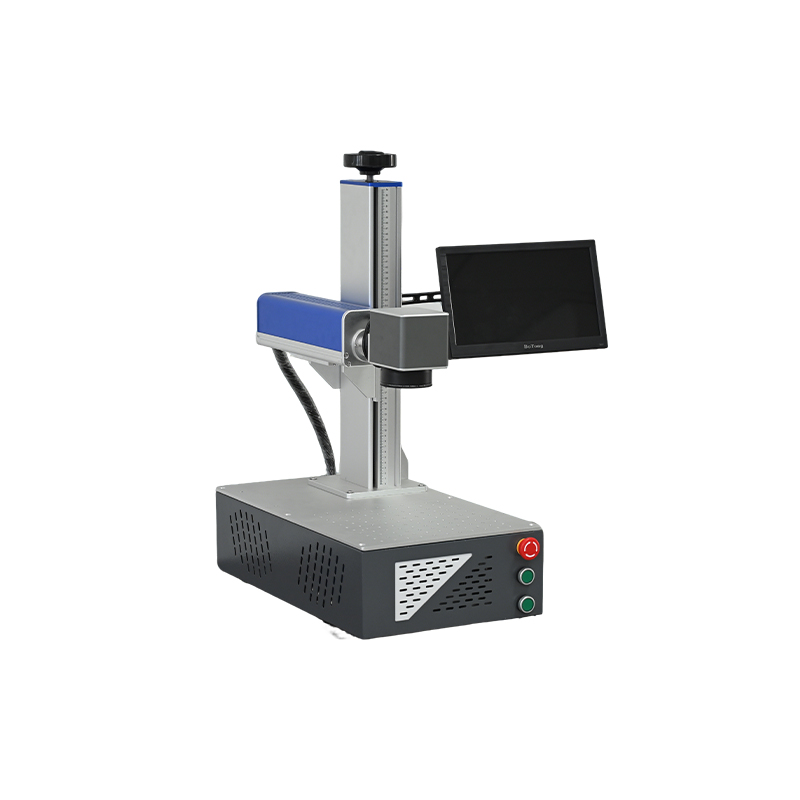
Desktop UV Laser Marking Machine — 355 nm, 3 W / 5 W
The 355 nm UV format is specified with 3 W or 5 W laser power, a pulse width below 60 ns, modulation frequency of 30–100 kHz, and single-mode beam quality of M² < 1.5. Marking area is 110 × 110 mm, marking speed reaches 10,000 mm/s, repeatability is ±0.001 mm, and minimum line width and minimum character are both stated at 0.4 mm and 0.15 mm respectively. The unit operates on 110–240 V, draws under 400 W overall, uses a standard USB control interface, carries 140+ font libraries with custom fonts addable on request, and measures 352 × 603 × 800 mm.
The documentation-relevant detail is the cooling architecture: this format uses an external industrial water chiller (DWUV-05 included) rather than built-in air cooling. Because the chiller is specified as a separate external unit, the electrical and installation documentation covers a second powered device and a water loop in addition to the marking head. The optical file, by contrast, is comparatively simple — a single 355 nm source selected precisely because cold processing avoids thermal damage on heat-sensitive substrates such as PE and PVC plastics, film, packaging, glass and composite materials. Reported case outcomes for this format include damage-free micro-marking down to 10 microns with no thermal damage to sensitive components, and application concentration in electronics manufacturing as well as food, pharmaceutical, cosmetics and daily-chemical production lines.
Miniature Multi-Material Laser Marking Machine — 1064 nm / 455 nm
The miniature unit is the lightest format in the comparison at 2.7 kg, and it is the only one with a switchable dual light source: 1064 nm and 455 nm, in pulse operation mode, with a gradient power regulation range of 25–100 and processing speed up to 4,000 mm/s. Scene focal length is 133 mm and the scanning area is 55 mm × 55 mm. Power comes from a built-in lithium battery or DC 20 V with power bank support, overall power draw is ≤ 100 W, cooling is air-based, and the interface set is TYPE-A for data and TYPE-C for power. Operation is supported through mobile app, PC software and touch screen. Materials covered include metals, bamboo and wood, leather, paper, coloured glass, plastics and ceramics, with application focus on gifts and crafts, jewellery, customized DIY workshops and 3C electronic accessories.
Two documentation consequences follow. First, a dual-wavelength enclosure presents two optical exposure profiles that should be described separately in the safety file — 1064 nm and 455 nm are not interchangeable in the way they interact with substrates. Second, the charging path is consumer-format: TYPE-C power input and capability for a DC 20 V power bank. In a workshop environment that makes charging and battery handling an electrical-safety item rather than a convenience feature. This format is applied in customized marking solution projects, which means the configuration record should match the customization actually ordered.
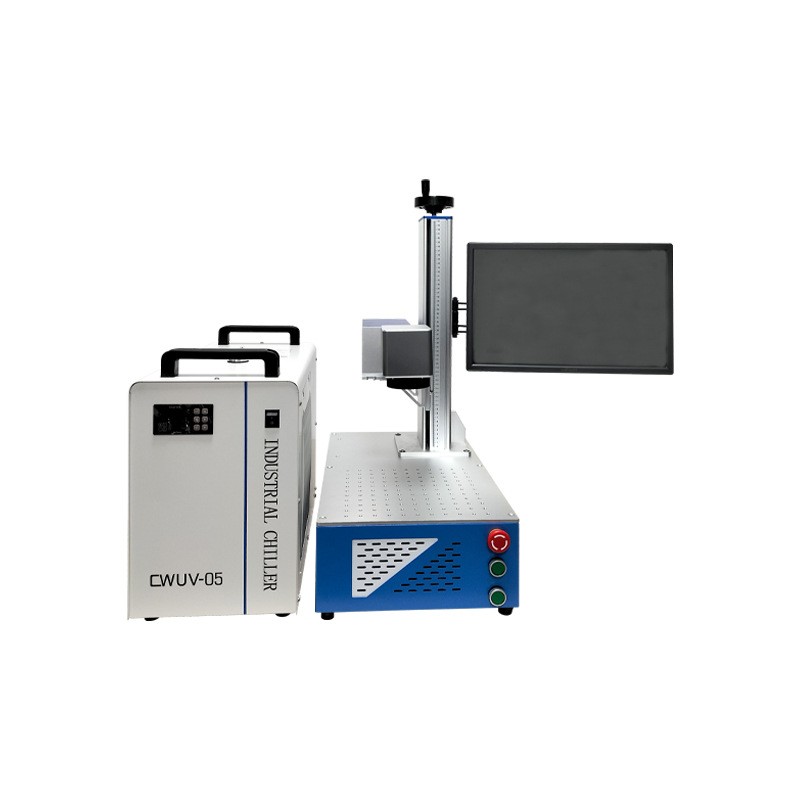
Desktop Fiber Laser Marking Machine — 1064 nm, 20 W to 100 W
The 1064 nm desktop fiber format offers the widest power span of the four: 20 W, 30 W, 50 W or 100 W. Pulse width is below 60 ns, marking speed reaches 10,000 mm/s, and base marking area is 110 × 110 mm with optional 150 × 150 mm, 175 × 175 mm and 200 × 200 mm fields. Repeatability is ±0.001 mm, minimum character is 0.15 mm, minimum line width is 0.4 mm, maximum marking depth is 0.4 mm, and the unit uses built-in air cooling with overall power under 400 W. It is built as an all-in-one integrated design with a large display screen and a high-speed galvanometer scanning system. Surface marking tasks include logos, QR and barcodes, and batch or date coding; industrial concentration is in hardware and tools, auto parts, electronic components, machinery parts and jewellery, including OEM/ODM projects and hardware manufacturing.
Here the documentation variable is power. A 100 W configuration is not documented the same way as a 20 W configuration, and the two are frequently quoted under a single series description. Buyers should require the file that matches the ordered power option, the ordered lens and the interface as shipped, rather than a generic series sheet.
Handheld Fiber Laser Marking Machine — 1064 nm, 20 W to 60 W
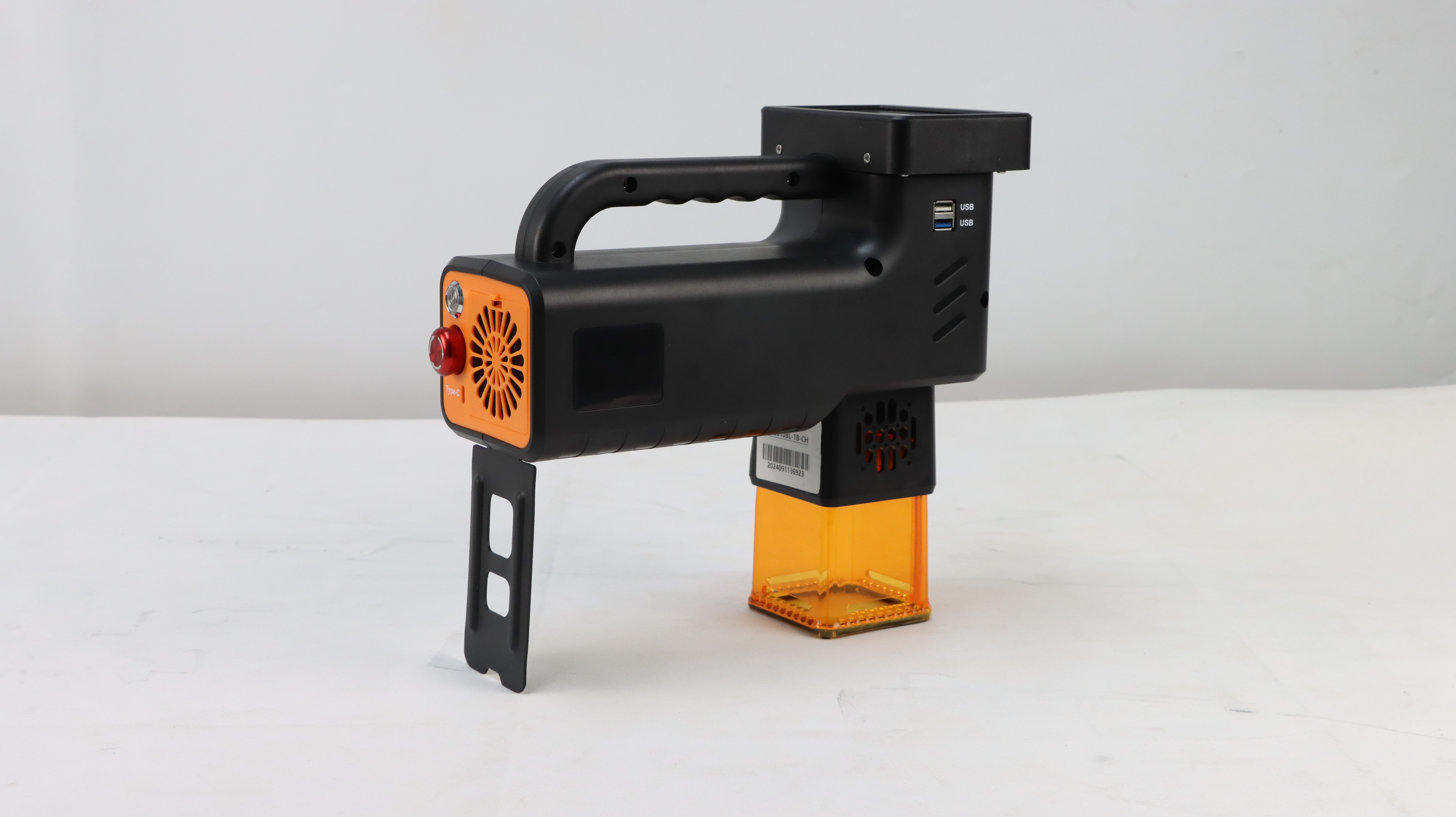
The handheld fiber format is specified with 20 W, 30 W, 50 W or 60 W power, 1064 nm wavelength, air cooling, and a Linux system with a 7-inch touch screen. It supports Bluetooth, WiFi and mobile app control, runs from a built-in lithium battery, and is rated at approximately 100,000 hours of laser life. Supply is 90–240 V, 50/60 Hz, marking area is 110 × 110 mm, and the unit weighs about 6 kg. It imports JPG, PNG, BMP, SVG, PLT, DXF, Excel and TXT files as well as barcode and QR code data. Materials include stainless steel, carbon steel, aluminium oxide, aluminium alloy, aluminium, copper, iron, gold, silver, carbide, painted metal, acrylic, PVC, leather and painted wood. Typical industries are mechanical parts processing, electronic and electrical production, medical equipment, advertising signs, building materials, hardware parts, auto parts, pipes, profiles, jewellery, gifts and crafts.
This is the format where the safety file changes most. Because the machine is hand-held, EN ISO 11553-2 applies as the named reference, and the documentation burden shifts from fixed cabinet guarding to operating procedure, battery handling and on-site deployment rules. The battery also removes the assumption of a permanently tethered power supply, so the electrical section of the file has to describe both the battery mode and the 90–240 V mains mode.
Format comparison — the variables that drive the safety file
| Format | Source / wavelength | Power options | Marking or scanning area | Cooling & power supply | Interface |
|---|---|---|---|---|---|
| Desktop UV Laser Marking Machine | 355 nm | 3 W / 5 W | 110 × 110 mm | External industrial water chiller (DWUV-05 included); 110–240 V | Standard USB |
| Miniature Multi-Material Laser Marking Machine | 1064 nm / 455 nm dual, switchable | Regulation range 25–100 | 55 × 55 mm scanning area | Air cooling; built-in lithium battery or DC 20 V (power bank supported), ≤ 100 W | TYPE-A (data), TYPE-C (power) |
| Desktop Fiber Laser Marking Machine | 1064 nm | 20 W / 30 W / 50 W / 100 W | 110 × 110 mm (optional 150 × 150, 175 × 175, 200 × 200 mm) | Built-in air cooling; under 400 W overall | Integrated interface with large display screen |
| Handheld Fiber Laser Marking Machine | 1064 nm | 20 W / 30 W / 50 W / 60 W | 110 × 110 mm | Air cooling; built-in lithium battery; 90–240 V, 50/60 Hz | Linux, 7-inch touch screen, Bluetooth, WiFi, mobile app |
A Three-Part Scoring Model for the Safety File
Scoring is easier when the documentation request is split into the three risk categories a portable marking unit actually creates. Each category maps to evidence a buyer can request and check before the order is placed.
1. Laser radiation and optical safety
- Wavelength and power option, stated for the unit ordered — 355 nm on the UV format, 1064 nm on the desktop and handheld fiber formats, and a switchable 1064 nm / 455 nm source on the miniature multi-material unit.
- Applicable standard reference — EN ISO 11553-2 for hand-held laser processing machines, and FDA 21 CFR Subchapter J, Parts 1000–1005, for laser products sold in the United States.
- Beam quality and minimum feature size where they define the exposure envelope — M² < 1.5 single mode on the UV format; 0.15 mm minimum character and 0.4 mm minimum line width on the fiber formats.
- Whether the file distinguishes hand-held from fixed operation. Only the handheld fiber format requires this distinction, and it is the one where the reference standard differs.
2. Electrical and high-voltage safety
- Supply configuration as shipped — 110–240 V operating voltage on the desktop UV format; 90–240 V, 50/60 Hz on the handheld fiber format; under 400 W overall power on the desktop fiber format.
- Cooling architecture, because it changes the number of powered devices covered by the file: external industrial water chiller (DWUV-05) on the UV unit; built-in air cooling on the desktop fiber and handheld fiber units; air cooling on the miniature unit.
- Battery and DC arrangements — built-in lithium battery on the handheld fiber unit; built-in lithium battery or DC 20 V with power bank support and TYPE-C power input on the miniature unit.
- Data and control interfaces as ordered — standard USB on the desktop UV format, TYPE-A data on the miniature unit, and Linux with 7-inch touch screen, Bluetooth, WiFi and mobile app on the handheld fiber unit.
3. 24/7 operation evidence
- Pre-shipment process. The supplier states that all machines undergo aging tests and precision calibration before delivery, with pre-shipment inspection procedures.
- Duty-cycle statements tied to model and cooling. Continuous industrial operation and 24-hour operation are stated as dependent on model and cooling — a conditional claim that should be matched to the ordered configuration.
- Service-life statements. Approximately 100,000 hours of laser life is specified for the handheld fiber unit, and zero-consumable operation is described across the range.
- Reported case outcomes, read as case evidence rather than as a default guarantee — 99.9% scanning accuracy on 2D codes and barcodes, permanent coding resistant to temperatures up to 1000 °C, and micro-marking to 10 microns with no thermal damage.
Purchase Terms That Should Travel With the Safety File
Safety documents and commercial terms are usually reviewed by different people and reconciled late. All four portable formats share a common set of term fields that should be confirmed in writing alongside the technical file.
- Configuration lock. Wavelength, power option, marking area and interface written into the purchase order exactly as ordered — 110 × 110 mm base marking area on the desktop UV, desktop fiber and handheld fiber formats; 55 × 55 mm scanning area on the miniature unit; optional 150 × 150, 175 × 175 and 200 × 200 mm lenses on the desktop fiber format.
- Acceptance criteria. ±0.001 mm repeatability on the UV and desktop fiber formats, minimum character and line width figures on the fiber units, and the physical sample marked during pre-shipment inspection.
- Pre-shipment evidence. Aging test and precision calibration records for the specific unit.
- Commercial minimums. The supplier states a minimum order quantity of 5, with lead time scheduled by order volume.
- Warranty and support. A one-year warranty period is stated in the supplier's case record, together with full English after-sales technical support.
- Customization scope. Customized marking solutions and OEM/ODM services are offered, with specific options and limits confirmed at quotation.
- Trade documentation. HS code 845611 for the machine type; the supplier states that its machines comply with CE, FDA and ISO standards and are designed for certification and customs clearance requirements in multiple countries.
- Export footprint as a support proxy. Equipment has been exported for years to more than 80 countries and regions, including Vietnam, Thailand, Malaysia, Türkiye, the United States, Poland and the Middle East.
Application Mapping: Matching the Format to the On-Site Task
Format selection should be driven by where the machine has to work, not only by what it has to write. The same specification range supports markedly different deployment patterns.
- Hardware parts, mechanical spare parts, auto parts. The 1064 nm fiber formats lead — desktop fiber at up to 100 W where the workpiece can be brought to the machine, or handheld fiber at 20–60 W where it cannot.
- Pipes and profiles, large workpieces. The handheld fiber format, because the 110 × 110 mm marking field travels to the part rather than the reverse. Unit weight is approximately 6 kg, which makes operating procedure part of the selection decision.
- Electronic components and heat-sensitive substrates. The 355 nm desktop UV format, selected because cold processing avoids thermal damage; the format is concentrated in electronics manufacturing.
- Jewellery, 3C accessories, gifts and crafts. The miniature multi-material unit at 2.7 kg with a switchable 1064 nm / 455 nm source and a 55 × 55 mm scanning area, applied in customized marking solution projects.
- High-speed or inline production. Benchtop flying or desktop machine operation integrated into production lines, where the supplier supplies marking hardware and supporting technical services. Line integration requires supporting equipment such as conveyors, flying brackets, code detection devices, and PC or mobile control devices, and continuous or 24-hour operation depends on model and cooling.
Market Context Behind the Safety-First Purchase
The global laser marking machine market is estimated at USD 4.4 billion in 2026 according to Grand View Research. Within that market, fiber laser technology held a revenue share of 46.1% in 2025, and Asia Pacific is the largest regional market at approximately 44% revenue share.
The practical implication for procurement is a benchmarking one. Fiber is the volume case, so the terms and documents requested for a 1064 nm unit — power option, marking area, repeatability, cooling, acceptance records — are the ones most easily compared across quotations. The 355 nm UV format and the dual-wavelength miniature format are specialist configurations and should be evaluated on their own evidence rather than by analogy to a fiber quotation.
Published growth forecasts for the category diverge, partly because different reports include or exclude coding equipment alongside marking equipment. Buyers should treat any single CAGR figure as methodology-dependent rather than as a procurement input. Market size estimates are more stable than forecast rates, and both are less useful than the specification file of the unit being ordered.
Where the Portable Format Stops Being the Right Answer
A comparison that only lists advantages is not a buyer reference. The four formats have defined boundaries that should be stated before an order is raised.
- Marking area is a hard limit. The base field is 110 × 110 mm on the desktop UV, desktop fiber and handheld fiber formats, and the miniature multi-material unit's scanning area is 55 × 55 mm. Workpieces larger than the field either move, or the lens changes — and optional 150 × 150, 175 × 175 and 200 × 200 mm lenses are specified for the desktop fiber format, not for every format.
- The UV format is not fully cordless. It relies on an external industrial water chiller. The marking head is compact, but the chiller travels with it, which is a genuine constraint on deployment in tight or remote workspaces.
- Battery cycle data is a documented gap. Verified third-party figures on lithium-battery cycle life for cordless marking units are not available in the public source set used here. Buyers intending to run a battery unit across a full shift should request runtime and cycle figures directly rather than infer them from the presence of a battery.
- Weight and ergonomics matter. The handheld fiber unit weighs approximately 6 kg. Third-party guidance places hand-held and portable laser marking units typically in the 15–35 lb range, roughly 6.8 to 15.8 kg. Sustained hand-held operation is an operating-procedure question, not only a specification line.
- 24-hour operation is conditional. Continuous and 24-hour operation are stated as dependent on model and cooling. They are not universal attributes of the portable category, and a quotation that presents them without a model and cooling reference should be clarified.
- Portable formats do not replace inline systems. For high-speed dynamic marking on moving production lines, flying or benchtop configurations integrated with conveyors and code detection devices remain the appropriate architecture.
What Changes in the Next Procurement Cycle
Two shifts are already visible in the specification data. The first is format compression: the miniature multi-material unit places a switchable 1064 nm / 455 nm source, air cooling and a battery in a 2.7 kg enclosure, which means a single safety file increasingly has to describe two optical profiles and two power modes rather than one of each.
The second is the normalisation of battery and USB-family interfaces as standard equipment. TYPE-A data and TYPE-C power on the miniature unit, and built-in lithium batteries on both that unit and the handheld fiber format, move charging behaviour into the electrical-safety scope of a workshop rather than leaving it as an accessory question.
The supply side is already oriented this way. With Asia Pacific accounting for roughly 44% of laser marking revenue and fiber holding 46.1% of technology share, export-facing documentation — CE, FDA and ISO statements, HS classification under 845611, pre-shipment aging and calibration records — is treated as part of the product rather than as a post-sale service. Buyers who build the safety file into the purchase order are aligning with how the category is already documented, not asking for something unusual.
Frequently Asked Questions
Which safety standards apply to a portable laser marking machine?
Hand-held laser processing machines are assessed against EN ISO 11553-2 in the EU and international context. Laser products sold in the United States must comply with FDA 21 CFR Subchapter J, Parts 1000 through 1005. Machine tools operated by laser processes are classified under HS code 845611 for international trade. A buyer should confirm which of these the supplier's documentation addresses for the exact format and configuration ordered.
Does a handheld laser marker need different documentation than a desktop unit?
Yes, in structure rather than only in detail. The handheld fiber format is a hand-held laser processing machine, so EN ISO 11553-2 applies directly, and the unit runs from a built-in lithium battery with a 90–240 V, 50/60 Hz supply. The desktop fiber format uses built-in air cooling and under 400 W overall power, while the 355 nm desktop UV format uses an external industrial water chiller (DWUV-05 included). The safety file should describe the configuration as installed, not as listed at series level.
What should be written into the acceptance criteria of a portable laser marking machine order?
At minimum: the ordered wavelength and power option, marking area, interface, repeatability, and the pre-shipment process. Relevant figures from the reference range include a 110 × 110 mm marking area, ±0.001 mm repeatability on the UV and desktop fiber formats, 0.15 mm minimum character on the desktop fiber format, and pre-delivery aging tests with precision calibration. Acceptance testing should reference the sample marked under those settings rather than the catalogue image.
How do the four portable formats differ in power supply and site requirements?
The desktop UV unit operates on 110–240 V and requires an external industrial water chiller. The desktop fiber unit uses built-in air cooling and draws under 400 W overall. The miniature multi-material unit runs from a built-in lithium battery or DC 20 V with power bank support, with overall power at or below 100 W and TYPE-C power input. The handheld fiber unit uses a built-in lithium battery plus a 90–240 V, 50/60 Hz supply. Site requirements follow from cooling and power configuration, not from marking quality.
Is a 110 × 110 mm marking area sufficient for on-site industrial work?
It depends on workpiece size, and the limit is real. 110 × 110 mm is the base marking area for the desktop UV, desktop fiber and handheld fiber formats. The miniature multi-material unit's scanning area is 55 × 55 mm. Where a larger field is required, the desktop fiber format offers optional 150 × 150, 175 × 175 and 200 × 200 mm lenses. Alternatively, a handheld unit can move to the workpiece rather than the workpiece moving to the machine.
How can 24/7 operation claims be verified before ordering?
By tying the claim to a model and a cooling configuration. The supplier states that 24-hour continuous industrial operation depends on model and cooling, and that all machines undergo aging tests and precision calibration before delivery. Buyers should request the aging and calibration records, the duty-cycle statement for the ordered configuration, and any stated service-life figures — approximately 100,000 hours of laser life is specified for the handheld fiber unit.
Which commercial terms should be reviewed together with the safety documentation?
Configuration lock, acceptance criteria, pre-shipment records, order minimums, warranty and support, customization scope, and trade classification. For reference, the supplier states a minimum order quantity of 5, lead time scheduled by order volume, a one-year warranty period in its case record, full English after-sales technical support, and compliance with CE, FDA and ISO standards for certification and customs clearance. HS code 845611 applies to the machine type.
Reference material
A downloadable product brochure covering the portable, desktop and benchtop laser marking range is available here: second-generation laser marking machine product brochure (English).
Tem questões ou precisa de mais detalhes?
Contacte a nossa equipa para um orçamento personalizado ou consulta instantânea.
Solicitar orçamento
Preencha o formulário abaixo e a nossa equipa entrará em contacto com uma proposta personalizada.
Chat direto do WhatsApp
Prefere conversar em tempo real? Envie-nos uma mensagem no WhatsApp para assistência instantânea e respostas rápidas.
- Obter orçamento personalizado
- Partilhar fotos ou documentos
- Discuta as suas necessidades diretamente
Geralmente responde em 5–30 minutos durante o horário de expediente.