
Portable Laser Marking Machine Uptime: A Long-Term Audit
Portable Laser Marking Machine Uptime: A Long-Term Audit
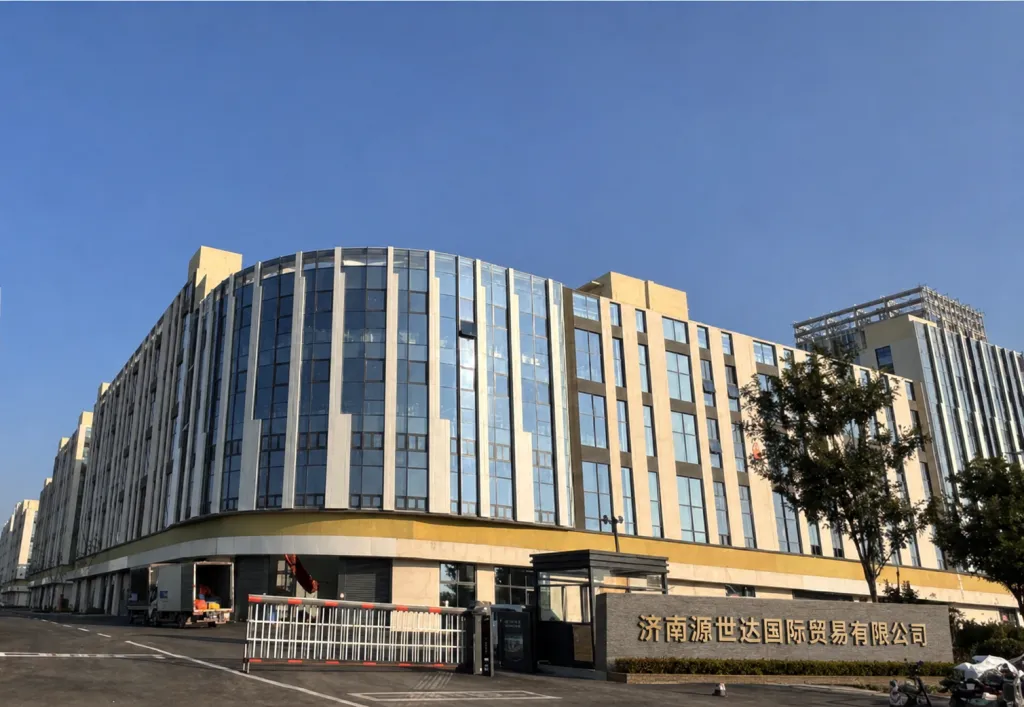
Industrial laser marking supply: the purchase order is the start of a service relationship, not the end of the decision.
A portable laser marking machine is bought once and serviced for years, so the supplier decision is really a decision about which machine characteristics will still be supportable in year three and year five. Price compares easily because it arrives as a single number on a quotation. Uptime does not. It has to be read from the marking process itself, from the way heat leaves the laser, from the rated life of the source, from the continuity of the marking software, and from the evidence a supplier can actually produce behind a continuous-operation claim.
This evaluation examines those signals for the portable and desktop laser marking formats offered by Jinan Yuanshida International Trade Co., Ltd., a Jinan-based exporter of industrial laser marking equipment whose range covers handheld, bench-top, desktop and precision marking equipment, and whose stated production practice is stability first, precision in details and efficient after-sales service. The purpose is not to recommend a purchase, but to show a buyer, integrator or distributor what belongs in a supplier file when the planning horizon is measured in years rather than weeks.
Uptime Is a Cost Line, Not a Compliment
A marking machine carries three cost layers: acquisition, consumed parts, and the unplanned stops that interrupt everything downstream of the marking station. Long-term supplier evaluation is mostly about the third layer, because the first two are visible before the order is signed and the third is not.
Laser marking changes the shape of that problem. A laser marker produces its mark through non-contact thermal ablation rather than by pressing a blade or depositing ink, so the recurring consumable list is short. Company comparison material supplied for this evaluation describes a fixed optical path with zero mechanical wear, in contrast with CNC engraving, which requires frequent bit changes, tool zeroing and dust or chip cleanup. When nothing is consumed per mark, the supplier's long-term value moves to how long the laser source and the heat-removal hardware remain serviceable, and how quickly a failed module can be replaced.
The distinction matters for procurement because it relocates the recurring budget. A buyer who has only compared purchase prices has compared the smallest and most transparent part of the total. The larger questions are the module replacement path, the service interval of the cooling arrangement, and whether documentation exists that a second owner, an auditor or a customs officer could read years later.
What the Zero-Consumables Process Actually Removes
The marking process consumes no ink, paste or cutting tool. What it does not remove is the need to control heat, keep the optical path clean, and set parameters for each material. Those three items are where the service years are won or lost, and they are the items a buyer should price before signing.
Company comparison material for this equipment positions the laser process against CNC engraving in several concrete ways. It states that the laser beam diameter reaches down to 0.01 mm against a minimum bit size of roughly 0.5 to 1 mm, that marking speed is described as ten times faster, and that laser power stays stable at around 100 W while a CNC route adds high-power spindles plus the energy load of industrial dust extraction. The same material notes that initial laser price is comparable to mid-to-high CNC equipment but eliminates the ongoing cost of varied cutter bits and tool wear.
Those figures are useful directionally, and they should be read that way. The comparison does not state the substrate, power setting, pass count or ambient conditions behind the speed and beam-diameter figures, so they cannot be transferred into a throughput guarantee for a specific production cell. What they do establish credibly is the structure of the cost difference: the laser route concentrates spending in the machine and its modules, while the blade route spreads it across tooling and setup labour.
For the buyer, the practical translation is a spare-part and module schedule. Ask what is expected to be replaced within five years, what each item costs, how long replacement takes, and whether the replacement can be done on site or requires a factory return. A supplier who can answer those four questions has demonstrated more about long-term serviceability than a supplier who can only quote a purchase price and a warranty period.
Cooling Architecture Decides the Maintenance Routine
In the portfolio description used for this evaluation, the desktop UV unit is specified with an external industrial cooling arrangement, while the desktop fiber formats are specified with built-in air cooling. That is not a marketing contrast; it produces two different maintenance routines, two different sets of ambient limits and two different failure modes, and the buyer should choose between them on that basis.
External industrial cooling on the desktop UV unit separates heat rejection from the marking head. The practical consequences are structural. Heat is handled by a discrete subsystem with its own inspection rhythm, its own serviceable components and its own alarm behaviour, and it can in principle be serviced or replaced without opening the laser path. The cost of that separation is that the buyer now owns a second piece of equipment: it needs space, it needs its own preventive checks, and where the machine is moved between sites it becomes an additional item to transport and reconnect.
Built-in air cooling on the desktop fiber formats removes that second item. Siting is simpler, transport is simpler, and there is one fewer subsystem to schedule. In exchange, heat rejection depends on the ambient air and on an unobstructed airflow path, so the routine shifts towards keeping that path clean and keeping duty cycles within the conditions the supplier specifies. In a hot, dusty or enclosed workshop, that routine is the difference between a machine that runs for years and one that trips on thermal protection.
UV formats are generally chosen where cold processing matters, because shorter-wavelength marking limits thermal load on heat-sensitive substrates. When that choice is made, the thermal question does not disappear; it moves from the workpiece to the laser source and to whatever removes heat from it. A buyer assessing a UV unit for a heat-sensitive part should therefore ask as carefully about the cooling unit as about the wavelength.
Four questions settle most of this comparison. What ambient temperature and humidity range does the supplier specify for the machine? Is the cooling unit included in the quoted scope or listed separately? What is its service interval and which of its parts are field-replaceable? And if cooling fails, does the machine alarm and stop, or does it continue marking while the source degrades?
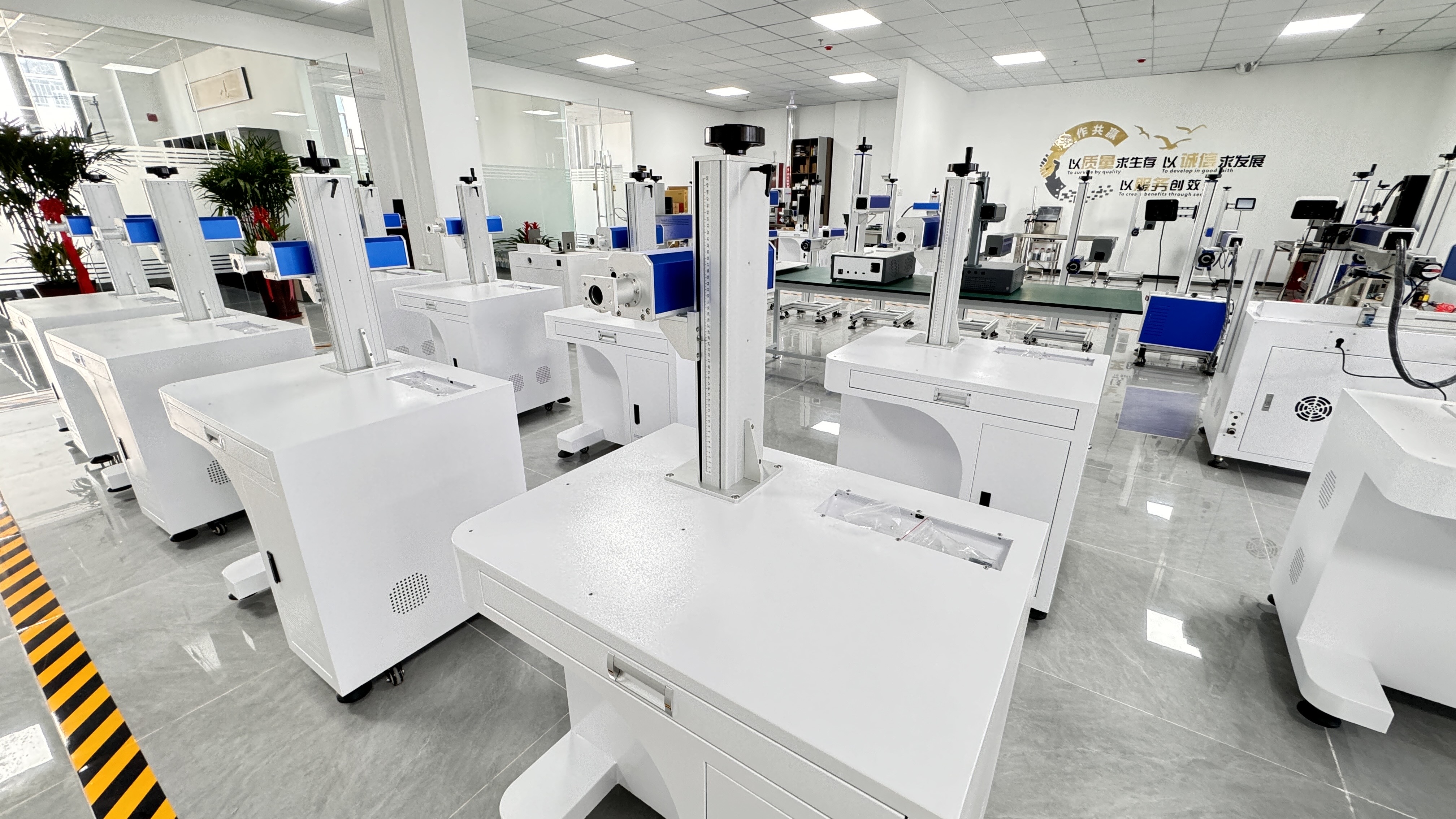
Assembly and pre-dispatch testing: the stage at which ageing-test records and calibration records are created, and the stage a buyer should ask to see documented.
Reading a Rated Laser Source Lifespan
The flying online unit in this range is specified with a rated laser source lifespan. A rated figure is a specification produced under stated conditions, not a promise of hours at any duty cycle, and treating it as the latter is one of the most common errors in long-term equipment planning.
The first step is to ask what the rating refers to. A source rating, a module rating and a system rating are three different numbers, and only the last one describes what the buyer actually operates. The second step is to ask for the conditions attached to the figure: output power, duty cycle, ambient temperature and whether the number comes from a bench test, an accelerated test or field data. A rating quoted without conditions cannot be compared with a competing supplier's rating, and comparing two unqualified figures produces a decision that looks analytical but is not.
The third step converts the rating into money. If a source is expected to reach the end of its rated life in a given number of operating years, the replacement becomes a planned capital item rather than an emergency. That planning figure, plus the lead time for a replacement module, is the real long-term cost of the marking asset. A supplier who can state the lead time, the replacement procedure and the cost of the module has given the buyer something a lower purchase price cannot offset.
Software Continuity: 140+ Fonts and Custom Faces
The marking software in this range carries a library of more than 140 fonts, with custom fonts available on request. On a short evaluation that reads as a convenience feature. On a multi-year evaluation it is a continuity asset, because a marking program that depends on a specific typeface stops being reproducible if that typeface disappears from the controller.
Part numbers, traceability codes, standard symbols and brand marks are all set in specific faces, and a change of face can invalidate a customer-approved marking layout or a labelling convention agreed with an end user. The relevant questions are therefore administrative as much as technical. How are custom fonts supplied and validated before they enter production? What is the update path for the standard library, and can an update be deferred or rolled back? Can marking layouts be exported and archived so they can be restored on a replacement controller? And for how long does the supplier intend to support the software version being purchased?
These are answerable questions, and the answers separate suppliers who maintain a software routine from suppliers who ship a controller and stop there. For a buyer running the same part family for five years, the second type of supplier transfers a hidden risk that only appears when a controller is replaced.
The 24/7 Claim Has to Be Verified, Not Accepted
Continuous round-the-clock operation is one of the most frequently repeated claims in this equipment category and one of the least frequently documented. It should be treated as a question with an evidence trail, not as a product feature.
This supplier's documentation does contain material evidence. Every machine undergoes a 72-hour continuous full-load ageing test and strict insulation withstand voltage testing before dispatch, and all equipment passes multiple ageing tests and precision calibration before leaving the factory. The electrical design includes overload protectors, a residual current circuit breaker and grounding protection, together with automatic thermal shutdown and alarm mechanisms for the laser and power supplies. The safety design includes a Class 4 laser safety enclosure with anti-radiation observation windows, a safety door interlock that cuts emission when the door opens, an emergency stop button and OD5+ protective eyewear.
Read precisely, those facts establish a screening process and a protection architecture. A 72-hour full-load run is designed to surface early-life failures before shipment; it does not by itself demonstrate multi-year duty at a given ambient temperature. The protections establish that overheating is detected and stopped rather than ignored, which is a durability-relevant design choice, but detection is not the same as thermal margin.
To move from claim to evidence, a buyer should request the documented duty cycle and ambient conditions, the service interval that applies under continuous operation, the availability of spare modules, and the response terms that apply if a machine stops during a production run. For a genuinely round-the-clock cell, it is also worth asking how the machine behaves across long shifts from a safety standpoint, because interlock and emergency-stop behaviour is part of uptime in any regulated plant.
A Multi-Year Evaluation Table
The table below converts the discussion into a request list. Each row names the characteristic, the evidence to obtain and the boundary that keeps the evidence honest.
| Characteristic | Evidence to request | Why it matters over years | Boundary to keep in view |
|---|---|---|---|
| Zero-consumables marking process | Spare-part and module price list; expected replacement intervals; on-site versus factory-return replacement | Moves recurring spend from consumables to modules and service, which is the layer that decides total cost | No consumables does not mean no maintenance; optics, cooling and calibration still need routine work |
| Cooling arrangement | Ambient temperature and humidity specification; whether the cooling unit is in scope; service interval; alarm and shutdown behaviour | Heat removal is the routine that most often determines whether a machine survives a difficult workshop | Neither external nor built-in cooling is automatically better; fit depends on ambient conditions, duty cycle and mobility |
| Rated laser source lifespan | The rating's reference object, test conditions, replacement lead time and cost | Converts an unplanned failure into a planned capital item | A rated figure is not guaranteed hours at any duty cycle; unqualified figures cannot be compared across suppliers |
| Software and font continuity | Custom-font process, library update path, layout export and archive, support horizon for the purchased version | Protects reproducibility of approved markings when a controller is replaced | A large font library is a continuity asset only if updates and archives are managed |
| Continuous-operation claim | Ageing-test record, thermal protection behaviour, documented duty cycle, spare-module stock, response terms | Distinguishes a screened machine from a documented continuous-duty capability | A 72-hour full-load test is a screening run, not proof of years of service |
| Supplier continuity | Compliance file (CE, FDA, ISO), calibration and ageing records, after-sales language and channel | The file is what a second owner, auditor or customs authority will read long after the sales contact has changed | Certification claims should be matched to the exact model and destination market |
Matching the Format to the Work Over Several Years
The strongest uptime decision is the one made before the machine is chosen, because a format that fits today's workpiece mix but not the mix three years out will be replaced early regardless of how well it is serviced.
The application range described for this equipment covers hardware and auto parts, pipes and profiles, electronic components, jewelry and accessories, mechanical parts, and gifts and crafts. Those categories pull in different directions. Pipes and profiles and other large workpieces favour on-site working, where the machine travels to the workpiece instead of the workpiece travelling to a bench. Electronic components and jewelry favour fine, low-distortion marking, which is where a UV format's cold processing earns its place on heat-sensitive parts. Hardware, auto parts and mechanical parts generally favour a fiber format for routine identification work at higher volume. Gifts and crafts usually involve lower duty cycles and more variable setups, so setup flexibility matters more than sustained throughput.
One specification cuts across all of them. The marking area is 110 mm by 110 mm, so the field is a fixed window: parts or features outside that window require repositioning, rotation or fixtures, and that handling time is part of the real cycle time. A buyer projecting several years of work should check the largest and smallest parts expected against that field before deciding, not after.
The mobility question also deserves a multi-year answer. A light-weight or battery-powered configuration changes how the machine is used across a site, but it also changes the maintenance picture, because batteries and portable power paths add items that a bench-mounted unit does not have. Where the machine will move between buildings, that trade-off belongs in the evaluation rather than in a later accessory purchase.
Supply Continuity and the Documents That Outlive the Order
Jinan Yuanshida International Trade Co., Ltd. states that its products have been exported for many years to more than 80 countries and regions, including Vietnam, Thailand, Malaysia, Turkey, the United States, Poland and the Middle East, and that it serves overseas factories, distributors and trading companies. It provides standard equipment, customized marking solutions, OEM/ODM services and full English after-sales support, and states that it is committed to building long-term, stable and mutually beneficial partnerships with customers worldwide.
For a long-term evaluation, the operational details matter as much as the relationship language. The stated minimum order quantity is 5 units, payment terms are deposit plus balance, and delivery terms such as EXW, FOB or CIF are confirmed with sales rather than fixed in advance. Acceptance is based on pre-shipment ageing tests and precision calibration, with the specific acceptance procedure — on-site acceptance, remote testing or third-party inspection — negotiated and confirmed with the client. Buyers should treat those as items to settle in writing, because acceptance procedure is exactly what determines who carries the risk if a machine underperforms on arrival.
The equipment is described as complying with international quality standards including CE, FDA and ISO, and as designed to meet certification and customs clearance requirements in multiple countries. Two external reference points are worth adding to the file. Laser products sold in the United States must comply with FDA 21 CFR Subchapter J, Parts 1000 through 1005, and portable laser markers are assessed against EN ISO 11553-2 for hand-held safety in the European and international context. For trade documentation, HS code 845611 is the primary classification for machine tools operated by laser processes.
None of that paperwork feels urgent at the point of purchase. It becomes urgent when an operator changes, a customer audits the marking process, or a replacement machine has to clear customs under a different tariff environment. The supplier file assembled at order time is the cheapest version of that file the buyer will ever have.
Market Context That Should Not Drive the Decision Alone
Industry forecasts are useful background and poor substitutes for machine-level evidence. Grand View Research estimated the global laser marking machine market at USD 4.4 billion in 2026, with fiber laser technology holding a 46.1% revenue share in 2025 and Asia Pacific accounting for approximately 44% of revenue in the same year. Published growth forecasts for the category diverge widely — from roughly 7.4% to about 11.8% — largely because some studies include coding equipment within the marking category and others do not.
That divergence is a useful reminder for procurement. A forecast that changes by several percentage points depending on definition cannot tell a buyer whether a specific supplier will still stock a replacement module in five years. What it can do is confirm that fiber formats dominate current supply, which is relevant when assessing spare-part availability, and that portable units remain a small, defined segment — typically quoted at 15 to 35 pounds, or about 6.8 to 15.8 kilograms, by category sources — where configuration choices matter more than category averages.
Outlook: Serviceability Becomes the Differentiator
As laser marking hardware matures, the differences between competent machines narrow and the differences between competent suppliers widen. The characteristics that decide years of usable service — a marking process without consumables, a cooling arrangement matched to the workshop, a documented source rating with a replacement path, software and font continuity, and an ageing-test record that a buyer can actually inspect — are all knowable before purchase. None of them requires trusting a brochure.
The practical consequence for a buyer entering the decision and execution stage is a change of sequence. Instead of shortlisting on price and then negotiating service, the stronger approach is to specify the evidence first, shortlist the suppliers who can produce it, and let price compete on a defined scope. That sequence does not guarantee uptime, but it removes the suppliers whose long-term support exists only in the sales conversation.
FAQ
What machine characteristics determine how long a portable laser marking machine stays in service?
The main determinants are the durability of the laser source and its documented rating, the way heat is removed from the source, the availability and lead time of replacement modules, and the continuity of the marking software and its font library. Maintenance routine, ambient conditions and duty cycle then decide how closely actual service approaches the design expectation.
Is a zero-consumables laser marking process maintenance-free?
No. A laser marker consumes no ink, paste or cutting tool, but it still requires optical inspection, cooling inspection, calibration and safety verification. The honest reading of a zero-consumables process is that recurring spend shifts from consumables to modules and service labour, not that it disappears.
How does external industrial cooling on a desktop UV unit differ from built-in air cooling on desktop fiber formats?
External cooling separates heat rejection into its own subsystem, which can be inspected and serviced independently of the laser path but adds a second item to site, transport and maintain. Built-in air cooling removes that second item and simplifies siting, while making heat rejection dependent on ambient air and an unobstructed airflow path. Which is preferable depends on workshop conditions, duty cycle and whether the machine travels.
How should a buyer verify a 24/7 continuous operation claim?
Ask for the ageing-test record, the documented duty cycle and ambient conditions, the thermal protection behaviour, spare-module availability and the response terms that apply to a stoppage during production. A 72-hour full-load ageing test performed before dispatch is a screening step that surfaces early failures; it is not by itself evidence of multi-year continuous duty.
Why does a 140+ font library matter in a long-term supplier evaluation?
Because approved marking layouts, part numbers and standard symbols are set in specific typefaces. If a typeface is removed or a controller is replaced without an archive of the layout, reproducibility is lost. The library is therefore a continuity issue: custom-font handling, update paths and layout export matter more than the raw count of available fonts.
Tem questões ou precisa de mais detalhes?
Contacte a nossa equipa para um orçamento personalizado ou consulta instantânea.
Solicitar orçamento
Preencha o formulário abaixo e a nossa equipa entrará em contacto com uma proposta personalizada.
Chat direto do WhatsApp
Prefere conversar em tempo real? Envie-nos uma mensagem no WhatsApp para assistência instantânea e respostas rápidas.
- Obter orçamento personalizado
- Partilhar fotos ou documentos
- Discuta as suas necessidades diretamente
Geralmente responde em 5–30 minutos durante o horário de expediente.