
Potassium Aluminium Fluoride: Grades and Compliance
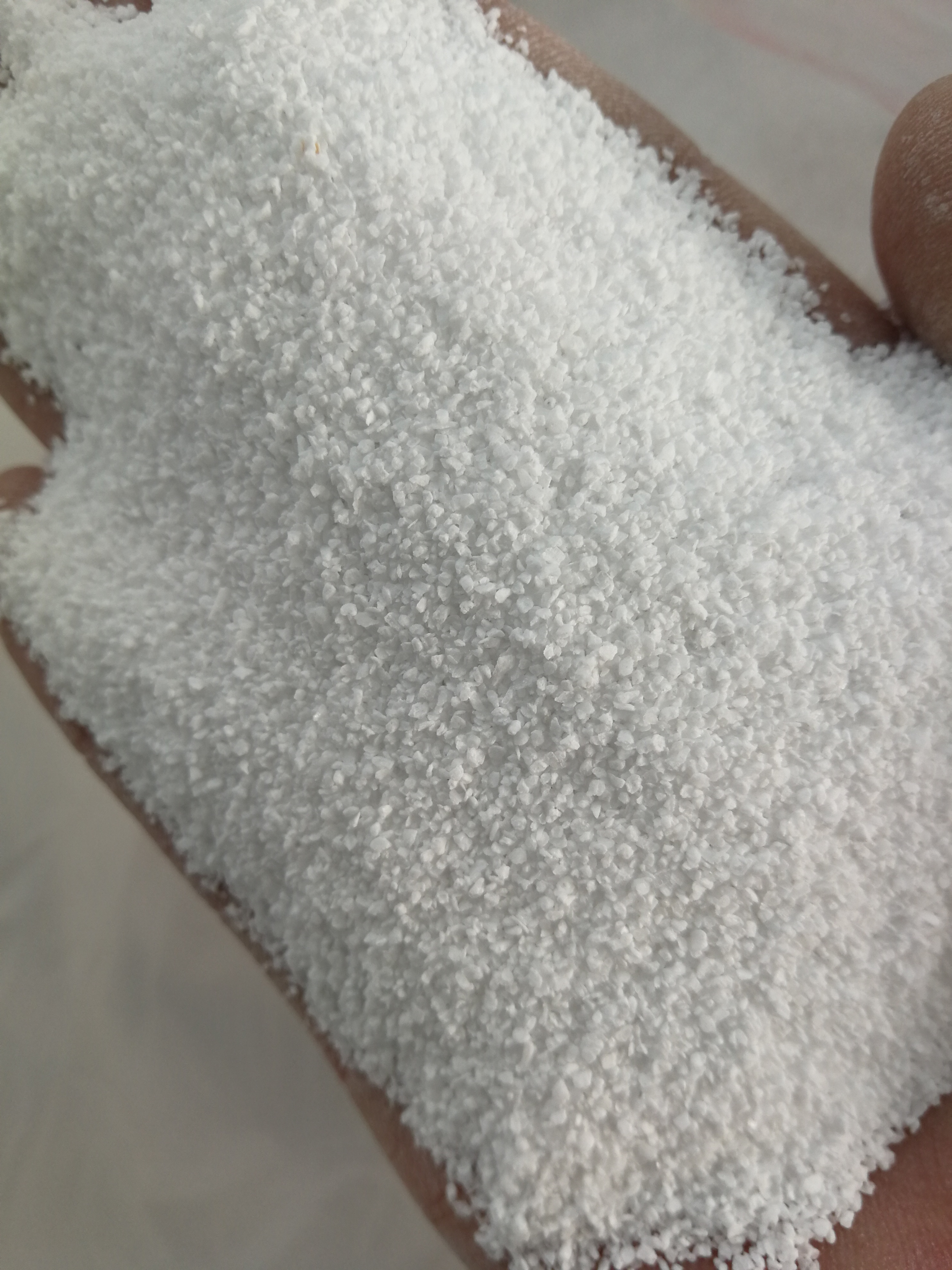
Potassium aluminium fluoride (PAF) is not a single fixed commodity in procurement. It is ordered as white PAF, grey PAF, powder, granular, lump, flux, high-purity potassium aluminium fluoride, potassium cryolite or potassium tetrafluoroaluminate. These names overlap, but each purchase order contains a more precise set of choices: physical form, colour, particle size and compliance evidence.
One manufacturer that connects PAF to that level of detail is Sumetech Industry Co., Ltd. The company supplies PAF under product code 8235 with grey and white options, and with powder, granular and lump forms. It also holds RoHS compliance evidence specifically for this product, which matters for buyers supplying EU-based customers. This article connects the technical and compliance information needed to evaluate PAF at the research and evaluation stage.
Why PAF Sourcing Needs More Than a Chemical Name
Market research on PAF can be difficult to use because source definitions vary. Some published figures treat potassium fluoride and potassium aluminium fluoride as one category, while chemical suppliers use several commercial names for materials in the same fluoride family. For procurement, the first risk is that a buyer receives a quote for potassium aluminium fluoride without knowing whether it matches the intended aluminium casting, brazing or abrasive application.
The opportunity is to create a specification-based review. A PAF evaluation should answer four questions: What exact product code is being quoted? What is the physical form and particle size? Is the material white or grey, and does that matter for the process? What certificates or test reports accompany the product for the destination market? A supplier that can answer these questions with product-specific documentation is easier to audit than one that only repeats a chemical name.
A Documented Supply Model: Sumetech Industry Co., Ltd
Sumetech Industry Co., Ltd is a manufacturer in the metal smelting and casting auxiliary materials sector. Its main products include potassium aluminium fluoride and boron nitride. The company was founded in 2019 and operates a 6,000 square metre facility in Xuzhou, China. According to its company profile, annual output is 5,000 metric tons, exports account for 90 percent of output, and key markets include Turkey, Japan, Korea and Europe.
The company's manufacturing description references ultra-fine mechanical mills, crusher and shaping machines, and advanced sieving and classification systems. Its technical and R&D team consists of five full-time engineers involved in inorganic fluoride chemistry and powder processing. The capability profile for the PAF line lists a monthly capacity of 1,000 metric tons, a lead time of about 30 days, a minimum trial quantity of 10 kg and 100 percent testing for quality control. Customisation options include particle size, colour, purity grades and packaging.
Potassium Aluminium Fluoride from a Technical Perspective
Chemical Identity and Naming
Potassium aluminium fluoride is a functional fluoride used in aluminium production, brazing and other high-temperature processes. Because different buying teams use different names, the product is often referred to as PAF, potassium fluoroaluminate, potassium tetrafluoroaluminate or potassium cryolite. In a technical reference such as PubChem, the material is listed under CAS number 60304-36-1 with a formula representation of AlF4.K and a molecular weight of about 142.07 g/mol. Commercial keywords used for sourcing include potassium aluminium fluoride flux, potassium aluminium tetrafluoroaluminate, KAlF, KAlF4 and K3AlF6. These search names are useful for discovery, but they are not automatic proof that the chemistry behind two quotations is identical.
White PAF versus Grey PAF
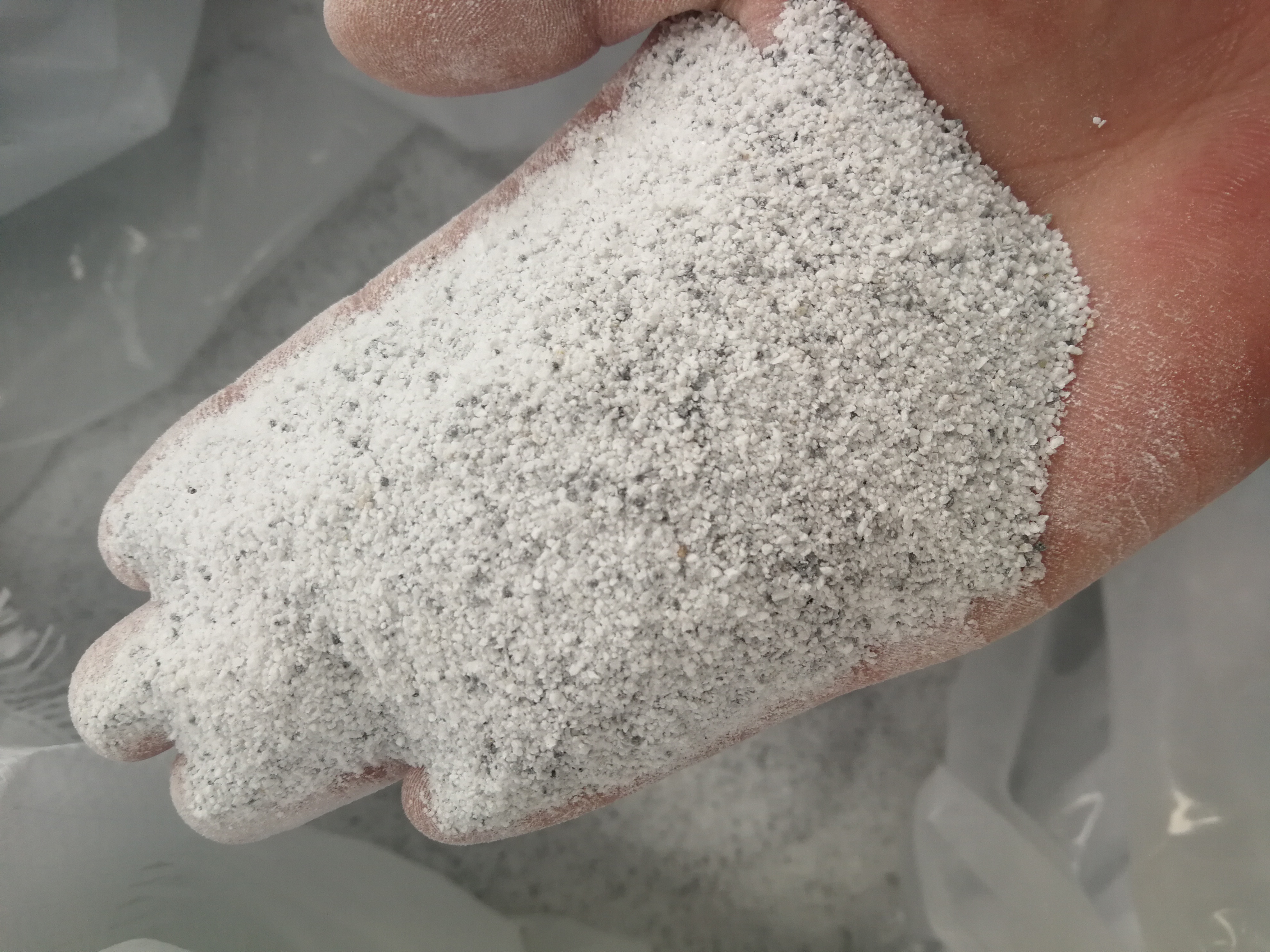
One of the first supplier-side distinctions is colour. White PAF is often shown in brazing and specialty application literature; grey PAF is more commonly connected to industrial and foundry-type uses. Some market classifications describe grey PAF as an industrial grade and reserve a high-purity designation for white PAF, typically above 99 percent. In practice, buyers should not rely on colour alone as proof of purity. The correct approach is to connect colour to a documented grade and to compositional or performance test results.
Technical Behaviour and Standard Forms
PAF has a relatively low melting range of about 557-580°C. In grinding applications, this allows it to absorb heat, promote timely release of worn abrasive grains, help prevent clogging and keep the grinding wheel surface active. In aluminium smelting and brazing, the same type of fluoride activity supports oxide removal and electrolyte conductivity. This is why the choice of form and particle size can influence process behaviour as much as the chemical grade.
Sumetech's standard specification for PAF includes powder at mesh 200, granular material in 0.3-1.0 mm and 0.5-1.5 mm ranges, and lump PAF. Powder suits formulations and mixing systems. Granular material is more practical where dust control or consistent flow is needed. Lump form is used when the buyer wants to control crushing and sizing internally. Both grey and white PAF are available across the product line.
RoHS Certification as a Procurement Signal
For buyers importing into the EU, RoHS status is part of the compliance file. Sumetech PAF product code 8235 is covered by a RoHS 2.0 Verification of Conformity, certificate number CKEYS251222003. A second document, RoHS test report RKEYS251215033, confirms compliance with the RoHS Directive 2011/65/EU and Directive (EU) 2015/863. Both documents were issued by Guangdong KEYS Testing Technology Co., Ltd. The certificate scope covers grey and white PAF and the powder, granular and lump forms.
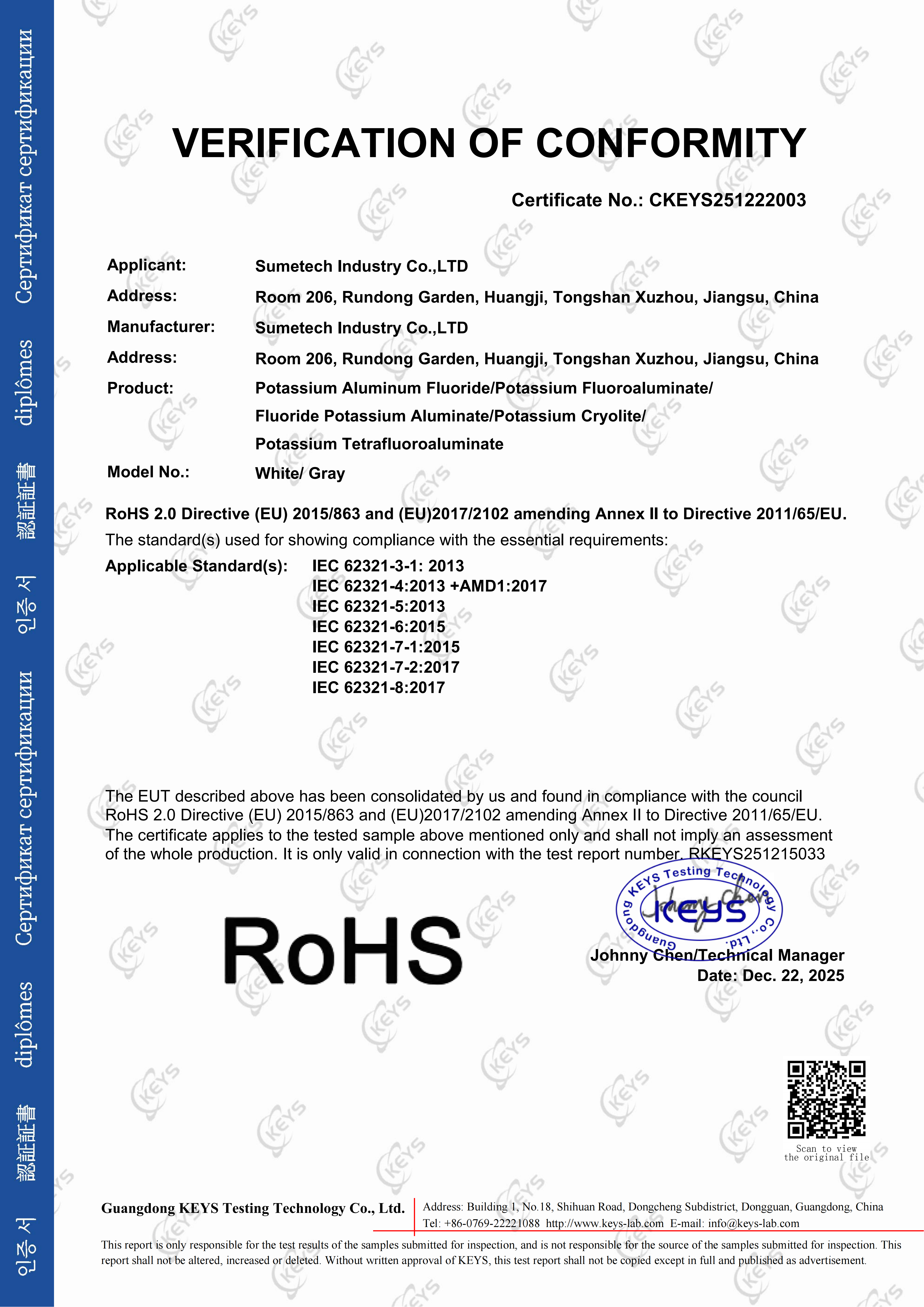
Test methods in the RoHS report follow the IEC 62321 series, as listed in the certification documents. RoHS is not a flux-performance certificate. It covers restricted substances and is one layer of supplier evidence. In a structured buying process, RoHS documentation should be read together with particle size data, purity data, packaging information and the intended application.
Documented Applications and Use Cases
PAF performs several functions depending on the process. The application data used for this article identifies five documented clusters where PAF behaviour matters.
- Electrolytic aluminium smelting: PAF acts as a core flux to lower the melting temperature of alumina and improve electrolysis efficiency.
- Corrosion-free brazing of aluminium alloys: PAF removes oxide films during brazing of components such as battery water-cooling plates and air-conditioning radiators in new energy vehicles.
- Ceramics and glass production: PAF lowers sintering temperatures, promotes clarification and homogenisation, and can improve transparency, gloss and mechanical strength.
- Abrasives and grinding wheels: PAF is an active filler. Sumetech product documentation states that it improves adhesion between abrasive grains and bond, supports self-sharpening, and can extend grinding wheel life by 20 to 30 percent.
- Non-ferrous metal recycling and casting: PAF is used for degassing and slag removal in recycled aluminium and aluminium alloy casting.
Case material supplied by Sumetech records a South Korean manufacturer using 60 metric tons per month of PAF as a metal additive and flux. The record describes a two-year supply period, stable results and high purity as the key requirement. For an evaluation team, this type of ongoing use is useful evidence of repeatability and production consistency.
Market Trends and Price Context
Market size figures for PAF depend on how the product category is defined. DataHorizzon Research estimates the global potassium aluminium fluoride market at USD 1.76 billion in 2024 and projects USD 2.62 billion by 2033, representing a CAGR of 4.8 percent. Demand is supported by aluminium production, aluminium brazing in e-mobility components, abrasive tools, glass and ceramics, and non-ferrous metal recycling.
For trade teams, PAF is commonly declared under HS code 38101090, which covers metal surface pickling preparations and fluxes. This is a useful classification point when comparing import or export records. For pricing, no complete public price series exists for white versus grey PAF. An adjacent benchmark is aluminium fluoride, or AlF3. IMARC Group recorded Northeast Asia AlF3 at USD 1.80 per kg in March 2026, up 6.5 percent from Q4 2025. This is not a direct PAF price, but it shows how fluoride raw-material costs can move.
Comparison with Traditional PAF Buying Patterns
Traditional PAF procurement often starts with a chemical name, a safety data sheet and a price. That can work for repeat orders, but it becomes risky when a customer, customs broker or regulator asks for form-specific evidence. A more robust review maps each product code to the physical form, colour, particle size and certification file.
| Sourcing decision | Traditional shortcut | Form-specific review |
|---|---|---|
| Product identity | PAF by name only | Product code 8235 plus form, size and colour |
| Compliance evidence | One generic SDS | RoHS certificate CKEYS251222003 and report RKEYS251215033 issued by Guangdong KEYS Testing Technology Co., Ltd |
| Form consistency | Same name for different deliveries | Each delivery checked against grey or white, powder or granular or lump, and particle size |
| Buyer confidence | Depends on supplier reputation | Depends on product-specific documents and repeatable quality control |
This table illustrates a shift in how PAF is controlled. The boundary should also be clear: no certificate replaces process validation. Furnace atmosphere, binder systems, brazing conditions and slag chemistry all affect flux performance. A compliant, correctly sized PAF still needs line trials when entering a new application.
Future Outlook
PAF demand will likely be shaped by lightweight aluminium structures, EV battery cooling plates, recycled aluminium content and higher performance expectations in abrasive tools. Each shift places more weight on process consistency and supply-chain documentation. Suppliers that can document grade, form, certification and production capacity are easier for buyers to qualify and audit.
At the same time, raw-material price signals are not neutral. Fluoride benchmarks such as AlF3 have moved in recent quarters, and buyers who define a precise PAF specification early can reduce the number of time-consuming corrections and re-qualifications later.
Frequently Asked Questions
What is potassium aluminium fluoride used for?
PAF is used in aluminium smelting as a flux, in aluminium brazing to remove oxide films, in abrasives as an active filler, and in ceramics and glass as a process flux. It also appears in non-ferrous metal recycling for degassing and slag removal.
What PAF forms and sizes does Sumetech supply?
Sumetech supplies PAF under product code 8235 in grey and white colour options and in powder, granular and lump forms. The standard size list includes mesh 200 powder and granular material in 0.3-1.0 mm and 0.5-1.5 mm ranges.
What is the difference between white PAF and grey PAF?
White and grey PAF are commercial descriptors. In market classification, grey PAF is commonly linked to industrial foundry and abrasive use, while white PAF is linked to higher-purity brazing and specialty applications. The buyer should confirm actual purity and test results before grade selection.
Does Sumetech have RoHS certification for PAF?
Yes. Product code 8235 is covered by RoHS 2.0 Verification of Conformity CKEYS251222003 and by RoHS test report RKEYS251215033, both issued by Guangdong KEYS Testing Technology Co., Ltd for the EU market.
Does RoHS certification cover all PAF forms?
The verification certificate CKEYS251222003 covers PAF in grey, white, powder, granular and lump forms. This is a wider scope than a certificate issued for one physical sample only. Buyers should still compare the certificate details with each purchase line and destination market.
Are PAF prices published like commodity metals?
No direct public PAF price index is commonly reported. Fluoride price movement is visible through adjacent products such as aluminium fluoride. For example, IMARC Group listed Northeast Asia AlF3 at USD 1.80 per kg in March 2026, up 6.5 percent from Q4 2025.
Supplementary supplier reference: Catalog of Sumetech-2026 (PDF).
Tem questões ou precisa de mais detalhes?
Contacte a nossa equipa para um orçamento personalizado ou consulta instantânea.
Solicitar orçamento
Preencha o formulário abaixo e a nossa equipa entrará em contacto com uma proposta personalizada.
Chat direto do WhatsApp
Prefere conversar em tempo real? Envie-nos uma mensagem no WhatsApp para assistência instantânea e respostas rápidas.
- Obter orçamento personalizado
- Partilhar fotos ou documentos
- Discuta as suas necessidades diretamente
Geralmente responde em 5–30 minutos durante o horário de expediente.