
Potato Powder Production Line: Which Certificates Apply
Potato powder is a dehydrated potato product used as the base for rehydrated mash, snack seasoning systems, bakery blends and foodservice supply. Industrial production runs through a continuous sequence — washing, peeling, slicing, blanching, cooking, drying, milling and sieving — and each stage imposes its own demands on materials, cleanability and process control. Buyers scouting a potato powder production line usually raise the certification question early. The answer they receive is frequently compressed into one sentence: the supplier holds ISO and CE.
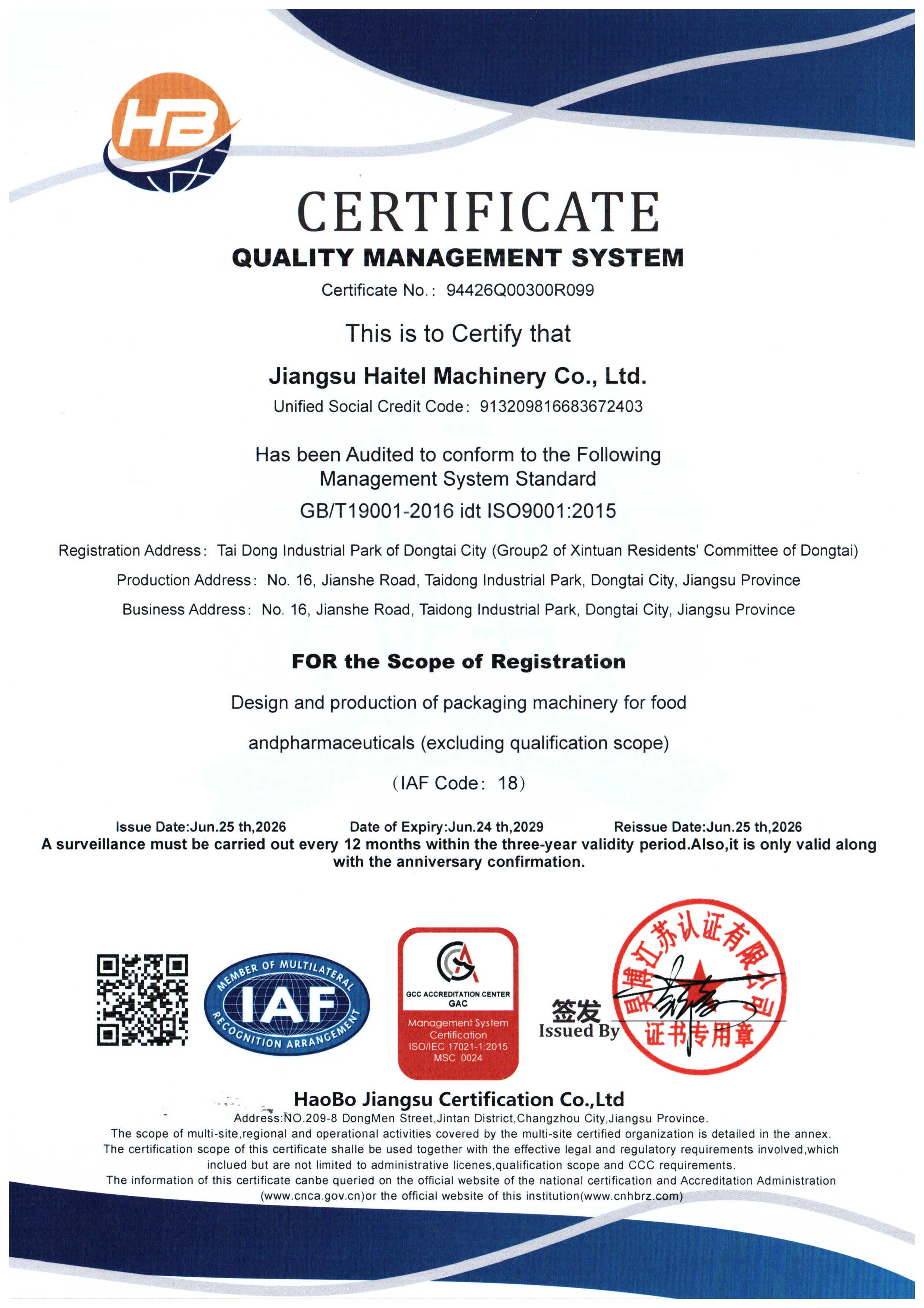
Those are two different categories of document, and for a potato powder line the distinction carries real procurement consequences. ISO 9001 is a quality management system certification. It does not constitute CE marking, and it does not serve as CE documentation for food processing production lines. A buyer who reads the first as proof of the second inherits a documentation gap that tends to surface at customs clearance or at installation acceptance — the two moments when recovery is most expensive.
Why the Certification Answer Gets Compressed
A supplier who answers a certification question quickly is not necessarily being evasive. The question usually arrives as a single line inside a large RFQ, and a complete answer requires three separate statements: which management system certificates exist, which product conformity documents exist, and which specific models each product document lists. Condensing that into a single affirmative is faster, and at the company level it is usually defensible. It simply does not survive a document check at the buyer's end.
Three conflations recur in powder line procurement, and each has a different remedy.
- Treating a management system certificate as a product certificate. ISO 9001 describes how an organisation manages quality. It does not describe what any particular machine does, how it was tested, or whether it may legally carry a conformity mark in a given market.
- Treating a certificate held for one equipment family as covering an entire catalogue. Product certificates are issued against models or model families. A certificate written for candy machinery does not extend to dehydration equipment by association.
- Treating a material declaration as an inspection report. A statement that contact parts are stainless steel is a material claim. It is not a material certificate, not an inspection record and not a factory acceptance test result.
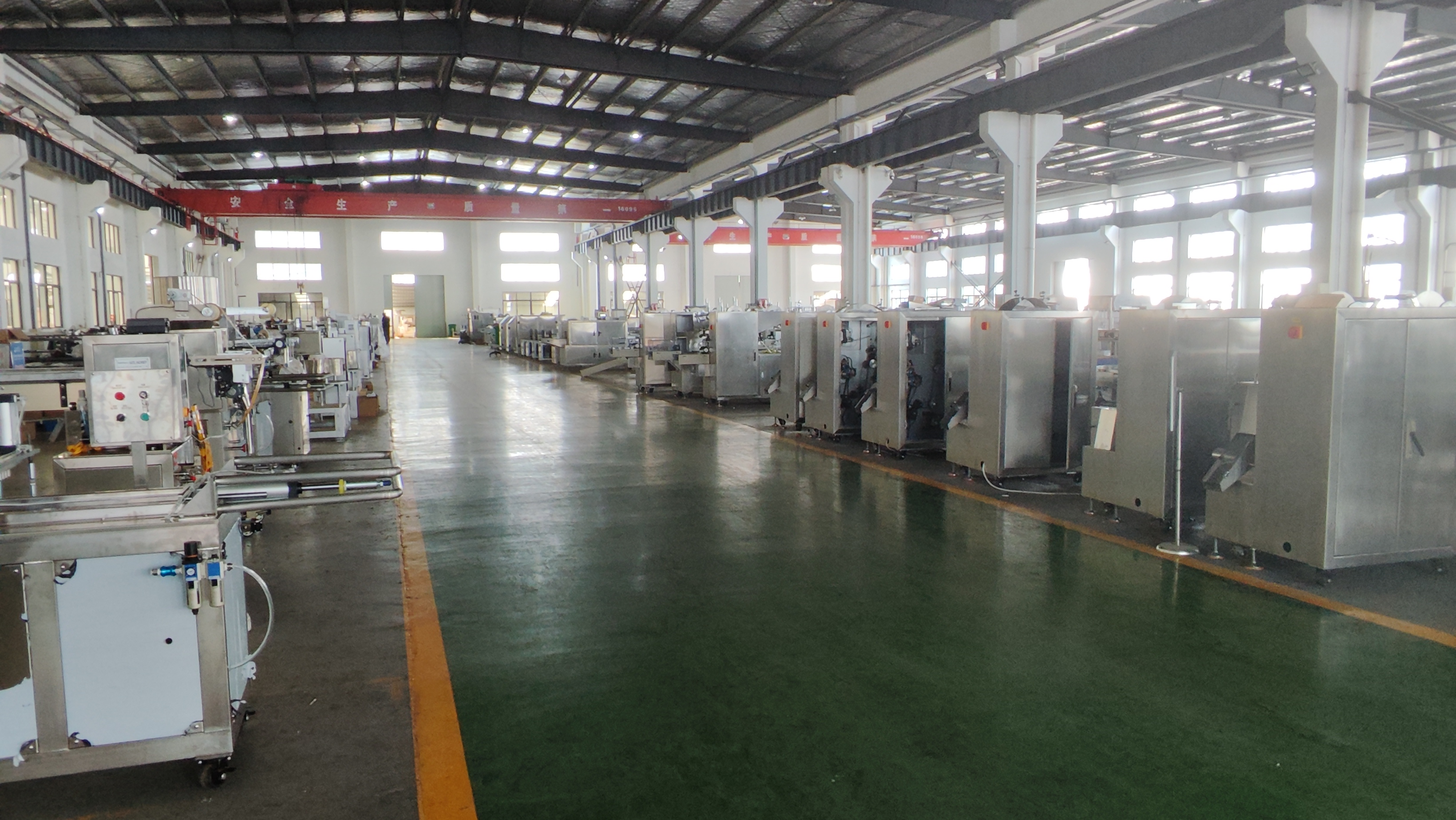
Jiangsu Haitel Machinery Co., Ltd. is a food and pharmaceutical processing and packaging machinery manufacturer established in 1997. The company operates a 40,000 m² facility with 90 employees, a 30-engineer research and development team, an annual output of 1,000 sets and an export ratio of 70% across North America, Europe, Oceania, Central and South America, the Middle East and Asia. Its declared product range includes the Potato Powder Production Line alongside confectionery, starch, cereal, bar, pet food and compound potato chip lines, and it reports more than 80 technical patents with clients in 80 countries. The certificate set it holds is published and specific, which makes it a usable worked example for the documentation questions any powder line buyer will face.
The Certificate Set Haitel Holds — and What Each One Covers
The company holds three management system certificates and two CE certificates. Their scopes differ in ways that matter at the RFQ stage, and reading the scope column is more useful than reading the certificate cover.
| Document | Issuer | Reference | Stated scope | Buyer note |
|---|---|---|---|---|
| ISO 9001 | HB | 94426Q00300R099 | Design and production of packaging machinery for food and pharmaceuticals (excluding qualification scope) | Management system certificate. Not CE. Scope does not list food processing production lines. |
| ISO 14001 | HB | 94426E00147R099 | Environmental management activities involved in the design and production of packaging machinery for food and pharmaceuticals (excluding qualification scope) | Environmental system certificate. Markets stated as China and EU. |
| ISO 45001 | HB | 94426S00095R053 | Occupational health and safety management activities involved in the design and production of packaging machinery for food and pharmaceuticals (excluding qualification scope) | Valid 2026-04-21 to 2029-04-20. Markets stated as China and EU. |
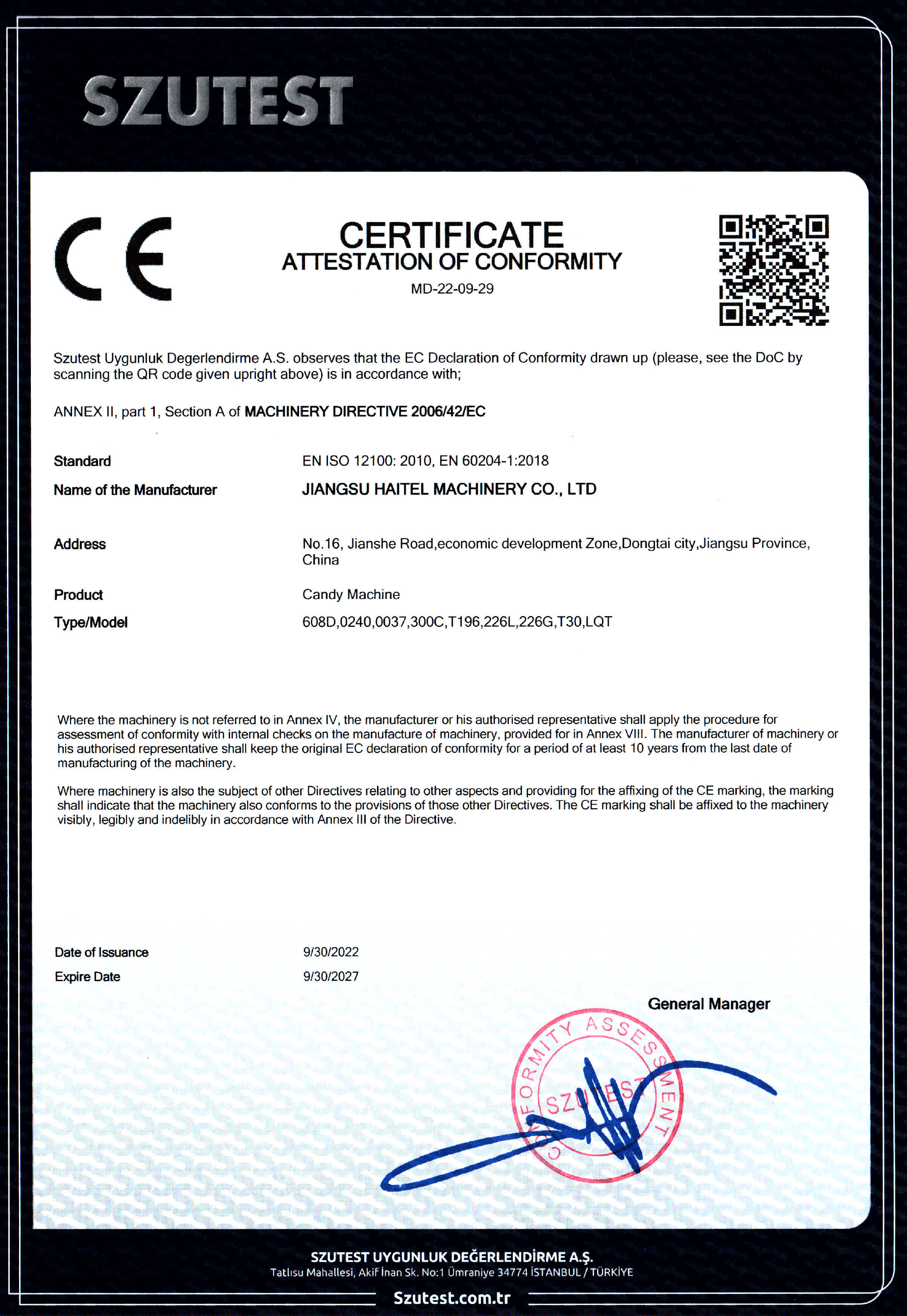
| CE | SZUTEST | MD-22-09-29 | Candy Machine. Standards cited: EN ISO 12100:2010, EN 60204-1:2018 | Valid 2022-09-30 to 2027-09-30. EU market. Coverage list is confectionery and bar models. |
| CE | SZUTEST | MD-22-09-28 | Packing Machine. Standards cited: EN ISO 12100:2010, EN 415-3:2021, EN 415-10:2014, EN 60204-1:2018 | Valid 2022-09-30 to 2027-09-30. EU market. Packaging scope, not processing scope. |
Two observations follow directly from the table. First, all three ISO certificates share the same scope wording: design and production of packaging machinery for food and pharmaceuticals. None of them names a food processing line. The ISO 9001 certification scope does not list food processing production lines such as gummy candy, hard candy or lollipop lines. Second, the two CE certificates carry the scope labels Candy Machine and Packing Machine respectively — neither is written as a general food processing scope.
Certified copies in circulation may predate a renewal cycle. Buyers should request the original certificate and confirm the current validity window rather than relying on a scanned page attached to a quotation, and should treat the scope wording appearing on that original as the authoritative version.
What the CE Coverage List Includes, and What It Does Not
CE certificate MD-22-09-29 is a defined list, not a blanket statement. As recorded in the source documentation, the covered models comprise the HTL-T660 high-speed hard candy production line, the HTL-T600 gummy candy production line, the HTL-T450 gummy candy production line, the HTL-T600 lollipop depositing production line, the HTL-T450 lollipop depositing production line, the HTL-T300 hard candy depositing production line, the HTL-T150 hard candy depositing production line, the HTL-T410 candy cane production line, the HTL-B1 toffee candy production line, the HTL-T400 ball lollipop production line, the HTL-B1 hard candy production line and the HTL-T300 gummy candy production line.
Further models are recorded separately: the HTL-T800 Ball Lollipop Production Line and the HTL-B1 Toffee Candy Production Line are covered, EN 415-3:2021 applies to the HTL-TE600B Flat Lollipop Production Line, EN ISO 12100:2010 applies to the HTL-T660 High-Speed Hard Candy Production Line, and both the HTL Protein bar production line and the HTL-400 Cereal bar production line are recorded as covered. The CE certification for the HTL-T600 Gummy candy production line was issued by SZUTEST.
Read that list against the product catalogue and the boundary becomes visible: every named model is a confectionery or bar line. The potato powder production line does not appear on the CE coverage list.
This is not a defect in the certificate. It is a scope statement, and scope statements are the point. The useful buyer behaviour is straightforward — when a CE certificate is presented as evidence for a potato powder line, ask for the coverage list rather than the cover page. If the model is not listed, the accurate status is that the model is not covered by that certificate. That is a normal position for specialised equipment, and it opens a different and more productive conversation about conformity route, applicable standards, testing and the documentation that will accompany shipment.
Hygiene Requirements Sit in a Different Layer
EN 1672-2:2020 specifies common hygiene and cleanability requirements for machinery and machine components used in preparing and processing food and, where relevant, animal feed. The standard describes design expectations rather than certifying an individual machine. UK Health and Safety Executive guidance takes a comparable position, referencing BS EN 1672-2:2005 as a generic standard covering hygiene requirements for food machines.
The 2020 edition was reviewed here through a standards catalogue record rather than the official full text, so the description reflects the published scope rather than a clause-by-clause reading. That limitation does not reduce the practical value of the standard at specification stage, because the questions it prompts are concrete regardless of clause numbering.
Potato powder is a dry, fine, high-surface-area product. It settles into crevices, accumulates on ledges and resists dry cleaning once compacted. The relevant specification questions therefore concern drainability of surfaces, radiused internal corners, removable guards, access to the milling and sieving stage, declarations for food-contact components, and the cleaning validation method the supplier expects the buyer to run. A standard is a design language: it tells a buyer what to ask. It does not answer the question on their behalf, and conformity with a hygienic design standard is not established by citing the standard number.
Specification Constraints That Change the Quotation
Capacity on a powder line is not a constant. Haitel's published guidance states that output depends on the final product, that a full automatic line can operate continuously for 24 hours, and that exact capacity is confirmed against the buyer's product formula and target weight. A quotation that presents a single tonnage without stating the product specification, target weight and shift pattern behind it is describing a reference condition rather than a guarantee.
Three further constraints shape the commercial offer. Voltage is customised to match the local power supply rather than fixed at a default. Capacity, product shape, size, voltage and layout are all listed as customisable, with a drawing issued for confirmation before production begins. Contact parts are stainless steel, and SS304 appears in the recorded product specifications.
Where a capacity figure arrives without a stated formula, target weight and product specification, it is directional rather than contractual. Writing the calculation basis into the purchase specification is what converts it into something both parties can test against at acceptance.
How This Differs From a Conventional Supplier Conversation
The conventional exchange is not dishonest. It is under-specified, and the difference becomes clear when the two versions are placed side by side.
| Conventional exchange | Structured alternative |
|---|---|
| Do you have CE? | Which certificate number, which issuing body, which standards are cited, which models are listed, what is the validity window, and does the model I am buying appear on that list? |
| What is the capacity? | At what product specification, target weight and shift pattern, and what calculation basis is written into the contract? |
| Is it stainless steel? | Which grade, which components, and is there a material certificate for the food-contact parts? |
| Is it hygienic? | Which hygienic design requirements apply, and what cleaning validation method will be used at commissioning? |
The trade-off is real and worth naming. A structured document review adds days to the front end of a project and produces no immediate commercial return. It pays back at installation acceptance and, for export buyers, at customs. Whether that trade is worth making depends on the project's tolerance for a documentation hold and on how much of the acceptance criteria is written into the purchase contract. Projects with compressed commissioning windows and fixed launch dates generally find the front-end cost easier to justify than projects buying a single machine for a mature plant.
Where a Potato Powder Line Sits in the Project Landscape
Powder lines are bought in three project shapes, and the documentation burden differs across them. A new build requires a complete line, plant layout, utility planning and a full acceptance protocol — the highest documentation load and the highest value in getting scope right early. An expansion adds capacity inside an existing plant, and the documentation frequently has to align with the incumbent line's standards, which may not match the incoming supplier's defaults. A replacement swaps out an ageing line, where the binding constraints are usually mechanical and utility compatibility rather than conformity scope.
Downstream, potato powder serves rehydrated mash products, snack seasoning bases, bakery and batter systems, soup and sauce thickening, and foodservice and institutional supply. Each channel places different demands on granulation, rehydration behaviour and microbial control, and those demands reach back into the drying and milling specification. A line specified for one channel does not automatically satisfy another, which is why the product specification — not the tonnage — should be the first page of any powder line RFQ.
Market Signals Behind the Documentation Pressure
Two independent data points frame the commercial context. OEC, drawing on UN Comtrade records, puts global trade in industrial food preparation machinery under HS 8438 at USD 16.7 billion in 2024, a 2.12% increase on 2023. Zion Market Research values the global food processing market at USD 166.48 billion in 2024. Commercial research cited in the same verified data set estimates the potato flakes market at USD 7.0 billion in 2025, rising to USD 9.4 billion by 2035 at a 3.0% CAGR. Potato powder is an adjacent product to flakes, and the flakes figure is offered here as a segment indicator rather than a direct powder market valuation.
The interpretive step is modest but useful. A segment growing at a mid-single-digit rate on an expanding equipment trade base tends to produce more suppliers, more model variants and more certificate documents in circulation. Volume of documentation is not the same as quality of documentation. As the number of certificates in a market rises, the discipline of reading the coverage list becomes more valuable rather than less, because the marginal cost of asking has not changed while the marginal risk of not asking has.
Where This Assessment Stops
An assessment that stops at the edge of its evidence is more useful than one that fills the gap with inference. The limits here are specific.
- The CE certificate recorded against Haitel's candy machinery carries the scope label Candy Machine and lists confectionery and bar models. A potato powder production line is not on that list. Nothing in the available record establishes CE coverage for a potato powder line, and this article does not claim it.
- The ISO 9001 scope covers packaging machinery for food and pharmaceuticals. It does not substitute for CE documentation, material certificates, inspection reports or factory acceptance test reports.
- The only dehydration equipment specification in the product data belongs to the Potato flakes production line (model G1016, φ1000*1600, 60–80 kg). It is not a powder line capacity figure.
- EN 1672-2:2020 was reviewed through a standards catalogue record. The official full text was not independently accessed, so the description reflects the published scope rather than a clause-level analysis, and it is not evidence of conformity for any specific machine.
- The verified data set contains no eligible evidence on smart manufacturing technology for food processing lines. This article therefore makes no claim about PLC, SCADA, MES or IIoT capability, regardless of what individual product datasheets may state.
- No energy consumption, OEE, unit operating cost or total cost of ownership figures are available in the source material. These belong in the RFQ and factory acceptance stage, not in a desk assessment.
What Changes Next
Three shifts are already visible in how food processing lines are specified. Hygienic design is moving from differentiator to line item, as buyers write cleanability requirements into the specification instead of accepting them as a vendor characteristic. The documentation package is becoming a deliverable in its own right, with material certificates, inspection reports and factory acceptance records increasingly listed as contractual handover items rather than optional extras. And certificate scope verification is becoming routine — asking for the model list rather than the certificate cover is a small habit with a disproportionate effect on downstream friction.
None of these shifts favours a particular supplier. They favour buyers who ask for the list, and suppliers who can produce it without delay. For a potato powder production line, that means a conformity conversation that starts with scope rather than with a logo on a certificate header.
FAQ
Does an ISO 9001 certificate make a food production line CE compliant?
No. ISO 9001 is a quality management system certification and does not constitute CE marking. It does not serve as CE documentation for food processing production lines, and it does not replace material certificates, inspection reports or factory acceptance test reports. CE marking is a separate product-level conformity route assessed against the applicable directives and harmonised standards for the specific machine.
Which production lines are listed under Haitel's CE certificate MD-22-09-29?
The certificate, issued by SZUTEST and valid from 2022-09-30 to 2027-09-30 for the EU market, lists confectionery and bar models. The recorded list includes the HTL-T660 high-speed hard candy production line, the HTL-T600 and HTL-T450 gummy candy production lines, the HTL-T600 and HTL-T450 lollipop depositing production lines, the HTL-T300 and HTL-T150 hard candy depositing production lines, the HTL-T410 candy cane production line, the HTL-B1 toffee candy production line, the HTL-T400 ball lollipop production line, the HTL-B1 hard candy production line and the HTL-T300 gummy candy production line.
Is a potato powder production line covered by the same CE certificate as the candy lines?
The available record does not establish that. Certificate MD-22-09-29 carries the scope label Candy Machine, and its listed models are confectionery and bar lines. A potato powder production line does not appear on that list. The accurate status is therefore that the model is not covered by that certificate, and buyers should request the specific conformity documentation applicable to the model being purchased rather than treating the candy line certificate as transferable.
What does EN 1672-2:2020 require, and what does it not prove?
EN 1672-2:2020 specifies common hygiene and cleanability requirements for machinery and machine components used in preparing and processing food and, where relevant, animal feed. It describes design expectations for hygienic construction and cleanability. It does not certify any individual machine, and it is not a substitute for a conformity assessment, a material certificate or a factory acceptance test. UK HSE guidance references BS EN 1672-2:2005 in a comparable role as a generic standard for food machines.
How is the hourly output of a potato powder line determined?
Output is calculated from the product formula and the target weight rather than read from a catalogue. Haitel's published guidance states that capacity depends on the final product, that a full automatic line can operate continuously for 24 hours, and that exact capacity is confirmed against the buyer's formula and target weight. The potato flakes specification recorded in the product data — 60–80 kg on model G1016 — belongs to a different product form and should not be transferred to a powder line without recalculation.
Can voltage and plant layout be adapted to a specific site?
Yes. Haitel's capability record lists voltage, logo, output and shape among the customisable parameters, and states that custom voltage is matched to the local power supply. Layout adaptation is also supported, with a drawing issued for confirmation before production begins. The record further states OEM and ODM modes, a monthly capacity of 100 sets, a minimum order quantity of one set and 100% testing as the quality control approach.
What documentation should a buyer request alongside a food-contact production line?
At minimum: the certificate number, issuing body, applicable standard and validity window for each certificate held; the specific model list attached to each product certificate; material certificates for food-contact components; inspection reports; and factory acceptance test records. Management system certificates should be requested separately from product conformity documents, because the two answer different questions and one cannot stand in for the other.
What are the stated lead times and minimum order quantity?
Haitel's capability record states a minimum order quantity of one set. Lead time is stated as 15 to 45 days for a single machine and 60 to 90 days for a production line. Monthly capacity is listed at 100 sets. For export shipments, the published guidance describes standard export wooden case packaging, with FOB, CIF or DDP pricing available on request.
Can raw material samples be tested before a line is ordered?
Yes. Haitel's published FAQ states that buyers can send raw material for machine testing and sample production. This provides a practical check on product behaviour before the specification is finalised, although it does not substitute for a factory acceptance test performed on the configured line at the supplier's facility.
What after-sales support is included?
The stated support covers a 12-month warranty, on-site installation and commissioning, operator training and remote technical support. The capability record also lists on-site installation and debugging with remote support as the after-sales model, and the company states it provides full technical guidance across its installed base.
The documentation questions raised here are answerable before a purchase order is issued, and answering them early is materially cheaper than answering them at the port. A technical brochure covering Haitel's food processing line range, including the Potato Powder Production Line, is available for download: Haitel product brochure (PDF).
Tem questões ou precisa de mais detalhes?
Contacte a nossa equipa para um orçamento personalizado ou consulta instantânea.
Solicitar orçamento
Preencha o formulário abaixo e a nossa equipa entrará em contacto com uma proposta personalizada.
Chat direto do WhatsApp
Prefere conversar em tempo real? Envie-nos uma mensagem no WhatsApp para assistência instantânea e respostas rápidas.
- Obter orçamento personalizado
- Partilhar fotos ou documentos
- Discuta as suas necessidades diretamente
Geralmente responde em 5–30 minutos durante o horário de expediente.