
Powder Coating Supplier Capability: Test Data, Not Claims
For construction and decoration buyers, the question is not whether a supplier says it can meet a specification. The question is whether the supplier can show the test method, the measured result, and the batch record behind it.
Hsinda, formally Chengdu Hsinda Polymer Materials Co., Ltd., is a China-based manufacturer of thermosetting powder coatings founded in 2015. The company produces epoxy, polyester, epoxy-polyester hybrid, TGIC-free, aluminum, anti-corrosion, metallic, sandy, wrinkle, hammer tone, glossy and matt powder coatings, and exports to more than 70 countries, according to company information. For a construction buyer, the useful part of that profile is not the list itself. It is the test data that sits behind each product family.
Construction and decoration projects put coatings under mixed stress: ultraviolet light, moisture, salt, abrasion, cleaning chemicals and handling damage. A facade panel, window profile, railing, ceiling, cabinet or partition may look similar across suppliers, but the evidence behind the finish can differ sharply. This article sets out how buyers can read Hsinda's published product data, what each test method actually proves, and how to turn those values into purchasing terms and acceptance criteria.
The Procurement Problem: Adjectives Are Not Acceptance Criteria
Powder coating tenders often contain phrases such as weather resistant, high hardness, strong adhesion or long service life. These phrases are useful as a first filter, but they are not testable. A buyer cannot accept or reject a batch against an adjective. A buyer can accept or reject a batch against a method, a value and a sampling rule.
The practical opportunity is to move supplier evaluation from brochure language to evidence language. That means asking for the standard number, the test condition, the measured result and the batch traceability behind it. It also means defining the acceptance criteria before the purchase order is issued, not after the first complaint.
Supplier snapshot, company-reported
- Founded in 2015 in Chengdu, China.
- 8 production lines and 3 sample lines; annual output about 5,000 tons.
- Monthly capacity 400 tons; quality control stated as 100% test.
- Stated lead time: 15–20 days for ODM and 20 days for OEM; stated MOQ: 300 kg for ODM and 6 tons for OEM.
- Exports to more than 70 countries.
- ISO 9001 and ISO 14001 certified; RoHS, REACH, FDA, carbon footprint and antibacterial test documents are available for relevant products.
The Evidence Set: What Hsinda Publishes for Powder Coating
The following values appear in Hsinda product data for its thermoset powder coating range. They should be read as datasheet evidence, not as a project warranty. The buyer's task is to confirm that the same methods and values apply to the specific product, color, finish and batch being purchased.
| Test item | Method | Stated result | What it helps verify |
|---|---|---|---|
| Adhesion | ISO 2409:2020 | 0 Grade | Cross-cut adhesion on the tested substrate and film build. |
| Hardness | ISO 15184:2020 | ≥H | Pencil hardness of the cured film. |
| Impact resistance | ISO 6272-1:2017 | 50 kg/cm for standard product families; Aluminum Powder Coating datasheet states 2.5 Nm | Resistance to mechanical damage during handling and service. |
| Salt spray resistance | ISO 7253:1996 | 500 hours, film unchanged, unilateral corrosion at the cross section ≤2 mm; Aluminum Powder Coating datasheet states 1000 hours | Corrosion screening under accelerated conditions. |
| Gloss | ISO 2813:2014 | 5%–95%; Matt Powder Coating 5%–30% | Specified gloss level at the agreed measurement geometry. |
| Bending | ISO 1519:2002 | ≤2 mm; Aluminum Powder Coating ≤5 mm | Flexibility of the coated system after forming. |
| Cupping | ISO 1520:2006 | ≥6 mm; Aluminum Powder Coating ≥5 mm | Formability and resistance to cracking under deformation. |
| Humidity and heat | GB/T 1740-2007 | 1000 hours, slight gloss loss, ≤ level 1 | Resistance to warm, humid conditions. |
| Weather resistance | ISO 11341:2004 | 340 lamp 500 hours, no powdering, light retention >50%; Aluminum Powder Coating 1000 hours; Florida natural aging 1 year, gloss retention >50% for Aluminum Powder Coating | UV and outdoor durability screening. |
| Coverage | Product data | 8–10 m²/kg at 30–90 μm film thickness | Estimating consumption, not a guaranteed coverage promise. |
| Film thickness | Product data | 70 μm | Typical reference film build for the range. |
| Particle size | Product data | Average 32–42 μm | Application behavior and film uniformity. |
| Curing | Product data | 180–200°C, 10–15 minutes | Cure window to verify against the coater's oven profile. |
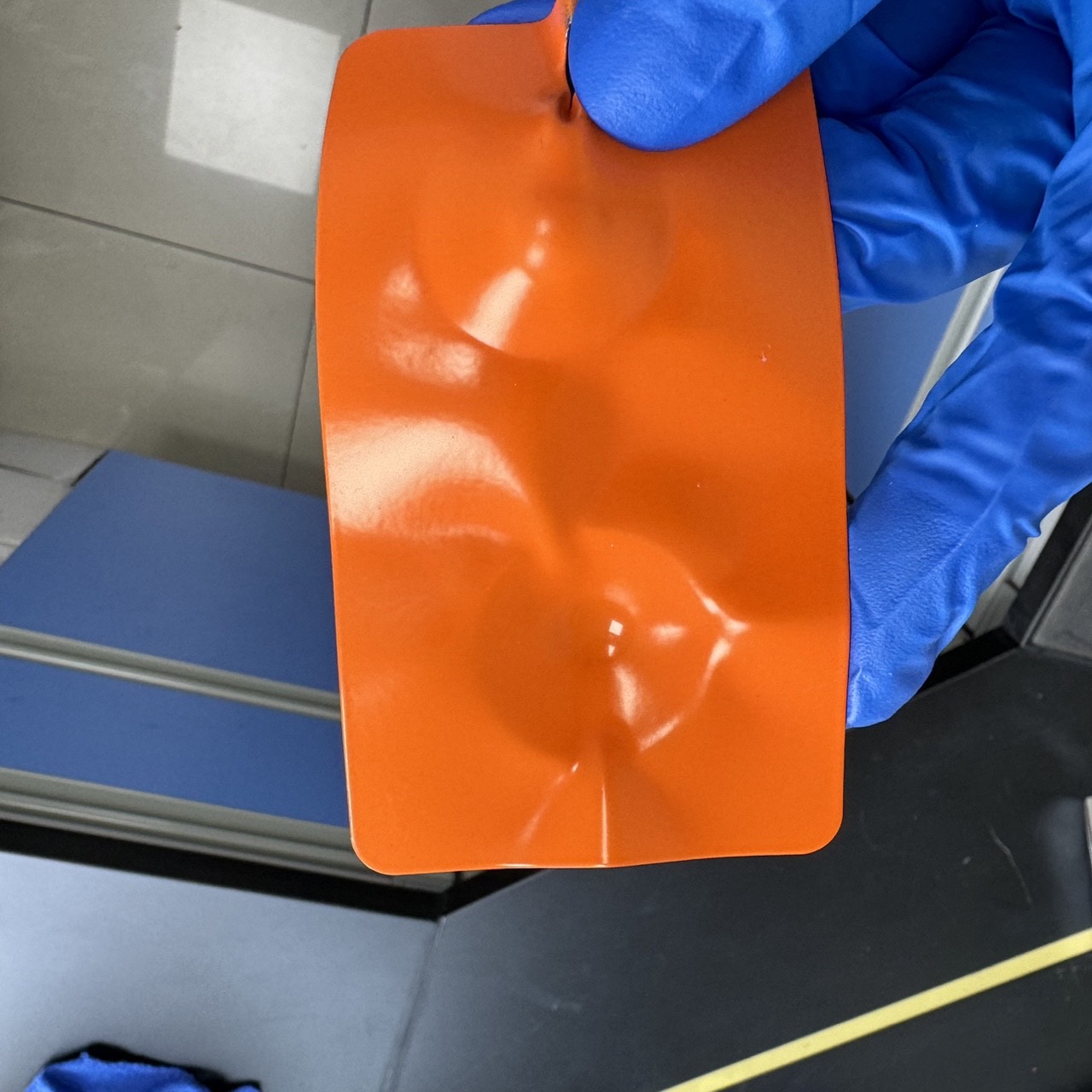
Reading the Numbers: What Each Test Actually Tells a Buyer
Adhesion 0 Grade under ISO 2409:2020 is a cross-cut result. In this method, 0 is the best classification on the scale, meaning no detachment at the cut edges. It is a useful indicator of substrate preparation, pretreatment and film formation. It does not prove adhesion on every alloy, every pretreatment line or every thick-film condition. Buyers should confirm the substrate and pretreatment used for the test report.
Hardness ≥H under ISO 15184:2020 is a pencil hardness result. It indicates that the cured film meets at least the H grade under the stated test conditions. Hardness is not the same as flexibility. A very hard film can still crack under impact or bending if the formulation and cure are not balanced. That is why the impact, bending and cupping results should be read together, not in isolation.
Impact 50 kg/cm under ISO 6272-1:2017 is stated for many Hsinda product families, including polyester, epoxy, hybrid, TGIC-free, anti-corrosion, metallic, sandy, wrinkle, hammer tone, glossy and matt products. The Aluminum Powder Coating datasheet states 2.5 Nm instead. That difference is important. The units are not the same, and the test conditions may differ. A buyer comparing suppliers must normalize the unit and the method before deciding which result is tougher. The presence of two values across one portfolio is not a defect in the data; it is a warning against assuming one headline number applies to every product.
Salt spray 500 hours under ISO 7253:1996 with film unchanged and unilateral corrosion at the cross section ≤2 mm is an accelerated corrosion result. It is useful for screening and batch consistency. It is not a service-life guarantee. The Aluminum Powder Coating datasheet states 1000 hours, which is a different evidence level within the same portfolio. For a coastal facade, a tunnel, a chemical plant or a high-humidity interior, the buyer should match the test duration and acceptance value to the actual exposure, not simply choose the longest number on a brochure.
Gloss 5%–95% under ISO 2813:2014 shows that the range covers matt through high gloss. The Matt Powder Coating datasheet states 5%–30%. Gloss must be specified at the agreed measurement angle, usually 60 degrees for many industrial finishes, and with a tolerance. A statement such as matt or glossy is not enough for batch acceptance. The purchase order should define the target and the permitted variation.
Coverage 8–10 m²/kg at 30–90 μm is an estimating figure. Actual coverage depends on film thickness, specific gravity, part geometry, reclaim and application efficiency. It should be used for budgeting and line trials, not as a contractual guarantee without agreed conditions. The same applies to particle size, average 32–42 μm, and the 70 μm film thickness reference. These values describe the product and process window, not a promise that every part will land exactly on the same film build.
Curing at 180–200°C for 10–15 minutes is a process window. The coater must verify the metal temperature, oven load and line speed. A datasheet cure schedule cannot compensate for an under-cured part. Buyers should ask for the cure window to be written into the trial plan and checked with a cure test or oven profile.
Product Range and Application Fit
The test values only become useful when they are linked to the right product family and the right construction or decoration use case. The table below summarizes the range using Hsinda product data and stated application information.
| Product family | Construction and decoration role | Evidence note |
|---|---|---|
| Epoxy Powder Coating | Interior and anti-corrosion use, electrical enclosures, pipes, steel components. | 500-hour salt spray; chemical resistance to general acids and oils, average alkali resistance. |
| Polyester Powder Coating | Outdoor aluminum, doors and windows, curtain walls, railings, street furniture. | 500-hour salt spray; 500-hour weathering; 50 kg/cm impact. |
| Epoxy Polyester Hybrid Powder Coating | Indoor furniture, appliances, shelving, electrical cabinets. | Balances epoxy and polyester behavior; 500-hour salt spray; 50 kg/cm impact. |
| TGIC Free Powder Coating | REACH-sensitive projects, indoor appliances and furniture. | REACH certificate CKGIN25000923901; 500-hour salt spray; 50 kg/cm impact. |
| Aluminum Powder Coating | Aluminum profiles, doors and windows, glass curtain walls, sunrooms, architectural partitions. | 1000-hour salt spray; 1000-hour weathering; 1-year Florida natural aging with gloss retention >50%; 2.5 Nm impact; listed as Qualicoat and AAMA powder coating type. |
| Anti-corrosion Powder Coating | Pipelines, valves, steel reinforcement, heavy equipment. | Pure epoxy; 500-hour salt spray; 50 kg/cm impact. |
| Metallic Powder Coating | Decorative aluminum, automotive trim, appliances, furniture. | 500-hour salt spray; 500-hour weathering; 50 kg/cm impact. |
| Sandy Powder Coating | Building materials, cabinets, doors and windows, instrument housings. | 500-hour salt spray; 500-hour weathering; 50 kg/cm impact. |
| Wrinkle Powder Coating | Electrical cabinets, furniture, machinery, tools. | 500-hour salt spray; 500-hour weathering; texture finish. |
| Hammer Tone Powder Coating | Security doors, furniture, public facilities, aluminum profiles. | 500-hour salt spray; 500-hour weathering; 50 kg/cm impact. |
| Glossy Powder Coating | Architectural aluminum, appliances, automotive, furniture. | Gloss range 5%–95%; 500-hour salt spray; 500-hour weathering. |
| Matt Powder Coating | Appliances, electronics, automotive interior, lighting fixtures. | Gloss 5%–30%; 500-hour salt spray; 50 kg/cm impact. |
Qualicoat and AAMA: Classification Is a Starting Point, Not a Conclusion
The Aluminum Powder Coating product is described as an aluminum profile powder coating and is listed as a Qualicoat and AAMA powder coating type. The company's customization capability also lists weather-resistant options with reference to AAMA 2604 and Qualicoat 1 and Qualicoat 2 standards. These references are meaningful because they connect the product to recognized architectural coating frameworks. They are not, by themselves, a project qualification.
For a curtain wall, window system or exterior facade, the buyer should ask for the exact class or performance level, the certificate scope, the substrate and pretreatment, the test methods and the laboratory behind the report. A Qualicoat or AAMA reference on a product page does not automatically mean that every color, every batch or every application meets the project's requirements. The purchase order should define the classification and the evidence package that must be supplied with each lot.
From Evidence to Purchase Order: Acceptance Criteria That Work
Test data becomes useful when it is written into the purchasing terms. The following clauses are practical examples for construction and decoration projects. They can be adapted to the project's exposure and the coater's process.
| Term to define | Why it matters | Testable clause example |
|---|---|---|
| Resin chemistry and finish | Polyester, epoxy, hybrid and TGIC-free systems behave differently outdoors and indoors. | Specify the product family, the finish type and the application environment. |
| Color and gloss | RAL or Pantone matching without a gloss tolerance can still fail visually. | Define the color standard, the 60-degree gloss target and the permitted variation. |
| Film thickness and coverage | Coverage depends on film build and application efficiency. | Use 70 μm as a reference; define the measured film thickness range and the coverage basis. |
| Mechanical tests | Adhesion, hardness and impact together describe handling and forming risk. | Adhesion 0 Grade per ISO 2409:2020; hardness ≥H per ISO 15184:2020; impact per ISO 6272-1:2017 with the product-specific value and unit stated. |
| Corrosion and weathering | Salt spray and UV exposure are the main screening tests for exterior durability. | 500-hour or 1000-hour salt spray per ISO 7253:1996 with unilateral corrosion ≤2 mm; weathering per ISO 11341:2004 with the agreed duration and gloss retention. |
| Cure window | A powder can meet its datasheet only if the part reaches the required cure. | 180–200°C for 10–15 minutes; verify with the coater's oven profile and a cure check. |
| Certification scope and batch records | A certificate number is useful only when the scope and product match. | Require the certificate number, issuing body, standard, product scope and batch COA with each shipment. |
System certifications support the quality argument but should not be confused with product performance. Hsinda's production and sale of thermosetting powder coating is certified to ISO 9001 under GB/T 19001-2016/ISO 9001:2015, certificate number 2052025Q00440R0S, issued by China International Certification Co., Ltd. The polyester powder coating is certified to ISO 14001 under GB/T 24001-2016/ISO 14001:2015, certificate number 2052025E00271R3S, issued by the same body. RoHS certificate CKGEC25000071901 is issued by SGS under the IEC 62321 series and applies to Matt Powder Coating for the EU and global markets. REACH certificate CKGIN25000923901 is issued by SGS under EU REACH Regulation (EC) No 1907/2006 for TGIC Free Powder Coating. FDA certificate TSNPC25004542302 is issued by SGS under US FDA 21 CFR 175.300 and is stated to apply to metal and epoxy powder coating products globally. The carbon footprint certificate TZJ136660053R0S is issued by Huaqixin Certification Service (Chengdu) Co., Ltd. under ISO 14067:2018 and PAS 2050:2011. Antibacterial powder coating is tested to ISO 22196:2011, report number ASH25-0055689-02, issued by SGS.
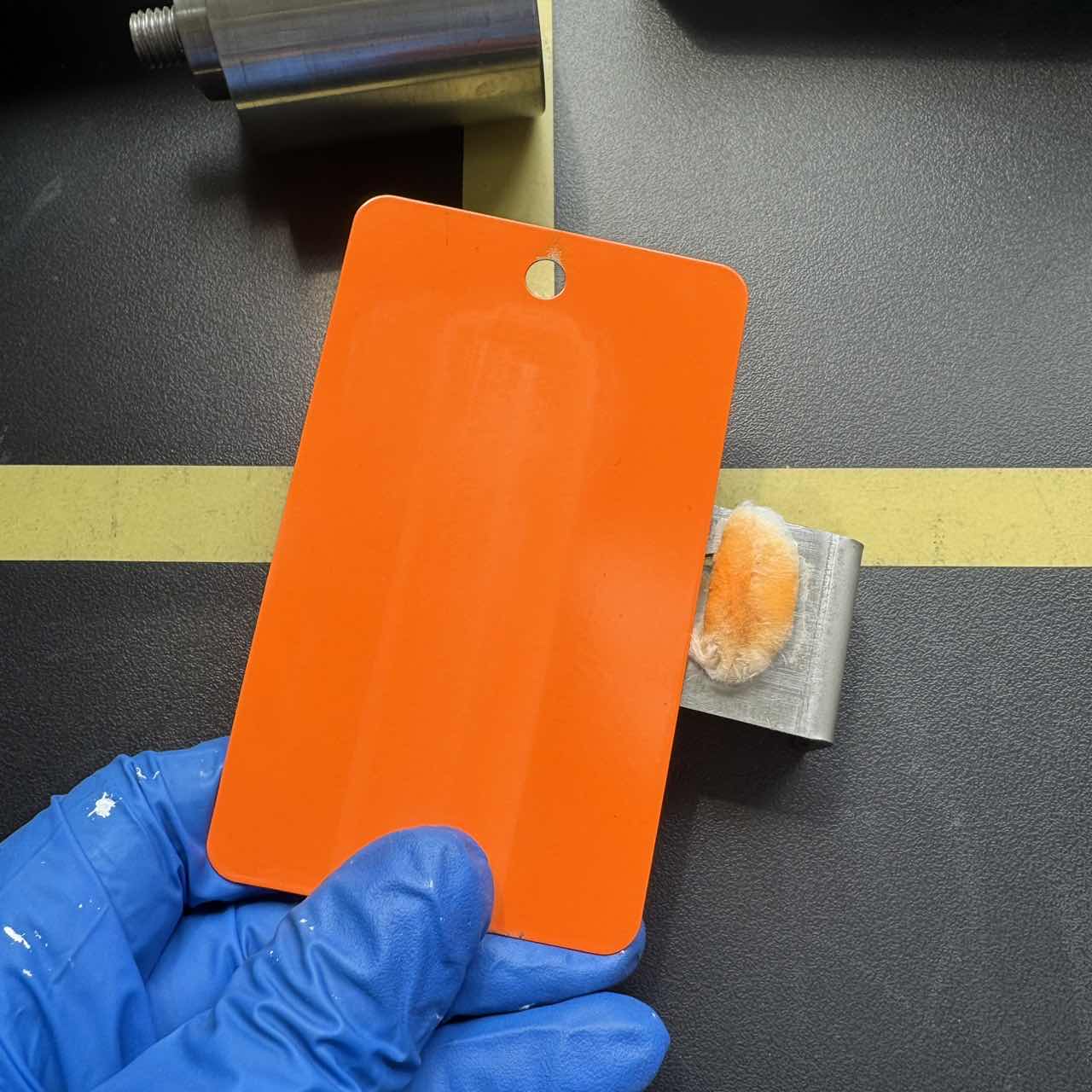
Where the Evidence Fits: Construction and Decoration Scenarios
Aluminum profiles, doors and windows, glass curtain walls, sunrooms and architectural partitions are the clearest fit for the Aluminum Powder Coating and polyester exterior range. These applications need color and gloss consistency, film integrity and a credible weathering package. The 1000-hour salt spray, 1000-hour weathering and 1-year Florida natural aging data are relevant here, provided the project specification accepts those methods and the coater can reproduce the pretreatment and cure conditions.
Interior partitions, railings, ceilings, cabinets, lighting fixtures, electrical cabinets and shelving can use hybrid, epoxy or matt and texture finishes where UV is not the main exposure. In these applications, adhesion, hardness, impact and chemical resistance often matter more than the longest salt spray number. A powder that is over-specified for a dry interior may add cost without improving the outcome; a powder that is under-specified for a wet or coastal exterior may fail early.
Hsinda's case record includes an electrical enclosure project of 40 tons across Mexico, Paraguay, Sri Lanka, Russia and China over a 10-year duration, with requirements for corrosion resistance, insulating or static conductive behavior and aesthetics. It also includes an industrial shelving project in Colombia of 100 tons over 10 years, using an epoxy-polyester electrostatic powder coating process with custom RAL colors and a stated zero-VOC process. These cases do not replace project-specific testing, but they show where the product data is applied in practice.
Market Context: Why Evidence-Based Sourcing Is Gaining Ground
Commercial research estimates put the global powder coatings market at USD 16.12 billion in 2025, with Asia Pacific accounting for 63.10% of revenue, according to Fortune Business Insights. Grand View Research estimates that polyester accounted for 48.2% of 2025 market share, reflecting its role in exterior and weathering-sensitive applications. Another commercial report values the 2024 market at USD 17.01 billion, which shows how scope and methodology affect headline numbers. The exact figure is less important for a buyer than the direction: a large, Asia-Pacific-weighted supply base makes supplier qualification and evidence checking more important, not less.
For construction and decoration buyers, the market context supports a simple conclusion. There are many suppliers and many product claims. The differentiator is the ability to provide method-specific data, batch records and acceptance criteria that survive a project audit. That is a more durable advantage than a glossy sample card.
Comparison with Traditional Evaluation Approaches
| Approach | Strength | Limitation |
|---|---|---|
| Brochure-led evaluation | Fast and easy to compare at first glance. | Cannot verify method, substrate, batch or test laboratory. |
| Datasheet plus COA | Traceable and usable in a purchase order. | Still not project-specific; test coupons may differ from production parts. |
| Project-specific qualification | Closest to actual fit and risk tolerance. | Requires time, agreed test methods and access to the coater's process data. |
The boundary is real: datasheet evidence is necessary but not sufficient. A supplier can publish a 500-hour salt spray result and still fail a project if the substrate, pretreatment, film thickness or cure is wrong. That is why the evidence package should include process assumptions, not just final numbers.
Limits of Datasheet Evidence
- Datasheet values are not a warranty. They describe a tested product under stated conditions.
- Test coupons may not represent complex production parts, welded assemblies or thick-film edges.
- Salt spray hours are accelerated results, not a prediction of years in a specific environment.
- The Aluminum Powder Coating datasheet states 2.5 Nm impact, while many other products state 50 kg/cm. The unit and test condition must be aligned before comparison.
- Qualicoat and AAMA references require scope verification. A classification is not the same as a project approval.
- Color and gloss can vary by batch and cure. Acceptance tolerances must be agreed in advance.
- High-risk facades, coastal projects and safety-related components may need third-party witness testing or project-specific mock-ups.
Future Outlook
Powder coating procurement is likely to become more evidence-based. Buyers are asking for method-specific reports, batch COAs and acceptance criteria that can be audited. Suppliers that can connect product data to process data, such as cure windows, film thickness and coverage, will be easier to qualify. Suppliers that rely only on adjectives will face more requests for proof.
The next step is not more marketing language. It is a clearer evidence package: the standard, the result, the batch, the substrate and the acceptance rule. That package protects the buyer, the coater and the project.
FAQ
What test data should a construction buyer request from a powder coating supplier?
Ask for datasheet values and batch COAs covering adhesion per ISO 2409:2020, hardness per ISO 15184:2020, impact per ISO 6272-1:2017, salt spray per ISO 7253:1996, gloss per ISO 2813:2014, film thickness, coverage, particle size and cure schedule. For aluminum profiles, also ask for the Qualicoat or AAMA classification and the exact certificate scope. For regulated markets, request RoHS, REACH, FDA or other relevant certificates by product and market.
What does adhesion 0 Grade mean under ISO 2409:2020?
In the ISO 2409 cross-cut method, 0 Grade is the best classification on the scale. It means no detachment at the cut edges under the stated test conditions. It is a useful indicator of adhesion, but it should be confirmed on the actual substrate, pretreatment and film thickness used in production.
Is 500-hour salt spray enough for outdoor construction?
It is a useful screening result, not a service-life guarantee. Hsinda product data states 500 hours with film unchanged and unilateral corrosion ≤2 mm for many products, while the Aluminum Powder Coating datasheet states 1000 hours. The buyer should match the duration and acceptance value to the project environment, such as coastal, industrial or sheltered inland exposure.
Why does the Aluminum Powder Coating datasheet state 2.5 Nm impact instead of 50 kg/cm?
Different product datasheets use different units and test conditions. The Aluminum Powder Coating datasheet states 2.5 Nm, while many other Hsinda products state 50 kg/cm under ISO 6272-1:2017. Buyers should normalize the unit and confirm the test conditions before comparing results across products or suppliers.
How should Qualicoat and AAMA be written into a purchase order?
Specify the exact class or performance level, the substrate and pretreatment, the test methods, the certificate scope and whether witness testing is required. Do not accept a logo or a general reference as sufficient evidence. The purchase order should identify the document that proves the classification for the product being supplied.
What purchasing terms prevent disputes over powder coating quality?
Define the resin chemistry, color standard, gloss range, film thickness, mechanical test values, salt spray and weathering criteria, cure window, sampling method, COA requirements, packaging, MOQ and lead time. Use the same units and test methods in the specification, the trial plan and the batch release document.
Conclusion
Hsinda's published test data give construction buyers a concrete starting point: adhesion 0 Grade, hardness ≥H, impact 50 kg/cm for many product families, 500-hour salt spray with ≤2 mm unilateral corrosion, 1000-hour salt spray for Aluminum Powder Coating, gloss 5%–95%, coverage 8–10 m²/kg at 30–90 μm, average particle size 32–42 μm, 70 μm film thickness and a 180–200°C, 10–15 minute cure window. The product range covers epoxy, polyester, hybrid, TGIC-free, aluminum, anti-corrosion, metallic, sandy, wrinkle, hammer tone, glossy and matt finishes.
The practical rule is simple: ask for the method, the result, the batch record and the acceptance criterion. If a supplier cannot provide all four, the claim is not yet evidence.
Reference: Hsinda powder coating company brochure (PDF).
Tem questões ou precisa de mais detalhes?
Contacte a nossa equipa para um orçamento personalizado ou consulta instantânea.
Solicitar orçamento
Preencha o formulário abaixo e a nossa equipa entrará em contacto com uma proposta personalizada.
Chat direto do WhatsApp
Prefere conversar em tempo real? Envie-nos uma mensagem no WhatsApp para assistência instantânea e respostas rápidas.
- Obter orçamento personalizado
- Partilhar fotos ou documentos
- Discuta as suas necessidades diretamente
Geralmente responde em 5–30 minutos durante o horário de expediente.