
Powder Coating vs. Liquid Paint: A Quantitative Comparison for Industrial Buyers
For procurement and engineering teams evaluating surface finishing options, the choice between powder coatings and traditional liquid paint often comes down to total cost of ownership, environmental compliance, and long-term durability. Powder coating is a dry finishing process that uses electrostatically charged particles to form a durable, seamless layer, offering measurable advantages over solvent-based liquid paints. This article provides a fact-based comparison—covering cost, performance, energy efficiency, and supplier differentiation—to support decision-making in industrial and architectural applications.
The Industry Shift: Why Powder Coatings Are Gaining Ground
The global powder coatings market was valued at approximately USD 11.5–16.4 billion in 2025 and is projected to reach USD 18.5 billion by 2033, according to Grand View Research and IMARC Group. Thermoset powder coatings—primarily epoxy and polyester resins—accounted for a 76.6% market share in 2026 (Coherent Market Insights), driven by demand from construction, automotive, and appliance sectors. China’s coating industry exported 334,800 tons in 2024, valued at USD 1.065 billion, reflecting an 18.65% year-on-year increase (China Coatings Industry Association). These figures signal a structural shift away from solvent-based systems, as regulatory pressure and sustainability targets accelerate adoption.
Architectural and decorative applications represent a major end-use segment, requiring UV-resistant, long-lasting finishes for facades, window profiles, and structural components. International certification schemes such as Qualicoat, GSB, and AAMA standards (2603, 2604, 2605) govern these applications, setting clear benchmarks for weather resistance and adhesion.
Powder Coating vs. Traditional Liquid Paint: Head-to-Head Comparison
Compared to traditional liquid paint, powder coating offers distinct advantages in environmental friendliness, cost efficiency, and performance. The key differentiators are quantified below:
| Parameter | Powder Coating | Traditional Liquid Paint | Verifiable Data |
|---|---|---|---|
| VOC Emissions | Nearly zero | Contains solvents | – |
| Comprehensive Cost Reduction | 35–40% lower | Higher | Source: Hsinda cost analysis |
| Material Utilization Rate | Up to 99% | 40–60% (overspray loss) | – |
| Energy Consumption Reduction | 22% lower total energy vs. solvent paints | Higher energy per unit | Hsinda proprietary data |
| Carbon Emission Reduction | 30–50% lower | Higher carbon footprint | Hsinda energy analysis |
| Curing Time | 10–20 minutes (single pass) | 24+ hours (multiple coats) | – |
| Service Life (Typical) | 10–20 years | 3–8 years | Industry experience |
Honest limitation: Powder coating requires higher initial capital investment for equipment (spray booths, curing ovens, recovery systems). For low-volume or highly customized color runs, liquid paint may still be more flexible. However, for high-volume, assembly-line production, the TCO advantage is decisive.
How Hsinda Delivers a Cost and Performance Edge
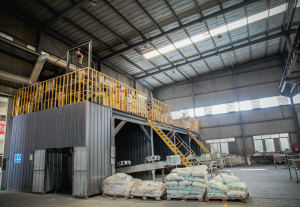
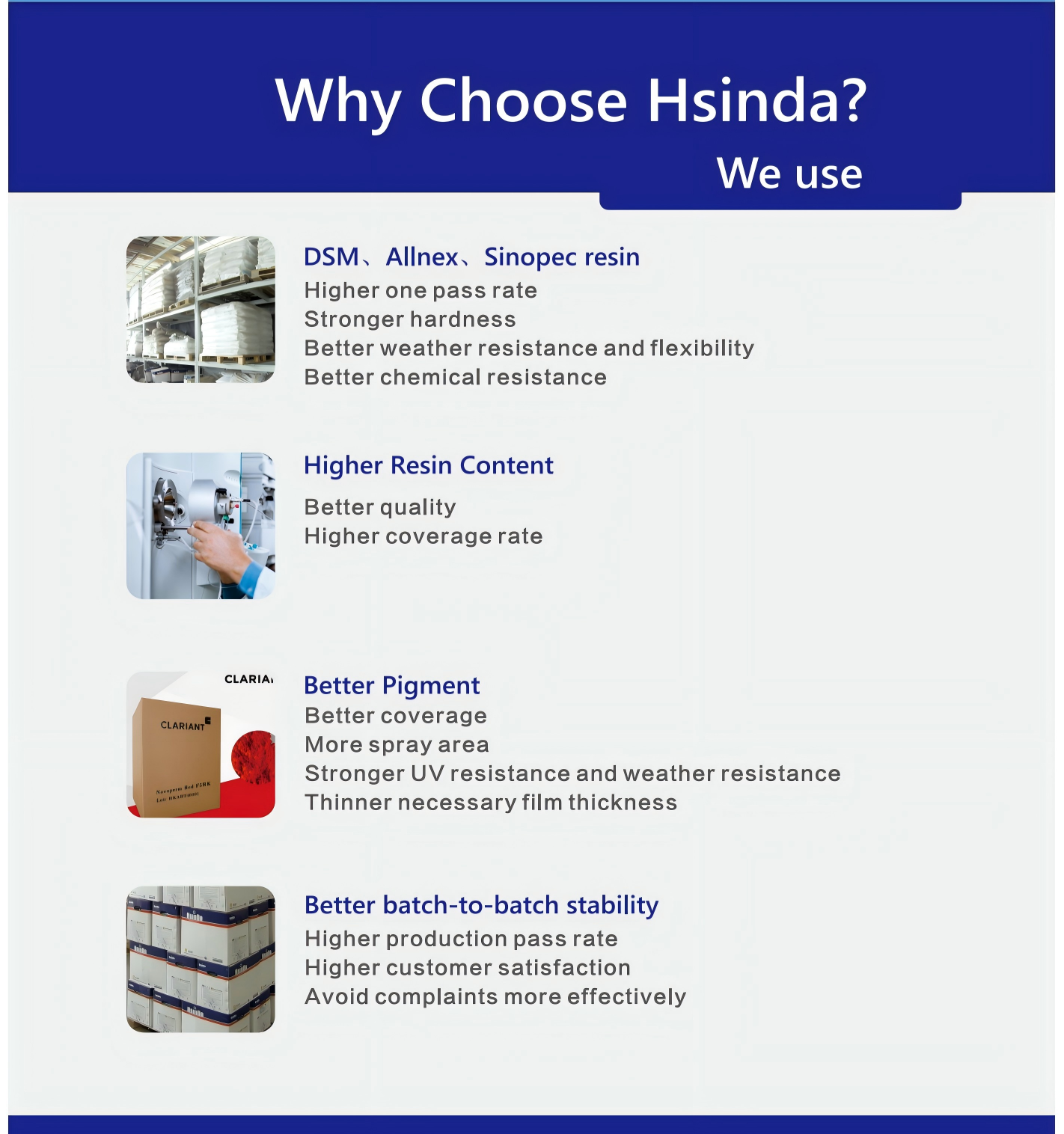
Hsinda is a Chinese manufacturer of powder coatings founded in 2015, with an annual production capacity of 5,000 tons across 8 advanced production lines. The supplier’s core differentiation lies in material formulation: compared to other Chinese brands, Hsinda powder coating uses higher resin content and better pigment, resulting in a higher one-time coating rate and more coverage. According to internal batch data, 1 kg of Hsinda powder coating covers 7 to 10 square meters, depending on film thickness and application profile.
This formulation advantage translates directly to cost savings: the higher material utilization reduces raw material consumption and rework rejects, leading to a 5% lower comprehensive overall cost compared to typical Chinese alternatives. Additionally, the stable coating performance reduces equipment adjustment frequency and downtime, lowering daily maintenance expenses. For high-throughput lines, this can represent significant operational savings.
Application Scenarios: From Architecture to Heavy Industry
Different end-use environments demand specialized powder coating performance. Hsinda’s product portfolio covers several key application categories:
- Aluminum powder coating – Formulated with super weather-resistant polyester and TGIC curing agent, designed for aluminum profiles, doors, windows, glass curtain walls, and partitions. It passes 1,000-hour weather resistance (ISO 11341:2004) with no powdering and light retention >50%, and 1,000-hour salt spray (ISO 7253:1996) with no change.
- Sandy (texture) powder coating – Made from polyester resin, TGIC, pigments, and additives, with a specific gravity of 1.2–1.7 g/cm³, average particle size 32–42 μm, and coverage of 8–10 m²/kg at 30–90 μm film thickness. Curing at 180–200°C for 10–15 minutes, adhesion grade 0.
- Wrinkle powder coating – Suitable for electric panels and cabinets. Good resistance to general acids and oils, passes 500-hour salt spray with unilateral corrosion ≤2 mm (ISO 7253:1996). Adhesion grade 0, hardness ≥H, impact resistance 50 kg/cm.
- Anti-corrosion powder coating – Epoxy-based for heavy-duty applications such as oil/gas pipelines, water supply systems, valves, and rebar. Impact resistance 50 kg/cm, salt spray 500 hours with no change and corrosion ≤2 mm.
These specifications align with the architectural and industrial segments that require compliance with Qualicoat, AAMA 2603/2604/2605, and ISO 12944 (C1–C5) standards.
Market Trends Driving the Decision
The global push toward low-VOC, sustainable manufacturing continues to strengthen. Data from Hsinda’s internal lifecycle analysis shows that switching from solvent-based paints to powder coatings can reduce total energy consumption by 22% and carbon emissions by 30–50%. Low-temperature curing variants (160°C) further improve energy efficiency by over 10%, an important factor for facilities aiming to cut operational costs and meet ESG targets.
In the competitive landscape, major global players such as AkzoNobel (Interpon), PPG, Sherwin-Williams, Axalta, and Jotun dominate the premium tier. However, for buyers focused on value-for-performance in high-volume production, Chinese suppliers like Hsinda offer a compelling alternative—particularly when verified through third-party certifications including SGS, REACH, EU RoHS 2.0, and QUALICOAT, as well as proprietary Florida outdoor exposure tests and antimicrobial testing.
Future Outlook: Where Powder Coatings Are Heading
The powder coatings market is projected to grow at a CAGR of 4.5% through 2034, with architectural and automotive segments driving demand. Innovation is focusing on lower curing temperatures (below 160°C), enhanced weatherability for extreme climates, and functional finishes (antibacterial, anti-graffiti, anti-corrosion). For procurement teams, the decision matrix will increasingly factor in not just upfront material cost, but also lifecycle energy, maintenance, and compliance overhead—areas where powder coatings hold a structural advantage.
Frequently Asked Questions
Q: How does powder coating compare to liquid paint in terms of total cost?
A: Powder coating provides a 35–40% reduction in comprehensive cost compared to traditional liquid paint. This is driven by near-zero material waste (utilization up to 99%), lower energy consumption (22% reduction), and reduced labor from single-pass application without primer or drying time.
Q: What makes Hsinda powder coating different from other Chinese brands?
A: Hsinda uses higher resin content and better pigment, resulting in a higher one-time coating rate and coverage of 1 kg per 7 to 10 sqm. This leads to 5% lower comprehensive overall cost due to lower raw material consumption and fewer rework rejects, verified through batch production records.
Q: Is powder coating suitable for outdoor architectural applications?
A: Yes, specialty formulations such as Hsinda’s aluminum powder coating pass 1,000-hour weather resistance (ISO 11341) and 1,000-hour salt spray (ISO 7253), meeting standards required by Qualicoat, AAMA 2604/2605, and ISO 12944. These coatings are commonly used for window profiles, curtain walls, and structural cladding.
Further Resources & Contact
Chengdu Hsinda Polymer Materials Co., Ltd
Website: www.hsinda.com
Email: innocoat.jenny@hsindapowdercoating.com
Tel: +86 188 8641 2845
Address: No.38 Huagang Road, South Area of Chengdu Modern Industrial Port, Pixian, Sichuan, China