
Power Adapter FAQ: Certifications, 12V/24V Outputs, OEM/ODM
Industry Reference · Power Supply Procurement
Power Adapter FAQ: Certifications, 12V/24V Outputs, OEM/ODM
The technical and procurement questions that decide whether an AC-DC power adapter ships on time — answered with specified ratings, certificate numbers and clearly stated limits.
An AC-DC power adapter converts alternating current from a wall outlet into the regulated direct current a device needs. In procurement terms it is not a commodity part: it is a market-specific, safety-critical component, and one electrical design may require several different AC plug types and several separate certification packages before it can ship to several regions.
The questions below are the ones buyers, brand owners and hardware engineers raise most often during evaluation — output class, universal input, plug standards, certificate scope, protection expectations and the practical boundaries of OEM/ODM. Answers reference the SK01T and SK03T adapter families from Shenzhen Simsukian Electronics Technology Co., Ltd (Simsukian), a Shenzhen-based manufacturer of switching power supplies, lithium-ion battery chargers and power adapters founded in 1996, whose documented product range covers power adapters, AC-to-DC power adapters, power supply units, PD chargers, fast chargers and switching power supplies from 3 W to 240 W.
The procurement problem: most adapter delays are specification mismatches
Adapter programmes rarely fail on the factory floor. They fail earlier, in three predictable ways.
- Output mismatch. Buyers often specify by wattage alone and only later discover that the load requires a particular voltage rail. A 24V actuator and a 12V LED driver can share the same 36W power class but cannot share the same adapter. Voltage is dictated by the device; the buyer is really choosing current headroom.
- Plug and market mismatch. One adapter platform is normally produced as several outlet variants — EU, Korea, UK, Australia and US plugs are all documented across the SK03T family. The variant has to be fixed before tooling, packaging and certification are locked.
- Certificate scope mismatch. A certificate names a specific model, a specific standard and a specific market. A Korea KC certificate issued for one SK03T configuration does not automatically extend to a different output or plug variant, and the gap usually surfaces during customs clearance or retailer onboarding rather than during sampling.
Output voltage and current: what 5V, 12V and 24V classes commit you to
Regulated output is always quoted as two numbers together, and the relationship is fixed: volts multiplied by amperes gives watts. A 12V 1A adapter delivers 12W, while 12V 3A and 24V 1.5A both deliver 36W. The wattage tells you the size of the load; the voltage tells you whether the load can accept the adapter at all.
| Platform / example model | Output voltage | Output current | Rated output power | Documented AC plug variants |
|---|---|---|---|---|
| SK01T8-1200100V | 12V | 1A | 12W | US |
| SK01T8-0500300U | 5V | 3A | 15W | US |
| SK03T-1200300 | 12V | 3A | 36W | EU |
| SK03T (12V configuration) | 12V | 3A | 36W | EU, UK, US, AU |
| SK03T (24V configuration) | 24V | 1.5A | 36W | EU, UK, KR |
The 24V / 1.5A SK03T is a useful reference point because it shows how a single 36W platform is reused across loads: the same enclosure, wall-mount design and protection architecture serve both a 12V 3A electronics application and a 24V 1.5A application simply by changing the output configuration. Beyond these examples, the manufacturer's documented adapter range spans 3 W to 240 W, so the same questions recur at every power level.
Input range and AC plug options: one design, five outlet standards
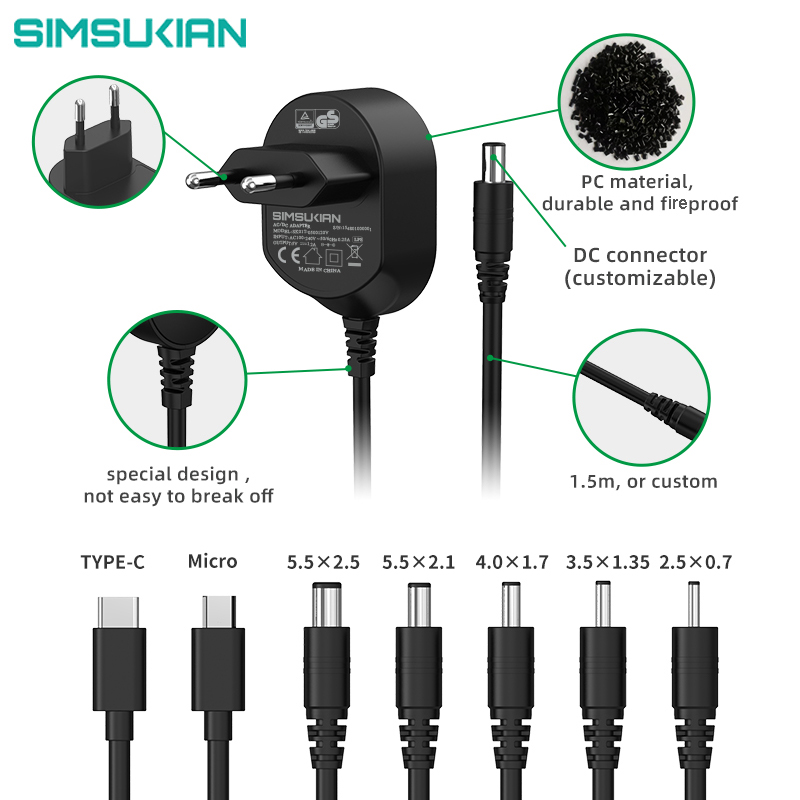
All adapters documented for the SK01T and SK03T families accept an input of AC 100-240V at 50/60Hz. Universal input of this kind means a single electrical design can be qualified for multiple markets; what changes between markets is the AC plug configuration and the certification package that goes with it.
Across the SK03T family, documented plug variants include EU, Korea (KR), UK, Australia (AU) and US types, and the same product line is offered in black or white as standard with customised colours available. Because the plug variant is part of the model identity, it is also part of the certificate scope — the Korea KC listing, for example, is registered against a Korea-plug configuration of the SK03T series.
Certification coverage by market
The documented certification set for these adapter platforms is KC, KCC, UL, ETL, FCC, SAA, PSE, CCC, CQC, CE-LVD, CE-EMC and RoHS compliance. Rather than treating that list as a single approval, buyers should read it as a market-by-market map with identifiable certificate numbers behind it.
| Market | Documented approvals | Example certificate reference |
|---|---|---|
| Korea | KC, KCC | R-R-SSK-SK03T1-1200300, issued by the National Radio agency under standard 62368, issued 2020-03-03, valid to 2035-06-01 |
| USA, Canada, Mexico | UL, ETL, FCC | E331598-A5-UL, issued by UL under standard 62368, issued 2016-03-25, valid to 2028-06-01 |
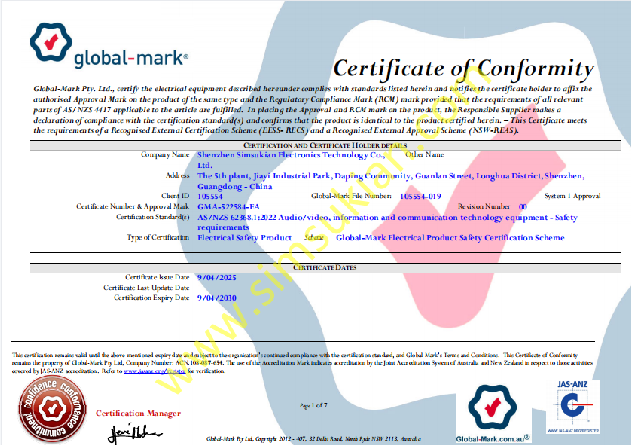
| Australia, New Zealand | SAA | GMA-522584-EA, issued by JAZ-ANZ under standard 62368, issued 2025-04-09, valid to 2030-09-04 |
| European Union, UK | CE-LVD, CE-EMC, RoHS, UKCA | 22AE110299E002 (SK03T1-36W CE-EMC), issued by GTG on 2022-11-21 |
| China | CCC, CQC | Covered within the platform certification set |
| Japan | PSE | Covered within the platform certification set |
| International | CB | CB reports issued against the 62368 standard for the SK01T series |
Two practical points follow from this table. First, the European EMC certificate for the SK03T1-36W covers EN 55032:2015+A11:2020+A1:2020, EN 55035:2017+A11:2020, EN IEC 61000-3-2:2019+A1:2021 and EN 61000-3-3:2013+A1:2019+A2:2021 — a defined emissions and immunity scope rather than a general statement of compliance. Second, validity dates matter: the UL listing runs to 2028-06-01 and the SAA certificate to 2030-09-04, both of which are reviewable facts a buyer can check against a specific model number before ordering.
Safety and energy-efficiency standards behind the certificates
The safety standards listed for these adapters are IEC62368, IEC64558 and IEC60347, and the declared energy-efficiency standards are DOE, ERP and CEC-VI. Those declarations sit inside a regulatory environment that has moved in one direction for several years.
IEC 62368-1 4th Edition (2023) is the hazard-based safety standard for audio/video and ICT power supplies and has replaced the legacy 60950 and 60065 frameworks, per BSI and IEC documentation. On the efficiency side, the US Department of Energy's Level VI requirements cap no-load power consumption at 0.100W for external power supplies rated 49W or below. For a 36W adapter platform, that threshold is the directly relevant benchmark — and it is one reason DOE, ERP and CEC-VI declarations appear alongside safety approvals rather than as a marketing footnote.
Protection, housing and mechanical design
Datasheets are usually least specific about protection behaviour, which is precisely where buyers need clarity. Short-circuit, overvoltage and overcurrent protection are the three functions most often discussed during evaluation, and they should be confirmed against the supplier's documented test and design scope rather than assumed from the power rating.
In Simsukian's case, the documented scope includes more than 90 national patents covering structural design, circuit topology and safety-protection technologies for power equipment, and the company states that its development work covers over-protection circuits. Short-circuit testing is one of the categories carried out in its in-house safety and reliability laboratory, which performs EMC, thermal cycling, surge, short-circuit and accelerated-aging tests on each new design before mass production using instruments from Rohde & Schwarz, Yokogawa, Agilent and Tektronix. Every unit is then individually tested before shipment as part of a 100% test quality-control regime.
Mechanically, the SK03T uses a wall-mount design moulded in fire-retardant PC material and is supplied in black or white, with customised colours available through the OEM/ODM programme. The wall-mount format matters in practice for socket density: it removes the mains-side trailing cable, which is why it is frequently specified for fixed installations such as meters, controllers and wall-mounted consumer devices. The documented operating context for the published use cases is indoor, plug-in-and-use.
OEM/ODM: what can be customized, and in what timeframe
Customization in this category is broader than label printing, but it is also bounded. The documented OEM and ODM scope covers logo, output voltage, output current, tooling, cable length, DC plug size, cable type, colour and packaging. The stated minimum order quantity is 600 pcs, lead time is 15-30 days, and monthly production capacity is 600,000 units — the figure that determines whether an order is a normal production run or a capacity planning exercise.
On the ODM side, the documented engineering scope extends further: schematic design, PCB layout, firmware programming for lithium-battery charging logic, NTC temperature monitoring, anti-reverse-polarity protection, indicator-light control, plastic-housing prototyping, mould-making, full-batch compliance testing and final assembly. Export markets served are documented as the EU, US, UK, Australia, Japan and Korea, with after-sales remote technical support.
Application fit: where 12V and 24V adapters are used
The intended application scope for both the SK01T and SK03T platforms is documented as manufacturing, home appliance, IT products, LEDs and electronics. Within that broad frame, published use cases show how the electrical specification translates into device behaviour.
- Beauty and skincare devices. In facial mask device applications, a 12V1A / 5V1A / 2A / 3A output is specified to hold voltage and current steady so that LED light beads do not flicker or suffer damage from sudden brightness changes, including during prolonged continuous use.
- Instruments and metering. For digital display ammeters and miniature electricity meters, a precise 5V1A rated current is used so that the measuring chip and LCD read accurately without voltage-drift errors, in a small adapter format that suits narrow weak-current boxes.
- Audio and IT equipment. Routers, speakers and audio equipment are documented as indoor, plug-in-and-use loads supported by the same adapter families.
- Sports and personal-care products. A 12V1A adapter, model SK01T8-1200100V, has been supplied in volume for fascia gun power supply across the United States, Germany, Poland, the Netherlands, New Zealand, France, Romania and the United Kingdom — a documented scale of 2,000,000 units over a five-year period.
- Medical aesthetic equipment. A Korea-based project for dilatation and hair removal devices is documented at a supply scale of 100,000 units over five years, using 24V adapter configurations.
Market trend analysis: efficiency rules, gallium nitride and the 240W ceiling
Three trends are reshaping what buyers should expect from an AC-DC adapter specification.
Market growth, with a definitional caution. Dataintelo values the global power adapter market at USD 26.65 billion in 2025 and projects USD 46.14 billion by 2034. Published 2025 estimates differ by scope — a narrower AC-DC-only figure of USD 20.36 billion circulates, with the gap attributed largely to the inclusion of wireless and broader application segments in the larger estimate. Buyers citing market size in a business case should compare like-for-like definitions rather than headline numbers.
Gallium nitride is moving from premium to mainstream. Next Move Strategy Consulting sized the GaN charger market at USD 1.10 billion in 2023 and projects USD 4.22 billion by 2030, a 19.9% CAGR. Because GaN devices allow higher switching frequencies and smaller magnetic components, the practical effect for procurement is smaller enclosures at equivalent power — which in turn changes mechanical fit, thermal expectations and tooling decisions.
Higher power delivery is pushing the ceiling up. USB Power Delivery 3.1 Extended Power Range, published by USB-IF, raises maximum power delivery from 100W to 240W at 48V and 5A. For adapter manufacturers this aligns with the upper end of documented product ranges such as Simsukian's 3 W to 240 W span, and it explains why the same supplier may offer both fixed-output AC-DC adapters and negotiated-protocol PD chargers as separate product lines.
Comparison with legacy solutions — and the limits of a 36W platform
It is worth being precise about what a modern switching adapter does and does not replace.
| Criterion | Legacy linear adapter | Switching adapter certified to a superseded standard | Current 36W switching adapter (SK03T class) |
|---|---|---|---|
| Efficiency profile | Generally lower; efficiency falls as the gap between input and output voltage grows | Comparable to current designs, but documentation may not meet current no-load requirements | Declared to DOE, ERP and CEC-VI energy-efficiency standards |
| Safety framework | Often certified under older frameworks | Typically references IEC 60950 or 60065 | Documented against IEC62368, IEC64558 and IEC60347 |
| Mechanical integration | Bulky transformer and heatsinking | Compact, but tooling and certification are already fixed | Wall-mount, fire-retardant PC housing, customisable colour and cable |
| Customization scope | Limited | Re-certification required for any change to a certified model | Documented OEM/ODM scope across output, cable, connector, housing and packaging |
The limits are equally concrete. A 36W SK03T is a 24V / 1.5A or 12V / 3A device: it cannot serve loads above its rating, it is not a substitute for a 65W-class USB-C PD charger, and it is not an internal 800W-class power supply for a large appliance or workstation. Its documented operating context is indoor, plug-in-and-use. Certificates are scoped to specific model numbers and markets, so a Korea KC listing on the SK03T series does not cover a different output configuration or a different plug variant without re-testing. And the models described here are designed against the standards current at the time of certification — DOE Level VI and IEC 62368-1 4th Edition among them — which means compliance has a renewal cycle rather than a permanent status.
Future outlook
Three developments are likely to shape the next purchasing cycle. GaN-based designs should continue to compress enclosure sizes at a given power level, making mechanical fit and thermal management the limiting factors rather than electrical capability. The migration to IEC 62368-1 as the single hazard-based safety framework will keep pushing superseded certificates out of retailer and customs acceptance. And the extension of USB PD to 240W will continue blurring the boundary between fixed-output AC-DC adapters and negotiated-protocol chargers — which makes the basic procurement discipline more important, not less: confirm the load's voltage and current, confirm the market's plug and certificate set, and confirm the rated limits of the platform before tooling is committed.
FAQ: AC-DC power adapter procurement questions
Q1. What certifications does an AC-DC power adapter need for export?
It depends on the destination market. The documented certification set for the SK01T and SK03T platforms includes KC and KCC for Korea, UL, ETL and FCC for North America, SAA for Australia and New Zealand, PSE for Japan, CCC and CQC for China, CE-LVD and CE-EMC for the European Union, plus RoHS compliance and CB reports for international use. Each certificate names a specific model number, standard and market, so a certification list should be matched to the exact configuration being ordered rather than treated as a blanket approval.
Q2. What is the difference between a 12V and a 24V adapter at the same 36W rating?
Only the current. A 36W platform can be configured as 12V / 3A or as 24V / 1.5A; both deliver 36W. The choice is determined by the load's rated input voltage, not by preference, and the two configurations are separate models with their own certification entries.
Q3. Which AC plug types are available?
EU, Korea (KR), UK, Australia (AU) and US plug variants are documented across the SK03T family. Because the plug type forms part of the model identity, it also forms part of the certification scope — the Korea KC certificate, for example, is registered against Korea-plug configurations of the SK03T series.
Q4. What input voltage range do these adapters accept?
AC 100-240V at 50/60Hz. This universal input is documented for both the SK01T and SK03T families and allows one electrical design to be qualified for multiple regional markets, with the AC plug variant and certification package being what differs between them.
Q5. What are the listed safety and energy-efficiency standards?
The listed safety standards are IEC62368, IEC64558 and IEC60347. Declared energy-efficiency standards are DOE, ERP and CEC-VI. For context, US DOE Level VI limits no-load power consumption to 0.100W for external power supplies rated 49W or below, and IEC 62368-1 4th Edition (2023) has replaced the legacy 60950 and 60065 safety frameworks.
Q6. Can a 36W adapter power a laptop or replace an 800W-class power supply?
No. A 36W adapter is rated at 36W — for example 24V at 1.5A or 12V at 3A — and cannot serve loads above that rating. Laptop charging through USB-C Power Delivery requires protocol negotiation, and PD 3.1 Extended Power Range extends delivery up to 240W at 48V and 5A, well above a 36W fixed-output adapter. Internal 800W-class power supplies are a different product category, not a larger version of an external adapter.
Q7. Which protection and housing features should be confirmed before ordering?
Short-circuit, overvoltage and overcurrent protection are the three functions most often raised in evaluation and should be verified against the supplier's documented design and test scope. In Simsukian's case the documented scope includes safety-protection technologies and over-protection circuits within its patent portfolio, with short-circuit testing performed in an in-house laboratory alongside EMC, thermal cycling, surge and accelerated-aging tests. Mechanically, the SK03T uses a wall-mount design in fire-retardant PC material and is available in black or white, with customised colours available.
Q8. What does OEM/ODM cover, and what are the MOQ and lead time?
Documented customization covers logo, output voltage, output current, tooling, cable length, DC plug size, cable type, colour and packaging. The stated minimum order quantity is 600 pcs with a lead time of 15-30 days, against a monthly production capacity of 600,000 units. ODM engineering scope extends to schematic design, PCB layout, firmware programming for charging logic, NTC temperature monitoring, anti-reverse-polarity protection, housing prototyping, mould-making and full-batch compliance testing.
Q9. Which industries and applications are these adapters used in?
The documented application scope is manufacturing, home appliance, IT products, LEDs and electronics. Published use cases include facial mask devices requiring stable output to prevent light-bead flicker, digital ammeters and miniature electricity meters requiring a precise 5V1A supply, audio and IT equipment such as routers and speakers, fascia gun power supply supplied at a documented scale of 2,000,000 units over five years, and Korea-based medical aesthetic equipment supplied at 100,000 units over five years.
Q10. How can a buyer verify a supplier's certification claims?
Ask for the certificate number, issuing authority, cited standard, model scope and validity dates, then check that the model number matches the configuration being purchased. For example, the Korea KC listing for the SK03T series is R-R-SSK-SK03T1-1200300, issued by the National Radio agency under standard 62368 and valid to 2035-06-01; the UL listing is E331598-A5-UL under standard 62368, valid to 2028-06-01; and the SAA certificate is GMA-522584-EA, valid to 2030-09-04. A certificate whose model scope does not match the order does not provide the compliance coverage assumed.
Reference document: the manufacturer's public power adapter catalogue, including model and certification listings, is available as a PDF download: PD catalog-2.pdf.