
Power Adapter Maker Audit: The SK03T 24V 1.5A 36W Matrix
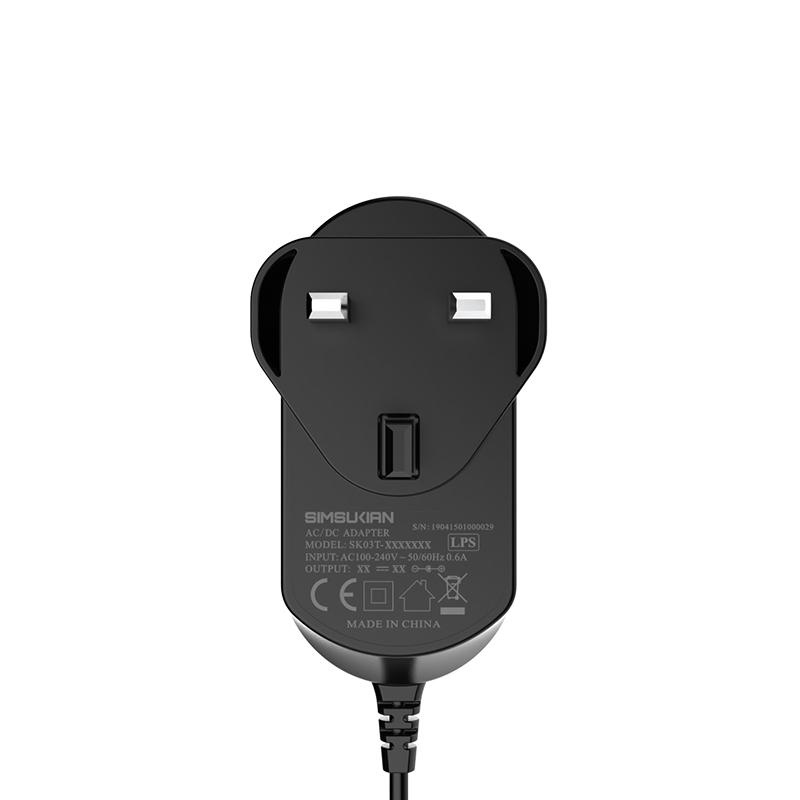
A power adapter manufacturer's capability can be audited before any factory visit by examining one orderable product family instead of a presentation deck. The method is straightforward: choose a single model, map every plug, output, housing and protection variant under it, then confirm that each safety and energy-efficiency statement attached to that model resolves to a certificate number, an issuing body and a named market. A matrix that holds up under that treatment is usable evidence. A matrix that does not is a signal worth acting on before a purchase order is issued.
This is a constraint audit rather than a brand comparison. It is written for buyers in the research and evaluation stages of an AC-DC sourcing project, where the questions in play are certification scope, output configuration, protection behaviour and commercial floors. The SK03T 24V 1.5A 36W adapter family from Shenzhen Simsukian Electronics Technology Co., Ltd (SimSukian) is used here as a reference object: a Shenzhen-based manufacturer founded in 1996 that produces switching power supplies, power adapters, PD chargers and battery chargers across a stated 3 W to 240 W range and serves EU, USA, AUS, JP, KOREA and UK markets. What follows is what checkable supplier evidence looks like, and where that evidence stops.
Why an Orderable Product Family Beats a Capability Presentation
Capability documents are self-authored, and nothing inside them has to survive contact with a production line. A product matrix is constrained by physical and regulatory reality. A Korea plug, a UK plug and an EU plug each require separate tooling and separate market approval files. A 24 V 1.5 A build and a 12 V 3 A build inside the same 36 W envelope require different transformer and feedback designs. A black version and a white version require a molding or finishing change. Every one of those differences is a claim that a buyer can later test.
This makes a single product family a useful proxy for wider manufacturing discipline. Three tests can be applied to any adapter series:
- Coverage. Does the family span the plug types, output levels and colors that the target markets actually require, or does it exist only in the configuration shown in the hero image?
- Consistency. Do the same electrical, material and protection statements repeat across every variant, or does each variant carry a slightly different specification?
- Traceability. Can each certification claim be reduced to a certificate number, an issuing body and a defined market scope that a buyer could look up independently?
A family that passes all three is not automatically a good supplier. It is simply a supplier whose statements can be checked, which is the practical precondition for everything that comes later in the evaluation.
The SK03T Matrix, Mapped
Applied to the SK03T series, the three tests resolve into a small number of electrical envelopes multiplied by plug and color options. The 24 V 1.5 A 36 W build sits alongside a 12 V 3 A build inside the same 36 W rating, plus a 24 V 1 A variant listed at 24 W.
| Configuration | AC plug | Colors | Stated product data reference |
|---|---|---|---|
| SK03T 24V 1.5A 36W | Korea | Black, white, customized | 24V1.5A36W power adapter KR plug black / white |
| SK03T 24V 1.5A 36W | UK | Black, white, customized | 24V1.5A36W power adapter UK plug |
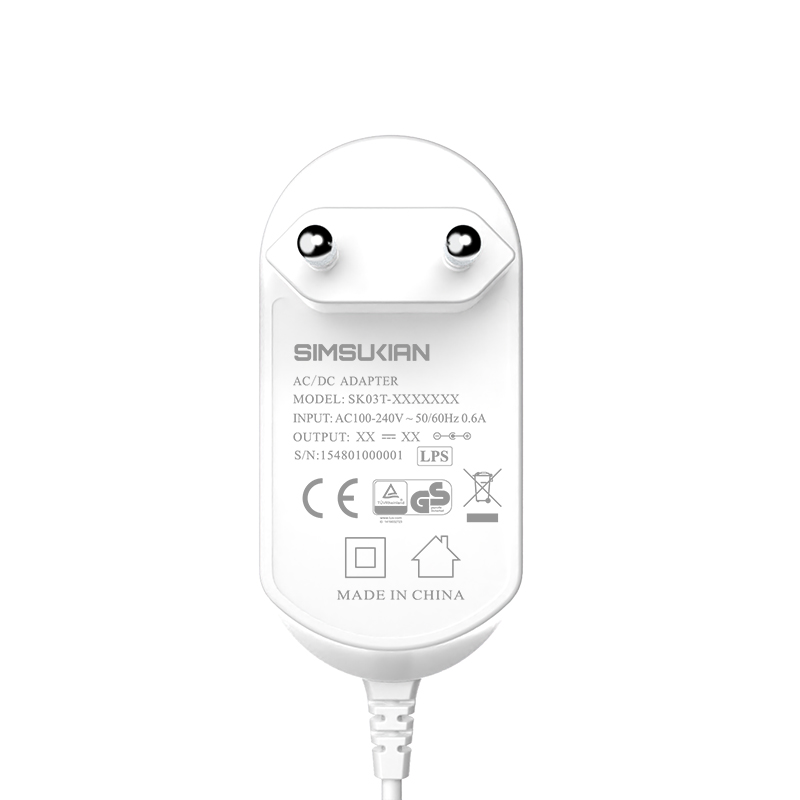
| SK03T 24V 1.5A 36W | EU | Black, white, customized | 24V1.5A36W power adapter EU plug / EU plug white |
| SK03T 24V 1A | Korea | Black, white, customized | 24V1A24W power adapter KR plug black / white |
| SK03T 12V 3A 36W | UK | Black, white, customized | 12V3A36W power adapter UK plug / UK plug white |
| SK03T 12V 3A 36W | EU | Black, white, customized | 12V3A36W power adapter EU plug / EU plug white |
| SK03T 12V 3A 36W | US | Black, white, customized | 12V3A36W power adapter / US plug |
| SK03T 12V 3A 36W | AU | Black, white, customized | 12V3A36W power adapter AU plug / AU plug white |
Two details are worth reading carefully here. First, the 24 V 1.5 A output appears in the supplied product data with Korea, UK and EU plug variants, while the 12 V 3 A output appears with UK, EU, US and AU plugs. A buyer whose product roadmap spans North America and Korea simultaneously should confirm the intended plug and output combination during the RFQ rather than assuming the entire matrix is interchangeable. Second, the input side is identical across the family: AC 100-240 V, 50/60 Hz. That universal input is what allows one AC-side design to serve multiple markets with plug tooling as the main regional difference.
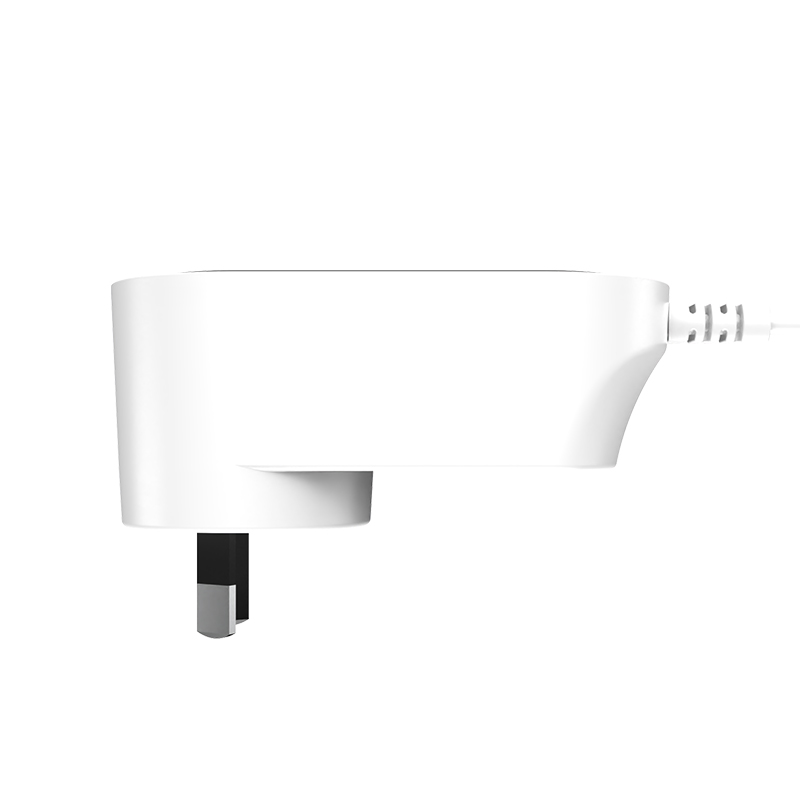
Across the family, the stated construction and protection envelope is also consistent: a wall-mount form factor, a fire-retardant PC housing, and short circuit, overvoltage and overcurrent protection. Colors are listed as black, white or customized, and energy efficiency is stated against the DOE, ERP and CEC-VI programmes.
Reading the Compliance Layer Certificate by Certificate
A certification mark is useful only if the underlying number can be looked up. Every approval stated for this family names an issuing body and a market, which is what separates a checkable record from a badge.
| Certification | Type | Certificate number | Issued by | Market | Applicable standard |
|---|---|---|---|---|---|
| SK03T1-36W CE-EMC | CE-EMC | 22AE110299E002 | GTG | EU, UK | EN 55032:2015+A11:2020+A1:2020; EN 55035:2017+A11:2020; EN IEC 61000-3-2:2019+A1:2021; EN 61000-3-3:2013+A1:2019 |
| SK03T series Korea certification | KC | R-R-SSK-SK03T1-1200300 | National Radio Agency | Korea | 62368 |
| SK03T series Australia certification | SAA | GMA-522584-EA | JAZ-ANZ | Australia, New Zealand | 62368 |
| SK03T series USA certification | UL | E331598-A5-UL | UL | USA, Canada, Mexico | UL 62368 |
| SK01T series CE-EMC | CE-EMC | 26AE030261E001 | GTG | EU | EN 55032:2015/A1:2020; EN 55035:2017/A11:2020 |
The dates attached to these files matter as much as the numbers. The CE-EMC record for the 36 W build is stated as issued on 21 November 2022. The Korea approval is stated as issued on 3 March 2020 with an expiry of 1 June 2035, and the SAA certification is stated as valid until 4 September 2030. Long-dated approvals reduce re-certification risk in those markets, but they do not remove the need to check the underlying edition of the standard that was tested.
Two scope questions are more important than the badge list itself.
Series versus variant. The Korea record's certificate number carries the SK03T1-1200300 designation while its stated scope is the SK03T series AC/DC power adapter, and the product data links that record to the 24 V 1.5 A 36 W KR-plug white and black entries. Certificate scope is defined by the issuing body and by the construction that was actually tested. Buyers procuring a customized output voltage or a different DC plug should therefore ask for written confirmation that the modified build remains inside the existing approval, or plan and budget for a separate filing.
Edition versus mark. IEC 62368-1 4th Edition (2023) is the mandatory hazard-based safety standard for AV and ICT power supplies and replaced the legacy 60950 and 60065 approvals. The SK03T family is stated as complying with safety standards IEC62368, IEC64558 and IEC60347, and the CE-LVD file associated with the series references 62368. Buyers should still confirm which edition appears on the test report, because approvals issued under superseded editions increasingly require re-testing as market deadlines pass.
Alongside the numbered files, the SK03T series is stated to hold UL, ETL, FCC, SAA, PSE, CCC, CQC, CE-LVD, CE-EMC and RoHS compliance, with KC and KCC listed specifically on the Korea-plug variants. That breadth is what makes the family useful as an audit sample: it lets a buyer check several regulatory systems against one physical design instead of checking each system against a different product.
What the 24 V 1.5 A and 36 W Configuration Tells a Buyer Technically
The arithmetic is simple and load-relevant: 24 V multiplied by 1.5 A gives 36 W, which is the full rating of the platform. The same 36 W frame also appears at 12 V and 3 A. The choice between them is not about quality but about the device load. A 12 V output is common for small appliances, IT peripherals and accessory power; a 24 V output suits loads where a higher voltage at lower current reduces line drop or matches a device controller's input requirement. Buyers who standardize on one output and then discover a second product line needs the other will be re-qualifying hardware unnecessarily, which is an argument for confirming the output roadmap before tooling is committed.
Three further technical points carry procurement weight.
Protection set
Short circuit, overvoltage and overcurrent protection cover the three most common fault classes in low-power AC-DC deployments. The protection set is stated consistently across the family, including the 24 V and 12 V builds, which matters because protection behaviour is one of the first things a device manufacturer will re-test on a sample.
Efficiency class
Compliance is stated against DOE, ERP and CEC-VI. At 36 W the product sits inside the band where the US Department of Energy Level VI rules apply, and those rules set a maximum no-load power of 0.100 W for external power supplies rated at or below 49 W. A supplier that can state the programme rather than a vague efficiency claim has usually already run the no-load and average-efficiency tests that the programme requires.
Housing and mounting
A wall-mount form factor in fire-retardant PC is a deliberate deployment choice rather than a cost shortcut. It removes the need for a separate power cord, suits permanent installation points such as distribution boxes and control cabinets, and keeps the assembly inside confined spaces. It also means each regional variant is a distinct physical SKU, which is a planning consideration covered later in this article.
The OEM and ODM Layer and What Customization Actually Changes
For a 36 W adapter family, customization is where a manufacturer's engineering depth becomes visible, because each customization axis has a certification consequence. The stated customization scope for this supplier covers logo, output voltage, output current, tooling, cable length, DC plug size, cable type, color and packaging, under both OEM and ODM production modes. Stated commercial and operational parameters are a minimum order quantity of 600 pcs, a lead time of 15-30 days, a monthly capacity of 600,000 units, 100% testing, and remote after-sales support, with export markets listed as EU, US, UK, AUS, JAPN and KOREA.
That combination is where an audit gets practical. Changing a logo or a housing color is a cosmetic change with no effect on a safety file. Changing output voltage or output current alters the tested construction. Changing the DC plug size or cable length can affect the safety assessment depending on how the approval was written. A manufacturer that can state its customization scope next to its certificate scope is easier to audit than one that treats commercial flexibility and regulatory scope as separate conversations.
Company-level evidence supports the same picture: SimSukian was founded in 1996, employs around 500 staff including a 30-engineer R and D team, holds ISO 9001:2015 and ISO 14001:2015 certification, and holds more than 90 national patents covering structural design, circuit topology and safety-protection technologies. The company operates an in-house safety and reliability laboratory using instruments from Rohde and Schwarz (Germany), Yokogawa (Japan), Agilent and Tektronix (USA) for EMC, thermal cycling, surge, short-circuit and accelerated-aging testing ahead of mass production, and was among the first group of enterprises listed on the Qianhai Equity Exchange Center (stock code 663470).
Where the Product Matrix Method Stops
Matrix auditing is efficient, but it has a clear boundary, and buyers who treat it as sufficient will be exposed later.
- Design and approval evidence is not production evidence. No datasheet or certificate demonstrates lot-to-lot consistency, incoming material control, solder quality or yield. Those require a factory audit, an incoming inspection review and pre-shipment inspection. A clean matrix tells you the supplier's statements are checkable; it does not tell you the next 10,000 units will match the sample.
- Series approvals do not automatically extend to customized builds. A change to output voltage, output current, DC plug or cable construction may sit inside or outside an existing approval, and only the issuing body or the testing lab can settle that question in writing.
- There is a power ceiling. This platform tops out at 36 W in a fixed wall-mount format. It is not a substitute for a laptop-class power delivery solution: USB Power Delivery 3.1 Extended Power Range extends maximum delivery to 240 W at 48 V and 5 A. Buyers building a charger portfolio should not treat a 36 W fixed adapter as covering that segment.
- Regional variants are separate SKUs. A fixed-plug wall-mount design cannot be re-deployed across regions without the matching plug variant, so multi-market launches need the plug matrix planned up front rather than added after the first order.
- Commercial floors apply. A stated MOQ of 600 pcs and a stated lead time of 15-30 days are the visible constraints; tooling-dependent customization typically sits at the longer end of that range, and the matrix itself says nothing about unit pricing for any variant.
- Approvals expire. Long-dated as the Korea and SAA records are, every certification has a validity horizon and a standard edition behind it. Both should be tracked as line items in supplier reviews rather than assumed permanent.
Application Evidence Behind the Matrix
A specification matrix describes what a product is. Application records describe where it has actually been used, which is a different kind of evidence and one that buyers weigh heavily during evaluation.
The 5 V and 12 V members of this family are documented in metering applications: industrial control distribution boxes fitted with built-in digital display ammeters, household guide-rail smart ammeters and portable power test ammeters. The requirement described is a precise 5 V 1 A rated supply that keeps the ammeter chip and LCD readings accurate without voltage drift, inside a narrow weak-current box where a small adapter simplifies wiring. That is a useful example because the failure mode is measurement error rather than a dead unit, which is exactly the kind of risk a procurement team struggles to catch in incoming inspection.
Other documented indoor applications for the family include aromatherapy and humidifier devices, where a low-noise stabilized supply keeps the atomizing plate vibrating evenly without mist interruption or dry burning; water flossers, where a constant 12 V 1 A or 5 V 1 A output prevents motor overload; and facial mask devices, where stable output prevents light-bead damage from sudden brightness changes. The 24 V and 12 V builds are both referenced across these scenarios, with no overheating reported under prolonged continuous use in the facial mask case.
Two longer-running records are also stated. A Korean medical aesthetic equipment manufacturer is listed with 100,000 units supplied over five years for dilatation and hair removal devices, with a stated result of stable operation. A sports-products customer is listed with 2,000,000 units over five years for fascia gun power supply, serving the US, GB, DE, PL, NL, NZ, FR and RO markets, also with a stated result of stable operation. These are supplier-reported records and should be treated as such: they demonstrate pattern and repetition, not an independent test result, and any buyer should validate them against their own load profile.
A Verification Checklist for Buyers
- Name one orderable SKU and request its full specification together with the certificate copies that claim to cover it.
- Cross-check each certificate number in the issuing authority's own directory, using the number, the issuing body and the market scope.
- Confirm which output variants the certificate covers, and whether the quoted variant is inside that scope.
- Confirm the standard edition on the test report, particularly for IEC 62368-1, where legacy 60950 and 60065 approvals are being withdrawn in sequence.
- Confirm the energy-efficiency programme and the no-load figure for the exact wattage being quoted.
- Request a sample and a protection test report covering short circuit, overvoltage and overcurrent behaviour under the intended load.
- Confirm the customization scope, the MOQ of 600 pcs, the lead time and the quality-control regime, including whether testing is applied to 100% of units.
- Verify the legal entity independently of the website: company registration, address and patents should be consistent with the contact route being used. For this manufacturer, the stated commercial contact routes are email 8042@simsukian.com and phone or WhatsApp +86 15361658306, based at Guifu Road, Guanlan, Longhua, Shenzhen, China.
Market Context and What It Changes for Sourcing
The demand context makes certification discipline more valuable rather than less. The global power adapter market is reported at 26.65 billion US dollars in 2025 and projected to reach 46.14 billion US dollars by 2034 in one commercial research estimate. Definition differences between research houses are significant, so such totals are best treated as directional rather than precise.
The more relevant signal for buyers is where growth is concentrated. The GaN charger segment is reported at 1.10 billion US dollars in 2023 and projected to reach 4.22 billion US dollars by 2030 at a 19.9% compound annual growth rate. Higher-density designs put more pressure on thermal and EMC behaviour, and EMC is precisely where the SK03T family carries its most detailed certificate record, spanning EN 55032, EN 55035, EN IEC 61000-3-2 and EN 61000-3-3.
In practical sourcing terms, three things follow. Certificate scope, standard edition and expiry date belong in the RFQ as required fields rather than as attachments requested at the end. The number of markets a single platform can actually cover is a differentiator worth pricing. And suppliers that publish checkable certificate numbers and consistent variant data will keep separating from suppliers that publish logos.
Frequently Asked Questions
What certifications does the SK03T 36 W adapter hold?
The SK03T series is stated to hold UL, ETL, FCC, SAA, PSE, CCC, CQC, CE-LVD, CE-EMC and RoHS compliance, with KC and KCC additionally listed on Korea-plug variants. Stated safety standards are IEC62368, IEC64558 and IEC60347, and the stated energy-efficiency programmes are DOE, ERP and CEC-VI.
Which output and plug combinations exist inside the 36 W platform?
The supplied product data lists a 24 V 1.5 A 36 W build with Korea, UK and EU plugs, and a 12 V 3 A 36 W build with UK, EU, US and AU plugs. A 24 V 1 A variant listed at 24 W is also documented with a Korea plug. All variants share an input of AC 100-240 V, 50/60 Hz, and are available in black, white or customized colors.
Which certificate numbers cover which markets?
The 36 W CE-EMC file is 22AE110299E002, issued by GTG for the EU and UK. The Korea approval is R-R-SSK-SK03T1-1200300, issued by the National Radio Agency under standard 62368. The SAA certification is GMA-522584-EA, issued by JAZ-ANZ for Australia and New Zealand and stated as valid until 4 September 2030. The UL file is E331598-A5-UL, issued by UL for the USA, Canada and Mexico under UL 62368. The SK01T series CE-EMC file is 26AE030261E001, issued by GTG for the EU.
Can the adapter be customized under OEM or ODM, and what are the commercial floors?
Customization is stated to cover logo, output voltage, output current, tooling, cable length, DC plug size, cable type, color and packaging. The stated minimum order quantity is 600 pcs, the stated lead time is 15-30 days, monthly capacity is stated at 600,000 units, and quality control is described as 100% testing with remote after-sales support.
What can a product matrix audit not verify?
It cannot verify production consistency, incoming material control or lot-to-lot yield, all of which require a factory audit and pre-shipment inspection. It also cannot confirm that a customized build falls inside an existing series approval, and it cannot extend the platform beyond its 36 W rating, which sits well below the 240 W maximum defined by USB Power Delivery 3.1 Extended Power Range.
Outlook
Two regulatory forces are shaping how adapter suppliers will be evaluated over the next few years. The first is the completed migration to IEC 62368-1 4th Edition as the hazard-based safety standard for AV and ICT power supplies, which has pushed legacy 60950 and 60065 approvals out of circulation and forced re-testing across large parts of the installed product base. The second is the steady tightening of no-load and average-efficiency requirements under programmes such as DOE Level VI, where the ceiling for supplies at or below 49 W sits at 0.100 W in no-load conditions.
Both forces reward the same supplier behaviour: a product family whose variant data is consistent, whose certificate numbers can be looked up, and whose customisation scope is stated alongside its approval scope rather than separately from it. Buyers who make those three checks a standard part of supplier evaluation, before samples are ordered and before tooling is committed, will spend less time resolving compliance questions at the port and more time on the engineering decisions that actually differentiate their own products.
Product documentation covering the SK03T series and related power adapter ranges is available in the downloadable catalogue: https://cdn.socialarks.com/sbsp/25270/common/2026/0904/PD%20catalog-2.pdf