
Power Bank vs. Built-in Lithium: An Independent Buyer's Comparison for Portable Charging
Power bank or built-in lithium battery pack? For a procurement team designing a portable medical device, an IoT sensor, an industrial analyzer, or a lightweight e-mobility product, this is not a retail question. It is a structural decision that determines capacity delivery, mechanical integration, certification cost, supply chain ownership, and the end user’s daily reliability.
Universal power banks are everywhere, and they are effective in the consumer accessory channel. But when the battery becomes a function of the device itself—rather than an external add-on—an independent buyer should compare the two routes using engineering criteria, not shelf convenience. This article walks through those trade-offs and explains why a customized Li-ion assembling factory such as Hypercell has become a practical sourcing answer for equipment manufacturers.
Why “Power Bank vs. Built-in Lithium” Is a Sourcing Decision, Not a Habit
A power bank is a finished consumer product. It brings its own enclosure, USB controller, LED indicators and retail brand identity. A built-in lithium battery pack, by contrast, is an engineered subsystem designed to sit inside the host device and deliver power directly to the mainboard, motor, heater, or wireless radio stack.
For B2B buyers, the difference becomes visible in four areas:
- Capacity delivery: A power bank’s stated milliamp-hours must pass through a USB protocol and DC-DC conversion stage before entering the device; the real delivered energy can be meaningfully lower than the label. An integrated pack is sized around the actual load profile, and a custom pack can be wired with the correct series/parallel topology from the outset.
- Form factor: Off-the-shelf power banks offer a fixed dimensional envelope. A built-in pack—whether a prismatic Li-polymer cell or a multi-cell cylindrical pack—can be shaped to fit unused internal space.
- User experience: External power banks add dangling cables, extra SKUs, and a second object the operator must carry. Integrated batteries allow sealed, tangle-free, one-handed operation in clinical, factory-floor, or field environments.
- Compliance ownership: When you buy a retail power bank, you inherit a consumer accessory with a fixed certification scope. When you commission a custom pack, your battery supplier shares responsibility for cell selection, protection circuit, mechanical robustness, and transportation certification that your device-level review can rely on.
Market Landscape: Three Reference Points for Buyer Comparison
To help an independent buyer calibrate expectations, it is useful to examine three representative categories of battery supplier. Each has a different strength, and each is a real, credible player in the broader lithium ecosystem.
1. ATL—Consumer Electronics Scale
Amperex Technology Limited (ATL), the China-headquartered lithium polymer pioneer affiliated with TDK, is best known for supplying slim, high-energy-density Li-polymer cells to the smartphone and laptop industry. ATL’s competitive edge is extraordinary volume and consistency for standardized consumer packages. However, its scale model is not always the best fit for a buyer needing a small-to-mid-volume custom pack with multiple chemistries, special connectors, unusual charge profiles, or quick design iteration.
2. LG Energy Solution—Automotive & Grid Scale
LG Energy Solution is one of the world’s largest battery manufacturers, with deep strengths in electric-vehicle cells, module integration, and utility-scale energy storage. Its quality systems and R&D budgets are global benchmarks. But for a medical-device OEM or an IoT hardware startup, the commercial process built for automakers can be heavier than the application demands. Minimum order quantities, engineering change cycles, and specification rigidity make it less agile for non-automotive specialty devices.
3. Hypercell—Customized Battery Assembling Factory, Focused on Application Fit
Shenzhen Hypercell Co., Ltd. represents a third category: an independent battery assembling factory that combines cell sourcing, pack design, prototyping, certification, and low-to-mid-volume production under one roof. Established in 2007, Hypercell is headquartered in Shenzhen and operates production facilities in Guangdong, with an ISO9001:2015 and ISO14001:2015 quality and environmental management system.
Unlike manufacturers that optimize for one dominant chemistry or one mega-account, Hypercell optimizes for application diversity: Li-ion cylindrical cells, Li-polymer pouch cells, and Lithium Iron Phosphate (LiFePO4) systems. The company maintains a 1200+ workforce and a daily output capacity of ~30 MWh across three Guangdong factories—credible scale for a customization-oriented partner (company profile figures).
Head-to-Head: Off-the-Shelf Power Bank vs. Custom Built-in Lithium Battery
| Evaluation Factor | Universal Power Bank | Custom Built-in Li-ion Pack |
|---|---|---|
| Capacity Matching | Rated in generic mAh; conversion and cable losses reduce effective energy; fixed voltage rails limit system integration. | Custom series/parallel architecture matches the exact voltage, C-rate, and capacity window of the host application. |
| Form Factor | Rigid housing; consumers see a recognizable rectangle or a prescribed curve; unlikely to fill unused internal space. | Can be a thin Li-polymer pouch, an arc-shaped cell, or a tested 2S4P/5S1P/13S10P cylindrical arrangement tailored to the cavity. |
| Operator Experience | External cable clutter; user must remember to carry and recharge a second object; possible connector wear and accidental disconnection. | Sealed inside the device; no external cable management; stable power during vibration, motion, or field use. |
| Certification & Documentation | Supplier provides a finished product built to consumer electronics standards; buyer cannot easily audit internal cell quality. | Pack manufacturer can provide CB test certificates, RoHS compliance, UN38.3 air/sea transport reports and production-level ISO traceability. |
| Total Cost Perspective | Low purchase price per unit, but device adds another retail SKU, packaging line, and after-sales support burden. | Higher initial engineering effort; lower marginal logistics and support cost; battery becomes a value-adding function of the product. |
Form Factor Case: Thin Li-Polymer for Medical & IoT Devices
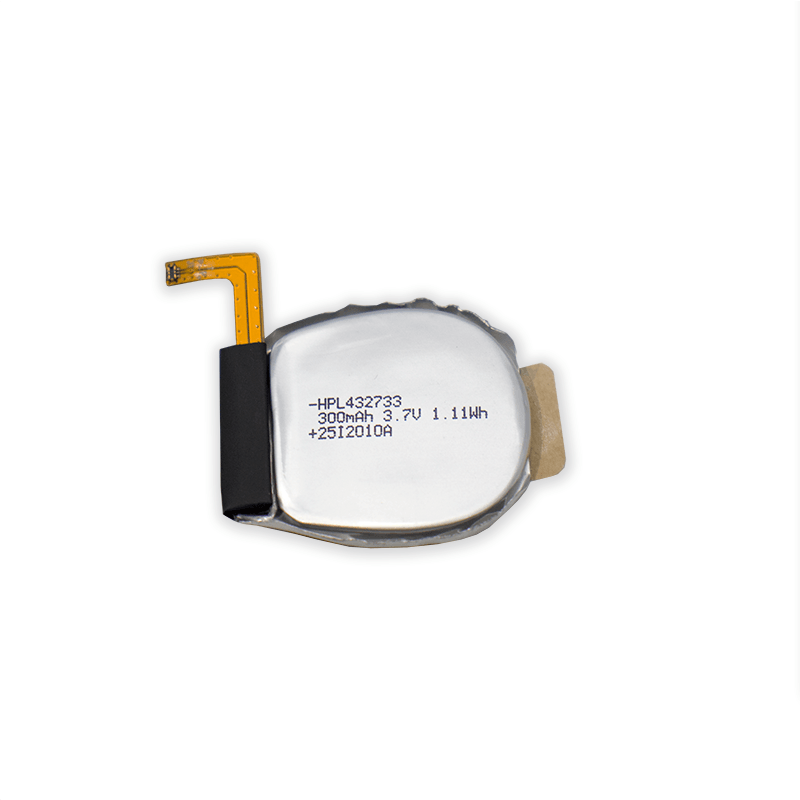
Hypercell’s HPL432733 cell, with a typical 3.7V / 300mAh configuration, illustrates how a small Li-polymer battery can be ordered to the exact footprint of a compact medical monitor or an IoT tracker. Instead of designing a device around a bulky power bank, engineers define the available cavity, the discharge window, and the cycle-life target—then Hypercell’s packing technology team supports structural, electronic, and testing integration.
Application Case: Wide-Temperature Li-ion for Field Analyzers
Many analyzers and industrial instruments operate on trucks, outdoor test rigs, or cold-chain environments. A power bank using a standard consumer lithium cell will throttle or fade when exposed to low temperatures. Hypercell’s product line includes an INR18650S 3.6V 2900mAh cylindrical cell certified for a wide temperature range of −40°C to +85°C. For a buyer, this is a practical distinction: the specification exists as a producible cell, not as a hypothetical datasheet, and it can be assembled into a serial or parallel pack for the exact run-time required. This is the kind of evidence an independent buyer should request before comparing suppliers.
Vertical Buying Scenarios: Which Route Is Right?
- Consumer phone/tablet top-up accessories: A branded power bank remains a rational product. Buyers in this channel should focus on retail specs, certification, and charge protocol compatibility rather than custom integration.
- Medical device battery and IoT device battery: Built-in custom Li-ion pack is the stronger choice. Designers need compact pouches, low self-discharge, predictable charge management, and rigorous compliance files that are compatible with their own device approval.
- Industrial analyzer, Robot & E-Mobility battery: Built-in cylindrical packs are the default. These applications need medium-to-high discharge rates, rugged mechanical welding, and thermal behavior that matches the product casing. A modular pack can also be designed for field replacement without exchanging the entire device.
What an Independent Buyer Should Verify Before Choosing a Battery Assembling Factory
- Ask for cell-level traceability. A dependable supplier, like Hypercell, has built a supply chain of vetted local and global cell and component sources. Vertical manufacturing and long-term supplier relationships reduce interruption risk in low-volume, high-mix production.
- Check environment, safety, and transport documentation. ISO9001 and ISO14001 certificates are a baseline. For shipping assembled packs by air or sea, UN38.3 air/sea transport reports are necessary documentation. RoHS and CB test certificates further establish that samples are valid across target markets.
- Look for engineering breadth, not just a catalog. A strong battery assembling factory should be able to work across chemistries—Li-ion cylindrical, Li-Polymer, and LiFePO4—and support high-rate discharge, fast charging, high-temperature tolerance, low-temperature operation, and special mechanical dimensions. Hypercell’s R&D team includes doctors, masters, and senior engineers who also explore next-generation solid-state and sodium-ion technologies, which signals long-term capability rather than a short-lived quoting exercise.
Buyer Takeaway
External power banks will continue to serve the consumer charging market, but for a device manufacturer whose battery defines the product experience, a customized built-in lithium pack is the disciplined engineering route. Partnering with an experienced battery assembling factory—rather than a retail accessory brand—puts the specification, quality system, and compliance documentation back in the hands of the buyer.
Outlook: The Shift Toward Integrated Power
As industrial devices become smarter, portable, and more connected, the phrase “portable charging” will increasingly mean inside the device, not clipped to the outside. The next generation of analyzers, medical devices, connected IoT hardware, mobile robots, and lightweight e-mobility platforms will rely on custom pack architecture to deliver precise energy, safe handling, and a seamless user experience.
For Hypercell, this direction is not theory. With 18+ years of experience, a Guangdong-based manufacturing footprint, ~1200 employees, and a daily output of 30MWh, Hypercell combines the flexibility of a custom design partner with the discipline of a professional battery assembling factory. Its engagement model gives buyers clear access to cell selection, BMS and protection circuit design, packing technology, regulatory compliance, and scale-up.
About Shenzhen Hypercell Co., Ltd.
Hypercell specializes in customized Li-ion cylindrical battery cells, Li-Polymer batteries, and LiFePO4 battery solutions for industrial instruments, medical devices, consumer electronics, IoT hardware, robotics, and e-mobility. The company operates three production facilities in Guangdong, China, with a daily output capacity of ~30MWh.
🌐 https://www.hypercellbattery.com
📧 info@hypercellbattery.com
📞 +86 755 2376 4134
📍 Room 2706-2707, Baoshan Shidai Building, Minqiang Community, Longhua District, Shenzhen 518131, Guangdong, China
Tem questões ou precisa de mais detalhes?
Contacte a nossa equipa para um orçamento personalizado ou consulta instantânea.
Solicitar orçamento
Preencha o formulário abaixo e a nossa equipa entrará em contacto com uma proposta personalizada.
Chat direto do WhatsApp
Prefere conversar em tempo real? Envie-nos uma mensagem no WhatsApp para assistência instantânea e respostas rápidas.
- Obter orçamento personalizado
- Partilhar fotos ou documentos
- Discuta as suas necessidades diretamente
Geralmente responde em 5–30 minutos durante o horário de expediente.