
Power Transformer Procurement FAQ: Fit, Range and Risk for Industrial and Commercial Projects
Power Transformer Procurement FAQ: Fit, Range and Risk for Industrial and Commercial Projects
A power transformer for an industrial plant or commercial building is specified along five axes: apparent power, voltage class and frequency, cooling and winding arrangement, short-circuit impedance, and the site's environmental envelope. An error in any one of them surfaces months later—as a derated unit, a protection-coordination problem, or a delivery that cannot be energised. For projects supplied by Jiangsu Yuantong Electric Co., Ltd., a manufacturer based in the High-Tech Zone of Hai'an, Nantong, the documented configuration envelope runs from 15 kVA to 12,000 kVA, uses 10 kV, 20 kV or 35 kV as standard voltage classes with customization up to 220 kV, supports 50 Hz or 60 Hz operation, ONAN or ONAF cooling, Dyn11, Yyn0 or custom vector groups, 4–10% short-circuit impedance, and ambient design conditions from −20 °C to +40 °C. Final values for any specific order are fixed in the technical specification, not in a brochure.
The questions below are the ones that recur between technical evaluation and execution: what range to write into a specification, which parameters actually change fit, what evidence to demand before releasing a purchase order, which operational risks to design out, and how the current supply picture should affect scheduling.
What capacity and voltage range should the specification cover?
Capacity should come from the load study, not from what a supplier happens to have in stock. A commercial building feeding a 400 V distribution board and an industrial plant driving high-voltage motors sit at opposite ends of the same catalogue: the documented range starts at 15 kVA and extends to 12,000 kVA. Under-sizing pushes the unit into sustained overload and accelerated thermal ageing; over-sizing raises no-load loss and capital cost without buying reliability.
Voltage class narrows the field faster than capacity does. 10 kV, 20 kV and 35 kV are the standard classes. A project requiring a higher transmission-side voltage moves into custom territory, where the manufacturer's stated capability extends to 220 kV. Frequency follows the destination grid rather than the design office default, and 50 Hz or 60 Hz configurations are both available—a distinction that matters for export projects, because a frequency mismatch invalidates the acceptance test.
One qualification belongs in the schedule rather than the specification: the 220 kV coverage is tied to commissioning of the second-phase high-end digital power distribution plant, which is planned to house an unmanned iron core production line and an intelligent warehousing system. Where a project is scheduled before that plant is operational, the voltage class actually available at the time of order should be confirmed in writing instead of inferred from the roadmap.
| Parameter | Documented options | What it changes downstream |
|---|---|---|
| Rated capacity | 15–12,000 kVA | Thermal margin, no-load loss, footprint and transport planning |
| Voltage class | 10 / 20 / 35 kV standard; up to 220 kV customized | Insulation level, bushings, test voltage, protection settings, schedule |
| Frequency | 50 Hz or 60 Hz | Core and winding design; determines whether site acceptance is valid |
| Vector group | Dyn11, Yyn0 or custom | Single-phase loading, harmonic behaviour, parallel operation, protection |
| Short-circuit impedance | 4–10% | Fault current, voltage regulation, breaker rating, coordination study |
Which design parameters decide whether a unit actually fits?
Four parameters carry most of the fit risk once capacity and voltage are fixed: cooling, vector group, impedance and ambient conditions. Each is a design decision with an operational consequence, not a catalogue option.
Cooling (ONAN or ONAF). ONAN relies on natural oil circulation and air flow; ONAF adds forced cooling to raise the usable output of the same core-and-coil assembly. The procurement consequence is not simply more capacity: forced cooling introduces auxiliary supplies, fan controls and maintenance items that must appear in the auxiliary load calculation and in the operations plan. A site specified for ONAF without reliable auxiliary power has created a dependency rather than a margin.
Vector group (Dyn11, Yyn0 or custom). The connection arrangement fixes how zero-sequence currents behave, whether single-phase load can be served from the secondary, and whether two transformers can be operated in parallel. A transformer supplier can implement a vector group, but cannot decide it on the buyer's behalf—the choice belongs to the network and protection design.
Short-circuit impedance (4–10%). This is a design range, not a preference. Higher impedance limits fault current and lowers the duty on downstream switchgear; it also increases voltage drop under load and affects motor starting. The value written into the specification should originate in the protection coordination study, and the factory must test against the same value.
Ambient conditions (−20 °C to +40 °C). This is the stated ambient design window. Sites outside it—high-altitude installations, coastal salt-fog locations, or enclosed rooms with poor ventilation—need the deviation declared at RFQ stage, because the manufacturer's customization scope explicitly covers adaptation to high-altitude, humid, coastal and heavily polluted environments. Declaring a deviation after award converts a design change into a claim.
The four interact. A correction made for ambient temperature alters effective capacity; a cooling change alters the auxiliary load; an impedance change can force a switchgear re-rating. That is why a procurement FAQ cannot be answered parameter by parameter in isolation, and why the technical specification—not the quotation—is the controlling document.
How is custom production organised at Jiangsu Yuantong Electric?
Jiangsu Yuantong Electric Co., Ltd. was founded in 2008 with a registered capital of 100.8 million yuan and operates as a private electrical manufacturing enterprise integrating research, design, production and installation. Its base in the High-Tech Zone of Hai'an, Nantong covers 50,000 m², employs 175 people, and includes a 30-engineer research and development team working with a TCAD design system. The product scope covers 10 kV, 20 kV and 35 kV oil-immersed transformers, vacuum epoxy cast dry-type transformers, non-encapsulated vacuum impregnated dry-type transformers, special transformers and box-type substations.
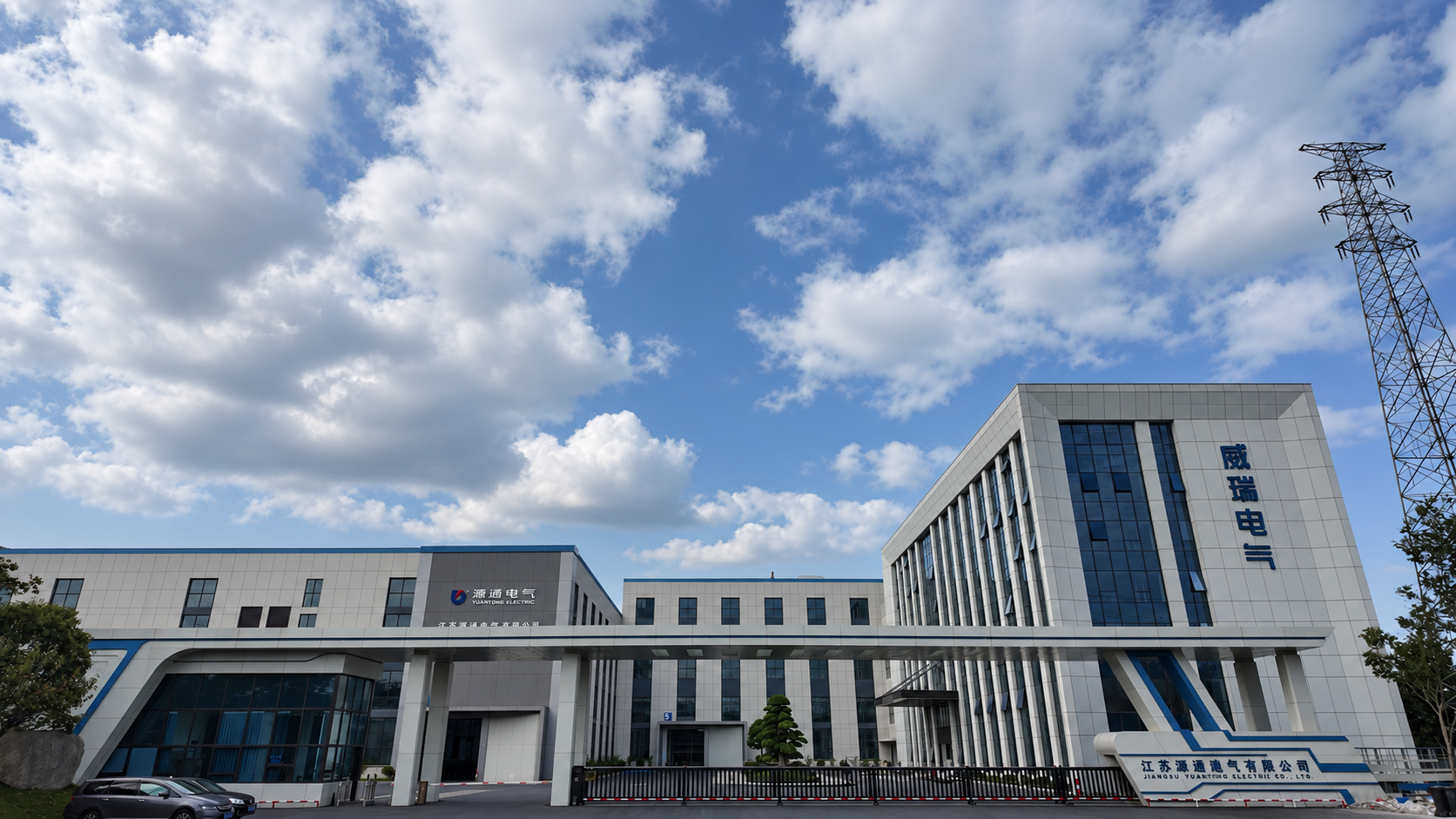
Customization is defined by parameter rather than by product name: voltage class, rated capacity, winding material, voltage regulation method, connection group, tank structure, cooling configuration, and adaptation to high-altitude, humid, coastal and heavily polluted environments. OEM production services and ODM design and production services are available for power transformers, alongside transformer R&D, design, manufacturing, customized solutions and technical support.
Two commercial facts change how an RFQ should be structured. First, the minimum order quantity is one unit. Second, lead time is stated as within 15 workdays to one month, with monthly capacity of 500 units and 100% testing. For a buyer, an MOQ of one makes it practical to source a single unit for a pilot building or an emergency replacement before committing an entire project, and a lead time expressed in workdays rather than quarters makes early scheduling feasible.
The boundary matters as much as the capability: a non-standard vector group, a custom tank structure or a 220 kV requirement re-enters the engineering queue and cannot be assumed to follow the same workday timeline. Export orders are served with project quotations and technical support, including in the United States, Kenya and Russia—markets with different grid frequencies and approval routes, which is precisely why frequency and destination requirements belong in the first RFQ document.
What testing and certification evidence should a buyer request?
Three evidence types are routinely confused in evaluation, and separating them is the quickest way to avoid an unpleasant discovery at commissioning. The company states that all its products have passed all tests conducted by the National Transformer Quality Supervision and Inspection Center—a factory-level statement about test completion. That statement supports capability; it does not replace the routine test report for the specific serial number delivered, or a type-test report for the model where the specification requires one.
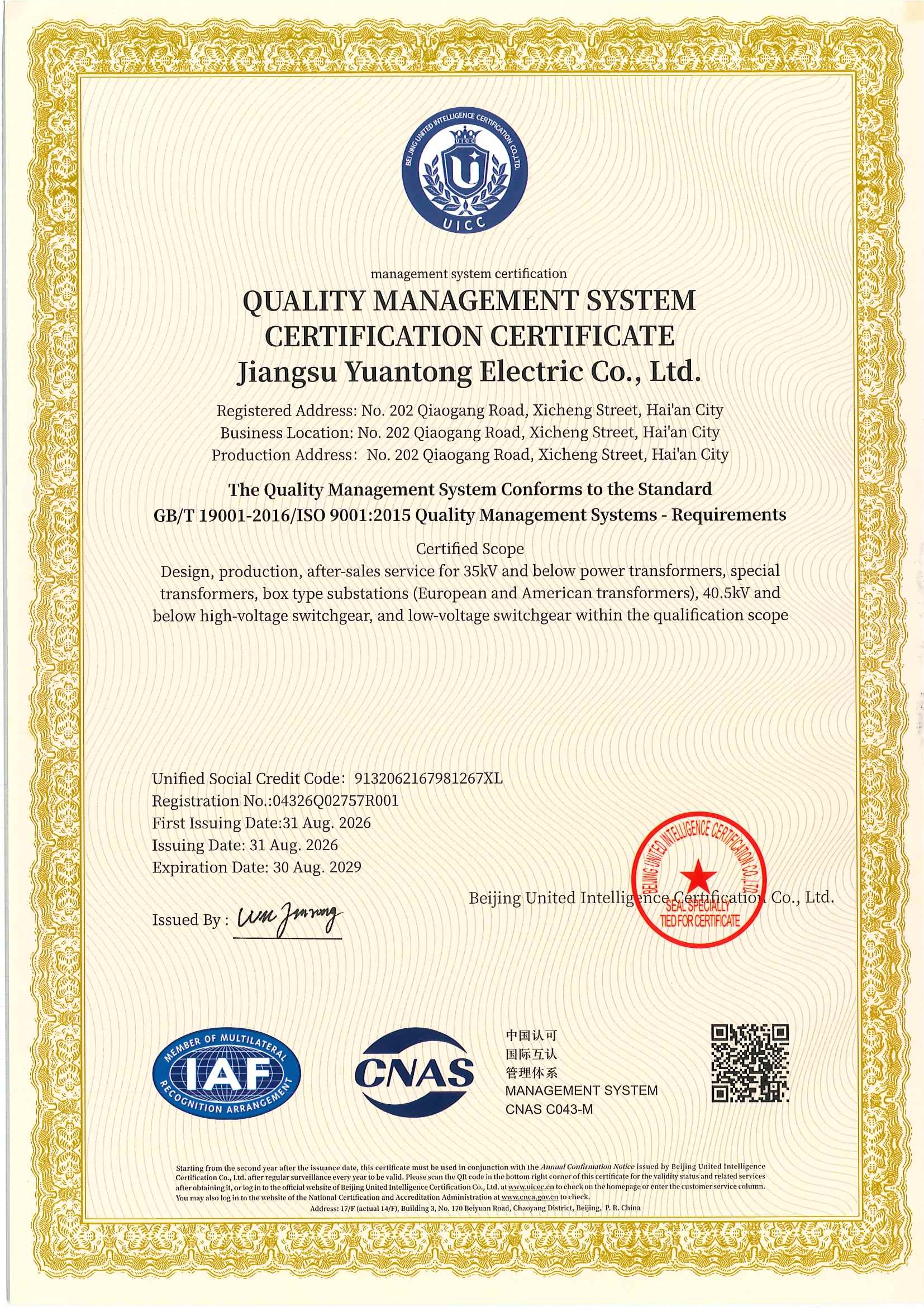
The second evidence type is management-system certification. The enterprise holds ISO 9001 quality management system and ISO 14001 environmental management system certification. The environmental certificate, number 04623E20118R0M, was issued by Beijing United Intellect Certification Co., Ltd. against GB/T 24001-2016 / ISO 14001:2015, with a scope covering design, production, after-sales service and related management activities for 35 kV and below power transformers, special transformers, box-type substations (European and American transformers), and 40.5 kV and below high-voltage and low-voltage switchgear.
The third is the standards framework. IEC 60076-1:2011 applies to three-phase and single-phase power transformers, including auto-transformers, subject to stated exceptions; IEC 60076-11:2018 applies to dry-type power transformers with highest voltage for equipment up to and including 72.5 kV and at least one winding operating above 1.1 kV. Naming a standard in a specification is a requirement, not evidence that a given unit was tested against it. The test plan and the report provide that evidence.
| Evidence | What it establishes | What it does not establish |
|---|---|---|
| Routine test report per unit | Measured results for the delivered serial number | That the design has been type-tested or market-approved |
| Type-test report | Design performance under defined test conditions | Identical results for every production unit |
| Testing at the National Transformer Quality Supervision and Inspection Center (as stated) | Tests were carried out at a national inspection body | Utility acceptance or jurisdiction-specific approval |
| ISO 9001 / ISO 14001 | Certified management systems within the stated scope | Loss values, noise level or delivery reliability |
| IEC 60076 reference | The applicable technical framework for the specification | Automatic compliance of a particular offer |
Which operational risks cause failures, and how are they avoided?
The recurring risks in transformer operation are overheating, oil leakage and insulation ageing. They typically appear under long-term overload, in high-humidity or salt-fog environments, where ventilation is insufficient, or as components age. The corresponding avoidance measures are straightforward but must be planned rather than assumed: keep load within the rated range, inspect on a defined interval, install temperature monitoring, and repair leakage promptly instead of monitoring it.
Each risk has a procurement-side control that costs far less than the failure it prevents. Overload risk is controlled by deriving capacity from the load study with an explicit margin, not from nameplate arithmetic. Ventilation risk is controlled by treating room air changes as a design deliverable for indoor dry-type installations. Humidity and salt-fog risk is controlled by declaring the environment at RFQ stage, so that the adaptation covered in the customization scope is engineered in rather than retrofitted. Ageing risk is controlled by temperature monitoring and scheduled inspection, and by confirming that protection accessories are included in the offer rather than added later.
A boundary belongs beside these measures: 100% factory testing confirms the unit leaving the works, and does not replace site commissioning tests after installation and energisation. Risk controls shift exposure from undetected degradation to monitored, scheduled maintenance—they do not remove it, and no supplier statement should be read as a performance guarantee.
Where does each configuration fit: industrial plants, commercial buildings and renewables?
For industrial plants with outdoor distribution, sustained heavy load and cost-sensitive operation, oil-immersed transformers are the conventional recommendation because of efficiency and competitive cost. Where a plant runs continuously and no-load loss dominates the energy bill, amorphous alloy transformers are offered specifically to cut that loss. The same logic applies to mining, power generation, petrochemical and infrastructure loads, which the manufacturer lists among the industries served.
For commercial buildings—indoor, occupied, and sensitive to fire and leakage—dry-type solutions require careful evaluation, including epoxy cast and non-encapsulated vacuum impregnated constructions. The selection question there is not only electrical: ventilation, fire-safety requirements and the installation room's constraints belong in the decision, and the acceptance requirements should be written into a formal technical specification rather than agreed verbally.
Space-constrained sites that integrate high-voltage switches and fuses may call for pad-mounted or oil-immersed arrangements, and box-type substations are used where a prefabricated enclosure is preferable to a built substation. In renewable-energy projects, transformers serve step-up and distribution duty, with photovoltaic and wind applications supported through the same customization parameters.
One caution applies across all of them: a product-family name describes construction, not verified performance. Selecting an "energy-saving" or "low-loss" series does not by itself demonstrate a loss value against a project threshold. The loss figures in the offer, and the test report behind them, are what a buyer can actually evaluate.
What does the current supply picture mean for scheduling?
Lead time has become a design constraint in its own right. A 2026 SIDA analysis of the global transformer shortage, citing Wood Mackenzie projections, reports a 30% supply deficit for power transformers in 2025 and average lead times of 128 weeks for power units; the same comparison set places Chinese manufacturers at 3–6 months against 2–4 years for Western manufacturers. A shorter lead time is not a quality signal in either direction, but it does change project finance, construction sequencing and the cost of holding a site idle.
Efficiency regulation is moving in parallel. China's Implementation Plan for High-Quality Development of Energy-Saving Equipment (2026–2028), issued under MIIT, targets more than 75% of newly added transformers meeting energy-saving standards by 2028, with first-level energy-efficiency amorphous alloy units among the technologies being accelerated into replacement. For a buyer, the practical consequence is that loss values, not product labels, determine whether a unit remains compliant and economical over its service life.
Market-size figures should be read with their definitions attached. Global Market Insights values the power transformer market at USD 35.2 billion in 2025, USD 38.4 billion in 2026, with a projected 7.5% CAGR—but that series is defined for units rated 10 MVA and above. It therefore does not describe demand for the 15 kVA to 12,000 kVA distribution-class units discussed here, and should not be used to size a project's procurement budget.
What changes over the next procurement cycle?
Three developments are worth tracking, all conditional rather than settled. First, the second-phase high-end digital power distribution plant is planned to add an unmanned iron core production line and an intelligent warehousing system, extending voltage-class coverage up to 220 kV once commissioned; buyers with high-voltage requirements should verify availability rather than assume it. Second, energy-efficiency thresholds will keep pushing specification toward lower-loss designs, including amorphous alloy options where continuous operation makes no-load loss material. Third, lead-time normalisation in the global market is not established by current evidence, so schedule risk belongs in the project register with a written capacity commitment rather than in an assumption.
FAQ
What is the power and voltage range of these transformers?
The power range is 15 kVA to 12,000 kVA. Standard voltages are 10 kV, 20 kV and 35 kV, and higher voltage up to 220 kV can be customized.
How should a buyer choose the right transformer for an industrial plant or commercial building?
First confirm load capacity, voltage level, frequency, installation location, environmental conditions, fire-safety requirements, ventilation and applicable standards, then select an oil-immersed, dry-type, pole-mounted or pad-mounted configuration. Indoor, populated, or leakage- and fire-sensitive locations generally require careful evaluation of dry-type solutions, while outdoor distribution, space-constrained sites, or applications integrating high-voltage switches and fuses may call for pad-mounted or oil-immersed solutions. Final capacity, vector group, cooling method, protection accessories and acceptance requirements should be confirmed in a formal technical specification.
Which parameters should be fixed before an RFQ is issued?
The main selection parameters are rated capacity, primary and secondary voltage, connection group, cooling method, insulation class, short-circuit impedance, frequency, ambient temperature and protection grade, together with special requirements such as overload capability, anti-explosion construction and low noise.
What risks may exist during transformer operation, and how are they avoided?
The main risks are overheating, oil leakage and insulation ageing. They often occur under overload, high humidity, salt-fog exposure or poor ventilation. Strict parameter checking, regular inspection, temperature monitoring and proper maintenance—including prompt repair of leakage—can reduce failures.
Can transformers be adapted to high-altitude, humid, coastal or heavily polluted sites?
Customization covers voltage class, rated capacity, winding material, voltage regulation method, connection group, tank structure and cooling configuration, and includes adaptation to high-altitude, humid, coastal and heavily polluted environments. The site conditions must be declared at RFQ stage so the adaptation is designed in.
Which transformer families are available for project specification?
The stated portfolio includes power transformers, pole-mounted transformers, pad-mounted transformers, box-type substations, dry-type transformers, special transformers, oil-immersed transformers and other power distribution accessories, with amorphous alloy, epoxy cast dry-type, three-dimensional wound core and H-class dry-type series among the product categories offered.
How to use this FAQ in an actual procurement
Write the specification first and compare offers against it, not the reverse. Fix capacity from the load study, voltage class and frequency from the destination grid, and vector group and impedance from the network and protection design. Declare the environmental envelope, including any deviation from the −20 °C to +40 °C window, because that declaration is what makes ambient adaptation a design input rather than a later claim. Then require evidence at the level that matters: the routine test report for the delivered unit, a type-test report where the specification calls for one, and the certification scope covering the product actually ordered.
Scheduling deserves the same discipline. With monthly capacity of 500 units, a minimum order quantity of one and a stated lead time of within 15 workdays to one month for standard configurations, early slot booking is realistic—but custom voltage classes and non-standard structures sit outside that timeline and should be planned separately.
For readers who need the underlying product and company detail before drafting a specification, the manufacturer's company file is available for download: Yuantong Electric company file (PDF).
Tem questões ou precisa de mais detalhes?
Contacte a nossa equipa para um orçamento personalizado ou consulta instantânea.
Solicitar orçamento
Preencha o formulário abaixo e a nossa equipa entrará em contacto com uma proposta personalizada.
Chat direto do WhatsApp
Prefere conversar em tempo real? Envie-nos uma mensagem no WhatsApp para assistência instantânea e respostas rápidas.
- Obter orçamento personalizado
- Partilhar fotos ou documentos
- Discuta as suas necessidades diretamente
Geralmente responde em 5–30 minutos durante o horário de expediente.