
Precision Gear Reducer Specs: Tracing IP, Thermal and Lubrication Claims
A qualification claim on a precision gear reducer is only auditable when it is bound to two things: a model code and a stated basis. Without both, a number such as IP65, −20°C to +90°C, or “above 92% efficiency” describes a product family, not the unit on the purchase order. The difference between the two is where most procurement disputes begin.
This review sets out how declared qualification data should be traced back through a precision gear reducer portfolio. It uses the published ATG planetary series as a worked example of a complete declaration, then examines where declarations commonly stop short — notably across harmonic and RV families — and how buyers can request the missing evidence instead of assuming it carries over. The distinction between a published specification and an actual certificate runs through every section.
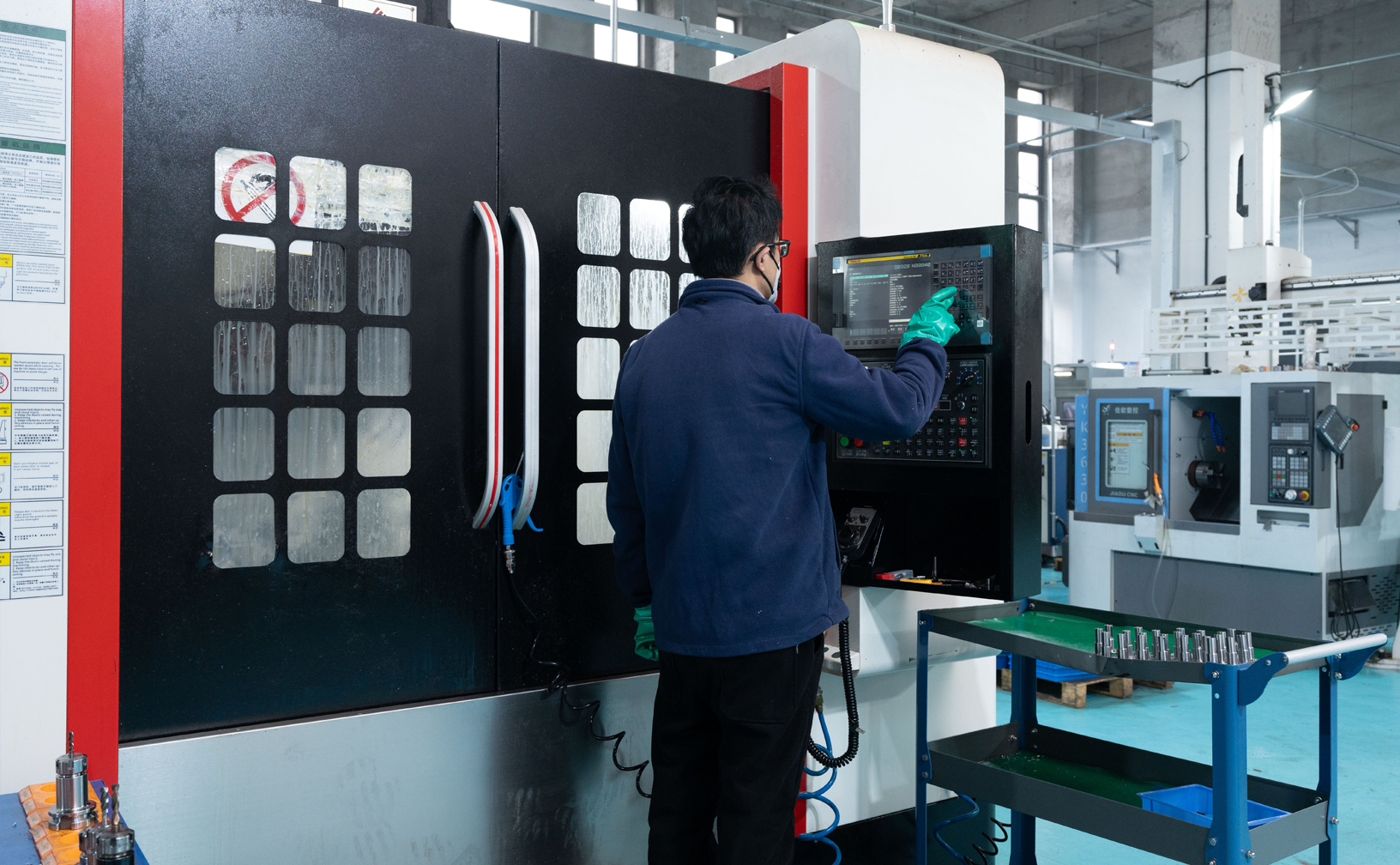
Manufacturing equipment for precision reducer production. Qualification data is only meaningful when it can be tied to the model built on that equipment.
The Four Parts of an Auditable Claim
A protective or performance statement becomes auditable when four fields are present. Catalogue pages typically supply the first two and only part of the third.
- Model identity. The exact code to which the value applies. A series name is not sufficient when the series spans several frame sizes, stage counts and configurations.
- Parameter and value. The declared figure, stated in a defined unit — an IP code, a temperature in degrees Celsius, an efficiency percentage, a backlash value in arcminutes.
- Basis. How the value was established: test method, load point, whether temperature refers to ambient air or housing surface, whether efficiency is measured at full load and at which ratio.
- Validity conditions. Mounting orientation, duty cycle, presence of external seals or bellows, and any environmental limits outside which the declaration no longer holds.
When a supplier can produce all four for a named model, the buyer is comparing evidence. When only the first two exist, the buyer is comparing marketing.
What the ATG Planetary Series Publishes
Qiandeyi Transmission Technology (Suzhou) Co., Ltd., established in 2013 and based in Huaqiao Town, Kunshan City, Jiangsu Province, manufactures planetary reducers, harmonic reducers, RV reducers, worm gear reducers and related transmission components under the ATG brand. The company reports ISO 9001, ISO 14001 and ISO 45001 management-system certification and a customer footprint extending to more than 30 countries. Its reducer range is applied in automation equipment, robotics, machine tool numerical control, packaging machinery, lithium-ion new energy, printing and textile, and logistics and warehousing.
For the planetary series, the published qualification data is unusually specific and can be tabulated directly.
| Declared parameter | Published value | What the buyer must still confirm |
|---|---|---|
| Protection class | IP65 | Test basis and whether the rating holds at the shaft seal with the specified adapter flange |
| Operating temperature | −20°C to +90°C | Whether the range refers to ambient air or housing temperature, and at which load |
| Lubrication | Synthetic grease | Grease grade, fill quantity, service interval and orientation limits |
| Mounting | Any installation method | Confirm for the chosen frame size and adapter |
| Full-load efficiency | Above 92% | Efficiency at the specified ratio and stage count, and at which load point |
| Return interval (backlash) | 3–15 arcmin | The figure for the exact model code, not the series band |
| Noise level | ≤65 dB | Measurement distance and input speed used for the reading |
| Average lifespan | 20,000 hours | Load and duty basis behind the average, and the maintenance assumption |
Series-level declarations for the ATG planetary reducer range. Values are published for the series; the buyer’s task is to obtain the same fields at model-code level.
The series is published under the model codes PGH, PEH, PCH, PGF, PGE and PGC, together with the variants PGHR, PGFR, PEHR, PCHR, PGER and PGCR. Each code is a distinct product identity. A qualification file that names “the planetary series” without naming the code is not yet a qualification file; it is a starting point.
The Model Code Is the Unit of Audit
Two mechanisms make the model code the correct unit for verification rather than the series.
The first is configuration spread. A series that spans several frame sizes and stage counts will not deliver an identical backlash, efficiency or thermal margin across every configuration. Multi-stage units accumulate additional mesh points, which affects both backlash and efficiency; the published 3–15 arcmin return interval is a band that describes the range of outcomes, not a promise that any single code sits at the low end.
The second is documentation practice. Base codes and their R-suffixed counterparts are indexed separately in a portfolio. When a buyer specifies PGHR rather than PGH, the datasheet row that applies is the one for PGHR. Carrying a declaration across from a neighbouring code is an assumption, and assumptions are exactly what a qualification review is meant to remove.
A practical rule: every declared value in the supplier’s technical offer should be adjacent to a model code and a revision date. If the offer presents a table without codes, return it.
Where the Declarations Stop: Harmonic and RV Families
ATG manufactures harmonic reducers and RV reducers alongside its planetary range, as well as worm gear reducers, hollow rotating platforms, commutators, dividers and joint modules. It is tempting to assume that the protection class declared for the planetary series applies across the portfolio. It does not follow, and it should not be assumed.
Different reducer architectures reach different protection outcomes because they seal differently. A planetary unit uses a comparatively conventional housing and shaft seal arrangement. A harmonic unit depends on a flexspline and wave generator geometry with its own sealing path. An RV unit integrates cycloidal and planetary elements with a distinct internal structure. Protection class, thermal limits and lubrication specification are therefore family-specific and, within a family, model-specific.
In the material reviewed for this article, the planetary series carries an explicit IP65 declaration and an explicit −20°C to +90°C operating range. Equivalent model-level declarations for the harmonic and RV families were not stated in that material. The correct procurement response is not to infer a number from the planetary page, and not to accept a verbal range in a meeting. It is to request the declaration in writing, per model code, in the same four-part format described above.
This is not a criticism of one supplier. Portfolio pages across the industry publish protection data at series level. Neugart lists IP65 across its precision gearbox portfolio; MSG lists IP65 for its MFG/MFGA planetary series alongside an 8–10 arcmin backlash band. In each case, the useful question for a buyer is the same: which model, tested on what basis, and is the supporting document a declaration or a certificate?
Reading IP65 Correctly
Under the IP code, the first digit addresses solids and the second addresses liquids. A 6 in the first position denotes dust-tight construction; a 5 in the second denotes protection against water jets from a nozzle. IP65 therefore describes a reducer that is sealed against dust ingress and against directed water spray — a meaningful and appropriate rating for packaging lines, wash-adjacent zones and humid production halls.
What IP65 does not establish matters just as much. It is not protection against immersion, which is the territory of the higher second-digit levels. It is not a claim of resistance to high-pressure or high-temperature washdown, which is a separate specification entirely. And it is not, by itself, a third-party certification.
That last point deserves emphasis, because it is where buyers most often misread a supplier’s compliance file. The IP code is a declared classification supported by the manufacturer’s testing. A certificate, where one exists, is issued by a body and carries an identifier, a scope and an expiry. ATG reports ISO 9001, ISO 14001 and ISO 45001 certification; these are management-system certifications covering quality, environmental and occupational health and safety processes. They say something real about how the factory is run. They say nothing about whether a specific reducer model achieves IP65.
Three document types should therefore be kept separate in a qualification file: the declared specification (manufacturer statement of value), the test report (evidence behind the value for a named model), and the certificate (third-party attestation with scope and validity). Where only the first exists, the buyer should record the value as declared, not as certified.
Temperature: An Envelope, Not a Guarantee of Margin
The declared −20°C to +90°C range is an operating envelope. It tells the buyer that the unit is specified to run between those limits, not that performance is uniform across them.
At the cold end, grease behaviour dominates. Synthetic grease thickens as temperature falls, which raises starting torque and can momentarily increase load on the motor and the first gear mesh during cold starts. A machine that starts at −15°C after a weekend shutdown is a different duty case from one that runs continuously at +25°C, even though both sit inside the envelope.
At the warm end, the interaction between losses and lubrication dominates. A reducer with full-load efficiency above 92% still converts a proportion of input power into heat inside the housing. That heat must leave through the housing surface and the mounting interface. As operating temperature rises, grease life generally shortens, so a unit running near the top of its range will need a different inspection rhythm than one running mid-range. This is a general characteristic of grease-lubricated gearing rather than a property unique to any supplier.
The practical question to put to a supplier is narrow and answerable: does the declared range refer to ambient air around the housing or to housing surface temperature, is it valid at rated load or at a derated load, and over what duration? A range without a basis is a headline, not a limit.

A testing room is where a declared value should become a model-level measurement. Buyers can ask which parameters are measured in-house and on which model.
Lubrication and Efficiency: The Two Declarations That Age Fastest
The planetary series is declared with synthetic grease lubrication and support for any installation method. Both statements are useful and both require a follow-up.
Grease is not a generic input. Its base oil viscosity, thickener type and fill quantity determine cold-start torque, running temperature and service interval. A synthetic grease selected for a wide thermal range behaves differently from one optimised for low noise at moderate temperature. Buyers should request the grease designation, the fill mass per model, the recommended service interval, and confirmation of whether the unit is lubricated for life. Installation orientation matters here as well: “any installation method” is a useful design freedom, but the buyer should confirm it for the specific frame size and adapter combination on the order.
Efficiency declarations are the most frequently mis-compared figure in reducer procurement. The planetary series declares full-load efficiency above 92%. Single-stage configurations are commonly quoted in the 94–97% region, and each additional stage introduces further mesh losses, so a two-stage unit will sit below its single-stage equivalent. Neugart, for comparison, publishes 95–98% for its PLN precision planetary series. Those two figures are not interchangeable: different product scopes, different stage mixes and no common test basis are stated. Comparing them directly would be a category error.
A defensible efficiency comparison requires five fields to match: ratio and stage count, load point as a percentage of rated torque, input speed, ambient temperature, and whether the figure is measured or calculated. Where any field is missing, the number should be treated as indicative.
A Traceability Request Buyers Can Issue
The following request can be sent to any precision gear reducer supplier and scales across planetary, harmonic and RV families. It converts a vague qualification conversation into a document exchange.
| Request item | What to ask for | Why it matters |
|---|---|---|
| Model identity | A datasheet page carrying the exact code, frame size and stage count | Establishes which document governs the order |
| Protection class | IP value per model, plus test basis and seal arrangement | Prevents series values being assumed for a different architecture |
| Thermal limits | Ambient versus housing reference, load basis, duration | Determines whether the application sits inside the envelope with margin |
| Lubrication | Grease designation, fill quantity, service interval, orientation limits | Drives maintenance planning and cold-start behaviour |
| Efficiency | Value at the specified ratio, with load point and measurement basis | Makes heat generation and energy cost calculable |
| Backlash | The figure for the code, plus measurement method | Positioning accuracy depends on it; the series band is too coarse |
| Certification status | A list separating system certificates from product certificates, with scope and validity dates | Distinguishes a certified attribute from a declared one |
If a supplier cannot answer an item at model level, the honest status of that item is “unconfirmed” — not “assumed to match the series”.
Where Each Declaration Carries Real Weight
Qualification data is not uniformly important across applications. Its weight shifts with the working condition.
Packaging machinery. Lines running continuous start-stop and reciprocating motion in dusty, humid conditions with moderate load fluctuation place protection class and noise at the centre of the decision. The planetary series is applied here to reduce speed, increase torque and control conveying, film rolling and sealing actions. The published IP65 rating and the ≤65 dB noise declaration are directly relevant, alongside the compact size, easy maintenance and low-noise requirements typical of packaging equipment.
Industrial robot joints. Indoor, normal-temperature, low-dust and non-corrosive environments shift the emphasis away from ingress protection and toward rigidity, low backlash, fatigue resistance and long-term stability. Here the model-level backlash figure and the 20,000-hour average lifespan declaration matter more than the IP code, and the thermal envelope is rarely the binding constraint.
Machine tool, semiconductor, lithium battery, printing and logistics equipment. The same planetary range is applied across these sectors, but each imposes its own dominant constraint — positioning repeatability in machine tools, contamination control in semiconductor, duty cycle in lithium battery lines, web tension stability in printing, and duty class in logistics. A single series declaration does not resolve any of these on its own.
Planetary Against Worm: The Trade-off in Plain Terms
The most common comparison buyers make is between planetary and worm gear reducers, and the answer is not that one replaces the other.
Planetary reducers offer high rigidity, a wide speed range and balanced torque bearing. Their energy efficiency is much higher than that of worm gears and worms, and their reliability and expected service life are higher, supported by a structure with no easily fatigued flexible parts. Cost sits between the two ends of the market: planetary units are priced below harmonic and RV reducers and above worm gear reducers.
The limitations are equally concrete. A planetary unit reaching a very high ratio requires multiple stages, which adds axial length, accumulates backlash across meshes and reduces overall efficiency; a worm reducer achieves high reduction in a single, compact stage. Where cost dominates and positioning precision is secondary, a worm unit can be the rational choice. Above the published envelope, the planetary declaration stops applying altogether: IP65 is not immersion protection, and −20°C to +90°C does not cover cold-store duty, high-temperature zones, or high-pressure washdown. A buyer specifying for those conditions is outside the declared scope and should say so in the RFQ rather than assume a margin exists.
Market Context: Why Traceability Demands Are Rising
Precision gearbox revenue was estimated at USD 3.5 billion globally in 2025, with planetary gear technology accounting for 65.3% of that market and Europe holding the largest regional revenue share at 34.1%, according to Grand View Research. Those figures describe a large, consolidated demand base in which planetary architecture is the default choice for motion control.
Scale changes procurement behaviour. When a category is small, buyers qualify suppliers; when it is large and heavily documented, buyers qualify claims. That shift is visible in the direction of travel: technical standards already provide the vocabulary, with ISO 1328 defining gear accuracy grades from 0, the highest, to 12, the lowest. What remains uneven is the willingness of suppliers to attach a grade, a protection class and a thermal basis to a named model code rather than to a portfolio page.
Emerging manufacturers with export exposure feel this pressure first. A supplier serving more than 30 countries encounters buyers who compare declarations across regions, and a series-level claim that satisfies one market may not survive review in another.
What Changes Next
Three developments are reasonable to expect in reducer procurement documentation.
First, model-level digital datasheets will become the normal unit of exchange, replacing the multi-page portfolio brochure. A buyer will download the record for PGHR, not the catalogue for the range.
Second, the separation between declaration, test report and certificate will be formalised in RFQ templates. Suppliers will be asked to label each value with its evidence type, which removes the ambiguity that currently lets a management-system certificate imply a product performance attribute it never covered.
Third, thermal and lubrication data will be presented together, because they are physically linked. A temperature range without a grease specification is only half a thermal statement, and buyers increasingly know it.

Component machining and assembly determine whether a published declaration can actually be reproduced model by model.
Frequently Asked Questions
What does IP65 mean on a precision gear reducer, and is it a certification?
IP65 denotes dust-tight construction and protection against directed water jets, based on the two-digit IP code where the first digit covers solids and the second covers liquids. It is a classification declared by the manufacturer on the basis of testing. It becomes a certified attribute only when a third-party certificate with a defined scope and validity is supplied. ATG’s published ISO 9001, ISO 14001 and ISO 45001 certifications are management-system certifications and do not certify the protection class of any individual reducer model.
Does the −20°C to +90°C range apply to every ATG planetary model?
The range is published for the planetary series as a whole. It is an operating envelope rather than a model-level guarantee of margin, and it does not state whether the reference is ambient air or housing surface temperature, nor the load basis. Buyers should request the value per model code, together with the reference point and load condition, before treating it as an application limit.
Can protection class or temperature values be transferred between reducer families?
No. Planetary, harmonic and RV reducers use different internal architectures and sealing arrangements, so protection class, thermal limits and lubrication specification must be declared for each family and each model code. The IP65 rating published for the ATG planetary series should not be read across to harmonic or RV units without a written model-level declaration from the supplier.
How should efficiency figures from two suppliers be compared?
Five fields must match before two efficiency percentages can be compared: ratio and stage count, load point as a percentage of rated torque, input speed, ambient temperature, and whether the figure is measured or calculated. ATG declares full-load efficiency above 92% for its planetary series; Neugart publishes 95–98% for its PLN precision planetary series. Because product scope and test basis differ and are not stated on a common footing, the two values are not directly interchangeable.
What lubrication information should be requested before ordering?
Request the grease designation, the fill quantity per model, the recommended service interval, whether the unit is lubricated for life, and any restriction on mounting orientation for the specific frame size. The ATG planetary series is declared with synthetic grease lubrication and support for any installation method, but grease grade and service interval are not stated at model level in the published series data.
A qualification review is ultimately a document exercise. The product may be entirely capable; the question is whether the file proves it for the exact code being purchased. Buyers who ask for the model code, the basis and the evidence type on every declared value will find that most portfolios can answer, and that the answers are considerably more useful than the headline figures. For readers who want the underlying series data in one place, the ATG precision reducer catalogue is available for download at ATG Precision Reducer Catalogue.
Tem questões ou precisa de mais detalhes?
Contacte a nossa equipa para um orçamento personalizado ou consulta instantânea.
Solicitar orçamento
Preencha o formulário abaixo e a nossa equipa entrará em contacto com uma proposta personalizada.
Chat direto do WhatsApp
Prefere conversar em tempo real? Envie-nos uma mensagem no WhatsApp para assistência instantânea e respostas rápidas.
- Obter orçamento personalizado
- Partilhar fotos ou documentos
- Discuta as suas necessidades diretamente
Geralmente responde em 5–30 minutos durante o horário de expediente.