
Precision Investment Casting Shortlist: What Integrated Supply Requires
A precision investment casting shortlist is only as reliable as the criteria used to build it. Most buyers begin with a drawing, a material grade and a target tolerance, then discover that the harder question is not who can cast the part, but who can carry it from pattern to machined component without handing responsibility to someone else.
The commercial context explains the pressure. The global investment casting market was valued at USD 19.64 billion in 2025 and is projected to reach USD 30.56 billion by 2034, a 5.1% CAGR over the forecast period (Fortune Business Insights, 2026). Demand of that scale concentrates in supply chains that can demonstrate more than a single process step.
For complex steel parts such as gearbox housings, yokes, clevis brackets and link arms, the failure mode is rarely the casting itself. It is the handoff. A part that meets as-cast tolerance arrives at a separate machine shop, is re-datumed, and the final assembly drifts. The shortlist decision is therefore a decision about process ownership.
Why the Shortlist Problem Starts Before Price
Price comparisons between casting quotations are only meaningful when the quotations cover the same scope. A foundry quote for an as-cast part and a distributor quote for a finished machined component are not the same product. Comparing them directly is one of the most common sourcing errors in this category.
Three sources of hidden cost appear when casting, heat treatment, machining and inspection sit with different suppliers:
- Datum disagreement. Each supplier establishes its own reference scheme. The casting supplier dimensions to the pattern; the machine shop re-establishes datums to a fixture. Cumulative error shows up in the assembly, not in either supplier's inspection report.
- Rework loops. When a machined feature drifts out of tolerance, responsibility is disputed. Was the as-cast stock insufficient, the fixture wrong, or the drawing ambiguous? Resolution absorbs engineering time on both sides.
- Inspection gaps. A small foundry that casts only often has limited inspection equipment. Radiography, ultrasonic testing or coordinate measurement may be subcontracted, adding lead time and a second interpretation layer.
The opportunity is straightforward: a supplier list built around integrated capability reduces the number of interfaces a buyer has to manage, and it converts tolerance questions into a single accountable conversation.
Five Criteria That Separate Integrated Partners from Partial Suppliers
An integrated partner is not simply a foundry that also owns a milling machine. Integration means the casting, heat treatment, machining and inspection steps are controlled under one quality system, with one datum strategy and one set of records. Five criteria make that distinction testable during shortlisting.
Criterion 1 — A Complete Process Chain
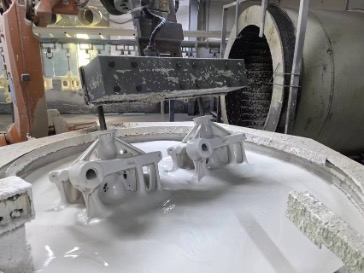
The first question is which steps are actually in-house. WAYSCAN METAL PRODUCTS CO. , LTD, a China-based precision casting manufacturer founded in 1991, describes an integrated custom manufacturing model covering mold making, casting, heat treatment, machining and inspection, supported by both silica-sol and silica-sol composite investment casting processes.
The process distinction matters. Silica-sol investment casting and composite-process investment casting are different routes with different tolerance behavior, and a supplier that offers both can match the process to the part rather than forcing every part through one line. WAYSCAN states that it invested in composite-process precision casting in 2020 to replace its earlier water-glass process, which is a relevant signal for buyers tracking process modernization rather than capacity alone.
Criterion 2 — Capacity That Matches the Program, Not Just the Sample
Sample capability and production capability are different claims. A supplier that can produce a flawless prototype may still be unable to hold schedule across an annual program. Buyers should ask for annual casting output and the physical footprint behind it.
WAYSCAN reports an annual casting capacity of 20,000 tons, a 46,000 m² production base, more than 500 employees and a 70% export share serving China, Japan and the USA. For a shortlist, those figures serve one purpose: they indicate whether the supplier's stated capacity is consistent with the program volume being sourced. They do not by themselves prove delivery performance, which is why capacity claims should be paired with production records during qualification.
Criterion 3 — Inspection Equipment You Can Audit
Inspection is where integrated and fragmented supply models diverge most visibly. A small foundry that casts only may rely on visual inspection and outsourced testing. An integrated supplier should be able to name the instruments on site and the methods applied to each part family.
WAYSCAN lists spectrometers, X-ray, ultrasonic testing and coordinate measuring machines among its inspection equipment, alongside induction furnaces and CNC machining centers. For a buyer, the practical test is not the equipment list itself but whether the listed methods map to the drawing's acceptance criteria — for example, whether radiographic inspection is applied to internal soundness requirements, or whether CMM reports are provided against the datum scheme in the purchase order.

Criterion 4 — Tolerance and Material Range Stated in Purchasable Terms
Tolerance claims become comparable only when they are tied to a recognised framework. ISO 8062-3:2007 defines general dimensional and geometrical tolerances and machining allowances for castings, and it is the reference that converts a phrase like "tight tolerance" into a cast tolerance grade a buyer can inspect against.
WAYSCAN states dimensional tolerance of CT6 for silica-sol casting, CT8 for silica-sol composite casting, and 0.01 mm for machining, with surface roughness in the Ra 6.4–12.5 μm range depending on process and post-treatment. Those figures give a buyer three distinct conversations: what the casting process can hold, what the composite process can hold, and what machining must correct.
Material scope follows the same logic. WAYSCAN reports casting stainless steel, carbon steel, alloy steel and ductile iron, with specific grades confirmed against customer drawings. For steel parts, ASTM A957/A957M provides common requirements for steel and alloy investment castings for general industrial use, while ASTM A732/A732M covers investment cast carbon and low-alloy steel and cobalt alloy castings. Referencing these specifications in an RFQ is more useful than accepting a generic material statement.
Material demand is also shifting. Stainless steel accounted for 46.8% of total investment casting material type demand in 2025, according to market research cited in the verified data set for this category. That share is a planning signal, not a recommendation: it indicates that stainless capability is a baseline expectation rather than a differentiator on many shortlists.
Criterion 5 — Engineering Depth and Sample Development
Complex steel parts rarely arrive as clean drawings. Wall thickness transitions, machining stock allocation and gating decisions require engineering judgement before a tool is cut. A supplier with a thin engineering team will typically resolve these questions through trial iterations, which extends the sample phase.
WAYSCAN reports more than 20 senior engineering and technical personnel and describes rapid sample development supported by 3D-printed patterns. For a buyer, the relevant question is what the sample phase is expected to prove: dimensional conformance only, or dimensional conformance plus process capability that can be carried into production.
How Integrated Casting and Machining Changes the Tolerance Conversation
In a separated supply model, the casting supplier delivers to a cast tolerance grade and the machine shop works from whatever stock arrives. Machining allowance is estimated rather than controlled, and the final dimension depends on the interaction between two independently set processes.
In an integrated model, the same organization sets the as-cast tolerance, the machining allowance and the final machined tolerance. That changes three things:
- Datum continuity. The reference scheme used for casting inspection can be carried into machining fixtures, reducing stack-up between process stages.
- Allowance discipline. Machining stock can be specified as a controlled variable rather than a default, which matters when a composite process at CT8 feeds a machined feature held to 0.01 mm.
- Single-point traceability. Material certificates, heat treatment records, inspection reports and machining data sit in one quality file rather than three.
This does not make integrated supply automatically more accurate. It makes accuracy attributable. That distinction is what a shortlist should be testing.
Where Integrated Supply Fits: Applications and Use Cases
Integrated casting and machining is most valuable where part geometry is complex and the tolerance chain crosses process boundaries. WAYSCAN lists automotive, forklift, mining, agricultural machinery, construction machinery, valves and general machinery components among its application areas, with typical parts including pipe elbows, clevis brackets, yokes, gearbox housings, transmission housings, mounting brackets and link arms.
The application logic is consistent across those categories. Structural components and housings typically combine as-cast features that are difficult to machine from solid with a limited number of critical machined interfaces. That combination is exactly where a single supplier controlling both stages reduces coordination load.
Demand evidence supports the focus. Automotive investment casting sales reached USD 1.70 billion in 2024, with Europe, China and North America representing 71% of demand (Investment Casting Institute / INCAST, 2025). Automotive buyers in those regions typically work within IATF 16949:2016, the automotive quality management system standard for production and relevant service parts organizations, which sets a qualification baseline above general ISO 9001:2015.
Market Context: Why Buyers Are Consolidating Supplier Lists
Supplier consolidation is not only a procurement preference. It reflects a market in which qualification cost is rising faster than casting cost. Each additional supplier in a chain requires its own audit, certificate review and quality agreement, and the cost of that administration does not scale down with part volume.
Three verified signals support consolidation pressure:
- Global market value is forecast to grow from USD 19.64 billion in 2025 to USD 30.56 billion by 2034 at a 5.1% CAGR, which implies expanding qualification workloads rather than a shrinking supplier base.
- Automotive demand remains concentrated in three regions representing 71% of segment sales, which favors suppliers able to serve export programs with consistent documentation.
- Stainless steel's 46.8% share of material demand in 2025 means buyers frequently evaluate stainless capability first, making it a screening criterion rather than a differentiator.
None of these signals proves that integrated suppliers will win share. They indicate that the administrative cost of fragmented supply is becoming harder to justify at moderate volumes.
Comparing Supply Models: Where Integration Helps and Where It Does Not
The comparison that matters at shortlist stage is not supplier against supplier. It is supply model against supply model.
| Supply model | Datum ownership | Inspection depth | Responsibility when a dimension drifts | Typical fit |
|---|---|---|---|---|
| Casting-only foundry with outsourced machining | Split between foundry and machine shop | Often limited on site; NDT subcontracted | Disputed across two suppliers | Simple parts with generous machined features |
| Casting foundry plus independent machine shop | Re-established at machining | Depends on the machine shop's metrology | Requires buyer arbitration | Programs with an established, trusted machine shop |
| Integrated casting and machining supplier | Single scheme across both stages | In-house NDT and CMM where claimed | Single accountable party | Complex geometry with critical machined interfaces |
Limits: When an Integrated Partner Is the Wrong Choice
Integrated supply is not a universal answer, and a shortlist that treats it as one will overpay or underperform.
- Very low volume or one-off prototypes. The coordination benefit of integration is smallest when there is no production ramp to protect. A specialist prototype shop may deliver faster.
- Part sizes or alloy families outside the supplier's stated range. A 20,000-ton annual capacity says nothing about maximum part weight or wall thickness. Buyers must confirm the size envelope explicitly rather than infer it from tonnage.
- Composite-process tolerance limits. Where a drawing requires CT6 behavior, a CT8 composite route will not substitute without additional machining. The process must match the feature, not the supplier's preference.
- Certification claims that have not been verified. WAYSCAN reports holding ISO 9001:2015, IATF 16949:2016, ISO 14001:2015 and ISO 45001:2018 certifications. Certificate scope, issuing body and validity should be confirmed from the certificate itself and, where possible, the issuer's registry before a supplier is placed on a qualified list.
- Terminology that does not survive scrutiny. CE marking is a conformity marking affixed by the manufacturer under EU harmonisation legislation; it is not a certificate issued to a casting foundry. A shortlist criterion phrased as "CE certified supplier" is technically imprecise and should be rewritten around the actual end-product regulation.
- Regulatory timelines that differ from component timelines. Regulation (EU) 2023/1230 replaces Directive 2006/42/EC and applies from 20 January 2027. That obligation attaches to machinery as a whole, not to individual cast components, so buyers should not push machinery-level compliance requirements onto a casting supplier without an assembly-level assessment.
A Practical Shortlist Scorecard
The following scorecard converts the five criteria into questions and evidence requests. It is intended to be completed before a supplier is invited to quote, so that quotations arrive on a comparable scope.
| Criterion | Question to ask | Evidence to request |
|---|---|---|
| Process chain | Which steps are performed in-house: pattern, casting, heat treatment, machining, inspection? | Process flow diagram and equipment list by department |
| Capacity | What is annual casting output, and what share is currently committed? | Capacity statement and recent production records |
| Inspection | Which NDT and metrology methods are available on site? | Equipment list, sample X-ray and CMM reports |
| Tolerance and materials | Which ISO 8062-3 grades and alloy families are routine? | Capability statement and first-article inspection reports |
| Engineering and sampling | How are samples developed and how many engineering staff support them? | Sample timeline, pattern method, engineering headcount |
| Quality system | Which certificates are held, with what scope and validity? | Certificate PDFs with issuer and certificate numbers |
| Commercial terms | What are MOQ, Incoterms, payment terms and tooling ownership? | Written quotation with terms stated explicitly |
The final row matters more than it appears. Minimum order quantity, delivery terms and payment conditions vary widely between suppliers and should be captured in writing at shortlist stage rather than negotiated after technical selection.
Future Outlook
Two forces are likely to shape precision investment casting shortlists over the next several years. The first is volume growth: a market moving from USD 19.64 billion in 2025 toward USD 30.56 billion by 2034 at a 5.1% CAGR will strain qualification capacity, which favors suppliers that can absorb more of the qualification burden themselves.
The second is regulatory sequencing. The EU machinery regulation applying from 20 January 2027, alongside the established medical device framework under Regulation (EU) 2017/745 and ISO 13485:2016 for medical supply chains, will continue to push documentation requirements upstream. Suppliers that already maintain structured quality records will be easier to keep on a shortlist than those that reconstruct records per order.
Neither force guarantees that integrated suppliers win every program. They do suggest that the criteria used to build a shortlist will be scrutinized more closely than the price attached to any single quotation.
FAQ
What is precision investment casting?
Precision investment casting, also called lost-wax casting, is a process in which a wax pattern is coated with ceramic shell layers, the wax is removed, and molten metal is poured into the resulting cavity. The process produces complex-shaped, small-to-medium castings with dimensional tolerances typically expressed against ISO 8062-3 grades. Common materials include stainless steel, carbon steel and alloy steel.
What does an integrated casting and machining supplier provide that a casting-only foundry does not?
An integrated supplier controls casting, heat treatment, machining and inspection under one quality system. This gives the buyer a single datum strategy across process stages, in-house verification instead of subcontracted testing, and one accountable party when a machined dimension drifts. A casting-only foundry delivers to a cast tolerance grade and hands the part to a separate machine shop, which re-establishes datums independently.
How can a buyer verify a supplier's claimed annual casting capacity?
Ask for a written capacity statement, the physical production footprint, and recent production records that show output against the claimed figure. Cross-check the stated capacity against the program volume being sourced. WAYSCAN, for example, reports 20,000 tons of annual casting capacity across a 46,000 m² production base — a figure that should still be validated against production records during qualification rather than accepted from a brochure alone.
Which tolerances and surface finishes are realistic for precision investment castings?
Tolerance depends on the specific process route. WAYSCAN states CT6 for silica-sol casting, CT8 for silica-sol composite casting, and 0.01 mm for machining, with surface roughness in the Ra 6.4–12.5 μm range depending on process and post-treatment. ISO 8062-3:2007 is the standard used to define casting tolerance grades and machining allowances, and buyers should reference it explicitly in RFQs so that tolerance statements become measurable.
Do ISO 9001 or IATF 16949 certificates prove a supplier is qualified?
No. ISO 9001:2015 specifies quality management system requirements and is the general baseline certificate. IATF 16949:2016 adds automotive-specific requirements and is the usual qualification gate for automotive supply chains. Holding either certificate indicates that a quality system exists; it does not confirm that the certificate scope covers the specific casting and machining operations being sourced, nor that the certificate is currently valid. Buyers should request the certificate itself, check scope and validity, and verify the issuer where possible.
When is an integrated supplier the wrong choice?
Integration adds the least value at very low volume, where there is no production ramp to protect and a specialist prototype shop may be faster. It also fails where the part falls outside the supplier's size or alloy envelope, where the drawing needs CT6 behavior but only a CT8 composite route is offered, or where commercial terms such as minimum order quantity and delivery conditions do not match the program. Those constraints should be tested before a supplier reaches the shortlist, not after.
For buyers who want to review process capability, equipment and application scope in more detail before issuing an RFQ, a technical presentation covering WAYSCAN METAL PRODUCTS CO. , LTD is available for download: Wayscan Metal Products Co., Ltd. presentation.
Tem questões ou precisa de mais detalhes?
Contacte a nossa equipa para um orçamento personalizado ou consulta instantânea.
Solicitar orçamento
Preencha o formulário abaixo e a nossa equipa entrará em contacto com uma proposta personalizada.
Chat direto do WhatsApp
Prefere conversar em tempo real? Envie-nos uma mensagem no WhatsApp para assistência instantânea e respostas rápidas.
- Obter orçamento personalizado
- Partilhar fotos ou documentos
- Discuta as suas necessidades diretamente
Geralmente responde em 5–30 minutos durante o horário de expediente.