
Precision Timing Belts: A 2026 Sourcing Reference for Conveyor Buyers
Timing belts, also called synchronous belts, are among the most specification-sensitive components in industrial conveying. For buyers moving from initial awareness to supplier research, the practical question is not simply whether a supplier sells timing belts, but whether the belt's material, tooth profile, width, length, and pulley compatibility match the intended application. This reference explains how timing belts are defined, which industries rely on them, and what a buyer should verify before purchasing high-quality conveyor belt components.
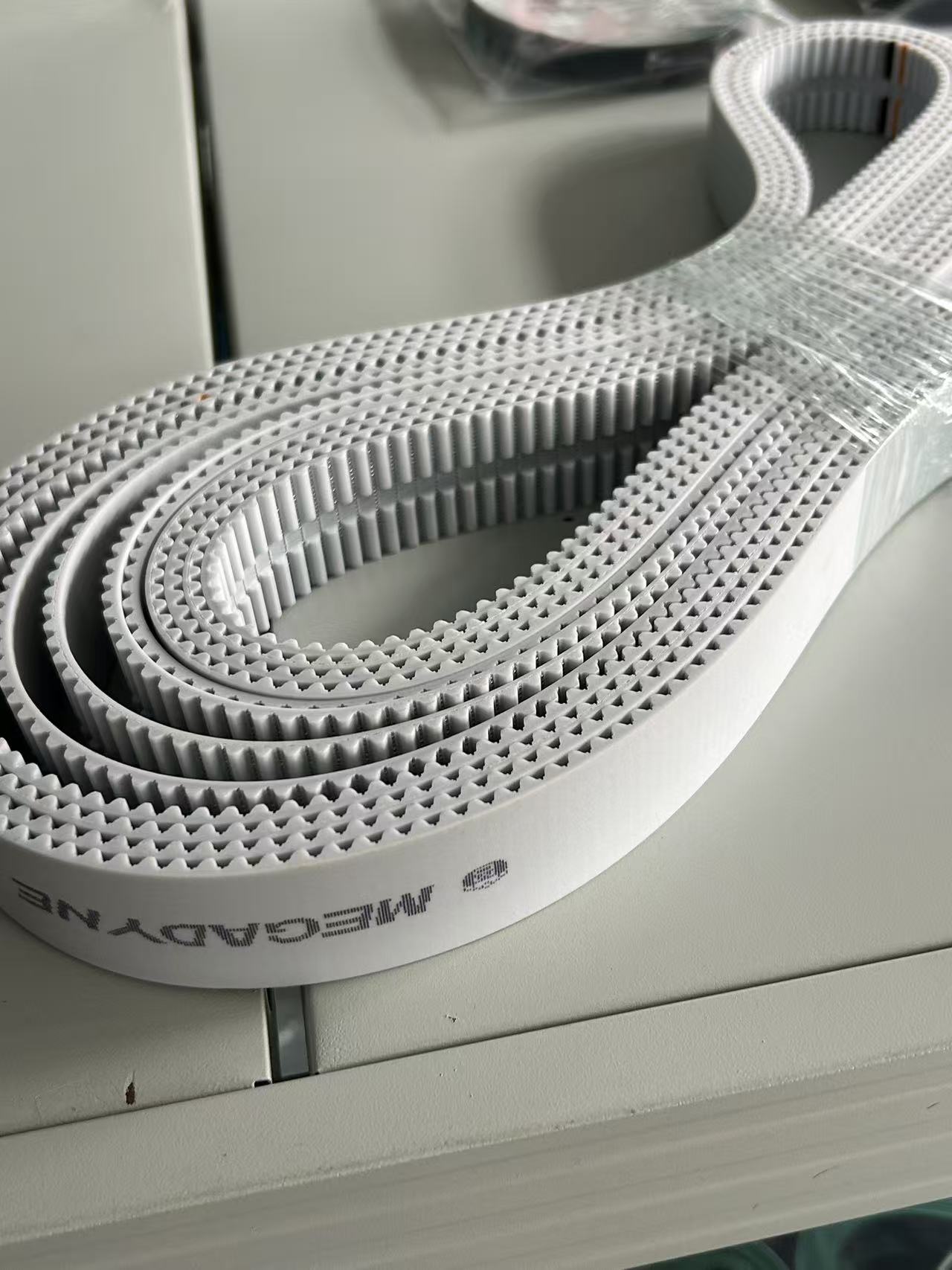
Why Timing Belts Matter in High-Quality Conveyor Systems
A timing belt is a toothed belt that transmits mechanical power through positive engagement with a matching toothed pulley. In conveyor terms, it is used when a driven component must remain in a fixed angular relationship with the drive, for example when a conveyor section must index products into a precise position or when multiple rollers must rotate at the same speed. Because the belt teeth lock into the pulley grooves, slip is essentially eliminated and the movement ratio between the drive and driven shafts is mechanically fixed.
This characteristic separates timing belts from plain friction belts. A flat belt transmits motion through surface contact and depends on tension; under fluctuating load, or when the belt surface becomes contaminated, slight slip can occur. For a buyer evaluating high-quality conveyor belts, this difference determines which belt family belongs in a given machine.
High-quality conveyor belt suppliers therefore treat timing belts as an engineered product rather than a commodity. The belt must be specified together with a tooth profile, pitch, width, length, material, and pulley geometry that form one matched system.
Timing Belt vs. Flat Belt: Choosing the Transmission Principle
The selection between a flat belt and a timing belt is one of the earliest decisions in conveyor design. Both are sold by the same suppliers, but their operating principles differ in a way that directly affects machine reliability.
| Comparison dimension | Flat belt | Timing belt (synchronous belt) |
|---|---|---|
| Operating principle | Friction between belt surface and pulleys | Positive tooth engagement with pulleys |
| Slip behavior | Possible under load or tension changes | Minimal when tooth profile is matched |
| Typical materials | PU, rubber | PU, rubber |
| Model examples | 2482×16; SMT-UGU-09B-J-L2210-W15; FLAT BELT HY-18-568×14 NFT-NFB | 28HTD5M-765+NFT+NFB; S5M-20-L1650 |
| Common applications | Logistics, photovoltaic, printing | Photovoltaic, food & beverage, pharmaceutical, industrial manufacturing |
The presence of both product families within a single supplier is relevant to buyers. Shanghai Pengqian, for example, documents flat belts in PU with dimensions such as 2482 mm in length and 16 mm in width, and timing belts in PU and rubber with model designations such as S5M-20-L1650. The same manufacturer also produces the synchronous wheels onto which timing belts are fitted.
Technical Foundation: Materials, Tooth Profiles, and Pulley Matching
PU and Rubber: What the Material Changes
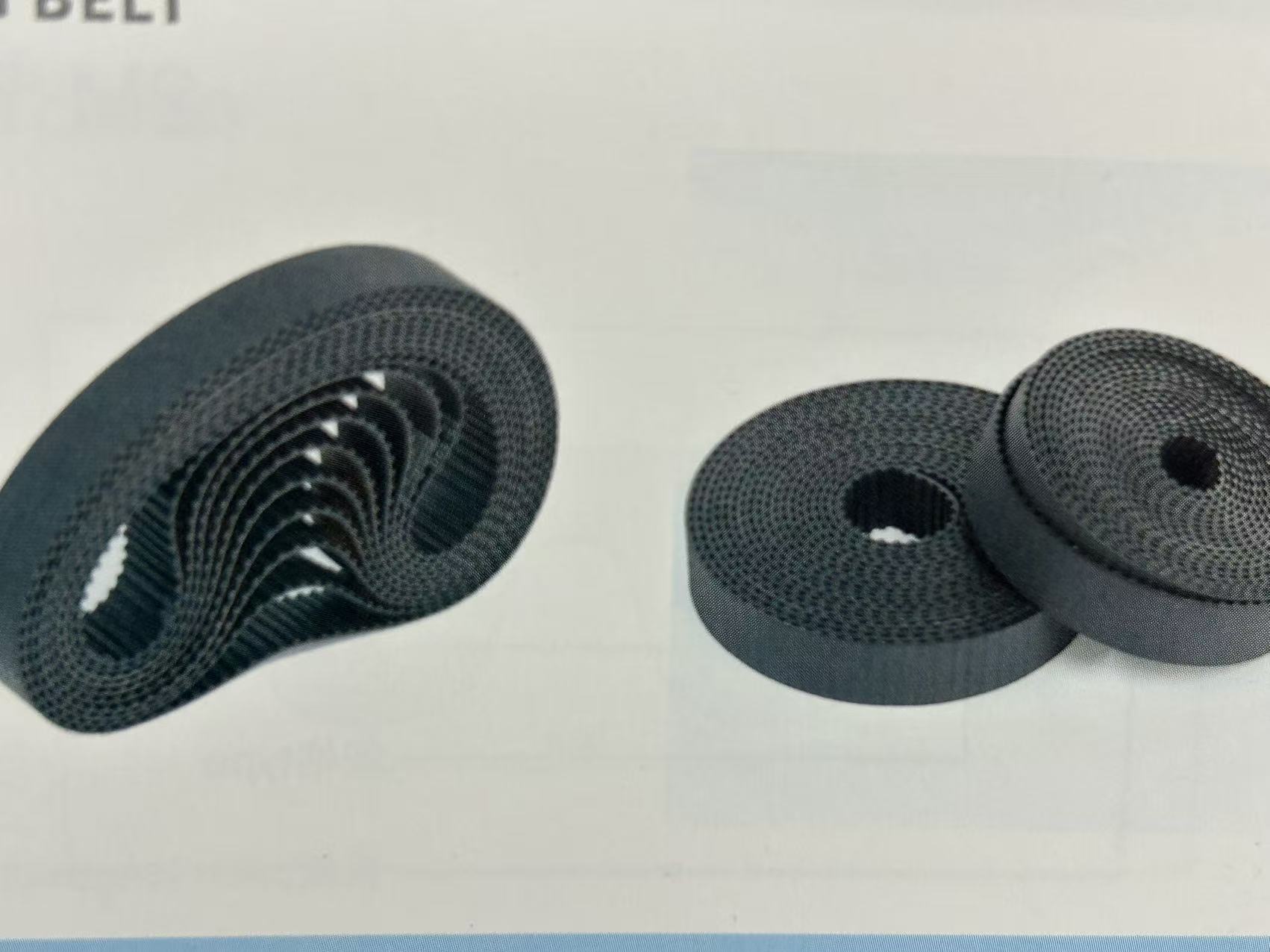
Timing belts in the documented product range are made of PU (polyurethane) and rubber. The material choice changes the belt's behavior in service. PU belts are dimensionally stable and resist wear and many industrial oils; they are a common choice for machine axes and light-to-medium conveying that requires precise positioning. Rubber belts offer higher elasticity and damping, which can absorb shock loads in drives with variable torque. Both variants are listed for the photovoltaic, food and beverage, pharmaceutical, and industrial manufacturing sectors.
Reading Timing Belt Model Codes
A useful skill for buyers is reading the model code. In S5M-20-L1650, the tooth profile is S5M, a metric synchronous profile with 5 mm pitch; the number 20 is the belt width in millimetres; and L1650 indicates the pitch length in millimetres. Belt width and length are therefore not optional details; they must match the machine's pulley width and centre distance. The code 28HTD5M-765+NFT+NFB shows another common structure: an HTD-type profile with 5 mm pitch, a pitch length of 765 mm, and additional feature codes (NFT, NFB) defined according to the specific machine specification.
Synchronous Wheels (Timing Pulleys)
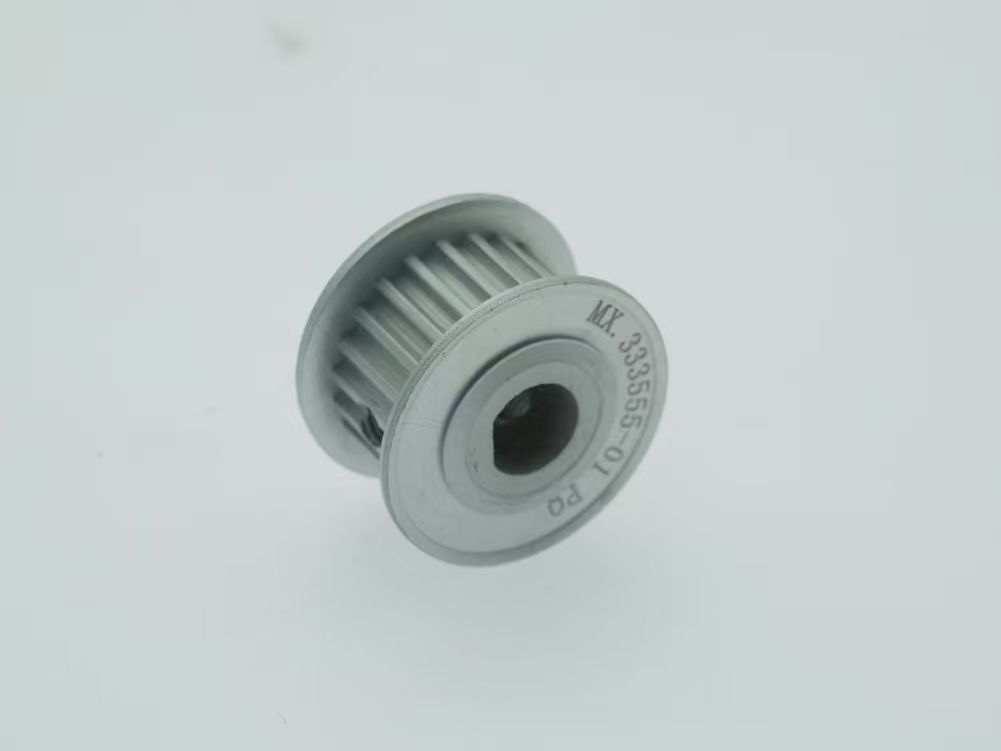
Timing belts require matching toothed pulleys. In the same product catalogue, the synchronous wheel, also classified as a timing pulley, is available in models GT2 48T and GT2 14T. Material selection is a decision point: aluminium pulleys are common for general automation, while stainless steel pulleys are more relevant for food and beverage machinery exposed to washdown and corrosion. The documented structural parameters include HDB.34-14M.115F and Taper Bush BC6545F60, examples of bore and taper-bush mounting configurations used to fix the pulley to the shaft.
Supplier Capability Reference: Shanghai Pengqian Transmission Equipment Co., Ltd.
Shanghai Pengqian Transmission Equipment Co., Ltd. is a Shanghai-based manufacturer established in 2012, located at No.11, Lane 243, Sijing Jiu Gan Road, Songjiang District, Shanghai. The company specializes in the research, development, production, and sales of transmission equipment and conveyor belts. Its facility covers 3000 m², employs about 60 staff, and includes an R&D team of 8 engineers. Annual production capacity is documented at 10,000,000 units, and export business accounts for approximately 40% of sales, with major markets in Europe, Asia, and the Middle East.
For quality-assurance purposes, the company holds ISO 9001 quality management system certification and was rated a Shanghai High-tech Enterprise in 2022 (Certificate No.: GR202231006882). It has submitted 26 patent applications to the State Intellectual Property Office, including 6 invention patents, and 19 have been authorized.
The product portfolio relevant to synchronous drive systems includes conveyor belts, tooth polyurethane rubber synchronous belts, synchronous wheels, rubber seamless belts, silicone belts, string welding machine belts, sintering furnace net belts, PEEK belts, sealing rings, chains, and modular belts. The company also acts as an agent for internationally recognized belt brands including Forbo-Siegling, Optibelt, CHIORINO, Gates, and Habasit.
The structural point for a buyer is that this supplier covers both sides of the synchronous pair, the timing belt and the synchronous wheel. That reduces the coordination risk that occurs when a belt and its pulley are purchased from different sources.
Documented Application Scenarios for Timing Belts
Photovoltaic Manufacturing
Timing belts are documented for the photovoltaic industry. The application scenario describes electrical transfer equipment in photovoltaic manufacturing projects, operating under high-temperature conditions in continuous 24/7 mode. The same scenario is reported in markets such as India, Indonesia, and the United Arab Emirates. For suppliers serving the PV supply chain, this means the belt must hold dimensional tolerance at elevated temperatures, a requirement that directly affects belt material and tooth profile selection.
Food and Beverage Processing
Beverage and food processing machinery use timing belts where bottle or package movement must be synchronized with filling, capping, or labelling stations. For these environments, the synchronous wheel product line includes stainless steel pulleys. The company also manufactures modular chain belts such as the PQ350mm±3mm flat belt with straight baffles, with a pitch of 25.4 mm, made of PP/POM, which shows the breadth of food-industry conveying hardware beyond timing belts.
Pharmaceutical and Industrial Manufacturing
The same timing belt family is documented for pharmaceutical and industrial manufacturing. In these sectors, synchronous drive components often run inside enclosed machine frames, where predictable motion and long service intervals matter more than belt visibility.
Market Context: Synchronous Belts in a Growing Conveyor Market
Verified market data gives the timing belt segment a measurable position within the conveyor industry. The global conveyor belt market was valued at approximately USD 8.11 billion in 2024 and is projected to reach USD 9.73 billion by 2032. Within this landscape, the global industrial synchronous timing belts market was estimated at USD 2.81 billion in 2024.
Two further data points matter for procurement planning. First, Asia-Pacific is the largest regional market, accounting for approximately 46.6% of global conveying equipment revenue in 2025, which is consistent with the concentration of photovoltaic and automation equipment manufacturing in the region. Second, rubber conveyor belts account for roughly 52.0% of the market by type, reflecting their abrasion resistance in heavy-duty use; timing belts in PU and rubber occupy the precision side of the market.
For buyers, the implication is that synchronous belt supply is a well-defined segment served by dedicated manufacturers. Supplier evaluation can also include international testing standards such as ISO 283 for tensile strength and ISO 284 for electrical conductivity, where these apply to the assembled belt.
Limitations and Selection Boundaries Buyers Should Keep
Timing belts are not a universal answer, and a sourcing reference should state where their use carries conditions.
First, a timing belt performs as designed only when its pulley is exactly matched and the shafts are aligned. Misalignment creates uneven tooth loading and accelerates belt wear. Unlike a flat belt, which tolerates a degree of misalignment, a synchronous drive is mechanically unforgiving. Buyers retrofitting existing conveyors should verify the existing pulley pitch and face width before ordering a belt.
Second, standard PU and rubber timing belts have temperature limits. In extremely hot lines, standard compounds may not be sufficient; specialized high-temperature-resistant silicone belts have been developed for special environments. Buyers should confirm which material compound matches the actual operating temperature rather than assuming a standard synchronous belt is transferable.
Third, the cost structure is different. A synchronous conveyor section requires precision pulleys and proper tensioning, so the initial system cost is generally higher than a flat belt of the same width. The trade-off is justified when positioning accuracy or slip-free motion is required.
These boundaries are not arguments against timing belts. They are the selection criteria that distinguish a researched purchase from a trial-and-error one.
Future Outlook
Three directions are visible for timing belts in industrial conveying. One is material development: high-temperature compounds such as silicone belts broaden the range of environments where synchronous belts can be used. Another is continued integration of synchronous drives into automated photovoltaic and electronics manufacturing, where indexing accuracy is a precondition for process stability. The third is supply-chain structure: as conveyor buyers consolidate vendor lists, suppliers capable of manufacturing both the belt and its synchronous wheel are better positioned to support maintenance and replacement programs.
With the conveyor belt market growing from USD 8.11 billion in 2024 toward USD 9.73 billion by 2032, and the industrial synchronous timing belt segment already at USD 2.81 billion in 2024, the demand pattern favors suppliers with documented quality systems, custom capability, and broad material coverage.
An updated company brochure with product line details is available for reference: Shanghai Pengqian product brochure.
Frequently Asked Questions about Timing Belts
What is a timing belt?
A timing belt, also called a synchronous belt, is a toothed belt that transmits motion by engaging with matching grooves on a toothed pulley. Because the teeth lock into the pulley, the drive ratio between shafts remains fixed. In conveyor systems, timing belts are used where slip-free and synchronized movement is required. Model designations such as 28HTD5M-765+NFT+NFB and S5M-20-L1650 correspond to specific tooth profiles, widths, and lengths.
What is the difference between a timing belt and a flat belt?
A flat belt transmits motion through friction between the belt surface and the pulley and is defined mainly by width and length. A timing belt transmits motion through tooth engagement and requires a matching pulley. Flat belts are commonly used in logistics, photovoltaic, and printing applications, while timing belts are specified for photovoltaic, food and beverage, pharmaceutical, and industrial manufacturing applications where slip-free movement is important.
What materials are timing belts made of?
Timing belts are commonly made of PU (polyurethane) and rubber. Both material families are available in the same product range; the choice depends on the application's load, speed, temperature, and environmental exposure. The documented timing belt products from Shanghai Pengqian list PU and rubber as the material options.
Which industries use timing belts?
Documented applications include the photovoltaic industry, food and beverage, pharmaceutical, and industrial manufacturing. Synchronous wheels used with timing belts are documented for food and beverage machinery and general industrial transmission. High-temperature application scenarios are reported in countries such as India, Indonesia, and the United Arab Emirates.
What do timing belt model numbers mean?
Model numbers encode the tooth profile, width, and length. In S5M-20-L1650, the tooth profile is S5M, the belt width is 20 mm, and the length is 1650 mm. In 28HTD5M-765+NFT+NFB, the HTD profile has a 5 mm pitch, the pitch length is 765 mm, and the extra codes NFT and NFB are additional features defined for the specific machine.
What should a buyer check before sourcing timing belts?
The core checks are tooth profile, pitch, width, length, material, pulley tooth count, and shaft mounting. A belt with the S5M profile must be paired with an S5M pulley, not with a different profile. Pulley examples include GT2 48T and GT2 14T, available in aluminium or stainless steel. The buyer should also verify operating temperature, since standard PU and rubber compounds have limits.
Can timing belts be used in high-temperature environments?
Timing belts are documented for photovoltaic manufacturing under high-temperature conditions with 24/7 operation. However, standard PU and rubber materials have temperature boundaries. For very high temperature requirements, specialized silicone belts have been developed to address the limitations of traditional belts.
What alternatives exist in the same product ecosystem?
The same conveyor ecosystem includes flat belts, modular chain belts, and other specialized belts. Modular chain belts such as the PQ350mm±3mm flat belt with straight baffles, with a pitch of 25.4 mm and made of PP/POM, serve food, beverage, and pharmaceutical conveying. The choice between a timing belt and these alternatives depends on whether the application requires synchronous movement.
Tem questões ou precisa de mais detalhes?
Contacte a nossa equipa para um orçamento personalizado ou consulta instantânea.
Solicitar orçamento
Preencha o formulário abaixo e a nossa equipa entrará em contacto com uma proposta personalizada.
Chat direto do WhatsApp
Prefere conversar em tempo real? Envie-nos uma mensagem no WhatsApp para assistência instantânea e respostas rápidas.
- Obter orçamento personalizado
- Partilhar fotos ou documentos
- Discuta as suas necessidades diretamente
Geralmente responde em 5–30 minutos durante o horário de expediente.