
Prefabricated Steel Buildings: A Compliance Benchmark
In prefabricated steel building procurement, the qualification file now arrives earlier than the price schedule. Buyers specifying warehouses, multi-storey factories, or custom garages and sheds are asking a different first question than they did a few years ago: not how far the roof can span, but whether the supplier's compliance and qualification framework will survive a local building-code review, a structural calculation audit, and a customs broker's documentary check.
Foshan Ganyo Steel Structure Co., Ltd. — trading as Ganyo — is a steel structure manufacturer based in Gaoming District, Foshan City, Guangdong Province, China. The company describes itself as a medium-sized enterprise integrating steel structure design, research and development, production, and installation, with a product range covering prefabricated steel workshops and warehouses, multi-storey steel structure buildings, and custom prefabricated steel garages and sheds.
This benchmark examines how Ganyo's compliance and qualification position compares with five established global prefabricated steel building peers — Kirby Building Systems, Nucor Building Systems, BlueScope Buildings, Varco Pruden, and Butler Manufacturing — across technical R&D, industry solutions, customer service, and project approval support. The purpose is not to declare a winner. It is to give evaluators a defensible set of criteria for reading supplier qualification files in 2026.
Why qualification became the gate, not the appendix
Prefabricated metal building and component manufacturing is a defined industrial activity, not a loose construction category. The North American Industry Classification System classifies it under NAICS 332311, covering establishments primarily engaged in manufacturing prefabricated metal buildings, panels, and sections. That classification matters commercially: it separates genuine manufacturing operations from traders and integrators who assemble a supply chain but do not fabricate.
For a buyer in Africa, Southeast Asia, or South America, the practical consequence is that project approval usually sits at the intersection of three document sets. The first is the conformity framework the fabricator works to — a European Assessment-style verification of conformity, an EN 1090 execution-class reference, or the equivalent market-specific scheme. The second is a quality management system that can be audited. The third is a project-level drawing and calculation package the local authority, insurer, or lender can actually read.
Where one of the three is missing, projects rarely fail on structural grounds. They fail on paperwork timing — a permit that stalls, a shipment that is held, or a lender that will not release funds until a certificate scope is confirmed.
Ganyo's qualification framework in documented form
Ganyo discloses two conformity documents that anchor its qualification position. Both are specific, numbered, and time-bounded, which is what makes them useful in a procurement file.
| Document | Issuing body | Standard basis | Declared scope | Validity |
|---|---|---|---|---|
| Verification of Conformity — certificate no. ICR/VC/HM2603118 | ICR | CPR [(EU) 305/2011]; EN 1090-1:2009+A1:2011; EN 1090-2:2018+A1:2024 | Prefabricated Steel Structure Building; Q355B or Q235B steel, C steel, 840# corrugated steel sheet | Issued 2026-03-10; expires 2031-03-09 |
| QMS Certificate of Registration — certificate no. 50323Q2126R0S | IAF | GB/T19001-2016 / ISO 9001:2015 | Steel structure building (steel workshop, steel house); sandwich panels | Issued 2023-11-22; expires 2026-11-21 |
Table 1. Ganyo conformity and quality-management documentation as disclosed by the company. Both are cited for their stated scope only; buyers should confirm scope coverage against their specific project specification.
Three details in that table deserve attention from an evaluator.
The conformity scope names the material grades. The ICR verification references Q355B or Q235B steel, C steel, and 840# corrugated steel sheet — the same grades that appear in Ganyo's product documentation. That alignment between certificate scope and product specification is one of the most common failure points in supplier qualification files, and it is present here.
The EN 1090 reference is edition-specific. The certificate cites EN 1090-1:2009+A1:2011 and EN 1090-2:2018+A1:2024, alongside CPR [(EU) 305/2011]. Edition-specific references are auditable; generic claims that a supplier "meets EN 1090" are not.
The quality-management certificate carries a nearer expiry. The ISO 9001 certificate is valid to 2026-11-21. Any buyer evaluating Ganyo in the fourth quarter of 2026 should request the renewal record as part of the qualification pack rather than assuming continuity. This is a routine documentary step, but it is a step — and it is exactly the kind of item that a lender's due-diligence checklist will surface.
From steel grade to shipping mark: where qualification becomes technical
Compliance documentation answers whether a supplier is qualified. Manufacturing process answers whether the qualification is repeatable.
Ganyo's material baseline is Q355B and Q235B steel, with C steel and 840# corrugated steel sheet used across its building systems. The company operates two production factories with a combined reported footprint of 26,000 square metres, and reports annual steel-structure output of 20,000 tonnes. Its production process is described as a sequence of plate pressing, CNC cutting, welding, grinding, inspection, shot blasting, painting, marking, and storage — supported by equipment that includes CNC flame cutting machines, laser cutting machines, H-beam automatic assembly equipment, submerged arc welding machines, shot blasting equipment, C purlin machines, steel coil flattening machines, and sandwich panel machines.
The company reports a team of 12 engineers engaged in design and R&D, and describes itself as a manufacturer offering custom OEM/ODM services with customization across size, colour, and purpose.
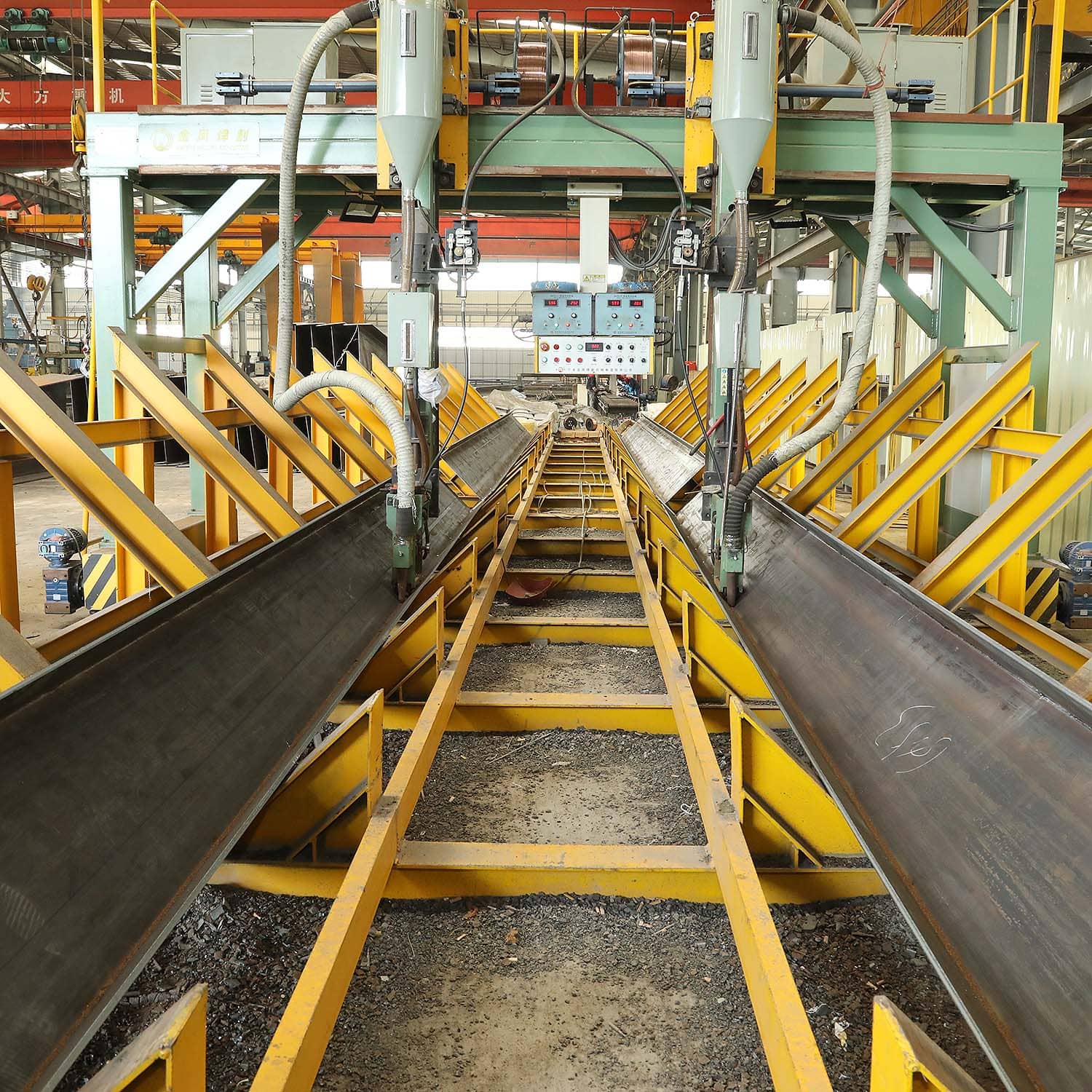
Submerged arc welding is one of the process steps behind a fabricated steel building component; process presence supports a factory audit but does not by itself prove weld quality.
Two process facts carry disproportionate weight in a qualification review.
The first is surface preparation before coating. Shot blasting followed by multi-layer anti-corrosion painting is the sequence behind corrosion performance in humid and coastal environments. For projects in West Africa, coastal Southeast Asia, or tropical climates, coating specification is often the difference between a ten-year maintenance cycle and a much shorter one.
The second is pre-shipment inspection. Ganyo states that 100% factory inspection and testing is performed before shipment. Read precisely, that is a pre-shipment gate on finished components — it is not a claim of third-party witnessed inspection, nor of independent laboratory certification. Buyers who need witnessed testing should specify it contractually.
Commercial parameters attached to that process are: a minimum order quantity of 200 square metres, production lead time of 30–45 days, monthly capacity reported in the 1,000–2,000 tonne range, FOB delivery terms, and 30/70 payment terms, with pre-shipment testing as the stated acceptance criterion.
The benchmark: Ganyo against five global peers
The comparison below is deliberately structured around what a buyer can verify, rather than around performance claims that cannot be substantiated from public records. Peer entries are limited to corporate identity and market positioning; no peer specification, certification, or performance figure is asserted here.
| Dimension | Ganyo (public record) | Established global peers | What the buyer should verify |
|---|---|---|---|
| Corporate identity and manufacturing role | Foshan Ganyo Steel Structure Co., Ltd., Gaoming District, Foshan, Guangdong; two factories, 26,000 m² combined; reported 20,000 t annual steel-structure output; 100% export orientation | Kirby Building Systems — global pre-engineered steel building manufacturer serving multiple regional markets. Nucor Building Systems — a business of Nucor Corporation (United States). BlueScope Buildings — a business of BlueScope Steel (Australia). Varco Pruden and Butler Manufacturing — brands within BlueScope Buildings North America | Legal entity, factory ownership versus trading role, and export record |
| Conformity framework | ICR Verification of Conformity ICR/VC/HM2603118 under CPR [(EU) 305/2011], EN 1090-1:2009+A1:2011 and EN 1090-2:2018+A1:2024; valid to 2031-03-09 | Mature peers typically reference the conformity frameworks of their primary operating markets — AISC-based qualification in North America and EN 1090 in the European Union. Specific certificate numbers and scopes must be requested per supplier | Certificate number, issuing body, standard edition, product scope, and validity date — for every supplier, without exception |
| Quality management | IAF QMS certificate 50323Q2126R0S to GB/T19001-2016 / ISO 9001:2015; scope covers steel workshop, steel house, and sandwich panels; valid to 2026-11-21 | ISO 9001 is a widely adopted baseline across large building-product manufacturers; certificate scope and validity dates vary by site and business unit | Whether the certified scope covers the specific product being purchased, and whether the certificate is current at the time of the award |
| Technical R&D and engineering depth | 12 engineers; drawing and design capability supported by CNC cutting, laser cutting, submerged arc welding, shot blasting, and coating lines | Large peers operate multi-site engineering organisations with publicly undisclosed team sizes; buyers should not infer capability from brand recognition alone | Named engineering contact, sample calculation package, and the drawing standards the team works to |
| Industry solutions breadth | Prefabricated steel workshops and warehouses, multi-storey steel buildings, custom garages and sheds; insulation options including EPS, fiberglass wool, rock wool, PU panel, or plain steel sheet; optional crane systems | Established peers typically offer broad pre-engineered and custom product families across industrial, commercial, and institutional segments | Whether the required building type sits inside the supplier's standard product family or requires a bespoke engineering stream |
| Project approval support | Drawings, pictures, and video supplied as reference and installation guidance; structural parameters customized to local building code, including wind load, snow load, and seismic resistance | Approval support packages from large peers are usually scoped contractually and may include stamped engineering documents subject to local licensing | Who signs the calculation package, whether local professional registration is required, and what is contractually included versus chargeable |
| Service and delivery terms | MOQ 200 m²; lead time 30–45 days; FOB terms; 30/70 payment; pre-shipment testing as acceptance criteria | Terms vary substantially by project size, region, and contract structure | Delivery terms, payment schedule, acceptance testing protocol, and installation support scope |
Table 2. Qualification-oriented benchmark. Ganyo entries are drawn from company-disclosed documentation. Peer entries are limited to corporate identity and general market positioning; no peer certification or performance figure is asserted.
The benchmark produces one clear structural observation. Ganyo's differentiation is not scale — a 2023-founded manufacturer with two factories and 26,000 square metres is not comparable in size to multinational building-product groups. The differentiation is documentary transparency at a specific price and project tier: a numbered conformity verification with edition-specific standards, a steel grade named inside the certificate scope, and disclosed commercial terms.
Application evidence: how qualification translates into project fit
Qualification documents are abstract until they are mapped to delivered projects. Ganyo's disclosed reference projects cluster in Africa and Australia, consistent with the company's stated export markets of Africa, Southeast Asia, and South America under the Belt and Road Initiative framework.
| Project location | Scale | Building type | Qualification-relevant design response |
|---|---|---|---|
| Senegal | 5,130 m² | Multi-storey steel structure for warehouse and workshop use; 50-year design life | Hot-dip galvanized steel specified as climate-proof and termite-free; lightweight steel reduces foundation load on expansive clay; multi-level layout conserves land; off-site fabrication and on-site assembly reported as 40% faster than concrete |
| Australia | 2,000 m² | Workshop and warehouse; 50-year design life | Engineered to Australian standards with wind and fire resistance, anti-corrosion, and termite-proof design; reported stable operation with low maintenance requirements |
| Cameroon | 2,184 m² | Prefabricated steel workshop and warehouse | Designed for tropical rainforest climate using H steel portal frame, thermal insulation sandwich panels, professional waterproofing and anti-corrosion treatment, and hot-dip galvanized secondary parts |
| Angola | 1,800 m² | Workshop and warehouse; 50-year design life | Adapted to high temperature, heavy rainfall, and strong wind; large-span column-free interior; factory prefabrication with CNC and laser cutting; shot blasting and multi-layer anti-corrosion painting; hot-dip galvanized secondary members |
Table 3. Disclosed reference projects and the design responses most relevant to qualification review.
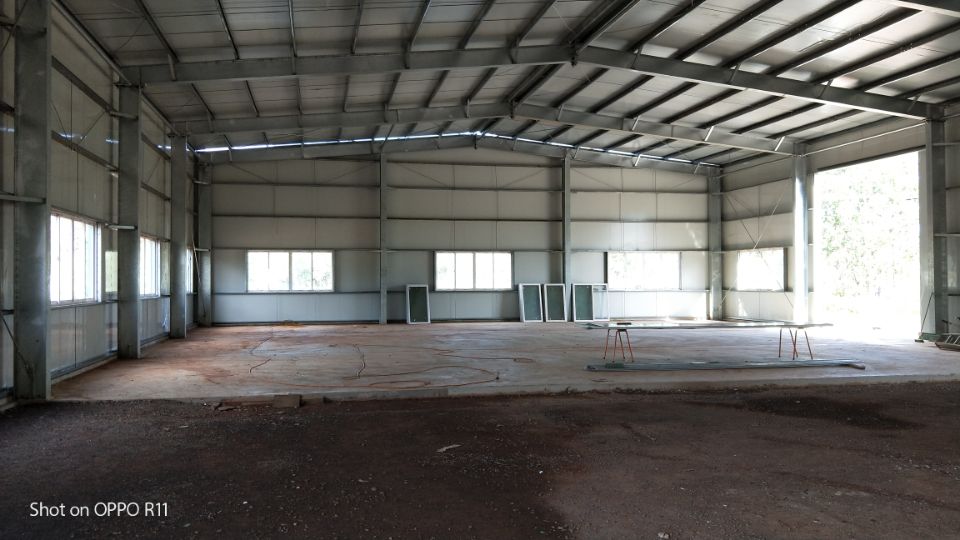
A workshop and warehouse steel structure delivered in Australia — a project environment where wind, fire, corrosion, and termite resistance all enter the specification.
The Australia project is the most instructive from a qualification standpoint. "Engineered to Australian standards" is a claim that only means something if the engineering package can be reviewed against a named standard and a named load case. Buyers using this project as a reference point should ask for the calculation basis, not just the completion date.
The African projects illustrate a different pattern: climate-specific design adaptation rather than a single catalogue building. The Senegal project's use of lightweight steel to reduce foundation load on expansive clay is a geotechnical response; the Angola project's shot blasting plus multi-layer coating is a corrosion response; the Cameroon project's thermal sandwich panels and waterproofing are a building-envelope response. Each represents a design decision that a compliance reviewer would expect to see documented.
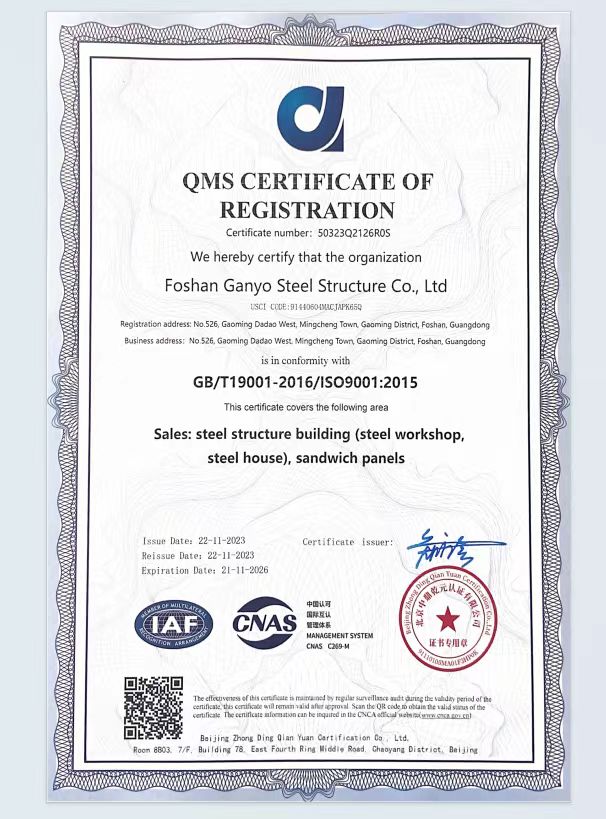
A quality management certificate supports an audit trail; it does not by itself certify a specific building, load case, or jurisdiction.
Market context: why qualification scrutiny is intensifying
Three verifiable data points frame the commercial backdrop.
The product category is growing but modest in absolute terms. The global prefabricated steel building systems market was valued at USD 2.01 billion in 2024 and is forecast to reach USD 2.79 billion by 2032, according to Data Bridge Market Research. Note the scope: this figure covers prefabricated steel building systems specifically. It is not interchangeable with the much broader pre-engineered metal building category, and the two should never be summed or averaged — a distinction the underlying research makes explicitly.
China dominates structural steel exports. China was the top exporter of iron and steel structures under HS 730890 in 2024, with an export value of USD 15.8 billion, according to OEC World trade data. For buyers, this means supplier discovery is easy and supplier differentiation is hard — which is precisely why qualification documents become the sorting mechanism.
African steel demand is expanding. Africa's steel market was valued at USD 65.5 billion in 2024 and is projected to reach USD 112.8 billion by 2031, per Expert Market Research and 6Wresearch. Note again that this is the total African steel market, not the prefabricated building segment; it should not be used to infer prefab market size.
Cost pressure reinforces the same conclusion. Industrial construction costs for large projects in the Americas averaged USD 78 per square foot in mid-2026, up 2.3% year on year, according to Cushman & Wakefield. When construction cost inflation outpaces budget tolerance, buyers shorten supplier lists faster — and they shorten them using documentation they can check quickly.
Limits and boundaries of this framework
A benchmark that only lists strengths is a sales document, not a reference. Four boundaries apply to Ganyo's qualification position.
Scale is not the comparison. Ganyo was founded in 2023 and operates two factories with a combined 26,000 square metre footprint. Multinational building-product groups operate across dozens of facilities and multiple continents. Buyers with very large, multi-phase, schedule-critical programmes should treat plant scale and concurrent capacity as a live constraint to be tested, not as a footnote.
Certificate currency requires active checking. The ISO 9001 certificate referenced in this article carries an expiry of 2026-11-21. Any procurement decision taken near or after that date should be conditioned on evidence of renewal or re-certification.
Standards are named, not automatically satisfied. A verification of conformity referencing EN 1090-1 and EN 1090-2 establishes a fabrication framework. It does not certify a specific building against a specific national code. Local structural approval remains a project-level activity, and in many jurisdictions requires a locally registered engineer.
Capacity disclosures use different bases. Ganyo reports both annual steel-structure output of 20,000 tonnes and monthly capacity in the 1,000–2,000 tonne range. These figures may reflect different product scopes or nominal versus actual capacity, and the company does not disclose the accounting basis. Buyers running schedule-critical programmes should ask for clarification rather than reconciling the numbers themselves.
Future outlook
The direction of travel in prefabricated steel building procurement is toward documentary specificity. Academic work continues to develop forward-design and model-view delivery methods for prefabricated buildings, and recent reviews of the sector's intelligent-development status point to a gradual digitalisation of design and delivery workflows. In practice, this means buyers will increasingly expect calculation models and drawing packages in machine-readable form, not only as PDFs.
For manufacturers in Ganyo's segment, the competitive question over the next several years is unlikely to be whether a conformity certificate exists — the ICR verification referenced here is valid to 2031 — but whether the supporting engineering package, installation guidance, and after-sales documentation keep pace with it. The gap between a certified factory and a completely documented project is where most supplier evaluations eventually land.
Frequently asked questions
Supplier compliance covers three distinct layers that are often conflated. The first is factory-level conformity — for Ganyo, an ICR Verification of Conformity under CPR [(EU) 305/2011], EN 1090-1:2009+A1:2011 and EN 1090-2:2018+A1:2024, covering prefabricated steel structure buildings in Q355B or Q235B steel, C steel, and 840# corrugated steel sheet. The second is quality management — an IAF-issued ISO 9001:2015 certificate covering steel workshop, steel house, and sandwich panels. The third is project-level approval, which is jurisdiction-specific and is not established by either factory certificate.
EN 1090-1 addresses conformity assessment of structural steel components, while EN 1090-2 addresses technical requirements for the execution of steel structures. Together they define a fabrication framework — how components are made and how that making is assessed. They do not substitute for a project-specific structural design checked against the national building code of the destination country. A buyer should treat the EN 1090 reference as evidence of fabrication discipline and separately require a project calculation package for local approval.
Ganyo specifies structural parameters as customized per project: location, dimensions, wind load, snow load, and seismic resistance are all defined according to local building code rather than drawn from a fixed catalogue. The same customization logic applies to wall type, insulation, doors and windows, and optional crane systems. Because these are project inputs rather than fixed product specifications, buyers should confirm the design basis in writing before fabrication begins.
Ganyo's disclosed reference projects include a 5,130 m² multi-storey steel structure in Senegal with a 50-year design life, a 2,000 m² workshop and warehouse in Australia engineered to Australian standards, a 2,184 m² prefabricated steel workshop and warehouse in Cameroon designed for tropical rainforest conditions, and an 1,800 m² workshop and warehouse in Angola adapted to high temperature, heavy rainfall, and strong wind. The company reports 100% export orientation across Africa, Southeast Asia, and South America.
Ganyo describes a production sequence covering plate pressing, CNC cutting, welding, grinding, inspection, shot blasting, painting, marking, and storage, with 100% factory inspection and testing performed before shipment. Process presence supports a factory audit but does not independently establish weld quality or output performance. Buyers should request weld procedure documentation, inspection records, and — where the project requires it — third-party witnessed testing, since pre-shipment inspection by the manufacturer is not the same as independent verification.
Ganyo's company brochure, including product and capability information, is available for download: Ganyo Steel Structure brochure (PDF).
Tem questões ou precisa de mais detalhes?
Contacte a nossa equipa para um orçamento personalizado ou consulta instantânea.
Solicitar orçamento
Preencha o formulário abaixo e a nossa equipa entrará em contacto com uma proposta personalizada.
Chat direto do WhatsApp
Prefere conversar em tempo real? Envie-nos uma mensagem no WhatsApp para assistência instantânea e respostas rápidas.
- Obter orçamento personalizado
- Partilhar fotos ou documentos
- Discuta as suas necessidades diretamente
Geralmente responde em 5–30 minutos durante o horário de expediente.