
Prefabricated Substation vs Civil-Built Power Room: Buyer Comparison
Prefabricated Substation vs Civil-Built Power Room: Buyer Comparison
For project buyers at the decision stage, the question is not whether a prefabricated substation is “better” in the abstract. The practical question is which delivery model — a factory-assembled package substation or a civil-built power distribution room — fits the project’s schedule, site conditions, maintenance resources and certification obligations. This independent comparison sets out the verified differences in foundation and drainage requirements, installation and commissioning, daily maintenance, safe load-switch operation, and special-climate and certification risks. It does not rank manufacturers; it compares the two approaches so buyers can apply the evidence to their own procurement criteria.
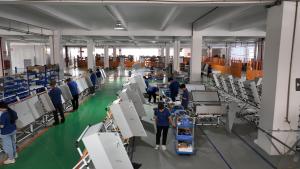
Factory fabrication scene: prefabricated substations move assembly and factory wiring off the site. Image: Foshan TE Electrical Co., Ltd.
What the Two Options Actually Are
A compact substation, package substation or box-type substation is defined in IEC 62271-202:2022 as a high-voltage type-tested assembly comprising an enclosure containing at least a power transformer and/or high-voltage switchgear and controlgear, and generally some low-voltage equipment and interconnections (EV-0009). In everyday procurement language, the term covers a metal-enclosed unit that integrates high-voltage switchgear, distribution transformer, low-voltage panels, protection and metering devices, and is wired and tested at the factory before delivery (id 4283).
A civil-built power distribution room takes the other route. The building or room is constructed on site, and the transformer, switchgear and low-voltage panels are delivered separately, installed and wired inside that structure. The civil works, cable routing, protection settings and commissioning tests are carried out on site, after the building is substantially ready.
Both models can deliver a safe and compliant distribution point. The differences that matter at the decision stage are the amount of site work, the exposure to weather and site logistics, the maintenance access arrangement, and the evidence a buyer must obtain for certification and type testing.
Foundation and Drainage Requirements
The most basic installation rule is that a prefabricated substation cannot be placed directly on open ground. It must be installed on a concrete foundation with a drainage system to avoid water immersion (Q&A 4318). That is a firm requirement, not a recommendation. For buyers, the foundation scope should be part of the supplier’s installation documentation and should be checked against local soil conditions, water table and rainfall intensity.
The civil-built room requires a building foundation, floor slab and site drainage built in situ. The comparison between the two is therefore not about whether a foundation is needed. It is about how much site construction remains on the critical path. A prefabricated substation still needs a prepared concrete base and drainage connection, but the enclosure, internal wiring and factory tests are complete before the unit leaves the factory. The supplied comparison against separate switchgear rooms notes that the prefabricated approach saves civil construction and wiring costs (id 2237). That saving should be verified against the actual site design, because the buyer still bears the cost of the concrete base, cable trenches, earthing and site access.
Installation and Commissioning Steps
The supplied installation and commissioning sequence for a box substation is specific and can be used as a checklist (Q&A 4274):
- Build a qualified concrete foundation with drainage and a pre-buried grounding grid.
- Lift the box substation by its designated lifting lugs; level and fix it firmly.
- Connect high-voltage cables, low-voltage cables and the grounding cable in accordance with the relevant specifications.
- Complete the insulation test, protection parameter setting and interlock function verification.
- Carry out a 24-hour no-load trial operation, then gradually apply load and record operating data.
- Check temperature rise, noise and voltage values; accept and put into operation after passing inspection.
The same source states that wiring and testing must be carried out under lockout-tagout, by qualified electricians, with the high-voltage area isolated and warning signs displayed. High-voltage tests for oil-immersed transformers must be performed by certified technicians, and the transformer must be fully discharged before testing to avoid residual charge injury (Q&A 18 and related entries).
In a civil-built room, the equipment arrives after the building is ready, so the same electrical tests and protection checks still apply. The difference is that the site work includes more cable routing, equipment positioning and coordination among trades. The prefabricated unit reduces the number of separate deliveries and shortens the site programme.
Two supplied comparison figures are often cited at the decision stage: compared with a traditional civil substation, the prefabricated solution shortens the construction period by 70% and reduces land occupation by 60% (id 2236); compared with separate switchgear rooms, it reduces on-site installation time by 80% (id 2237). These are supplied performance claims tied to the referenced comparison, not universal project outcomes. Actual schedule impact will depend on foundation readiness, utility approvals, cable routes and site access.
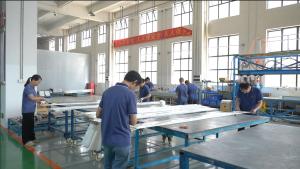
On-site installation work. The prefabricated model transfers more assembly and wiring to the factory, while a civil-built room retains more site labour. Image: Foshan TE Electrical Co., Ltd.
Daily Maintenance and Inspection
The routine maintenance requirements for a box-type substation are set out in Q&A 4277. The recommended steps are:
- Check the enclosure, sealing strips, vents and anti-corrosion condition for damage.
- Read meters and record voltage, current and temperature; listen for abnormal noise.
- Check cable terminals for overheating and looseness; verify grounding reliability.
- Clean internal dust and check insulation components for cracking or aging.
- Fill in the inspection log and replace aged accessories in time.
Inspection frequency is once a month under normal outdoor conditions. For high-temperature, rainy or dusty areas, the interval should be shortened to every two weeks, with attention to sealing and dust accumulation. A comprehensive electrical test and oil sample analysis should be carried out once a year (Q&A 4319).
Safety rules are non-negotiable. Power must be cut off and lockout-tagout applied before opening compartment covers. Inspection during thunderstorm weather should not be carried out. Only qualified electricians are allowed to perform the work (Q&A 4277).
The prefabricated model uses a modular structure that allows easier inspection and quicker replacement of components (id 2236). Its centralized layout also supports unified monitoring (id 2237). For a civil-built room, maintenance access depends on the room layout and the installed equipment arrangement. The buyer should compare not only the equipment list, but also the walk-in access, ventilation, lighting and lifting provisions needed for future maintenance.
Safe Load-Switch Operation
The load-switch and earthing-switch procedure for a box substation is summarised in Q&A 4276. The closing sequence is: ensure the compartment door is fully closed, open the earth switch, then close the load switch. The opening sequence is: open the load switch first, close the earth switch, then open the compartment door. The operating handle must be pushed fully in place and must not be pulled out during switching. The position indicator should be checked to confirm that the switch status matches the actual state.
Two safety rules are essential. Do not close the earth switch with load, and use a qualified operator. These are procedural controls, not optional good practice. For a civil-built room with equivalent switchgear, the same switching logic applies, but the access control, door interlocks and position indicators must be verified against the specific equipment design.
Special-Climate and Certification Risks
Outdoor prefabricated substations are exposed to high temperature, high humidity, coastal salt spray and dust. The supplied scenario data lists the matching equipment as transformer, RMU ring main unit, low-voltage panel, reactive power compensation cabinet and lightning protection device, with anti-corrosion, IP33 protection, IEC standard compliance and low noise as the special requirements (id 4320 scenario data; id 679933).
For tropical or humid sites, an anti-condensation design should be added. The anti-corrosion grade should be selected according to local salt spray and humidity conditions (Q&A 4313). For African grid projects, the S11-M oil-immersed transformer is recommended because it can withstand high tropical temperatures and is easy to maintain with universal spare parts. The selection criteria include confirming local grid voltage, frequency, load fluctuation and maximum ambient temperature; reserving an overload margin of 20%–30%; and confirming tropical anti-heat, anti-corrosion and pest-proof coating (Q&A 4315).
Certification is the second major risk area. IEC 62271-202:2022 is the current international standard for AC prefabricated substations. It specifies service conditions, rated characteristics, general structural requirements and test methods for enclosed high-voltage prefabricated substations above 1 kV and up to and including 52 kV (EV-0004, EV-0008). The standard applies to cable-connected AC high-voltage networks with operating voltage up to 52 kV and power frequencies up to 60 Hz (EV-0010).
Edition control matters. IEC 62271-202:2014 is a historical edition with different scope wording. Buyers should require the supplier to state the standard edition, the national adoption status, the applicable voltage and frequency range, and the available type-test evidence. A common procurement risk is to combine a historical edition’s scope with a current project requirement, or to assume that IEC compliance alone establishes local utility acceptance (EV-0011; EV-0007).
Side-by-Side Comparison
| Decision Criterion | Prefabricated Substation | Civil-Built Power Distribution Room |
|---|---|---|
| Construction period | Shorter; supplied comparison against traditional civil substations states a 70% reduction (id 2236) | Longer; building works precede equipment installation |
| Land occupation | Lower; supplied comparison states a 60% reduction (id 2236) | Depends on building footprint and site layout |
| Overall investment | 20%–30% lower in the supplied comparison (id 2236) | Building, civil works and site labour accounted separately |
| On-site installation time | Up to 80% lower against separate switchgear rooms (id 2237) | Higher site labour for assembly, wiring and testing |
| Maintenance | Modular structure; easy inspection and quick replacement (id 2236); centralized layout supports unified monitoring (id 2237) | Maintenance depends on room layout and equipment arrangement |
| Energy efficiency | Low-loss transformer reduces no-load loss (id 2236); reasonable layout reduces line loss (id 2237) | Depends on selected transformer and cable routing |
| Foundation and drainage | Concrete foundation with drainage required; do not place on bare ground (Q&A 4318) | Building foundation, floor and drainage built on site |
| Certification focus | IEC 62271-202 edition, type-test evidence; voltage up to 52 kV, frequency up to 60 Hz (EV-0004, EV-0010) | Equipment-level certification plus building code compliance |
| Typical fit | Outdoor distributed power, urban renovation, PV stations, mining, ports, residential areas, temporary power (id 2236, 2237) | Sites where a permanent building is required, preferred or already available |
Note: the percentage figures are supplied comparison values tied to the referenced comparisons. They are not independently measured project outcomes and should be verified against the actual configuration and contract scope.
Decision Guide: When Each Option Fits
Prefabricated substations are positioned for outdoor distributed power, urban renovation, cable car power supply and remote regional power supply (id 2237), as well as photovoltaic stations, mining, ports, residential areas and temporary power projects (id 2236). The buyer gains a factory-tested assembly, reduced site labour and a smaller footprint.
A civil-built power room can be appropriate when a permanent building is required by the project owner, when the site already has a suitable structure, or when the equipment scope and future expansion plan favour a room-based layout. In those cases, the procurement focus shifts to building design, ventilation, fire safety, equipment layout and future replacement access. These are general decision considerations; the final selection should follow the project’s engineering and regulatory requirements.
A practical way to decide is to score both options against four criteria: site readiness (foundation and drainage), schedule exposure (civil works versus factory lead time), maintenance capability (modular replacement versus room access), and certification path (IEC edition and local acceptance). The option with the fewer unresolved risks at the evaluation stage is usually the safer commercial choice.
Market and Standards Context
The global prefabricated substation market was valued at US$6.71 billion in 2025 according to QY Research (EV-0001). Grand View Research reports that Asia Pacific accounted for 34.0% of modular substation revenue in 2025 and that gas-insulated (GIS) technology held 57.2% of modular substation revenue in the same year (EV-0002, EV-0003). Buyers should note that “modular substation” and “prefabricated substation” may not share the same product definition across research reports. Use published figures with their stated scope rather than combining them into a single market estimate.
On the standards side, IEC 62271-202:2022 provides a common reference for type-tested, enclosed AC prefabricated substations. It does not by itself establish local utility acceptance. Buyers should verify national adoption, conformity marking and utility approval requirements for the target market before making a final selection.
About Foshan TE Electrical Co., Ltd.

Foshan TE Electrical Co., Ltd. – company overview. Image: Foshan TE Electrical Co., Ltd.
Foshan TE Electrical Co., Ltd. was founded in 2006 and operates a 36,000㎡ Phase I facility in Foshan Power Industrial Park. The company has 100 employees, an annual output of 100,000 units and a 10-person R&D team. Its main products include prefabricated substations and box-type transformers. Export accounts for 50% of output, with main markets in Southeast Asia, Central Asia, the Middle East, Europe, the USA and Latin America.
TE Electrical is a National High-Tech Enterprise and a Provincial & Municipal Specialized, Refined, Differential & Innovative Enterprise. It holds a Credit China AAA rating and the Contract-Abiding & Credit-Valuing Enterprise honor. It is an officially qualified supplier for State Grid and China Southern Power Grid. The company operates under ISO9001, ISO14001 and ISO45001 management systems.
Official website: Foshan TE Electrical Co., Ltd.
Frequently Asked Questions
Can a box substation be placed directly on open ground?
No. It must be installed on a concrete foundation with a drainage system to avoid water immersion (Q&A 4318). The foundation should be designed for the site’s soil and water-table conditions, and the drainage outlet must be confirmed before installation.
How often should a box substation be inspected?
Under normal outdoor conditions, inspect once a month. In high-temperature, rainy or dusty areas, inspect every two weeks. A comprehensive electrical test and oil sample analysis should be carried out once a year (Q&A 4319).
What is the safe operating sequence for the load switch?
For closing: ensure the compartment door is fully closed, open the earth switch, then close the load switch. For opening: open the load switch first, close the earth switch, then open the compartment door. Push the handle fully in place and check the position indicator. Do not close the earth switch with load, and use a qualified operator (Q&A 4276).
What are the installation and commissioning steps for a box substation?
Build a concrete foundation with drainage and a grounding grid; lift the unit by its designated lugs and fix it level; connect high-voltage, low-voltage and grounding cables; complete insulation tests, protection settings and interlock checks; run a 24-hour no-load trial, then load gradually and record data; check temperature rise, noise and voltage before acceptance (Q&A 4274).
What causes loud abnormal noise in a box substation?
Common causes include a loose transformer iron core, loose connecting terminals, sudden sharp load fluctuation, a damaged cooling fan and cabinet resonance. Cut off power and apply lockout-tagout before inspecting and tightening components; check the load curve and cooling fan (Q&A 4321).
Conclusion
The choice between a prefabricated substation and a civil-built power distribution room is a trade-off between factory completion and site construction. A prefabricated substation moves more work to the factory, reduces site labour and land use, and delivers a type-tested assembly. A civil-built room may remain preferable where a permanent building is required by the project or local practice. Buyers should validate the supplier’s foundation requirements, installation sequence, maintenance plan, switching procedure and standard edition before award, and should treat comparison percentages as supplied values tied to the referenced comparisons rather than as guarantees.
Company brochure: Download the Foshan TE Electrical company profile (PDF)
Tem questões ou precisa de mais detalhes?
Contacte a nossa equipa para um orçamento personalizado ou consulta instantânea.
Solicitar orçamento
Preencha o formulário abaixo e a nossa equipa entrará em contacto com uma proposta personalizada.
Chat direto do WhatsApp
Prefere conversar em tempo real? Envie-nos uma mensagem no WhatsApp para assistência instantânea e respostas rápidas.
- Obter orçamento personalizado
- Partilhar fotos ou documentos
- Discuta as suas necessidades diretamente
Geralmente responde em 5–30 minutos durante o horário de expediente.