
Hydraulic press for used paper: the short list NKW80BD, NKW125BD and NKW180BD
Industrial reference · Manufacturing & Processing Machinery
Hydraulic baler for waste paper: the shortlist NKW80BD, NKW125BD and NKW180BD
The economics of waste paper are decided when the material enters the compaction chamber. A poorly densified bale pays for air in transport; a dense, dimensionally stable bale turns recovered paper into a sellable logistics unit. That is why the hydraulic baler for waste paper is not auxiliary equipment within a recycling plant: it is the point where exit cost and dispatch pace are set.
This shortlist brings together three horizontal balers from NKBALER —NKW80BD, NKW125BD and NKW180BD— with the data that the manufacturer declares on the datasheet, the purchasing and acceptance criteria that an industrial buyer should close in writing, and the limits that the available information does not yet allow resolving. The goal is not to decide for the reader, but to make clear which model fits which type of operation and which questions must be answered before signing.
NKBALER is the commercial brand of Shaanxi Nick Machinery Equipment Co., Ltd., a company founded in 2013 and dedicated to the R&D and sale of environmental protection equipment and packaging machinery, with a 50,000 m² plant, an R&D team of 15 people and a declared export share of 90% to North America, South America and Asia.
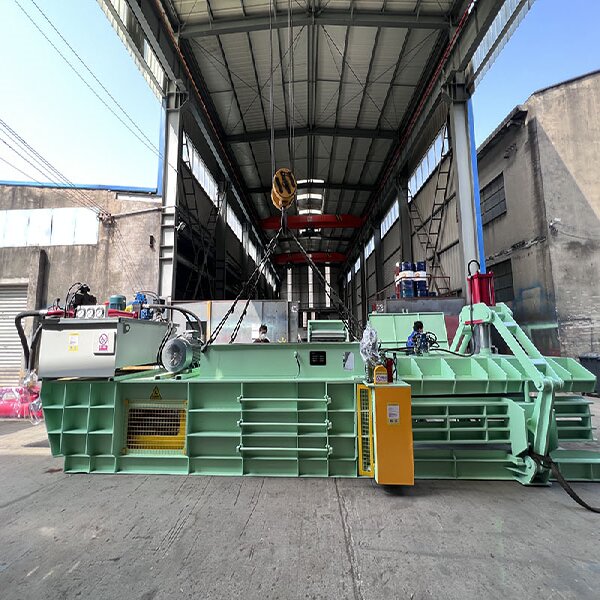
Fully automatic horizontal baler. Cycle automation determines how much human intervention each bale requires.
What is really decided when buying a hydraulic baler for waste paper
A buyer of a hydraulic baler for waste paper is not buying compaction: they are buying four concrete outcomes. First, bale density, because it determines how many kilograms fit in a truck or container. Second, hourly capacity, because it defines whether the plant can absorb reception peaks without piling material on the floor. Third, labor dependency, because each semi-automatic cycle requires an operator to complete the tying and ejection sequence. Fourth, continuity, because a stopped baler turns the recycling yard into a warehouse with no outlet.
Those four outcomes translate into a limited set of comparable technical variables: type of hydraulic drive, working pressure or rated force, bale size, tying system, horizontal or vertical architecture, and degree of automation. When a commercial datasheet does not declare one of those fields, the data is missing; it is not assumed.
The horizontal architecture, which is the one covered in this shortlist, is usually associated with continuous flows fed by conveyor or hopper and with volumes that justify mechanizing loading. Vertical architecture is usually reserved for smaller volumes or for spaces with floor restrictions. Neither is superior in the abstract: the difference is operational fit.
The three machines on the shortlist
The selection is limited to three horizontal models with data declared by the manufacturer. Certification figures, prices and independent test results are not included because they are not part of the verified information available.
| Model | Drive type | Declared capacity | Pressure / force | Datasheet data |
|---|---|---|---|---|
| NKW80BD | Fully automatic | 2–3 t/h | 18 MPa | — |
| NKW125BD | Semi-automatic | Not declared on the shortlist datasheet | 20 MPa | Bale 1100 × 1250 × 1700 mm |
| NKW180BD | Semi-automatic | 6–8 t/h | 180 tonnes | — |
NKW80BD: fully automatic for stable flows of 2–3 t/h
The NKW80BD is a fully automatic horizontal hydraulic baler that operates at 18 MPa and declares a capacity of 2 to 3 tonnes per hour. Its argument is not volume, but reduced operator dependency: in plants where staff are scarce, rotate frequently or cover several stations at once, a sustained automatic cycle prevents the baler from becoming the shift bottleneck.
The 2–3 t/h range places it in the entry segment of the horizontal family. It fits best in collection centers with scheduled reception, packaging plants that compact line scrap, and operations that prioritize density stability over production peaks.
NKW125BD: semi-automatic cycle with a defined bale format
The NKW125BD is semi-automatic, operates at 20 MPa and produces a bale of 1100 × 1250 × 1700 mm. The dimension is the most useful data on this datasheet: a standardized bale format simplifies tying, yard stacking, container loading and negotiation with the final buyer of recovered paper, because everyone is talking about the same unit.
The 20 MPa working pressure is the highest of the two semi-automatic machines on the list measured by that parameter. One absence should be noted: the datasheet for this shortlist does not declare capacity in tonnes per hour for the NKW125BD, so that figure must be expressly requested before using it as a sizing reference.
NKW180BD: the highest-capacity model, 6–8 t/h and 180 tonnes
The NKW180BD is semi-automatic and declares 6 to 8 tonnes per hour, with a rated force of 180 tonnes. It is the highest-throughput option of the three and the one best suited to sorting and recovery plants with massive incoming paper and cardboard, where the goal is to clear the yard before material loses quality due to moisture or repeated handling.
To set a density reference, the public datasheet for the horizontal cardboard baler declares a range of 600–650 kg/m³. It is a reasonable starting point for paper and cardboard, and a figure that should be taken to the RFQ as a minimum value to be validated with the buyer's actual material, not as a generic guarantee.
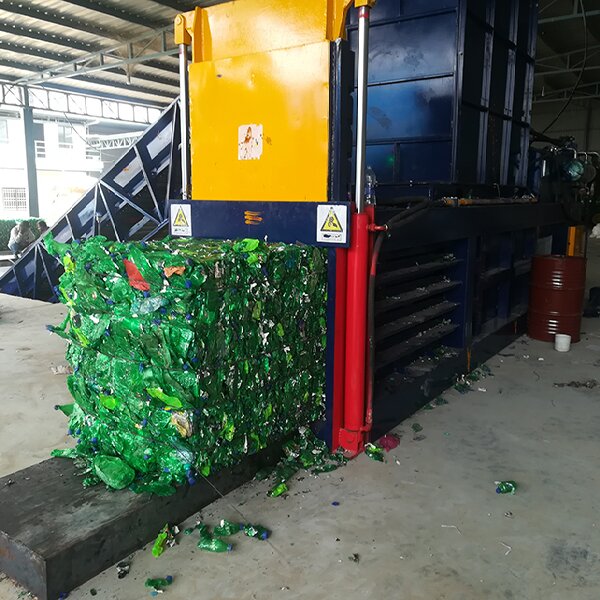
Semi-automatic horizontal baler. In the semi-automatic cycle, the operator intervenes in the bale tying and ejection sequence.
Technical explanation: pressure, force and cycle are not the same
A common error when comparing hydraulic balers is treating megapascals and tonnes as if they were interchangeable magnitudes. They are not. Megapascals describe hydraulic circuit pressure; tonnes describe the resulting force applied to the compacted material. Force depends on pressure and cylinder area, so a machine that declares 20 MPa is not automatically more powerful than one that declares 180 tonnes: they are different fields and must be compared with the complete geometry of the cylinder and the compaction piston.
In practice, the buyer should request three things for an honest comparison: working pressure, rated force and cycle time. With those three values plus the target density in their own material, real throughput can be estimated, and it almost never matches catalog throughput measured under ideal conditions.
The cycle of a horizontal baler follows a recognizable sequence: feeding, pre-compaction, main compression, tying and bale ejection. The degree of automation defines how many of those steps require human intervention. In a fully automatic machine the cycle repeats without the operator closing each bale; in a semi-automatic one, the operator takes part in the closing and tying steps, which reduces capital cost but increases cost per shift in labor and density variability.
Heat is the other technical variable that rarely appears in the commercial conversation. A continuous cycle generates heat in the hydraulic oil, and the manufacturer's risk datasheet identifies excessive heating as a specific risk, controlled through thermal protection and temperature sensors. That is the point where cooling stops being an accessory and becomes a configuration decision.
Applications in recycling: where each model fits
NKBALER hydraulic balers are declared applicable to waste paper, plastic recycling, used rags, metal scrap and other recovery streams. That breadth matters in multi-product plants, where the same machine must process corrugated cardboard in the morning and plastic film in the afternoon. For the three models on this shortlist, typical fit is ordered as follows:
- Collection centers and recovered paper warehouses: the NKW80BD provides automation with a small plant footprint and a short learning curve for the shift team.
- Packaging plants and cardboard converters: the NKW125BD offers a standardized bale format that facilitates sales of recovered material and yard inventory control.
- High-flow sorting and recovery plants: the NKW180BD, with 6–8 t/h and 180 tonnes of rated force, is designed to clear massive receptions and sustain the dispatch pace.
In operations that also process plastic bottles, metal scrap, rice husk, wood chips or cleaning rags, the model decision should be made with the real material mix on the table. A machine sized only for paper loses efficiency when the stream includes materials with different compression behavior.
Purchasing and acceptance criteria
The manufacturer's purchase record sets a minimum order of 2 units on one datasheet and 1 unit on another registered variant. That difference, however small it seems, should be confirmed in writing in the quotation request before planning the order.
The registered conditions are as follows:
- Minimum order quantity (MOQ): 2 units according to one datasheet; 1 unit according to another registered variant.
- Delivery terms: registered as MANDO/CIF.
- Acceptance criterion: pre-shipment test.
- Payment terms: 40/60.
The acceptance criterion is the most relevant point for the buyer, because it moves verification to the moment before shipment. The pre-shipment test should define what is measured and with what material: effective capacity in tonnes per hour with the buyer's actual mix, bale density measured on finished bales, final dimensions, thermal behavior during a continuous run, and list of spare parts included. Without that written protocol, the test becomes a visual inspection.
A practical acceptance protocol is organized in four steps:
- Define in the RFQ the material mix, expected moisture and target density in kg/m³.
- Require the pre-shipment test with that material and record the values obtained, not only the favorable result.
- Verify the bale format against the buyer's usual transport method.
- Agree in writing the scope of spare parts, technical documentation and post-delivery support.
Cooling and thermal control: the decision that gets forgotten
Excessive heating is a documented risk in hydraulic baler operation, and the manufacturer controls it with thermal protection and temperature sensors. For the buyer, that data has a practical consequence: the cooling configuration must be defined according to the site's ambient temperature and the planned duty cycle.
In recycling plants with continuous shifts in hot climates, the hydraulic circuit accumulates heat for more hours than in a single-shift operation. The right question in the RFQ is not whether the machine 'gets hot,' but what the declared duty cycle is, what the oil temperature alarm point is, and what cooling configuration is proposed for the ambient temperature at the installation site. These are configuration questions, and they should be answered in the offer, not discovered during commissioning.
Comparison with traditional solutions and limits of this shortlist
Against a piston compressor alternative, the manufacturer's comparative data reports a noise level 15 dB lower, a cost approximately 10% lower, lower maintenance and 12% higher throughput, with lower electricity consumption per tonne processed. These are vendor figures and should be contrasted with on-site measurements during the acceptance test.
The limits of this shortlist are as relevant as its advantages:
- No independent verification: specifications come from the manufacturer's datasheet. No third-party tests or external audit data on these three models are available in the public record consulted.
- Incomplete data by model: the t/h capacity of the NKW125BD is not declared in the information for this shortlist and must be requested.
- Automation requires stability: a fully automatic machine performs best with regular feeding and stable power supply. With highly irregular streams, a semi-automatic cycle may be more tolerant of variation.
- Higher capital and training cost: full automation implies a higher initial investment and requires trained technicians and spare parts availability.
- No verified certification data: the regulatory conformity required in the destination market is not covered by this information and must be requested by market.
Market context: why compaction is gaining weight in Latin America
The global market for hydraulic waste paper balers was valued at USD 1.45 billion in 2024, with a forecast of USD 2.24 billion by 2032, according to Data Insights Reports. The figure matters less for its magnitude than for what it reveals: compaction is becoming a compliance investment, not only an efficiency one.
In Latin America, Mexico and Brazil lead the region's paper packaging production, with growing investments in innovation, lightweight materials and circular economy initiatives, according to Packaging Insights. The same source notes that extended producer responsibility frameworks are advancing in the region with fragmented implementation, forcing plants to prepare for different requirements depending on the country and timing.
For the buyer, the reading is direct: when traceability of recovered material becomes mandatory, bale density stops being an operational metric and becomes a compliance data point. A baler that produces homogeneous bales facilitates documentation of volume, weight and destination of recovered paper. One that produces irregular bales complicates all of the above.
Perspective: supplier continuity as a purchasing criterion
In an Execution-stage decision, the question is no longer which machine to buy but with whom to sustain the operation over the coming years. That is where the manufacturer's capacity and verification data come in: NKBALER declares a monthly production capacity of 10 units and 100% testing of all products before shipment, which places individual verification of each unit in the standard process rather than in a commercial concession.
The capacity of 10 units per month also has a less comfortable reading: it defines a finite number of production slots per month. A buyer planning several machines or needing a tight delivery date should reserve their slot in advance and confirm the schedule in writing.
The 90% export share to North America, South America and Asia indicates familiarity with export operations, but does not replace verification of local support. Continuity assessment should cover four points: availability of critical spare parts, technical documentation in Spanish, failure response procedure and declared service-life expectation. None of those four points is resolved by a catalog photo.
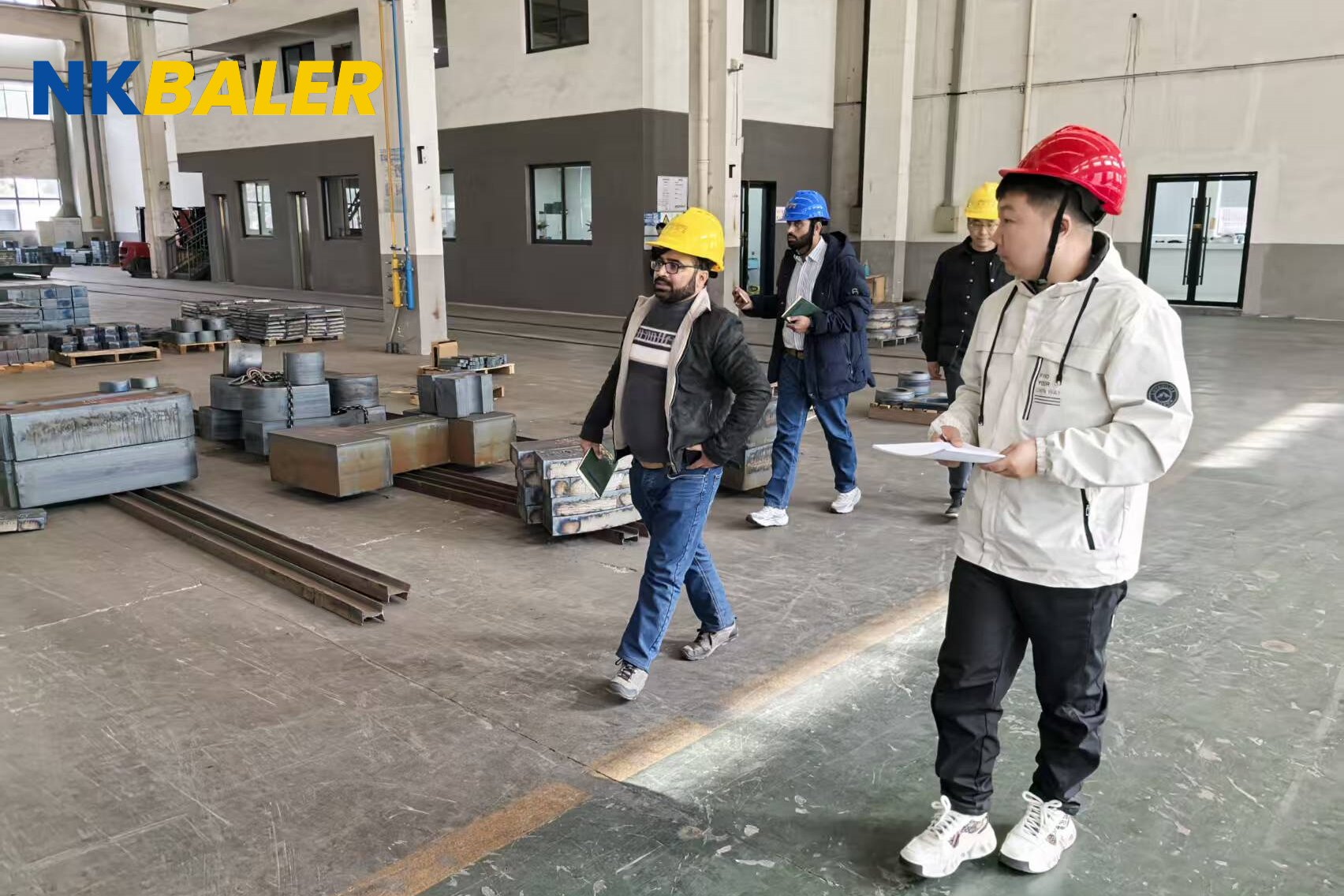
Manufacturing plant. The declared capacity of 10 units per month defines the available production slots.
Frequently asked questions
What is the practical difference between the fully automatic NKW80BD and the semi-automatic NKW125BD and NKW180BD?
The difference lies in who closes each cycle. The NKW80BD is fully automatic and declares 2–3 t/h at 18 MPa, which reduces operator intervention per bale. The NKW125BD and NKW180BD are semi-automatic: they require operator participation in the sequence and, in exchange, concentrate capacity in other ranges —the NKW180BD declares 6–8 t/h and 180 tonnes— and the NKW125BD offers a defined bale format of 1100 × 1250 × 1700 mm at 20 MPa.
What do 18 MPa, 20 MPa and 180 tonnes mean when comparing models?
Megapascals describe hydraulic circuit pressure, and tonnes describe the rated force applied to the material. They are different fields: force results from pressure multiplied by cylinder area. That is why a 20 MPa machine is not necessarily more powerful than a 180-tonne one. For a valid comparison, request working pressure, rated force and cycle time for the same model.
How is excessive heating controlled, and what should be defined regarding cooling?
Excessive heating is listed as a specific risk and is controlled through thermal protection and temperature sensors. The cooling configuration should be defined according to the site's ambient temperature and the planned duty cycle, and should be reflected in the offer along with the oil temperature alarm point. It is a configuration question answered before purchase, not during commissioning.
What are the purchasing conditions and acceptance criteria?
The manufacturer's purchase record indicates a minimum order of 2 units on one datasheet and 1 unit on another registered variant, delivery terms registered as MANDO/CIF, payment terms 40/60 and, as an acceptance criterion, a pre-shipment test. The MOQ difference between datasheets makes written confirmation in the quotation request essential.
What production capacity and verification does the manufacturer offer for repeat orders?
NKBALER declares a monthly production capacity of 10 units and 100% testing of all products before shipment, which implies individual verification of each machine. For repeat or multi-year orders, that monthly capacity limits available slots and it is advisable to reserve a schedule. The company also declares a 90% export share to North America, South America and Asia, with an R&D team of 15 people.
Tem questões ou precisa de mais detalhes?
Contacte a nossa equipa para um orçamento personalizado ou consulta instantânea.
Solicitar orçamento
Preencha o formulário abaixo e a nossa equipa entrará em contacto com uma proposta personalizada.
Chat direto do WhatsApp
Prefere conversar em tempo real? Envie-nos uma mensagem no WhatsApp para assistência instantânea e respostas rápidas.
- Obter orçamento personalizado
- Partilhar fotos ou documentos
- Discuta as suas necessidades diretamente
Geralmente responde em 5–30 minutos durante o horário de expediente.