
Pressure Control Switch Decision Guide: EPC-1.1, EPC-2.1 or EPC-3?
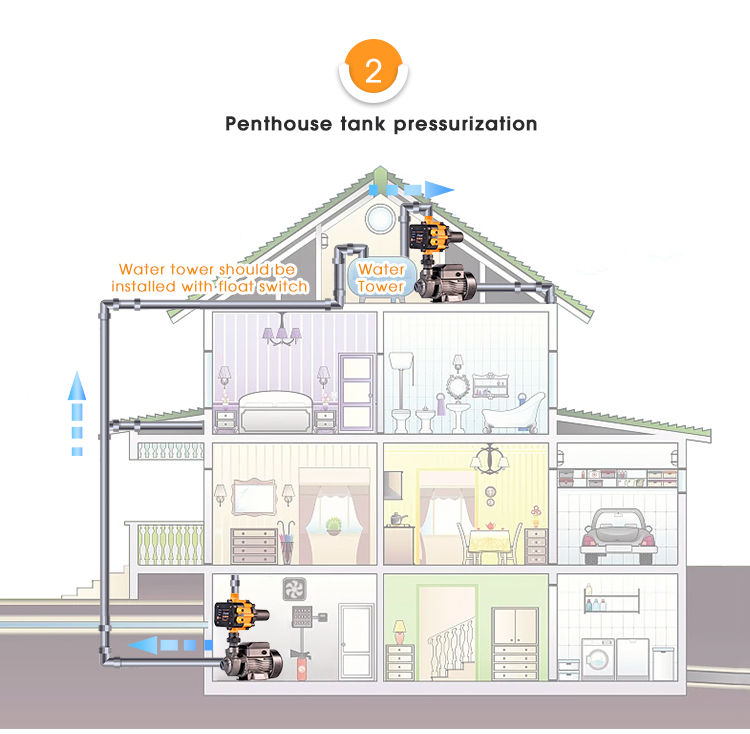
EPC series pressure controls are specified for domestic and residential water supply systems, as well as irrigation, water treatment and construction duties.
A pressure control switch decides when a water pump starts and when it stops. In the EPC range from Monro Switch, three models are routinely shortlisted for the same domestic and light water-supply duties: EPC-1.1, EPC-2.1 and EPC-3.
The three look almost interchangeable on a specification line. All three list the same starting-pressure settings of 1.2 bar, 1.5 bar and 2.2 bar. All three are described as maintaining constant pressure at constant flow, and all three include a built-in check valve together with built-in run-dry protection. None of those shared features separates them.
What separates them is a short list of verifiable differences: enclosure protection (IP65 or IP44), connection thread (G1", G1 1/4", G1 1/2" and NPT1" against R1" and G1" only), available motor power ratings, voltage handling, and whether the housing carries a pressure gauge for real-time line monitoring. This article sets out a buyer-side framework for choosing between the three.
The discovery problem: identical labels, different installations
Most buyers enter this category with one search term — pressure control switch — and land on a family of models that carry the same visible labels: 1.2 bar, 1.5 bar, 2.2 bar. That sameness creates a real risk of comparing on price alone and discovering a mismatch only at the point of installation.
In practice, the mismatch appears in one of five places:
- The connection thread does not match the manifold, the pump outlet or the existing pipework.
- The enclosure rating is too low for the position in which the unit is mounted.
- The motor power rating or the voltage range does not cover the pump actually installed on site.
- The buyer needed to read line pressure at the pump but selected a model with no gauge.
- The starting-pressure setting does not line up with the pump lift and the maximum water-use height of the building.
Each of these five risks is visible in the published EPC specification data. That means each can be resolved before an order is placed rather than after the unit arrives on site.
At-a-glance comparison: EPC-1.1, EPC-2.1 and EPC-3
| Specification | EPC-1.1 | EPC-2.1 | EPC-3 |
|---|---|---|---|
| Product type | Pump pressure control | Pump pressure switch | Pump pressure control |
| Enclosure protection rating | IP65 | IP44 | IP65 |
| Max. working temperature | 55°C | 55°C | 55°C |
| Starting pressure settings | 1.2 / 1.5 / 2.2 bar | 1.2 / 1.5 / 2.2 bar | 1.2 / 1.5 / 2.2 bar |
| Max. power ratings | 0.75 / 1.1 / 1.5 kW | 0.55 / 0.75 / 1.1 / 1.5 kW | 0.55 / 0.75 / 1.1 / 1.5 kW |
| Rated voltage | 220-240V or 110-120V; triple voltage 110V, 230V or 110-240V | 220-240V or 110-120V | 220-240V or 110-120V; triple voltage 110V, 230V or 110-240V |
| Connection thread | G1", G1 1/4", G1 1/2", NPT1" | R1" | G1" |
| Pressure gauge | Not listed | Not listed | Included, for real-time pipeline pressure |
| Check valve and run-dry protection | Both included | Both included | Both included |
| Listed application | Domestic | Agriculture irrigation, water treatment, construction | Agriculture irrigation, water treatment, construction |
| Pump compatibility | Surface or submersible pumps | Surface or submersible pumps | Surface or submersible pumps |
Specification data as published for the EPC-1.1, EPC-2.1 and EPC-3. Values shown are the options listed for each model.
A six-step buyer decision framework
Step 1 — Confirm the motor power of the pump
Power rating is the first filter because it removes models from the shortlist immediately. The EPC-1.1 is listed with maximum power ratings of 0.75 kW, 1.1 kW and 1.5 kW. The EPC-2.1 and EPC-3 are listed with 0.55 kW, 0.75 kW, 1.1 kW and 1.5 kW. All three are compatible with surface pumps and submersible pumps.
Step 2 — Match the rated voltage to the supply
EPC-1.1 and EPC-3 are listed with triple voltage capability: 110V, 230V, or 110-240V, alongside rated voltages of 220-240V or 110-120V. The EPC-2.1 is listed with rated voltages of 220-240V or 110-120V. All three operate at 50/60 Hz. Where a single stock item must serve several supply conditions, the triple-voltage listing on the EPC-1.1 and EPC-3 reduces the number of variants to hold.
Step 3 — Match the connection thread to the pipework
This is the step that most often decides the model. The EPC-1.1 offers the widest range of options — G1", G1 1/4", G1 1/2" and NPT1" — which makes it the most adaptable of the three for retrofit work. The EPC-3 is listed with a G1" connection thread only. The EPC-2.1 is listed with an R1" connection thread, a different thread designation, so it should be matched against the manifold before ordering rather than assumed to interchange with the other two.
Step 4 — Decide whether line pressure must be visible at the unit
If the installation has to be checked, adjusted or diagnosed on site, the EPC-3 is the only one of the three that includes a pressure gauge for real-time pressure monitoring in the pipeline. The EPC-1.1 and EPC-2.1 specifications do not list a gauge.
Step 5 — Match the enclosure rating to the mounting position
The EPC-1.1 and EPC-3 are rated IP65. The EPC-2.1 is rated IP44. In the two-digit IP code, the second digit relates to water ingress, and a higher second digit indicates a higher level of water protection. Where the unit sits in a plant room, a basement, a pump house or any position exposed to washdown or weather, that difference is the deciding factor among these three models.
Step 6 — Check the starting pressure against the pump lift
All three models are listed with starting-pressure settings of 1.2 bar, 1.5 bar or 2.2 bar. The correct setting is a function of the pump lift and the maximum water-use height of the system. The published guidance is straightforward: if starting pressure is 1.2 bar, maximum water-use height is 1.2 × 10 m = 12 metres, and the pump lift should be at least (1.2 + 0.8) × 10 m = 20 metres. A controller set above the available lift will not deliver.
A practical rule of thumb for the discovery stage: define the pump and the pipework first, then choose the model. EPC-1.1 answers thread and voltage variety; EPC-3 answers pressure visibility; EPC-2.1 answers compact, splash-protected installation with simplified wiring.
Technical explanation: the specifications that decide the purchase
Starting pressure, adjustment range and how it is set
All three models share the same three preset starting pressures — 1.2 bar, 1.5 bar and 2.2 bar — but they do not share the same adjustment range. The EPC-1.1 is listed with an adjustable starting pressure of 1.2 to 2.5 bar, and is available in adjustable and non-adjustable versions. The EPC-2.1 is listed with an adjustable starting pressure of 1.5 to 3.0 bar, also with adjustable and non-adjustable versions. The EPC-3 is listed with an adjustable starting pressure of 1.2 to 2.5 bar. Buyers who need a continuous setting band rather than a three-step preset should note that the wider adjustment ranges sit in other models of the same range: the EPC-10 and EPC-11A are listed with starting-pressure adjustment from 0.5 to 9.3 bar.
Enclosure rating: why IP65 and IP44 are not interchangeable
IP65 on the EPC-1.1 and EPC-3, and IP44 on the EPC-2.1, are not marketing labels — they describe how the housing behaves in service. A mounting position that is dry and enclosed can accept IP44. A position that sees spray, drips, condensation or outdoor exposure is better served by the IP65 units. All three models carry the same maximum working temperature of 55°C, which positions them for cold water systems rather than hot water lines.
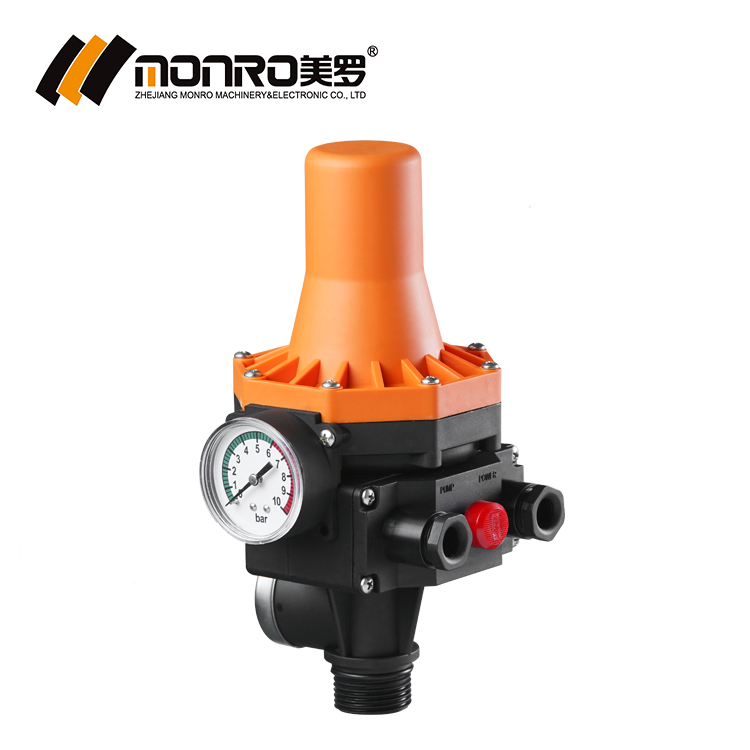
The EPC-3 includes a pressure gauge for real-time pressure monitoring in the pipeline.
Connection thread: the specification most likely to stop an installation
Thread designations are not cosmetic. The EPC-1.1 is listed with G1", G1 1/4", G1 1/2" and NPT1" options, which covers both parallel-thread and US tapered-thread fittings. The EPC-3 is listed with G1" only. The EPC-2.1 is listed with R1". Where the existing installation uses NPT fittings, the EPC-1.1 is the only one of the three that lists an NPT option. Where the manifold is already cut for R1", the EPC-2.1 avoids the need for an adapter. Confirming thread form before ordering is cheaper than correcting it afterwards.
Voltage and power: matching the controller to the pump
The EPC-1.1 tops out at 1.5 kW and the EPC-2.1 and EPC-3 also reach 1.5 kW, so all three cover the same upper limit of motor size. The difference sits at the lower end: the EPC-2.1 and EPC-3 list a 0.55 kW rating that the EPC-1.1 does not, which matters where small circulator-type or low-power transfer pumps are being controlled. Voltage-wise, the EPC-1.1 and EPC-3 list triple voltage; the EPC-2.1 lists 220-240V or 110-120V.
Check valve, run-dry protection and constant pressure
All three models are described as including a built-in check valve, built-in run-dry protection, constant pressure at constant flow, and simple installation that saves time and space. The check valve prevents backflow through the controller; run-dry protection stops the pump running without water. Because all three carry these functions, they cannot be used to differentiate between the models — but they do explain why the EPC family is specified instead of a bare pressure switch plus separate protection devices.
Installation sequence
The published installation guidance applies to the EPC family and is worth restating, because most field failures trace back to the first step:
- Run the pump separately to confirm normal operation, and verify that the parameters on the pump nameplate match those of the pressure controller. The pump head must be at least 0.8 bar higher than the controller’s start-up pressure.
- Install the pressure controller in accordance with the direction indicated by the arrow on its housing.
- Connect the power cord of the controller to a separate plug wire and wrap the connection securely with waterproof insulating tape so the joint is properly sealed.
- After all electrical connections are complete, open the main outlet valve and all faucets first, then connect the power supply.
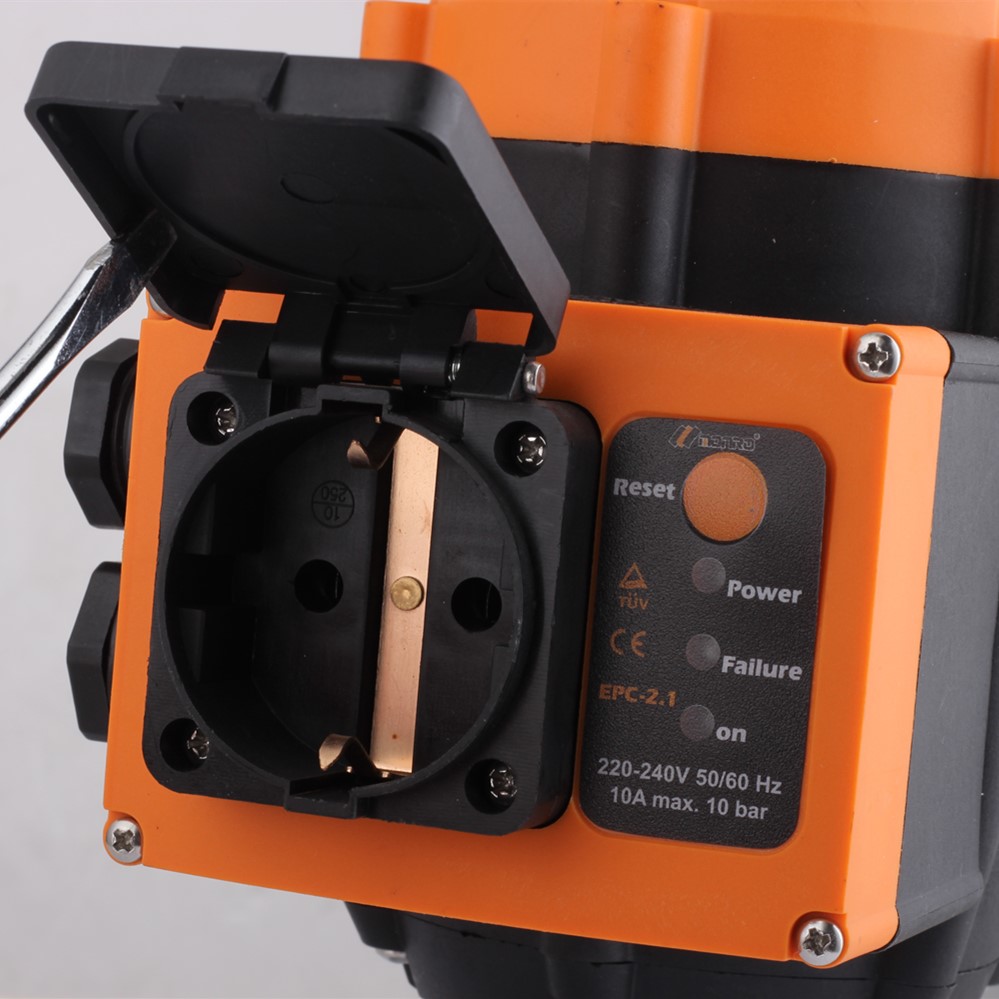
The EPC-2.1 includes a built-in socket to make wiring easier and faster, with inlet and outlet arranged at 90 degrees.
The manufacturer behind the EPC range
Zhejiang Monro Machinery & Electronic Co., Ltd. (Monro Switch) is a manufacturer of pump controllers, pressure switches and float switches based in Wenling City, Zhejiang Province, China. The company was officially established in 2010 and operates from a 30,000 square metre facility with approximately 200 employees, offering more than 40 models of pressure controllers for water pump systems and air compressors.
Several facts about the manufacturing base are relevant to a buyer evaluating the EPC-1.1, EPC-2.1 and EPC-3. Annual production capacity is listed at approximately 2.88 million pieces for the EPC series, 3.24 million pieces for the KRS series and 0.6 million pieces for the FPS series. Approximately 90% of products are exported, with major markets in Asia, Europe, North and South America, the Middle East and Africa. The company operates an ISO 9001:2015 quality management system, holds TUV (Germany) and CE (Europe) certifications, and selected models are also approved under the CUL standard for the United States and Canada.
For a buyer, the practical value of this information is limited to what it can be checked against: whether the supplier can support the model variants being specified (thread options, adjustable and non-adjustable versions, voltage variants), whether the certifications on file match the market the product is being imported into, and whether production volume is consistent with the lead time quoted.
Application fit: where each model is specified
The most common application listed for these controllers is domestic or residential water supply, where the controller automatically starts and stops the pump in response to system pressure changes — activating the pump at the preset low-pressure setpoint and deactivating it at the high-pressure setpoint. The working medium is clean water, and the listed working conditions are 220-240V or 110-120V, a pressure range of 0.5-10 bar, an IP65 protection rating and a maximum working temperature of 55°C.
Against that background, the three models divide along fairly clear lines:
- EPC-1.1 — listed for domestic applications, with the broadest thread set (G1", G1 1/4", G1 1/2", NPT1") and IP65 protection. Best suited to retrofit work where the existing connection is unknown until the unit is offered up, and to installations where the housing sits in a damp plant room.
- EPC-2.1 — listed for agriculture irrigation, water treatment and construction. Its distinguishing physical features are an inlet and outlet arranged at 90 degrees and a built-in socket that makes wiring easier and faster. That combination suits compact installations and sites where the electrical connection must be completed quickly. IP44 places it in splash-protected positions.
- EPC-3 — listed for agriculture irrigation, water treatment and construction, with IP65 protection and an on-board pressure gauge for real-time monitoring. Best suited to installations where someone will routinely read or record line pressure, or where a fault must be diagnosed without adding a separate gauge.
Beyond domestic supply, the listed application industries for the EPC family include agriculture irrigation, water treatment and construction — the same sectors in which the surrounding Monro catalogue is used, including float switches for level control and mechanical pressure controls for conventional pump start/stop duties.
Market trend analysis: what the surrounding data shows
The pressure switch category itself is still growing. Fortune Business Insights values the global pressure switch market at USD 3.2 billion in 2025, and projects growth from USD 3.38 billion in 2026 to USD 5.13 billion by 2034. That trajectory is relevant to specification decisions because it implies continued investment in pump control across residential, agricultural and water-treatment applications rather than a shrinking replacement market.
Within that market, the technology mix is still dominated by electromechanical designs. Market Research Future reports that electromechanical pressure switches accounted for approximately 62% of the global market share in 2024, with solid-state electronic pressure switches at approximately 38%. For buyers shortlisting the EPC-1.1, EPC-2.1 and EPC-3, this is a useful context point: the electromechanical approach remains the mainstream choice in water pump control, and the solid-state share is the segment that is growing alongside it.
On the standards side, IEC 60730-2-6:2025 is the current international standard for automatic electrical pressure sensing controls used in, on, or in association with equipment for household appliance and similar use. Buyers importing into regulated markets should treat the applicable edition of this standard as the reference point when verifying a supplier’s compliance documentation.
At the trade-classification level, water pump pressure switches are commonly traded under HS Code 853650, which covers electrical apparatus and switches for a voltage not exceeding 1000 volts. That classification is useful when checking whether a declared customs code matches the actual product being shipped.
Comparison with mechanical pressure controls — and the limits of this framework
The most direct alternative to the EPC series is the traditional mechanical pressure control, represented in the same catalogue by the KRS series. A mechanical control such as the KRS-1, KRS-2 or KRS-3 also starts and stops the water pump automatically according to the set pressure, but the design assumptions differ. The KRS-2 is listed with pressure ranges of 1.0-1.8 bar, 1.2-2.2 bar and 2.2-3.0 bar, a minimum cut-in of 0.5 bar, a maximum cut-out of 3.0 bar and IP20 protection. The KRS-8 is listed with pressure ranges of 1-6 bar and 6-12 bar, a minimum cut-in of 1 bar, a maximum cut-out of 12 bar and IP44 protection.
The practical difference for a buyer is not that one design replaces the other. Mechanical controls cover pressure bands — including higher ranges such as 6-12 bar — that the EPC-1.1, EPC-2.1 and EPC-3 do not list. Where the EPC models add value is integration: the built-in check valve and run-dry protection are inside the same housing as the switching function, which reduces the number of separate components in the assembly.
The limits of this comparison matter as much as the differences:
- The published specification data for the EPC-1.1, EPC-2.1 and EPC-3 lists starting-pressure settings but does not state a maximum working pressure value for these three models. Where system pressure exceeds the starting-pressure band, that figure should be confirmed with the supplier rather than inferred.
- The EPC-3 lists a G1" connection thread only. Sites built around NPT or R1" fittings will need an adapter or a different model.
- The EPC-2.1 is rated IP44. It is the least protected of the three and is not the appropriate choice for positions exposed to water jets, washdown or dust.
- All three models share a maximum working temperature of 55°C and a clean water medium requirement. They are not specified for hot water systems or for aggressive fluids.
- The starting-pressure band is a three-step preset — 1.2 bar, 1.5 bar, 2.2 bar — even where the adjustment range is wider (1.2-2.5 bar on the EPC-1.1 and EPC-3; 1.5-3.0 bar on the EPC-2.1). Applications needing continuous settings across a much wider band are served by other models in the same range, such as the EPC-10 and EPC-11A, which list 0.5-9.3 bar starting-pressure adjustment.
Future outlook
Three directions are likely to shape the next round of specification decisions in this category. The first is the continued coexistence of mechanical and electronic control, with electromechanical designs holding roughly 62% of the 2024 market and solid-state electronic designs around 38%; the balance will shift gradually rather than abruptly, and both architectures will remain in procurement lists for some time. The second is regulation: IEC 60730-2-6:2025 is the current edition of the standard governing automatic electrical pressure sensing controls, and buyers should expect documentation requests to reference it explicitly. The third is integration — controllers that combine switching, check valve, run-dry protection and, in the case of the EPC-3, on-site pressure indication, reduce the number of separate components a system integrator must stock and service.
For buyers at the discovery stage, the practical implication is that model selection will continue to be decided by installation variables — thread form, enclosure rating, voltage and power — rather than by the shared pressure presets that make these three models look identical at first glance.
FAQ
What is the difference between the EPC-1.1, EPC-2.1 and EPC-3?
All three are pump pressure control devices listed with starting-pressure settings of 1.2 bar, 1.5 bar and 2.2 bar, and all three include a built-in check valve and run-dry protection. They differ in four areas. The EPC-1.1 has IP65 protection, a G1", G1 1/4", G1 1/2" or NPT1" connection thread, maximum power ratings of 0.75 kW, 1.1 kW or 1.5 kW, and is listed for domestic applications. The EPC-2.1 has IP44 protection, an R1" connection thread, maximum power ratings of 0.55 kW, 0.75 kW, 1.1 kW or 1.5 kW, a 90-degree inlet and outlet arrangement and a built-in socket. The EPC-3 has IP65 protection, a G1" connection thread, the same power ratings as the EPC-2.1, and includes a pressure gauge for real-time pipeline pressure.
Which of the three is suitable for a damp or exposed installation position?
Enclosure rating is the deciding specification. The EPC-1.1 and EPC-3 are rated IP65, while the EPC-2.1 is rated IP44. In the IP code, the second digit relates to water ingress, and a higher second digit indicates a higher level of water protection. For positions exposed to spray, condensation or outdoor conditions, the IP65 models are the appropriate choices among these three. All three share a maximum working temperature of 55°C, so none of them is intended for hot water lines.
How should the starting pressure setting be chosen?
The starting pressure must match the pump lift and the maximum water-use height of the system. Published guidance gives a working example: with a starting pressure of 1.2 bar, the maximum water-use height is 1.2 × 10 m = 12 metres, and the pump lift should be at least (1.2 + 0.8) × 10 m = 20 metres. The three preset options are 1.2 bar, 1.5 bar and 2.2 bar, and the adjustment ranges differ by model — 1.2 to 2.5 bar on the EPC-1.1 and EPC-3, and 1.5 to 3.0 bar on the EPC-2.1. Adjustable and non-adjustable versions are listed for the EPC-1.1 and EPC-2.1.
Does voltage or motor power change which model I should choose?
Power coverage overlaps heavily: the EPC-1.1, EPC-2.1 and EPC-3 all reach a maximum power rating of 1.5 kW, and the EPC-2.1 and EPC-3 additionally list a 0.55 kW rating that the EPC-1.1 does not. Voltage is the clearer dividing line. The EPC-1.1 and EPC-3 list triple voltage capability of 110V, 230V or 110-240V, alongside rated voltages of 220-240V or 110-120V. The EPC-2.1 lists rated voltages of 220-240V or 110-120V. All three operate at 50/60 Hz and are compatible with surface pumps and submersible pumps.
What should be confirmed before placing an order?
Five items resolve most selection problems in advance: the connection thread required by the existing manifold or pump outlet; the motor power and rated voltage of the pump on site; the enclosure rating needed for the mounting position; whether on-site pressure indication is required, since only the EPC-3 lists a gauge; and the maximum working pressure of the system, because the published specifications for these three models state starting-pressure settings but do not list a maximum working pressure value. The working medium should also be confirmed as clean water, and the pump head verified as at least 0.8 bar above the controller’s start-up pressure.
The full Monro Switch product catalogue, including the EPC series and the mechanical KRS series, is available for download: Monro catalogue 2025.