
Pressure Control Switch Fit: Home, Irrigation, Site Work
Pressure Control Switch Fit: Home, Irrigation, Site Work
Matching a pressure control switch to an application is an exercise in restraint, not a specification contest. Three controllers from the Monro EPC range are documented against three different duties: EPC-1.1 for domestic and residential water supply, EPC-2 for agriculture irrigation, water treatment and construction water systems, and EPC-3 for systems that hold constant pressure at constant flow with a pressure gauge for live monitoring. The useful question is not which model carries the longest feature list, but which model’s documented values match the pump, the pipework and the environment it will actually serve.
Six requirements settle most of that decision: pump type, working temperature, protection rating, connection thread, starting pressure and power rating. Any one of them can rule a model out before price, stock or lead time is discussed. What follows sets out what is documented for the three models, how each requirement shifts the fit, and which values still have to be confirmed from a current datasheet before a purchase order is raised.
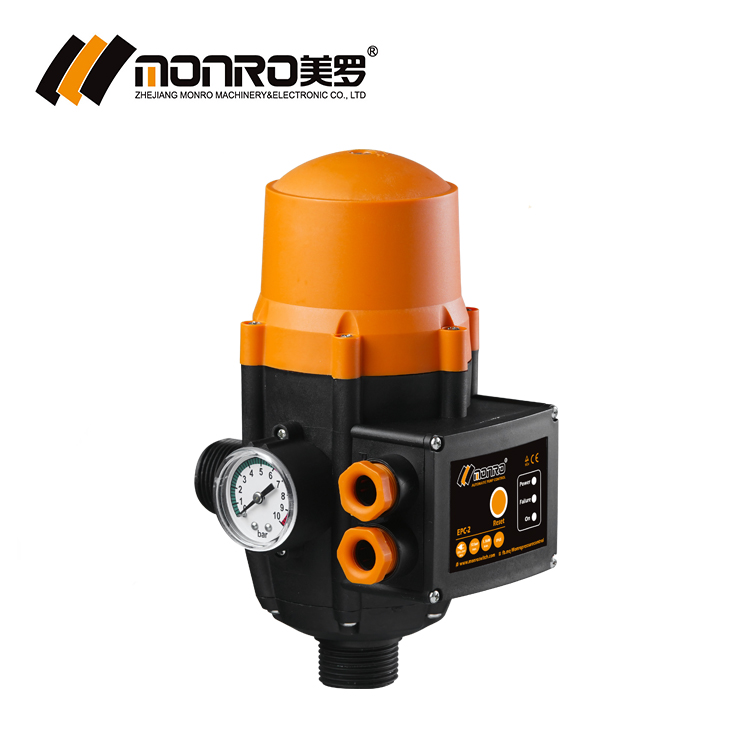
EPC-2 pump pressure control, the model documented for agriculture irrigation, water treatment and construction duty.
Why the six requirements outrank the headline specification
Pump type sets the physical arrangement. Domestic supply, irrigation lines and construction water systems draw from different pump configurations, and the controller has to sit correctly in each. The EPC-2 documentation states that the unit can be used with surface or submersible pumps. For EPC-1.1 the matched equipment is recorded simply as a water pump within the domestic and residential water supply application; domestic systems of that kind are built around either a surface or a submersible unit, so the installation point and the suction conditions should be confirmed for the specific property rather than assumed from the model name.
Working temperature and protection rating decide whether the housing survives the site. The EPC-2 specification states a maximum working temperature of 55 °C and IP65 protection. The domestic water supply application record, under which EPC-1.1 is listed, states the same IP65 rating and the same 55 °C ceiling. IP65 describes a dust-tight enclosure that is protected against water jets — a sensible baseline for pump houses, irrigation cabinets and enclosures on construction sites where hosing down and hose spray are normal. Where a rating is not stated for a model, it cannot be assumed from a neighbouring model in the same series.
Connection thread is the most common late-stage problem. EPC-2 is documented with an R1″ connection thread. A controller that is electrically correct but mechanically incompatible with the existing pipework turns into an adapter project, and adapters add joints, cost and potential leak points. Thread size belongs in the first enquiry, not the final confirmation.
Starting pressure and power rating are linked to the pump, not to preference. EPC-2 offers starting-pressure settings of 1.2, 1.5 and 2.2 bar, with a stated adjustable range of 1.5–3.0 bar on the adjustable variant. EPC-3 offers 1.2, 1.5 and 2.2 bar. Power options are 0.75, 1.1 and 1.5 kW for EPC-2, and 0.55, 0.75, 1.1 and 1.5 kW for EPC-3. A controller rated below the pump motor is the wrong controller, regardless of how well everything else lines up.
Domestic and residential water supply: where EPC-1.1 sits
EPC-1.1 is the model mapped to domestic and residential water supply, and its application record is unusually specific for a household duty. The working fluid is water, with clean water stated as a special requirement. Supply voltage is 220–240 V or 110–120 V, the pressure range for the application is 0.5–10 bar, protection is IP65 and the maximum working temperature is 55 °C. The function recorded for the application is automatic pump start and stop: the controller activates the pump at the preset low-pressure setpoint and deactivates it at the high-pressure setpoint as system pressure changes.
That operating pattern matters more in a house than the datasheet suggests. A household draws water in short bursts — a tap, a shower, a washing machine fill — so the switch spends its working life cycling between two setpoints rather than running continuously. The gap between the low and high setpoints therefore shapes both comfort at the outlet and the number of starts the pump sees. Because the domestic record describes clean water as the medium, the model fit assumes a clean water supply; abrasive or heavily contaminated media fall outside that description and should be discussed separately.
Two practical points follow. First, the application record documents the duty envelope, not every model-level value: the starting-pressure options, thread size and rated motor power for EPC-1.1 should be read from the current model datasheet before ordering. Second, domestic systems are frequently retrofits, so the existing pump and the existing pipe thread are fixed constraints — the controller has to fit them, not the other way round.
Irrigation, water treatment and construction: the EPC-2 profile
EPC-2 is documented for agriculture irrigation, water treatment and construction. Its specification reads as a site-oriented set: rated voltage 220–240 V or 110–120 V at 50/60 Hz, maximum power 0.75, 1.1 or 1.5 kW, starting-pressure settings of 1.2, 1.5 and 2.2 bar, an R1″ connection thread, IP65 protection and a maximum working temperature of 55 °C. The documented functions are built-in run-dry protection, a built-in check valve, constant pressure at constant flow, and an installation described as simple, saving time and space. The unit can be used with surface or submersible pumps, and both adjustable and non-adjustable starting-pressure versions are offered.
Run-dry protection is the feature that earns its place in these three sectors. Irrigation lines lose prime at the suction side, water treatment skids run to low-level conditions, and construction water systems are often fed from temporary tanks where the supply can stop without warning. A pump running without water is a repair bill; a controller that detects the condition and stops the motor is a preventive measure. The built-in check valve serves a related purpose by holding pressure in the line when the pump stops, which keeps the switch from re-triggering on every small fluctuation.
The R1″ thread is worth stating explicitly in any enquiry for irrigation and site work, because temporary and semi-permanent installations often mix fittings from different sources. And the power ceiling deserves the same attention: the documented EPC-2 options top out at 1.5 kW. Where a site pump motor exceeds that, the model is outside its documented range and a higher-power unit from the wider range — for example EPC-7, documented at 2.2 kW, 1.1 kW or 4 kW — becomes the relevant starting point rather than an oversized interpretation of EPC-2.
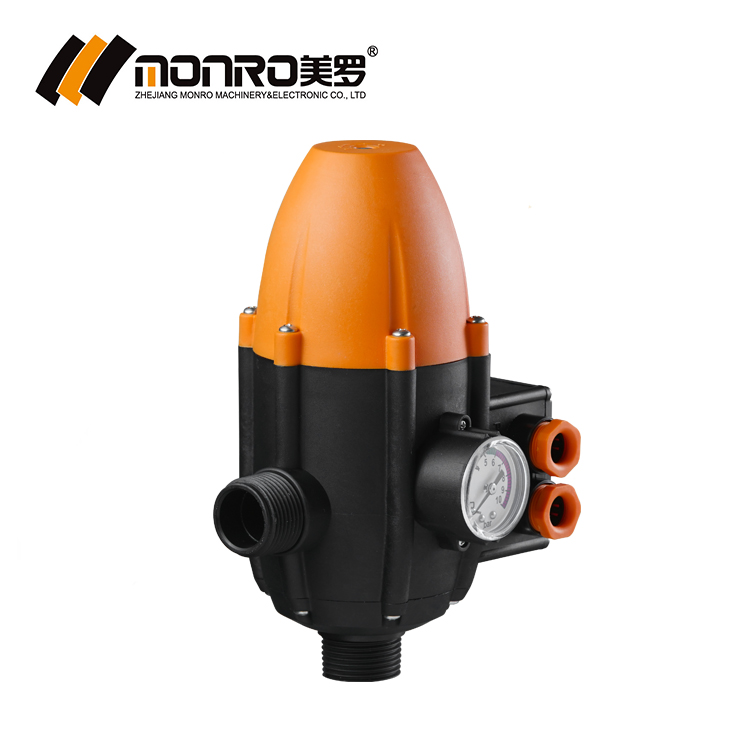
An automatic pressure switch of the type used to start and stop pumps on irrigation and site water systems.
Constant pressure at constant flow: what EPC-3 adds
EPC-3 is the model for systems where pressure has to be held steady while flow varies, and where that pressure has to be visible. Its documented specification lists starting-pressure settings of 1.2, 1.5 and 2.2 bar, maximum power options of 0.55, 0.75, 1.1 and 1.5 kW, a built-in check valve, built-in run-dry protection, constant pressure at constant flow, and a pressure gauge for real-time pressure monitoring.
The honest reading of this set is that EPC-3 and EPC-2 converge on more than they diverge. Both carry run-dry protection, both carry a check valve, and both document constant pressure at constant flow. What separates them in the supplied documentation is narrower and more useful: EPC-3 adds a gauge for live pressure reading and offers a 0.55 kW power option that EPC-2 does not list, while EPC-2 states IP65 protection, a 55 °C maximum working temperature and an R1″ thread that the published EPC-3 specification set does not state.
That last point is a procurement instruction rather than a criticism. The published EPC-3 specification set does not state a protection rating, connection thread, rated voltage or maximum working temperature, so those four values must be confirmed against the current model datasheet before the unit is specified into an outdoor cabinet, a wash-down area or a non-standard pipe run. The gauge, meanwhile, answers a real operational question: when an installer or a maintenance technician needs to know what the pipeline is actually doing, a local reading at the controller removes a step from every service visit.
Documented parameters side by side
The table below reproduces only what the supplied documentation states for each model. Where a value is not part of that documentation, the table says so instead of filling the gap with an assumption.
| Requirement | EPC-1.1 | EPC-2 | EPC-3 |
|---|---|---|---|
| Documented duty | Domestic / residential water supply, clean water | Agriculture irrigation, water treatment, construction | Constant pressure at constant flow with live gauge monitoring |
| Protection rating | IP65 (domestic application record) | IP65 | Not stated — confirm |
| Max. working temperature | 55 °C (domestic application record) | 55 °C | Not stated — confirm |
| Connection thread | Confirm from model datasheet | R1″ | Not stated — confirm |
| Starting pressure | Confirm from model datasheet | 1.2 / 1.5 / 2.2 bar; adjustable variant 1.5–3.0 bar | 1.2 / 1.5 / 2.2 bar |
| Max. motor power | Confirm from model datasheet | 0.75 / 1.1 / 1.5 kW | 0.55 / 0.75 / 1.1 / 1.5 kW |
| Documented functions | Automatic start/stop at preset low and high setpoints | Run-dry protection, check valve, constant pressure at constant flow | Run-dry protection, check valve, constant pressure at constant flow, pressure gauge |
Matching starting pressure to pump lift and use height
Starting pressure is not a comfort setting to be raised until complaints stop. Monro’s published selection guidance is to match the controller’s motor power to the water pump, then set starting pressure according to the pump lift and the maximum water-use height. The arithmetic is given directly: at a starting pressure of 1.2 bar, the maximum water-use height is 1.2 × 10 m = 12 m, and the pump lift should be at least (1.2 + 0.8) × 10 m = 20 m. The same guidance states that the pump head must be at least 0.8 bar higher than the controller’s start-up pressure.
Read in the other direction, this is a constraint on aspiration. Choosing a 2.2 bar starting pressure to satisfy a tall building does not create the head to deliver it; it raises the head the pump must supply. On a domestic system where the highest outlet is 12 m above the pump, a 1.2 bar starting pressure is consistent with the guidance above, while a 2.2 bar setting would demand a different pump. On an irrigation line feeding a riser or a distant hydrant, the same rule forces the designer to look at static height plus line loss before the setpoint is fixed. The switch controls the pump; it does not add lift.
Installation and commissioning checks that change the outcome
Fitting errors produce the same symptoms as model mismatch, which is why the two should be separated during commissioning. Monro’s documented procedure begins by running the pump on its own to confirm normal operation and checking that the pump nameplate parameters match the controller, with the pump head at least 0.8 bar above the controller’s start-up pressure. The controller is then installed in the direction indicated by the arrow on its housing — an installation against that arrow will not control pressure as intended.
Electrical work follows: the controller’s power cord is connected to a separate plug wire and the connection is wrapped securely with waterproof insulating tape to keep it sealed. Before energising, the main outlet valve and all water taps are opened, and only then is the power connected, at which point the pump controller begins operation. Sealing the joints, respecting the arrow and opening the outlets first are small steps that prevent a return visit, and they apply to all three models in this comparison.
Market context and the standards a buyer can point to
Pressure control sits inside a large component category. Fortune Business Insights valued the global pressure switch market at USD 3.2 billion in 2025 and projected growth to USD 5.13 billion by 2034 (source dated 3 August 2026). The figure is sensitive to which verticals a study counts, so it is best read as an order of magnitude rather than a pump-only forecast. On product mix, Market Research Future attributes approximately 62% of 2024 global market share to electromechanical pressure switches and 38% to solid-state electronic types — a reminder that mechanical and electronic control continue to coexist in the same installations, and that scenario fit is not automatically settled by choosing the electronic option.
Two reference points are worth carrying into a procurement file. IEC 60730-2-6:2025 is the current international standard for automatic electrical pressure sensing controls, published by the International Electrotechnical Commission, which means a conformity declaration can be checked against a dated edition rather than a generic claim. For importers, water pump pressure switches are commonly traded under HS Code 853650, the United Nations Statistics Division classification for electrical switches for a voltage not exceeding 1,000 volts.
What to confirm before the purchase order
Four values decide whether the chosen model will work on the site rather than on paper: the protection rating, the maximum working temperature, the connection thread and the maximum motor power. A fifth, starting pressure, should be calculated from pump lift and use height rather than copied from a previous project. Everything else — run-dry protection, check valve, constant-pressure behaviour, gauge — is documented per model and can be compared directly.
A short verification sequence covers the common failure modes. Confirm the pump motor rating against the controller’s maximum power in kW. Confirm the pipe thread against the documented thread, particularly for R1″ and for retrofit work. Confirm the environment against the stated IP rating and the maximum working temperature, especially where the enclosure sits in direct sun or is washed down. Confirm the required starting pressure by working back from the highest outlet and the pump lift. Where any of these values is not stated for a model in its published documentation, treat it as unresolved and obtain the current datasheet rather than substituting a value from a sister model.
Manufacturing and supply context
The three models are produced by Monro Switch (Zhejiang Monro Machinery & Electronic Co., Ltd.), based in Wenling City, Zhejiang Province. The company was officially established in 2010 and states more than 20 years of manufacturing experience in pressure controls and float switches, operating a 30,000 m² facility with 200 employees, a 10-engineer R&D team and roughly 90% of output exported to Asia, Europe, North and South America, the Middle East and Africa. Its quality system is certified to ISO 9001:2015, products hold TUV (Germany) and CE (Europe) certifications, and select models are approved under the CUL standard.
For programme planning, the documented commercial parameters are a monthly capacity of 180,000 pieces for the automatic pump control (EPC) series, 250,000 pieces for the KRS pressure switch series and 30,000 pieces for the float switch and liquid level control series, with a 204-piece minimum order quantity, a 45-day lead time, 100% testing and a one-year warranty supported by remote technical support. OEM production covers cable length, cable material, brand, colour box and colour customisation. A documented retail case in China records 50 units supplied for a water supply system over a two-year period, with the outcome listed as reliable automatic pressure control and automatic pump start/stop as the highlighted function. The full range and specifications are collected in the Monro catalogue 2025.
Frequently asked questions
Which of the three models suits a domestic water system?
EPC-1.1 is the model listed for domestic and residential water supply. The application record for that duty specifies clean water as the medium, a 220–240 V or 110–120 V supply, a 0.5–10 bar pressure range, IP65 protection and a maximum working temperature of 55 °C, with the controller starting and stopping the pump at preset low and high pressure setpoints. Starting-pressure options, thread size and rated power for EPC-1.1 are model-level values and should be read from the current datasheet.
Can one pressure control switch cover irrigation and construction water supply?
EPC-2 is documented for agriculture irrigation, water treatment and construction, with IP65 protection, a 55 °C maximum working temperature, an R1″ connection thread, 0.75, 1.1 and 1.5 kW power options, starting-pressure settings of 1.2, 1.5 and 2.2 bar, and a stated adjustable range of 1.5–3.0 bar. Those shared values explain why one model can serve several site types; the pump motor rating, the lift and the pipe thread still have to be checked for each individual installation.
What does constant pressure at constant flow mean on the EPC-3?
It is the documented operating capability of the controller: it maintains constant pressure at constant flow. EPC-3 also carries a pressure gauge for real-time pressure monitoring, which lets the pipeline pressure be read at the unit itself instead of at a remote point. The supplied documentation states the capability but does not describe the control method, so where a process requires a specific tolerance, the behaviour should be confirmed with the supplier.
How is starting pressure matched to pump lift?
Monro’s published method matches the controller’s motor power to the water pump, then sets starting pressure from the pump lift and the maximum water-use height. At a 1.2 bar starting pressure the maximum water-use height is 1.2 × 10 m = 12 m, and the pump lift should be at least (1.2 + 0.8) × 10 m = 20 m. The same guidance states that the pump head must be at least 0.8 bar higher than the controller’s start-up pressure.
What should be verified before an order is placed?
Confirm the values that differ between models — protection rating, maximum working temperature, connection thread, starting-pressure setting and maximum motor power — against the current datasheet for the exact model. On site, verify that the pump runs correctly on its own, that the nameplate parameters agree with the controller, that the unit is installed in the direction of the arrow on its housing, that electrical joints are sealed with waterproof insulating tape, and that the main outlet valve and all taps are open before power is connected.
Conclusion
Scenario fit is decided by a short list of documented values, not by the length of a feature list. EPC-1.1 is specified against a domestic duty envelope of clean water, 0.5–10 bar, IP65 and 55 °C. EPC-2 brings an R1″ thread, IP65, 55 °C, 0.75–1.5 kW and run-dry protection to irrigation, water treatment and construction. EPC-3 answers the constant-pressure requirement with live gauge monitoring at the controller, on a narrower published specification that leaves protection rating, thread, voltage and working temperature to be confirmed. Matching those values to the pump, the pipework and the environment — and resolving the gaps before the order, not after delivery — is what turns a pressure control switch into a working installation.
Tem questões ou precisa de mais detalhes?
Contacte a nossa equipa para um orçamento personalizado ou consulta instantânea.
Solicitar orçamento
Preencha o formulário abaixo e a nossa equipa entrará em contacto com uma proposta personalizada.
Chat direto do WhatsApp
Prefere conversar em tempo real? Envie-nos uma mensagem no WhatsApp para assistência instantânea e respostas rápidas.
- Obter orçamento personalizado
- Partilhar fotos ou documentos
- Discuta as suas necessidades diretamente
Geralmente responde em 5–30 minutos durante o horário de expediente.