
Pressure, Leakage, and Wipe-Off: Testing 5ml Jars Against 10ml Tubes
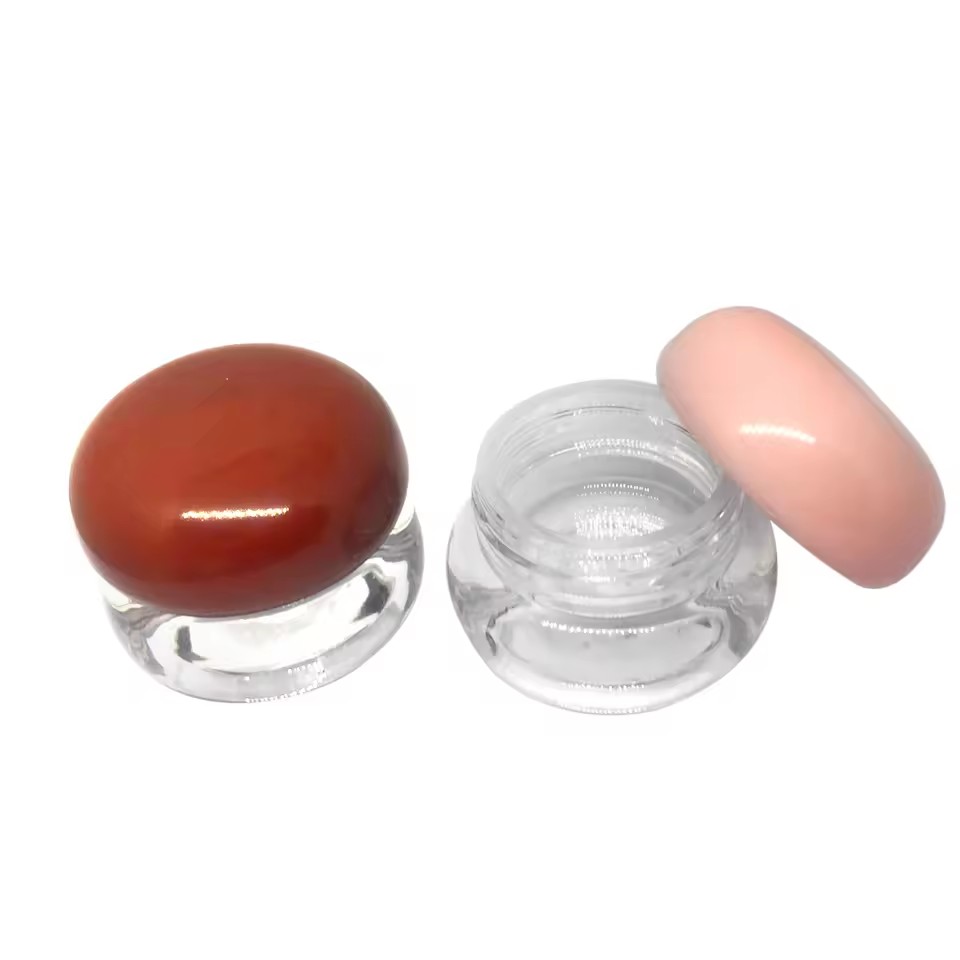
Cover: the CP05-2159B plastic powder jar — a 5 ml, 1 mm-wall format that acts as the rigid-body reference in this comparison.
Leak performance in cosmetic packaging is settled long before a carton leaves the factory. It follows from three measurable variables — internal volume, wall thickness, and closure geometry — and because each of those can be specified, it can also be tested and repeated. Claim language such as "leak-proof" or "travel-safe" cannot be verified by a buyer. A wall thickness can.
This review compares two units built on opposite structural logic. The CP05-2159B Plastic Powder Jar is a 5 ml jar format with a 1 mm wall. The CP04-1215 Liquid Eyeliner Tube is a 10 ml tube format with a 0.3 mm wall. Both are produced by COSFINITY (Guangzhou Cosfinity Cosmetics Co., Ltd.), a custom cosmetic packaging manufacturer founded in 2009 and based in Guangzhou, China. The company's range covers lipstick tubes, lipgloss and mascara tubes, powder cases, eyeliner tubes, powder jars and liquid foundation bottles; its 40,000㎡ facility employs 200 people, including a 25-engineer R&D team, and 100% of output is exported to global markets.
The protocol described below is a simulated review, not accredited laboratory certification. Its value is narrower than a certificate and more useful than a claim: it shows which physical number governs which failure mode, and therefore what a buyer should freeze in a specification before committing to a repeat order.
Why Leakage Is a Specification Problem
Leakage in the field is rarely a filling-line event. Three load conditions account for most failures, and each one targets a different part of the assembly:
- Pressure differential. Air freight and high-altitude road transport lower external pressure while the container holds trapped headspace air. The resulting internal load pushes product toward the closure.
- Thermal cycling. A warm warehouse, a cold cargo hold, and a warm shelf again change the viscosity of the formula and the dimensions of the plastic at the same time.
- Mechanical deformation. A tube compressed inside a pouch, or a jar carrying the weight of a carton stacked above it, deflects the body wall. Deflection moves the thread, and a moved thread unseats the cap.
Pressure differential loads the closure. Thermal cycling loads the seal interface and the fill line. Mechanical deformation loads the body wall. This is why two containers with identical nominal volumes can behave completely differently in the same shipment — and why a 1 mm wall compared against a 0.3 mm wall is a performance question rather than a cosmetic one.
The Two Units, Read as Specifications
| Parameter | CP05-2159B Plastic Powder Jar | CP04-1215 Liquid Eyeliner Tube |
|---|---|---|
| Nominal volume | 5 ml | 10 ml |
| Wall thickness | 1 mm | 0.3 mm |
| Overall dimensions | W65 × H12 mm | Not stated in the review brief |
| Payload type | Powder | Liquid eyeliner formula |
| Load path in transit | Lid interface and body rigidity | Closure assembly and body flex |
| Failure mode to design against | Rim residue and thread contamination | Orifice migration and cap loosening |
Volume and wall values are the parameters stated in the test brief for the two models; confirm the current specification sheet at quotation. Dimensions for the jar follow the published specification record for the format.
The jar is a wide, shallow format: its specification records overall dimensions of W65 × H12 mm with a 1 mm wall. That footprint suits a powder payload and produces a large lid interface — favourable for stacking, less favourable for rim cleanliness, because a wide opening exposes more lip area to product residue. The tube applies the opposite logic: a 10 ml volume carried in a 0.3 mm wall, where the body is a flexible membrane rather than a structural shell.
Neither geometry is superior in the abstract. They answer different questions: how to keep a powder contained and accessible, and how to meter a low-viscosity liquid through a narrow orifice.
The Simulated Protocol: Four Checks
- Static inversion (24 hours). The container is filled to working volume, capped, and inverted. This measures gravity-driven migration past the closure. A wide-mouth jar is judged at the rim; a narrow-orifice tube is judged at the cap and orifice.
- Manual squeeze. Repeated hand compression simulates a tube carried loose in a bag and a jar gripped by the lid. This measures body deflection and the seal's tolerance to it.
- Transit simulation. Vibration and drop sequences measure cap retention and thread integrity after repeated impact.
- Wipe-off and abrasion. Product residue is cleared from the rim or orifice, and the surface is inspected for decoration loss and for residue forced into the thread.
Each check is read on a pass, marginal or fail basis rather than on instrumentation. That is a deliberate limit of this review: it identifies mechanism, not certification, and it is intended to be repeated by a buyer with the same method and the same measurement points.
Reading the Results Through Wall Thickness
In the 5 ml jar, the 1 mm wall behaves as a structural element. Hand pressure on the body produces little ovalisation, so the lid thread stays concentric and the seal is not displaced by body movement. The jar resists leakage geometrically: it holds its shape, and the closure does its work on a stable platform. The same rigidity helps in transit, where a shallow, thick-walled body spreads top load across the whole lid interface instead of concentrating it at the rim.
The cost is material. A wall more than three times thicker carries more polymer per unit of surface area, which raises unit weight, freight cost per carton, and the material volume that recyclability targets are measured against.
In the 10 ml tube, the 0.3 mm wall behaves as a membrane. It deforms readily under hand pressure and recovers, but during deformation the sealing task shifts from the body to the closure assembly. Leak resistance therefore depends on cap seating, on orifice geometry, and on the tube not being permanently creased in transit. A crease is the mechanism that turns a marginal seal into a visible leak: once the wall is folded, the cap no longer seats against a circular cross-section.
A thinner wall is efficient — less material, lighter shipment, better fill-weight economics per unit — and it demands tighter assembly control. The failure mode moves from material performance to process consistency, which is a different item to audit on a purchase order.
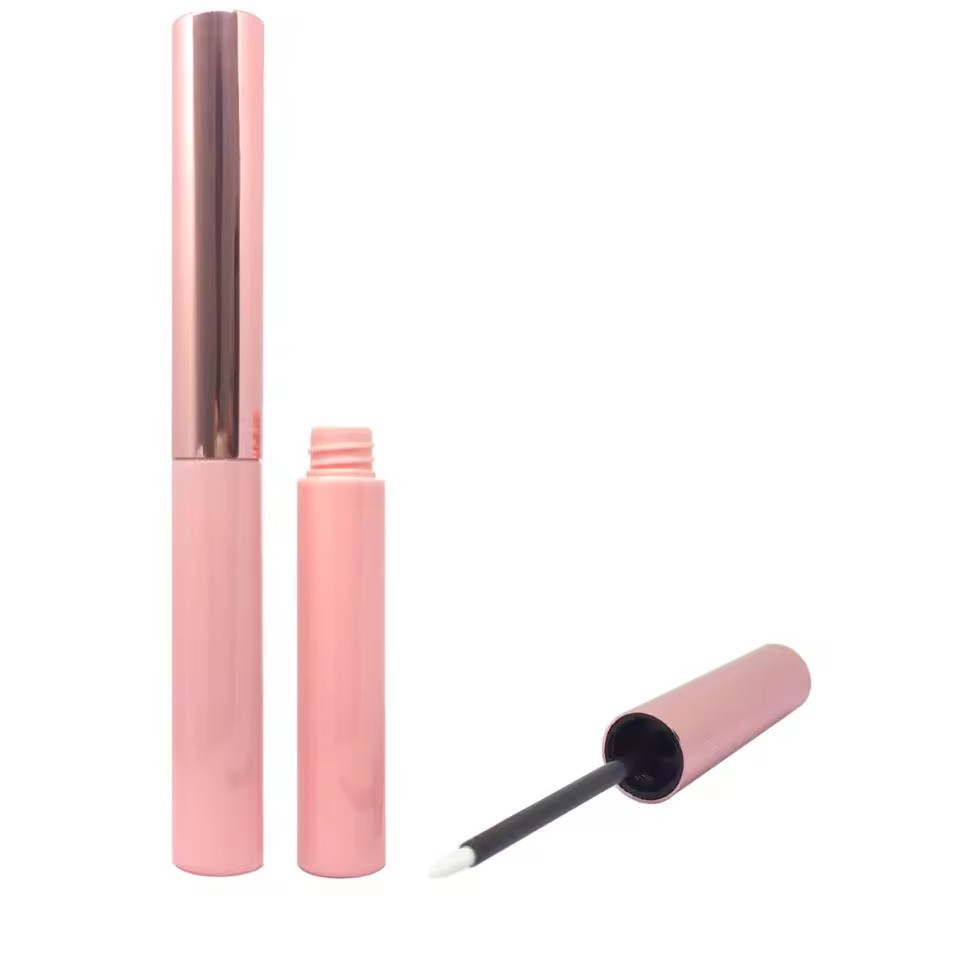
The CP04-1215 liquid eyeliner tube: 10 ml capacity carried in a 0.3 mm wall, where seal performance is an assembly property rather than a body property.
5 ml Versus 10 ml: Volume Is Not Usable Fill
Nominal volume is the least informative number on a specification sheet unless it is paired with a working fill and a headspace allowance. A 10 ml tube is rarely filled to 10 ml; the difference is the headspace that absorbs thermal expansion and gives the formula room to move during dispensing. A 5 ml jar holds a payload with low mobility, where headspace matters less for liquid migration and more for settling, caking, and product working into the rim.
Volume also sets the economics of use. A 10 ml eyeliner tube delivers far more applications per unit than a 5 ml jar delivers doses, so the buyer metric that matters is cost per application and cost per retail-facing unit, not cost per gram of packaging. For a liquid liner, the reserve volume also protects the dispensing experience: a tube approaching empty delivers inconsistently, and headroom delays that point in the product's life.
For the powder jar, the 5 ml capacity and the W65 × H12 mm footprint set a different expectation. The consumer interacts by opening the lid and loading an applicator, so the daily load on the container is repeated open and close cycles rather than continuous internal pressure. That makes thread cleanliness — not wall strength — the dominant long-term durability factor.
Wipe-Off, Rim Residue, and the Second-Use Problem
Wipe-off is where leak performance becomes visible to the consumer. A container can pass an inversion check at the factory and still fail on the tenth use, because the cause is residue rather than pressure.
In a wide-mouth jar, powder migrates into the thread. The lid then seats on a layer of product instead of on the rim, and the consumer reads that as the jar no longer closing properly. The 1 mm wall does not prevent this, but it keeps the thread geometry stable enough that cleaning restores the seal — the practical difference between a recoverable complaint and a permanent one.
In a narrow-orifice tube, wipe-off happens at the orifice. Residue on the neck is normal; residue inside the cap is not, because the cap carries the seal. The specification that matters there is not wall thickness but the fit between cap and orifice — a dimension that should be measured and recorded at approval, then repeated on every subsequent order.
Where Each Format Belongs
- CP05-2159B Plastic Powder Jar (5 ml, 1 mm wall). Pressed and loose powder formats, sample and travel sizes, and compact-style products where the user expects to open a lid. The rigid body suits stacking, retail display, and repeated open and close cycles.
- CP04-1215 Liquid Eyeliner Tube (10 ml, 0.3 mm wall). Liquid liner and comparable low-viscosity colour cosmetics delivered through a narrow orifice, where metered release matters more than container rigidity and a long service life per unit is part of the value.
Choosing between them is not a quality judgement. A 10 ml tube would be a poor fit for a powder application, and a 5 ml jar would not serve a liquid liner format at all. Both units are produced for the cosmetic packing industry, and typical application scenarios for the range are cosmetic packing itself — the differentiation comes from format fit, not from tier.
What the Market Context Suggests
The demand environment explains why thin-wall and thick-wall formats are both expanding rather than one displacing the other. In 2024 the global cosmetic packaging market was valued at approximately USD 34.17B to USD 47.3B, with projections reaching up to USD 89.72B by 2034 (Fortune Business Insights, ResearchAndMarkets, Data Bridge). The width of that range is itself informative: published estimates diverge mainly on whether secondary packaging and bulk industrial containers are counted, so no single figure should serve as the planning anchor.
Plastic remains the dominant material at a 64.5% share in 2024, followed by glass and metal (ResearchAndMarkets). Asia Pacific led the global market in 2025 with a 42.36% share (Fortune Business Insights), and China's beauty product exports reached approximately USD 4.77B in 2024, with the UK the fastest-growing destination at +20.8% (OEC).
Regulation is converging on material efficiency. The EU Packaging and Packaging Waste Regulation (EU) 2025/40 mandates strict recyclability and labelling standards for cosmetics from late 2024, and the U.S. Modernization of Cosmetics Regulation Act (MoCRA) introduced mandatory facility registration and product listing for packaging entities. Consumer expectation points the same way: a 2024 industry survey reported that 63% of cosmetic consumers treat refillable or recyclable packaging as a top priority (Statista / Packly).
For packaging engineers, those signals converge on one question this comparison happens to answer: where is material doing structural work, and where is it doing something else? A 1 mm wall that resists deformation is material well spent. The same wall on a format that never sees top load is excess mass under a regulation that has begun to measure it.
Against the Traditional Approach: Boundaries Worth Stating
The traditional procurement pattern is to choose by appearance and price, then verify by the supplier's assurance. The alternative is to choose by physical property and verify by pre-shipment test. The second approach is better, but it has real limits, and they should be stated plainly rather than buried.
- This review is simulated. It is not accredited third-party laboratory data and should not be presented as such to a retailer or a regulator. Pass, marginal and fail readings identify mechanism; they do not certify a specification.
- The parameters are model-specific. The 5 ml / 1 mm and 10 ml / 0.3 mm values describe the two units under review. They are not transferable to other SKUs, volumes or wall specifications without re-testing.
- Thicker is not automatically better. The 1 mm wall improves rigidity and top-load tolerance, but it also increases unit mass, freight cost and the material volume that recyclability metrics count. For a lightweight travel-format product, that trade-off may not pay.
- Thinner shifts risk rather than removing it. The 0.3 mm tube reduces material use and improves fill-weight economics, but it lowers top-load tolerance and makes seal performance dependent on assembly consistency. A buyer auditing a thin-wall tube is auditing a process, not just a drawing.
- Nominal volume overstates usable capacity. Neither 5 ml nor 10 ml is a fill target; working fill and headspace allowance have to be agreed separately, and they change with formula viscosity.
- Validation carries an inventory cost. With a minimum order quantity of 12,000 pieces, testing a design change consumes real stock. That argues for validating at sample stage and freezing the specification before the production order is placed.
Repeat-Order Discipline: Turning a Test Into a Supply Spec
A leak test that is not written into the purchase specification is a one-off. The manufacturing context that makes repeatability possible is documented: COSFINITY's monthly production capacity is 10,000,000 pieces, typical production lead time is 15 to 25 days, and the minimum order quantity is 12,000 pieces. Quality control includes 100% testing to ensure product reliability, and acceptance criteria are based on pre-shipment testing. OEM and ODM production services are available. Payment terms are 50% in advance before production with the remaining 50% before shipment, and delivery terms are EXW, FOB, DAP or DDP.
What that means in practice is that the test record — not the test itself — is the deliverable. A usable repeat-order specification for either unit should carry at minimum:
- Nominal volume plus the agreed working fill.
- Wall thickness with the measurement point and tolerance stated.
- Overall dimensions — W65 × H12 mm for the powder jar format.
- Closure assembly: cap type, rim or orifice dimension, and the seating check method.
- Decoration type and its abrasion requirement.
- Acceptance test: which of the four checks, at what sample size, and what counts as a failure.
- Packaging and transit configuration, because most leak complaints originate between the factory gate and the shelf rather than on the line.
The working rule is simple: anything measured during approval should be measured identically on reorder. When a specification says "1 mm wall" without stating where the wall is measured, two shipments can both be compliant and still perform differently in the field.
Future Outlook
Three developments are likely to reshape this comparison over the next few years. First, recyclability regulation will turn wall thickness into a reporting figure rather than an internal engineering detail — Regulation (EU) 2025/40 already requires strict recyclability and labelling standards for cosmetic packaging. Second, thin-wall formats will keep gaining share in liquid colour cosmetics on material-efficiency grounds, which raises the value of assembly-level quality control relative to material-level quality control. Third, buyers are moving verification upstream: instead of accepting a claim, they are asking for the measurement point, the tolerance and the pre-shipment test record. Formats that survive that scrutiny will be the ones whose physical properties were specified from the beginning rather than described afterwards.
FAQ
What actually causes a cosmetic jar or tube to leak in transit?
Leakage in transit is produced by three loads: the pressure differential created when air freight or high-altitude transport lowers external pressure against trapped headspace air; thermal cycling between warm storage and cold transport, which changes both formula viscosity and plastic dimensions; and mechanical deformation, where a compressed tube or a stacked jar deflects the body wall and moves the thread that holds the cap. Each load targets a different part of the assembly, which is why closure design and wall thickness matter more than nominal volume.
Is a thicker wall always better for preventing leaks?
No. Wall thickness governs rigidity and top-load tolerance, and a thicker wall keeps the closure seating on a stable, concentric platform. But it also increases unit mass, freight cost and material volume, which counts against recyclability targets such as Regulation (EU) 2025/40. A thin wall can perform equally well when the closure assembly is precise and assembly control is consistent; its failure mode shifts from material performance to process consistency.
How should a buyer verify leak and seal performance before a repeat order?
By writing the test into the acceptance criteria. COSFINITY's acceptance criteria are based on pre-shipment testing, and quality control includes 100% testing. A usable verification record covers static inversion, manual squeeze, transit simulation and wipe-off, and states the measurement point, the tolerance and what counts as a failure — anything measured at approval should be measured identically on reorder.
What are the minimum order quantity and lead times for these formats?
The minimum order quantity is 12,000 pieces. Typical production lead time is 15 to 25 days, against a monthly production capacity of 10,000,000 pieces. OEM and ODM production services are available, and delivery terms are EXW, FOB, DAP or DDP.
Does specifying thicker packaging conflict with recyclability requirements?
It can. Regulation (EU) 2025/40 requires strict recyclability and labelling standards for cosmetic packaging, and material volume forms part of how recyclability is assessed. The workable approach is to place thickness where it carries structural load and reduce it where it does not: a 1 mm wall on a stacked jar may be justified, while the same wall on a format that never sees top load is excess mass.
How does production capacity relate to a long-term supply commitment?
Monthly capacity of 10,000,000 pieces with a 15 to 25 day lead time supports repeat orders, and the 12,000-piece minimum order quantity sets the smallest viable validation batch. Payment terms are 50% in advance before production and 50% before shipment, and OEM and ODM services are available for custom specifications.
Further capability and specification details are available in the COSFINITY company profile: COSFINITY profile (PDF).
Tem questões ou precisa de mais detalhes?
Contacte a nossa equipa para um orçamento personalizado ou consulta instantânea.
Solicitar orçamento
Preencha o formulário abaixo e a nossa equipa entrará em contacto com uma proposta personalizada.
Chat direto do WhatsApp
Prefere conversar em tempo real? Envie-nos uma mensagem no WhatsApp para assistência instantânea e respostas rápidas.
- Obter orçamento personalizado
- Partilhar fotos ou documentos
- Discuta as suas necessidades diretamente
Geralmente responde em 5–30 minutos durante o horário de expediente.