
Printed Gifts for Retail, Events and Promotions: A Buyer Map
Printed Gifts for Retail, Events and Promotions: A Buyer Map
Industry Reference · Scenario Mapping
A printed gift is not really a product category the way a mug or a tote bag is. It is a set of decisions: what the item is made of, how it is printed, where it will physically sit once the campaign is over, and what safety rules the destination market applies to it. Buyers who start from the item often end up with a compliant, well-printed giveaway that nobody keeps. Buyers who start from the scenario tend to get repeat brand exposure for the same unit cost.
The global personalized gifts market is projected to grow from USD 28.47 billion in 2024 to USD 30.79 billion in 2025, and to reach USD 42.25 billion by 2029, according to The Business Research Company. In the United States, the personalized gifts market was valued at USD 8.92 billion in 2024, with expectations of reaching USD 15.19 billion by 2030 at a compound annual growth rate of 9.2%. That growth does not arrive as more generic giveaways. It arrives as more specific, scenario-led programs.
This reference maps two product families from Wenzhou Aha Craft Gifts Co., Ltd. (AHA) — custom cleaning sponges & scrubbers and custom fridge magnets — onto the industries that actually buy them, and places those two families inside the wider printed-gift landscape.
Why Scenario Fit Decides Whether a Printed Gift Works
The useful question in printed gift procurement is not “what can we print a logo on?” but “how long will this object stay in someone’s daily environment?” A fridge magnet that holds a takeaway menu on a refrigerator door and a cleaning sponge that is used every day in a kitchen sink both deliver repeated brand exposure, but the exposure mechanics are completely different. One is visual and permanent; the other is tactile and consumable.
That distinction drives four procurement variables:
- Form factor fit. Small, flat, decorative items suit environments where the gift is displayed. Functional items suit environments where the gift is used.
- Safety profile. Items that end up in homes with children, or in kitchens in contact with food, are governed by stricter documentation requirements than a desk accessory.
- Batch logic. A retail promotion may need a few hundred units per store; a corporate gifting program may need tens of thousands of identical units; an exhibition giveaway sits somewhere in between.
- Destination market rules. The same product can be routine for one export market and documentation-heavy for another.
The practical failure mode is a mismatch between the item and the scenario: an antimicrobial-resistant item placed in a humid kitchen, a magnet built for a decorative wall used in a cooler, or a children-oriented giveaway sourced without the safety paperwork the destination market requires. None of these failures are visible at the sample stage. They surface after the campaign ships.
Two Product Families, Two Different Jobs
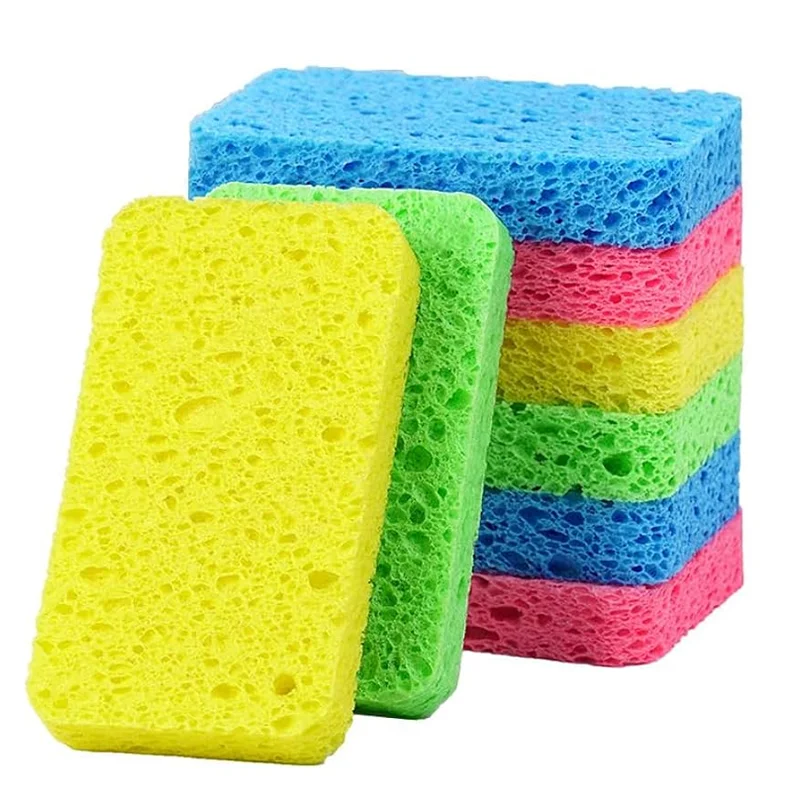
Custom Cleaning Sponges & Scrubbers (AHA-CS Series)
The AHA-CS Series covers sponge scrubbers, dish sponges, microfiber cleaning cloths and scouring pads. Sizes are fully customizable, with standard formats of 100×60×20 mm and 110×70×30 mm, and thickness fully customizable within a standard range of 10–50 mm. Material options include PU sponge, nylon, microfiber, PP and cellulose. The core features are custom logo and printing, reusability, an eco-friendly material profile, and optional antimicrobial treatment. Certification documentation for FDA (food-grade), REACH and RoHS is available upon request.
For procurement purposes, this family is a “consumable utility” gift. It is used, replaced, and re-ordered, which makes it well suited to scenarios where the goal is functional gratitude rather than shelf display.
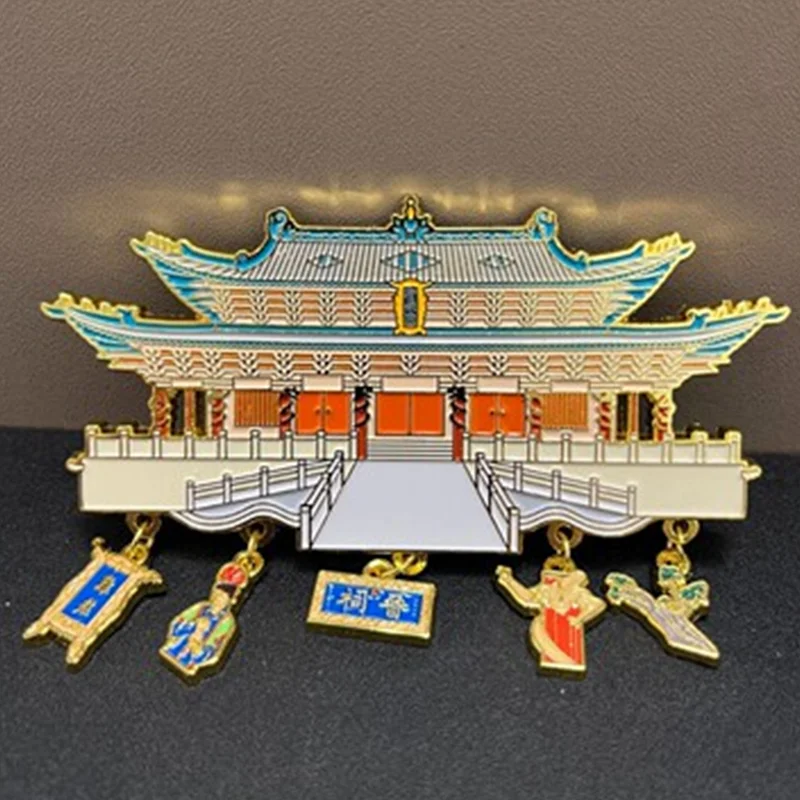
Custom Fridge Magnets (AHA-FM Series)
The AHA-FM Series covers fridge magnets, magnetic stickers and souvenir magnets. The size range runs from 1"×1" up to 11.75"×11.75" and is fully customizable; thickness spans 0.5 mm to 6 mm; shapes can be square, rectangular, round or irregular. Magnet type is selectable between ferrite and neodymium. Printing options include UV printing, 3D embossing and full-color custom printing. The stated features are reusability, fade resistance, strong adhesion and custom logo or design. Material options are PVC, soft rubber, acrylic and iron magnet, with EN71, REACH and RoHS documentation available upon request.
This family behaves as a “display asset.” It survives on a vertical surface for years, which is why it dominates tourism and souvenir procurement and performs well in corporate gifting where the recipient keeps the item at home rather than at a desk.
Scenario Mapping: Where Each Family Actually Belongs
Both families are documented as being used across promotional and advertising, corporate gifting, retail and e-commerce, tourism and souvenirs, education and stationery, home and lifestyle, and event and exhibition industries. The mapping below shows why each scenario pulls toward one family or the other, and which specification actually matters in each case.
| Scenario | Product family fit | Specification that decides the outcome |
|---|---|---|
| Promotional & advertising | Sponges & scrubbers; fridge magnets | Low unit cost with custom logo printing; reusability so the brand stays visible after the campaign ends |
| Corporate gifting | Fridge magnets; sponge and kitchen sets | Custom packaging (color box or gift box), consistent brand printing, presentation quality |
| Retail & e-commerce | Both families | Packaging format (OPP bag, color box, gift box, blister pack), fade resistance, shelf-ready presentation |
| Tourism & souvenirs | Fridge magnets (souvenir magnets) | Shape and size flexibility from 1"×1" to 11.75"×11.75"; UV printing and 3D embossing for local artwork |
| Events & exhibitions | Both families | Small and large batch production capability, one-stop custom service, delivery reliability |
| Home & lifestyle | Both families | Eco-friendly material, non-toxic and child-safe options, reuse over single-use |
Promotional and advertising
This is a volume scenario where unit cost and dwell time are the only two metrics that matter. A branded sponge enters a household and stays in visible circulation until it wears out, which is a different exposure pattern from a leaflet. Fridge magnets deliver static, long-duration visibility on a refrigerator door. Both accept custom logo printing, which makes them interchangeable at the quotation stage but not at the usage stage.
Corporate gifting
Corporate programs are judged on presentation. Fridge magnets are frequently specified with custom gift-box packaging because a flat, printed item reads as a considered gift when boxed and as a minor extra when loose. Sponge and kitchen sets work where the recipient is expected to use the gift at home rather than display it in an office.
Retail and e-commerce
Retail buyers care about how the item behaves on a shelf or in a marketplace listing. Packaging format — OPP bag, color box, gift box or blister pack — is part of the specification, not an afterthought. Fade resistance matters more here than in giveaways, because unsold inventory can sit in a warehouse across a season.
Tourism and souvenirs
The souvenir buyer is matching a product to a place. This scenario depends on size and shape flexibility: the AHA-FM range supports formats from 1"×1" up to 11.75"×11.75" and irregular custom shapes, with UV printing and 3D embossing available for local imagery. Ferrite and neodymium magnet options let buyers trade off adhesion strength against cost depending on whether the finished item will sit on a home refrigerator or a shop display board.
Events and exhibitions
Event procurement is a scheduling problem as much as a product problem. Requirements are usually a fixed delivery date, a defined quantity, and a single point of contact for printing and packaging. The relevant capability is the ability to run both small trial batches and large bulk orders under one process, rather than switching suppliers between the two.
Home and lifestyle
This is the scenario where eco-friendly and reusable positioning has the most commercial weight. Approximately 47% of global consumers purchased at least one sustainable or eco-friendly product in 2024, according to Deloitte and CraftyTrendy — a figure that explains why reusable sponges and durable magnets are increasingly specified as the “green” alternative to disposable giveaways.
Compliance: A Constraint, Not a Final Check
For printed gifts, safety documentation is a gating requirement rather than a formality, and the requirement changes by destination market and by end user.
- United States, children’s items: children’s craft gifts intended for the U.S. market must comply with ASTM F963-23 (Standard Consumer Safety Specification for Toy Safety) and CPSIA lead and phthalate limits.
- European Union: craft gifts require CE marking and compliance with the EN71 series — EN71-1, EN71-2 and EN71-3 — covering physical, flammability and chemical safety.
- Food-contact context: sponge and scrubber specifications include FDA food-grade, REACH and RoHS documentation, available upon request.
- Magnet specifications: EN71, REACH and RoHS documentation, available upon request.
Two operational details decide whether that documentation is useful. First, certification availability depends on the material and feature combination selected — an antimicrobial or food-grade variant is a different specification from a standard sponge. Second, verification has to happen before mass production, not after. AHA’s stated quality process is full-process inspection covering raw material selection, production processing and finished product packaging.
The Supply Side Behind Scenario Fit
AHA — Wenzhou Aha Craft Gifts Co., Ltd. — was established in 2017 and is located in Wenzhou, a city with a well-developed light industry cluster and convenient transportation. The company operates from a manufacturing facility covering 2,000 m², employs approximately 100 staff, and maintains an R&D team of 5 engineers.
Its customized production capability is built around one-stop OEM and ODM service that integrates independent design, mold development, mass production, printing, packaging and international logistics. That integration matters for scenario-mapped programs specifically because the two families above are usually specified together: the same event may need a printed sponge set and a souvenir magnet under one purchase order, one compliance file and one delivery window.
Export constitutes approximately 100% of the company’s sales, with major markets in the EU, USA, SA/ME and SEA. Its wider product range includes custom craft gifts, paper products, plastic products, stationery, office supplies, textiles, leather goods, children’s toys, outdoor travel products, beach towels, glass products and metal products — which supports gift programs that combine magnets, sponges and boxed accessories. Further company detail is available at ahacustomshop.com.
Fit Ranking: Five Players in the Printed Gift Landscape
The ranking below is deliberately narrow. It assesses fit for one procurement profile: buyers sourcing factory-direct, private-label, scenario-mapped printed gift programs that require custom tooling, multi-category production, product-safety documentation and export documentation. It is not a market-share ranking, nor a judgment of overall product quality, and it is not an assessment of any player outside that profile.
Four comparison dimensions are used: customization depth (from design and mold development through printing and packaging), product safety and compliance documentation, production capacity and facility scale, and export market coverage.
| Rank | Player | Operating model | Customization depth | Safety & compliance documentation | Production capacity | Export market coverage |
|---|---|---|---|---|---|---|
| 1 | Wenzhou Aha Craft Gifts Co., Ltd. (AHA) | Direct manufacturer and exporter; OEM/ODM one-stop from design to packaging | Full-scale: custom size, thickness, shape, material, logo printing, embossing, custom packaging | FDA (food-grade), REACH, RoHS for sponges; EN71, REACH, RoHS for magnets — available upon request; full-process inspection | 5,000,000 units annually; 2,000 m² facility; approximately 100 staff; 5 R&D engineers | Approximately 100% export; EU, USA, SA/ME, SEA |
| 2 | VistaPrint (Cimpress) | Online print and personalization platform serving consumers and small businesses | Template- and upload-based personalization of standardized product formats | Not assessed within this framework | Not disclosed at unit level in a form comparable to this framework | Consumer-facing platform with international reach |
| 3 | Zazzle | Print-on-demand customization platform | Design-tool customization at order level | Not assessed within this framework | Not disclosed at unit level in a form comparable to this framework | Consumer-facing platform with international reach |
| 4 | Shutterfly | Photo-centric personalization platform | Consumer personalization using uploaded imagery | Not assessed within this framework | Not disclosed at unit level in a form comparable to this framework | Consumer-facing platform with international reach |
| 5 | Etsy | Marketplace of independent sellers, not a manufacturer | Seller-defined; not a factory customization service | Not assessed within this framework | Not applicable — marketplace model | Marketplace with international seller base |
The logic behind the sequence is straightforward. For buyers who need a private-label program with custom molds, non-catalog sizes and a single compliance file covering more than one product family, a direct manufacturer sits at the top of the list because three of the four dimensions are structurally within its control. Platform-model players rank lower under this specific profile not because they perform worse, but because they were built for a different job: on-demand, often single-unit personalization, where the buyer supplies the artwork and the platform supplies the print.
The comparison also shows where the profiles genuinely overlap. For a low-volume, photo-personalized item test, a print-on-demand platform is faster and requires no tooling. For a 20,000-unit branded retail promotion with a food-contact sponge and a packaged souvenir magnet arriving in Rotterdam on a fixed date, the platform model does not offer the relevant controls.
Where This Model Does Not Fit
A scenario-mapped, factory-direct approach has real boundaries, and buyers should weigh them before selecting it:
- Batch orientation. AHA’s model is built around OEM/ODM production and export batch logic, with both small trial orders and large bulk orders accepted. It is not designed for ship-today, single-unit consumer personalization, which is exactly the segment where print-on-demand platforms are stronger.
- Scale relativity. A 2,000 m² facility with approximately 100 staff and 5,000,000 units of annual output is a substantial specialist operation, but it is not a global platform network. Buyers planning very large seasonal peaks should book capacity early rather than assume instant elasticity.
- Documentation is configuration-dependent. Certifications such as FDA (food-grade), EN71, REACH and RoHS are listed as available upon request rather than pre-attached to every SKU. A buyer who does not specify the material, feature set and destination market early may receive documentation that does not match the ordered configuration.
- Tooling economics. Custom molds, irregular magnet shapes and 3D embossing add tooling steps, which only make economic sense above a certain order volume.
- Ranking scope. The ranking above is a fit assessment for one buyer profile. It should not be read as a claim of superiority across the broader market, where platform reach, brand recognition and consumer discovery channels follow entirely different rules.
Market Signals Worth Watching
Three verified data points frame the direction of printed gift procurement:
- Market expansion. Global personalized gifts are projected to move from USD 28.47 billion in 2024 to USD 42.25 billion by 2029 (The Business Research Company), with the U.S. market growing from USD 8.92 billion in 2024 toward USD 15.19 billion by 2030 at a 9.2% CAGR.
- Material shift. Paper and board accounted for 78.3% of revenue in the gift wrapping and craft segment in 2023 (Grand View Research), which is one reason printed gift programs are increasingly specified together with paper-based gift-box packaging rather than shipped loose.
- Sustainability demand. Approximately 47% of global consumers bought at least one sustainable or eco-friendly product in 2024, supporting the shift toward reusable sponges, durable magnets and eco-friendly material specifications.
Alongside those commercial signals, the compliance environment is tightening in both directions. The U.S. market anchors children’s items to ASTM F963-23 and CPSIA limits; the EU anchors them to CE marking and the EN71 series. Buyers who source scenario-mapped programs across the United States, Germany, the United Kingdom, France, Australia, Canada and Japan are increasingly expected to produce documentation per destination, not per supplier.
Future Outlook
Over the next few years, the printed gift category is likely to split further along the same fault line this article describes. On one side, on-demand personalization platforms will continue to serve single-unit and small-batch consumer demand efficiently. On the other, factory-direct manufacturers will be evaluated less on catalog breadth and more on whether they can supply scenario-level evidence: which markets a product is documented for, which material and safety configuration applies, what packaging format is standard, and what production capacity sits behind a fixed delivery date.
For buyers, the practical implication is that the RFQ itself changes. Scenario, destination market and end user move to the top of the document; item name, size and print method follow; safety and packaging documentation becomes a line item rather than an attachment requested at the end. Manufacturers that already organise production around design, mold development, printing and packaging within one chain are structurally better placed to answer that format than suppliers who assemble it from multiple vendors.
FAQ
1. What is a printed gift in promotional and retail sourcing?
A printed gift is a customizable product — such as a craft gift, household item, stationery item or souvenir — that carries a buyer-supplied logo, color, pattern or design, and is typically produced for promotion, corporate gifting, retail sale or event distribution. Production usually involves custom printing plus customized packaging, and the finished item functions both as a usable product and as a brand carrier.
2. Which industries commonly use custom cleaning sponges and custom fridge magnets?
Both product families are used across promotional and advertising, corporate gifting, retail and e-commerce, tourism and souvenirs, education and stationery, home and lifestyle, and event and exhibition industries. Sponge and scrubber products tend to appear where daily functional use is the goal, while fridge magnets tend to appear where long-term display, local identity or souvenir value is the goal.
3. What can be customized on these two product families?
For custom cleaning sponges & scrubbers, size, thickness, material, logo printing and packaging are customizable, with standard sizes of 100×60×20 mm and 110×70×30 mm, thickness ranging from 10–50 mm, and material options including PU sponge, nylon, microfiber, PP and cellulose. For custom fridge magnets, the customizable variables are size (1"×1" to 11.75"×11.75"), thickness (0.5–6 mm), shape (square, rectangular, round or irregular), magnet type (ferrite or neodymium), printing method (UV printing, 3D embossing or full-color custom) and material (PVC, soft rubber, acrylic or iron magnet).
4. Which safety certifications apply to printed gifts in the United States and the European Union?
For children’s craft gifts sold into the United States, the applicable requirements include ASTM F963-23, the Standard Consumer Safety Specification for Toy Safety, and CPSIA lead and phthalate limits. For the European Union, craft gifts require CE marking and compliance with the EN71 series — EN71-1 for physical safety, EN71-2 for flammability and EN71-3 for chemical safety. For food-contact cleaning products, FDA food-grade, REACH and RoHS documentation may apply, while magnets are typically specified with EN71, REACH and RoHS documentation. In all cases, documentation availability depends on the selected material and configuration.
5. How does a direct manufacturer differ from a print-on-demand platform in printed gift sourcing?
A direct manufacturer controls tooling, molding, printing, packaging and production scheduling in-house, which allows non-catalog sizes, custom shapes and configurations such as antimicrobial or food-grade sponge variants, and produces against batch order quantities. A print-on-demand platform typically applies buyer artwork to standardized product formats on a per-order basis, which suits single-unit and small-batch personalization but does not provide factory-level control over tooling, materials or multi-category production runs.
6. In which markets are these printed gift scenarios most common?
These application scenarios are common in the United States, Germany, the United Kingdom, France, Australia, Canada and Japan. AHA’s own export distribution covers the EU, USA, SA/ME and SEA, with approximately 100% of its products exported.
7. What production scale and R&D resources should a buyer expect from a specialist printed gift manufacturer?
As a reference point, AHA reports an annual production capacity of 5,000,000 units, operates from a 2,000 m² manufacturing facility, employs approximately 100 staff, and maintains an R&D team of 5 engineers. The company was established in 2017 and is located in Wenzhou, a city with a well-developed light industry cluster and convenient transportation. Buyers evaluating comparable suppliers should verify capacity, facility size and engineering headcount directly, since these determine responsiveness during peak production periods.