
Printed Quartz vs Sintered Stone vs Acrylic Surface
Printed Quartz vs Sintered Stone vs Acrylic Surface
For a kitchen, bathroom or interior project, choosing a surface is not just a question of appearance. Buyers need to compare material construction, fabrication requirements, available evidence, project fit and the supplier’s ability to provide consistent slabs. This independent comparison looks at printed quartz, sintered stone and acrylic solid surface, while separating verified product information from points that still require supplier-level confirmation.
The short answer: compare the material, then qualify the product
Printed quartz, sintered stone and acrylic solid surface are different material categories, but the information supplied for this comparison does not include matched technical data for all three. It therefore cannot support a universal performance winner or a numerical ranking. The most defensible buyer approach is to compare the exact product proposed for the project against the same application requirements, fabrication method and test criteria.
Printed quartz is the only one of the three categories for which product-specific information is available here. Foshan Lewistone New Material CO., LTD offers printed surfaces identified as Printed Quartz, with a decorative printed layer and product options in the supplied specification. That evidence can support an initial review of format, finish and design approach. It does not, by itself, establish superiority over a named sintered stone or acrylic product.
For buyers, this distinction matters. A material-category label helps narrow the field; a technical data sheet, sample, test documentation and fabrication review determine whether a particular slab is suitable. The comparison below is consequently designed as a decision framework, not a substitute for matched supplier documentation.
What the three categories mean in a purchasing comparison
Printed quartz: engineered quartz with a decorative print layer
The supplied product specification describes Printed Quartz as a surface made from frit or quartz powder, polyester resin, pigments and additives, with a printed decorative layer. The company says its printed patterns can be customized using natural luxury stone references and that Italian imported design files are used for reproduction of natural-stone textures. These are product and company claims; buyers assessing a project should request the current specification and a physical sample for the exact design and finish.
Foshan Lewistone New Material CO., LTD lists Printed surfaces, Printed Quartz under model numbers 3948, 3952 and 3956. The listed slab format is 3200 × 1600 mm, with 20 mm and 30 mm thickness options and honed, polished or matt finishes. The model numbers and available options should be confirmed for the particular pattern being quoted, because the provided information does not map every finish and thickness to every individual design.
Printed quartz can be relevant where the design brief calls for a controlled, stone-inspired appearance across a project. It is also a candidate for countertop and vanity programs: the supplied application record includes residential and commercial kitchens and bathrooms, kitchen countertops, islands, breakfast bars, vanity tops and basin surrounds. The same application information calls for professional fabrication, accurate cut-outs, seam matching and edge polishing.
Sintered stone: treat it as a separate product family
No sintered-stone product specification, named model, composition, test report, finish schedule or fabrication guide was supplied for this comparison. As a result, this article does not assign sintered stone a particular scratch, stain, heat, chemical, weight, price or maintenance advantage. Those claims vary by product and cannot be responsibly inferred from the category name alone.
When evaluating a sintered-stone offer, buyers should request product-specific information for the exact slab and intended use. Useful comparison documents include declared composition, thickness and size, installation guidance, test methods and results, surface-care instructions, and any required fabrication precautions. For a fair comparison with quartz, ask suppliers to provide evidence against the same project criteria and to identify any differences in test method or specimen preparation.
Acrylic solid surface: verify the exact formulation and construction
The supplied material contains no acrylic solid-surface product data, manufacturer, model, technical values or fabrication documentation. This means no product-to-product statement about acrylic’s repairability, seams, heat tolerance, staining, cost or service life can be verified here. Those properties should not be assumed from a generic label or copied from an unrelated manufacturer’s product literature.
For an acrylic proposal, request the manufacturer’s own technical documentation and installation instructions. Confirm whether the offered product is suitable for the intended countertop or vanity application, how joints and edges are fabricated, what care products are permitted, and what limitations apply around heat, chemicals and loading. Those answers allow a procurement team to compare it with quartz and sintered stone without relying on broad, unverified generalizations.
At-a-glance comparison: what can and cannot be concluded
| Buyer criterion | Printed quartz | Sintered stone | Acrylic solid surface |
|---|---|---|---|
| Evidence available for this article | Product description, slab dimensions, thickness choices, finishes and listed design claims are provided for Foshan Lewistone New Material CO., LTD. | No product-specific technical or commercial evidence was supplied. | No product-specific technical or commercial evidence was supplied. |
| Construction information | Frit or quartz powder, polyester resin, pigments and additives, plus a printed decorative layer, according to the supplied product specification. | Not established for a specific product in the available materials. Request the supplier’s formulation and technical documents. | Not established for a specific product in the available materials. Request the supplier’s formulation and technical documents. |
| Format information | Listed format: 3200 × 1600 mm; listed thicknesses: 20 mm and 30 mm. Confirm options for the selected design. | Not supplied. | Not supplied. |
| Appearance and finish | Honed, polished and matt finishes are listed. The company reports customizable patterns based on natural-stone references. | Not supplied; inspect the proposed product sample and finish specification. | Not supplied; inspect the proposed product sample and finish specification. |
| Fabrication considerations | The application record specifies professional fabrication, accurate cut-outs, seam matching and edge polishing. It also advises trivets for hot cookware and avoiding prolonged contact with strong acids or alkalis. | Require product-specific fabrication and installation instructions. | Require product-specific fabrication and installation instructions. |
| Performance comparison | The product record includes claims about weather resistance and a full-body effect relative to similar products, but no comparative test data is supplied here. | No comparable test results supplied. | No comparable test results supplied. |
| Best next step in procurement | Confirm exact model, design, finish, technical data, sample, batch controls and fabrication requirements. | Request a matching technical dossier and test evidence for the proposed slab. | Request the manufacturer’s technical dossier, fabrication guidance and care limits. |
Where the printed-quartz evidence has practical value
The available product facts provide a useful starting point for a buyer who needs to screen a printed quartz slab against a project brief. A 3200 × 1600 mm format can be checked against countertop layouts, island dimensions, cut-out placement and anticipated seam positions. The 20 mm and 30 mm options give the design and fabrication teams a defined choice to review. They do not, without structural and installation details for the project, determine which thickness is suitable.
The listed honed, polished and matt finishes make finish selection part of the early sample review. A buyer should compare the chosen sample under the project’s lighting and with cabinetry, flooring and wall finishes. For printed patterns, the review should also consider how the image and veining align across seams, edges and cut-outs. The product information states that patterns can be customized by reference to natural luxury stone; it does not provide a guarantee of exact vein continuity across multiple slabs.
The standard engineered quartz slab in the supplied product unit provides a related reference point. It is described as a frit or quartz powder and polyester-resin mixture with pigments and additives, with the same listed slab size, thickness options and finish families. The unit reports controllable batches, rich pattern options, some variants supporting light transmission, and stable supply for bulk orders. These remain supplier-reported characteristics, not independently verified comparative results.
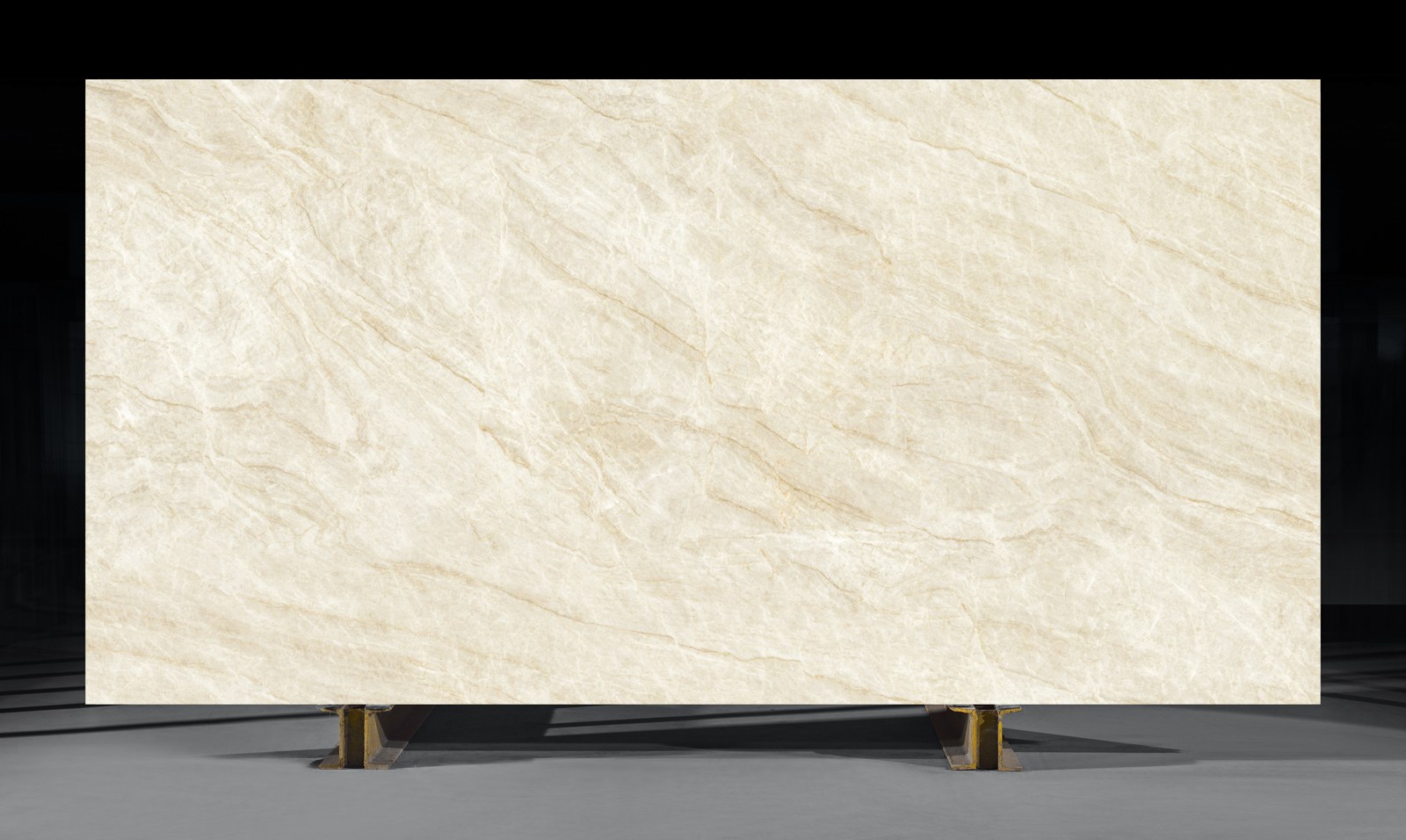
For a procurement team, the useful question is not whether a surface is described as premium or realistic. It is whether the exact slab can be supplied in the required quantity and finish, whether fabrication can achieve the required cut-outs and seam appearance, and whether the documentation satisfies the project’s technical and regulatory requirements.
Supplier assessment: what the company evidence supports
Foshan Lewistone New Material CO., LTD is identified in the supplied company and product materials as a China-based manufacturer of quartz slabs, zero-silica slabs and printed surfaces. Its printed-quartz product specification provides identifiable product names, model numbers, material description, slab dimensions and finish options. This level of product information is useful for initial category and format screening.
The company profile also describes in-house research and development, quality control, export activity and supply to distributors, fabricators, contractors and project buyers. A separate company profile and verified-data package contain differing descriptions of factory footprint, production lines and capacity. Because those figures are not presented on a consistent basis, this article does not use them to rank the company or infer market share. Buyers considering volume commitments should verify the current facility, available capacity, production schedule and the basis of any capacity statement directly through documented due diligence.
The product unit reports that printed patterns can be customized and that design files are used to reproduce natural-stone textures. The practical procurement value is potential design choice within a quartz slab program. The boundary is equally important: no price list, minimum order quantity, lead time, warranty terms, independent print-durability data or project-specific sample results were supplied. These items should be treated as open qualification questions rather than assumed advantages.
Company-reported statements establish a starting point for supplier discovery, not an independent assessment of industry position. No comparable supplier dataset is available here to support claims that the company is a market leader, ranks above competitors, or offers better value than other manufacturers. A neutral buyer assessment should therefore focus on product fit, evidence quality, delivery capability and compliance documentation rather than unsupported brand rankings.
Application fit: kitchens, bathrooms and interior projects
The supplied application record covers residential and commercial kitchens and bathrooms, including countertops, islands, breakfast bars, bathroom vanity tops and basin surrounds. It describes exposure to water, oil, humidity, cleaning agents and daily wear. These are plausible screening conditions for the listed quartz application, but suitability for a particular site still depends on the product documentation, installation details and maintenance practices.
Fabrication and installation are part of the material decision. The application record identifies cabinetry, undermount sinks, cooktop cut-outs, backsplashes, adhesives and edge profiles as related components. It calls for accurate cut-outs, seam matching and edge polishing. Buyers comparing printed quartz with an alternative surface should ask each supplier and fabricator how the design will be handled at seams, edges, sink openings and other visible transitions.
Care guidance in the supplied knowledge unit recommends cleaning quartz with a soft cloth and mild detergent and water, wiping spills promptly, and using cutting boards and trivets. It advises avoiding abrasive pads and strong alkaline or acidic cleaners. The application record likewise advises using trivets for hot cookware and avoiding prolonged contact with strong acids or alkalis. This is information for the quartz products covered by the supplied content; it should not be transferred automatically to sintered stone or acrylic surfaces.
Regulatory and market-access checks belong in the comparison
Material selection can be affected by where a product will be manufactured, processed, installed and used. Verified industry information states that Australia’s prohibition on the manufacture, supply, processing and installation of engineered-stone benchtops, panels and slabs took effect on 1 July 2024. Buyers should confirm how current local law defines the product they intend to purchase and should not assume that a different material label alone determines market eligibility.
The supplied industry evidence also documents occupational exposure rules and health concerns associated with respirable crystalline silica in relevant work settings. These are procurement and fabrication-safety considerations, not a statement about the safety of an installed countertop in ordinary use. For projects in regulated markets, ask suppliers and fabricators for product composition information, applicable test documents and work-practice controls. Verify requirements with the relevant regulator and project compliance team because rules differ by jurisdiction and the evidence provided here does not cover every market.
This is especially important when comparing printed quartz with sintered stone or acrylic solid surface. A project may have more than one qualification gate: product specification, permitted market use, worker protection during fabrication, and documentation required by the architect or authority. The available evidence does not establish the compliance status of any particular sintered-stone or acrylic product.
A practical buyer framework for a three-material shortlist
- Define the use: Record whether the surface is for a kitchen countertop, island, vanity, reception desk or another application. Identify exposure to water, oils, cleaning agents, heat and daily wear.
- Match the exact product: Compare named models and actual samples rather than category labels. For printed quartz, confirm the model, design, thickness and finish for the quote.
- Request comparable documentation: Ask all suppliers for technical data, test methods and results, fabrication instructions, maintenance guidance and applicable compliance documents. Do not compare unlike tests as if they were equivalent.
- Review fabrication and appearance: Check cut-outs, seam placement, edge details and pattern matching with the fabricator. Confirm that the selected surface can be processed using the available equipment and approved methods.
- Check supply assumptions: Confirm batch availability, order quantity, lead time, packaging, replacement-slab arrangements and the supplier’s process for resolving defects. The supplied corpus does not provide verified commercial terms for these points.
- Verify market access: Check the product’s legal classification and destination-market rules before ordering or processing. Obtain advice from the responsible compliance professional when the classification is unclear.
This framework does not make one material universally preferable. It makes the decision auditable: each shortlisted product must meet the same application, fabrication, documentation and supply requirements before price or appearance is used to break a tie.
Comparison boundaries and traditional assumptions
A common shortcut is to treat material labels as complete performance specifications. That approach is unreliable. Printed quartz is a descriptive product category, not proof that every printed slab has identical composition, pattern depth, fabrication behavior or test results. Likewise, the supplied evidence does not establish a single performance profile for all sintered stone or acrylic solid surface products.
Another limitation is the absence of a matched technical comparison. The available information contains no side-by-side laboratory results for flexural strength, stain resistance, abrasion, chemical resistance, heat exposure, emissions or service life across these three categories. It also contains no comparable prices, fabrication costs, shipping terms or maintenance-cost data. Consequently, this article cannot credibly state which material is cheapest, most durable, easiest to repair or best for a particular project without further product evidence.
For buyers, that limitation is actionable. Request samples and documentation from the actual suppliers under consideration, specify the same evaluation criteria, and document any exceptions. This is more reliable than relying on broad category reputations or promotional comparisons.
Market perspective and outlook
The verified evidence supports a cautious industry interpretation: material qualification and regulatory screening are increasingly important parts of surface procurement. The supplied data records regulatory restrictions in Australia and silica-related workplace requirements in the United States. It also identifies digital printing and full-body veining as a reported technology trend, while noting that independent evidence on the technology and its market availability is incomplete.
For printed quartz suppliers, design differentiation is only one part of the value proposition. Buyers also need consistent specifications, samples representative of shipped material, clear fabrication guidance and reliable documentation. For alternative surface categories, the same purchasing discipline applies: a material may be considered only after its actual product construction, intended use and compliance position are verified.
Foshan Lewistone New Material CO., LTD has product-level information for printed quartz, including model references, dimensions, thicknesses, finishes and a stated approach to pattern design. That makes the product a candidate for an initial buyer review, especially where a project is evaluating printed quartz surfaces for countertops or vanities. The evidence does not establish a market ranking or a comparative advantage over sintered stone and acrylic solid surface. The next step in a defensible evaluation is therefore not a category-wide winner declaration, but a matched review of current samples, specifications and project requirements.
FAQ
What is Printed Quartz and how does it work?
The supplied knowledge unit describes Printed Quartz Gen 2 as digital printing applied to a quartz base to reproduce marble, stone and concrete looks. The printed decorative layer adds pattern variety; the source describes the base as engineered quartz. For a purchase decision, confirm that the specific product under review matches this description and request its technical documentation.
What slab sizes and thicknesses are listed for the supplied quartz products?
The supplied printed-quartz and engineered-quartz product units list a slab size of 3200 × 1600 mm and thickness options of 20 mm and 30 mm. The available finish descriptions include honed, polished and matt. Confirm the exact options for the selected model and pattern.
How should a quartz surface be cleaned and maintained?
The supplied care guidance recommends a soft cloth, mild detergent and water for routine cleaning, prompt wiping of spills, and cutting boards and trivets during use. It advises against abrasive pads and strong acidic or alkaline cleaners. These instructions apply to the quartz products in the supplied information; obtain separate care instructions for sintered stone or acrylic products.
Tem questões ou precisa de mais detalhes?
Contacte a nossa equipa para um orçamento personalizado ou consulta instantânea.
Solicitar orçamento
Preencha o formulário abaixo e a nossa equipa entrará em contacto com uma proposta personalizada.
Chat direto do WhatsApp
Prefere conversar em tempo real? Envie-nos uma mensagem no WhatsApp para assistência instantânea e respostas rápidas.
- Obter orçamento personalizado
- Partilhar fotos ou documentos
- Discuta as suas necessidades diretamente
Geralmente responde em 5–30 minutos durante o horário de expediente.