
Private Label Adult Diapers: Certification and Spec Constraints
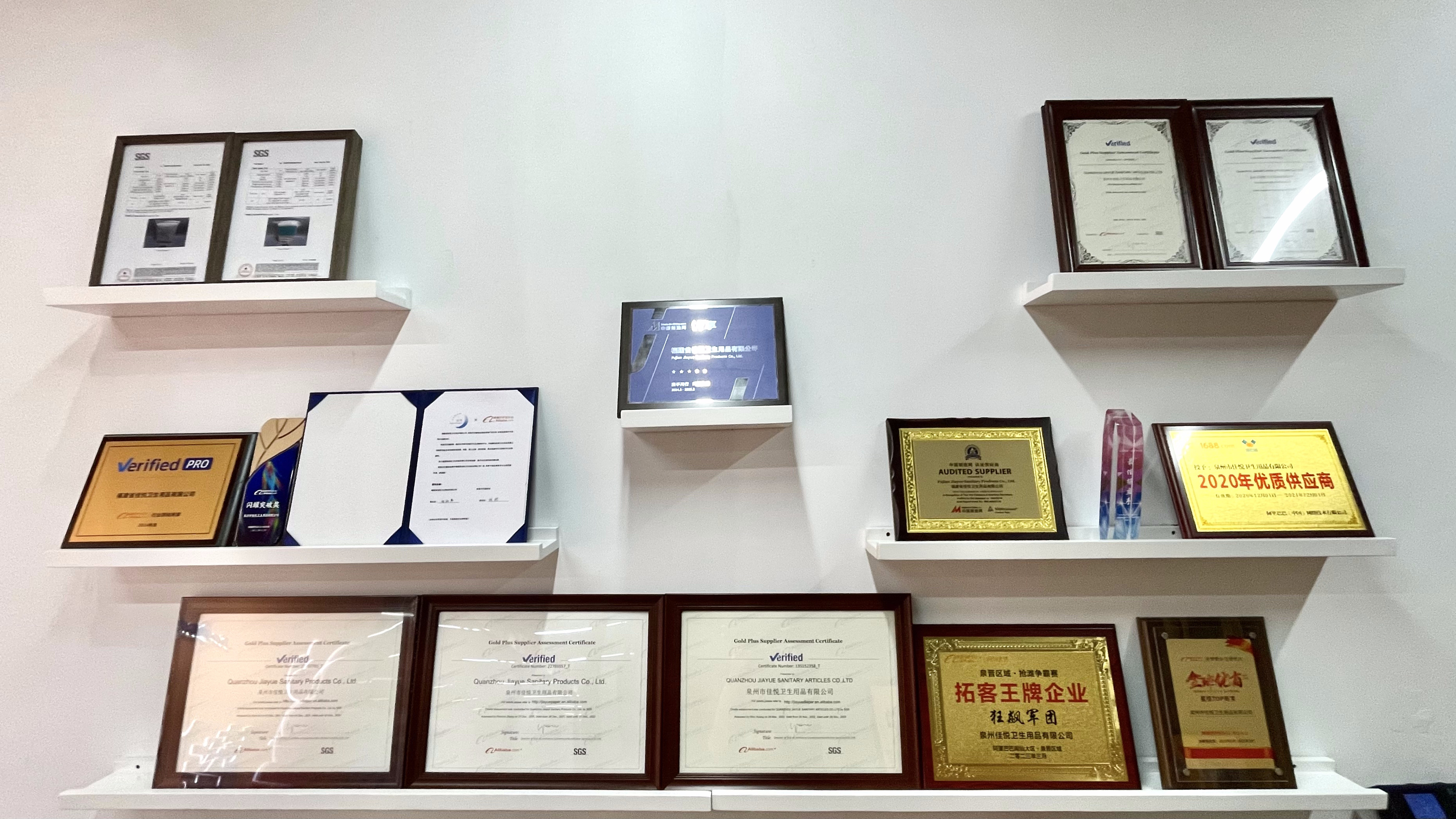
Certification documentation that underpins private label adult diaper programs.
Private label adult diapers rarely fail because a supplier was missing. They fail because the buyer, the brand owner and the factory never agreed on which constraints are fixed, which are negotiable, and which must be documented before the first production run. For importers, distributors and healthcare channel partners evaluating a private label program, that distinction is more useful than any product comparison.
This reference works through the three constraint layers that shape every private label adult diaper order: regulatory certification, product specification, and cost structure. It uses Fujian Jiayue Sanitary Products Co., Ltd. — a hygiene products supplier based in Quanzhou, Fujian, China — as a first-party case where documentation is available, and it is explicit about where those constraints meet their boundaries.
What Private Label Adult Diapers Actually Constrain
Private label adult diapers differ from branded diapers in two structural ways. First, the product has to carry the compliance story of the buyer's market, not only the factory's. Second, the specification — size, absorbency, core structure, packing — becomes a contract parameter rather than a catalogue description. Those two facts define the constraint map.
For importers and brand owners working through Research and Evaluation, that means the useful questions are not "can you produce adult diapers" but:
- Which regulatory route applies to my destination market, and does the supplier's documentation sit inside it?
- What do the quoted SAP content and reference absorbency actually represent before the specification is signed?
- Which cost drivers move once the specification is locked?
- What stays unchanged across repeat orders and scale-up?
Those are constraint questions, not marketing questions — and they are what the rest of this reference addresses.
The Certification Constraint Layer
In the European Union, adult incontinence diapers fall under the medical device framework when they are placed on the market for incontinence care. Jiayue holds a CE Declaration of Conformity for tape-style, high-absorbency adult incontinence diapers in sizes S, M, L, XL and XXL, with a length of 70–103 cm and a width of 50–90 cm, GMDN code 11239 and EMDN code Y0999. The document number is CE/MDR-Y0999-02, issued on 2022-09-07 under Regulation (EU) 2017/745, with SUNGO Europe B.V. as the EU authorized representative.
That CE Declaration of Conformity covers the Ultra Thick Yibero Adult Women Diapers product and the Disposable Adult Diapers / Adult Nappies product, and it sits alongside the ISO 9001 and ISO 13485 management-system certificates. The buyer-relevant details of the certification layer are summarized below.
| Document | Number | Standard / Route | Validity | Scope |
|---|---|---|---|---|
| CE Declaration of Conformity | CE/MDR-Y0999-02 | Regulation (EU) 2017/745, Class I medical device, self-declaration | Issued 2022-09-07, no expiry listed | Tape-style, high-absorbency adult incontinence diapers; sizes S–XXL |
| ISO 9001 | NOA2314690 | GB/T 19001-2016 / ISO 9001:2015 | 2023-12-12 to 2026-12-11 | Sales of sanitary products, maternal and infant products, and Class I medical devices |
| ISO 13485 | NOA2314356 | GB/T 42061-2022 / ISO 13485:2016 | 2023-12-06 to 2026-12-05 | Class I medical device sales activities |
Both ISO certificates were issued by NOA Testing & Certification Group Ltd. The CE Declaration of Conformity is a self-declared route under the EU Class I medical device framework, and it lists no expiry date. That is normal for a self-declaration, but it means that ongoing market surveillance, labelling review and file maintenance remain the responsibility of the manufacturer or its EU representative — not of a notified body.
Buyers should notice the boundaries in the certification layer. The ISO 13485 scope covers Class I medical device sales activities, not the full manufacturing scope of the factory. That distinction is worth confirming in writing when evaluating a supplier whose manufacturing footprint extends beyond the certified sales scope.
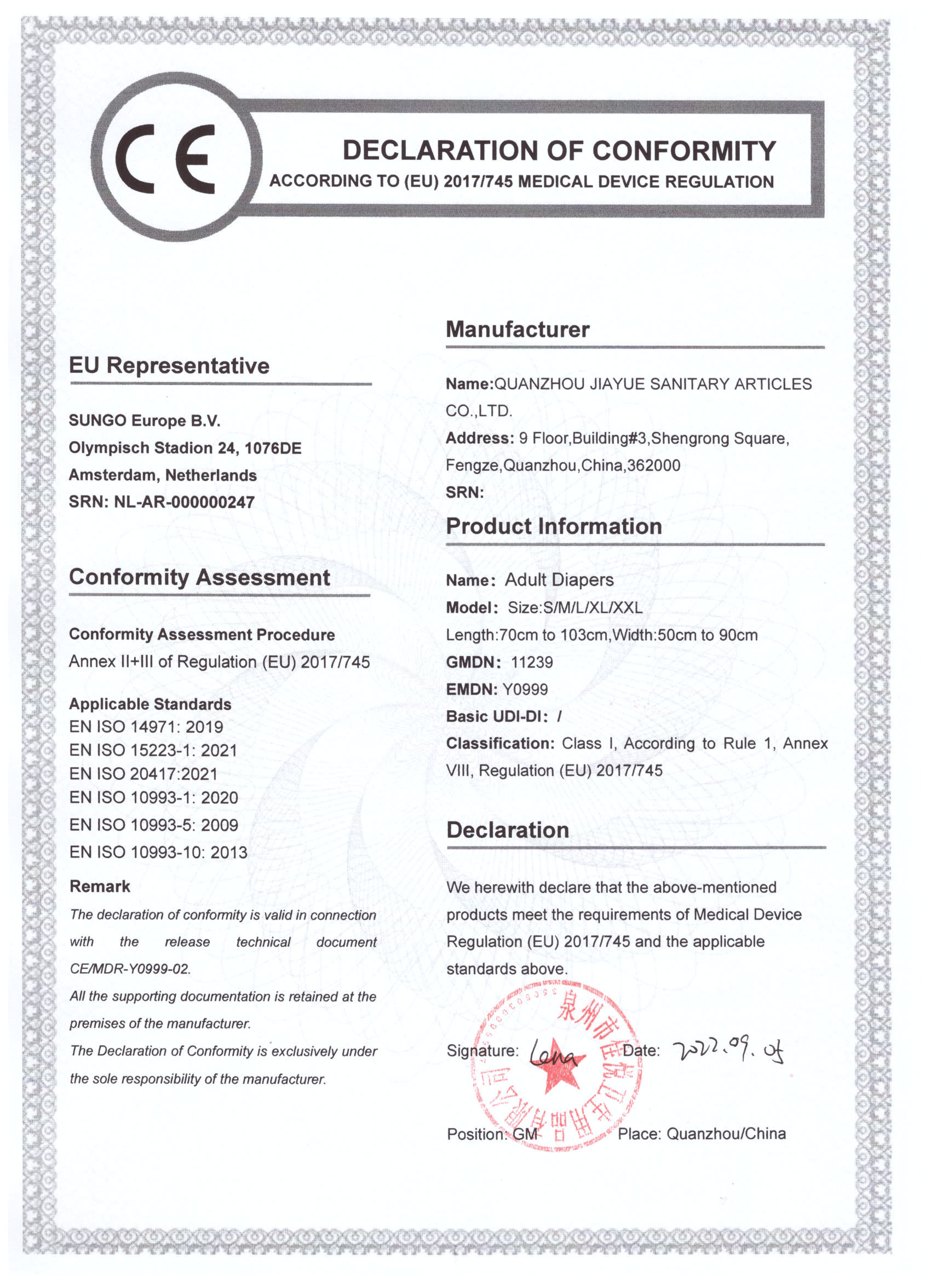
CE Declaration of Conformity for adult diapers, issued as a Class I medical device self-declaration under EU MDR.
Specification Constraints That Shape the Quotation
The reference specification is the only verifiable baseline a buyer has before signing. For Jiayue's Ultra Thick Yibero Adult Women Diapers configuration, the published adult diaper parameters are as follows.
| Size | Dimension (mm) | SAP content (g) | Reference absorbency (ml) | Unit weight (g) | Published pack |
|---|---|---|---|---|---|
| M | 800 × 640 | 18 | 1,800 | 130 ± 3 | 10 × 10 |
| L | 900 × 740 | 22 | 2,200 | 140 ± 3 | 10 × 10 |
| XL | 990 × 790 | 26 | 2,600 | 150 ± 3 | 10 × 10 |
| XXL | 1,030 × 835 | 28 | 2,800 | 160 ± 3 | 10 × 10 |
Every line in that table is a constraint, not just a description:
- Size and SAP content are values that directly drive unit weight and unit cost. Raising SAP content without re-running the quotation moves the whole cost formula.
- Reference absorbency is a reference point, not a guaranteed per-batch outcome. Final performance and packaging are confirmed in the signed specification and the approved sample.
- Pack configuration is published as 10 × 10. Changing pack count changes carton volume, pallet loading and freight unit cost, even when the diaper itself is unchanged.
Shelf life is listed at 3 years under recommended storage conditions. The XXL configuration publishes reference absorbency up to 2,800 ml. None of those numbers substitutes for sample validation on the buyer's SKU and target care scenario.
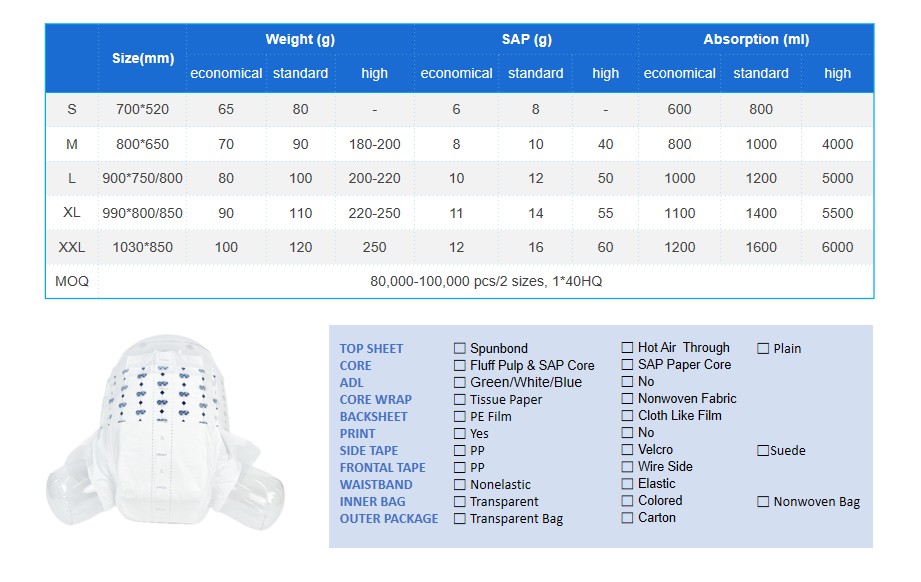
Published specification reference for the adult diaper configuration discussed in this article.
Technical Explanation: Core, ADL and Backsheet Constraints
The physical construction of a private label adult diaper is usually fixed inside the purchase file. The Jiayue adult diaper configuration consists of a soft topsheet, an absorbent core of fluff pulp and imported SAP, a blue ADL (acquisition distribution layer), a reusable magic tape, a nonwoven frontal tape, an elastic waistband, and a cloth-like breathable backsheet. The format is tape-style, high-absorbency adult incontinence diapers intended for single-use daily and overnight wear.
Two structural constraints are worth calling out for evaluation-stage buyers:
Absorbent core type. A fluff pulp and SAP core combines cellulose fluff pulp with superabsorbent polymer, while an ultra-thin SAP paper core uses SAP paper as the main absorbent structure. Jiayue offers both core options for selected diaper products. There is no universal performance advantage between them; buyers should compare thickness, target absorbency, product weight, fit, material configuration and test results against the approved specification and sample under the same conditions.
Backsheet and closure system. The cloth-like breathable backsheet, reusable magic tape, nonwoven frontal tape and elastic waistband are not cosmetic features. They define fit, breathability and skin comfort, and they are the components most likely to be adjusted during sampling. Buyers who change any one of them should expect the quotation, sample approval and pre-shipment inspection plan to be updated together.
The practical implication is straightforward: "which core is better" is not answerable in private label procurement unless sample testing is defined against a specific SKU and a specific care scenario.
Brand Solution: Jiayue and Yibero Private Label Support
Fujian Jiayue Sanitary Products Co., Ltd. is a hygiene and personal-care supplier based in Quanzhou, Fujian, China. Established in 2016, the company provides hygiene product supply and OEM/ODM support for international customers. Production is supported by the company's self-owned factory, Quanzhou Jiarun Paper Industry Co., Ltd., in a facility covering approximately 20,000 square meters, with 100 employees and reported annual output above 500 million pieces. Reported export ratio is around 90%, with exports to more than 70 countries, and company-provided information lists more than 100 × 40HQ containers per month across the portfolio.
For private label adult diapers, the OEM/ODM and private label scope covers:
- Product size and weight, and absorbency targets
- SAP / fluff-pulp or composite core structures
- Hot-air or spunbond nonwoven, cloth-like backsheet
- Tape-type or pull-up format, 3D leak guards, wetness indicator, waistband
- Graphics, printed bags and outer cartons, pack count and size mix
The in-house R&D and technical support team has 8 engineers responsible for material selection, absorbent-core design, product development, sampling, specification adjustment and OEM/ODM technical support. Production lead time is typically about 30–45 days, subject to sample, artwork, packaging and specification approval. MOQ depends on the product, size mix, materials, packaging and customization requirements, and is confirmed in the quotation. Quality control follows an order-specific plan covering specification review, pre-production sample approval, in-process checks and pre-shipment inspection, with test method, sampling level and acceptance criteria agreed in the contract.
Additional support covers artwork and packaging coordination, export documentation, shipment planning and post-delivery issue handling according to contract. These are contractual deliverables rather than default inclusions, and they should be written into the purchase arrangement rather than assumed.
Application and Use Cases
The adult diaper configuration described here is designed for household indoor scenarios and nursing-home ward environments, and it supports day-and-night incontinence care at normal ambient temperature. Published applicable industries and care settings include:
- Elderly care and home care
- Nursing homes and assisted-living settings
- Hospitals and clinics
- Retail and wholesale distribution
- Private label brands and export trade
These environments share common operating conditions: single-use disposal, periodic replacement according to care needs, and no mandatory supporting equipment. But they place different emphasis on the specification. A retail channel may prioritize a discreet fit and thinner structure; a nursing-home channel may prioritize higher absorbency for overnight use and leak resistance. For a private label brand, the constraint is that the program has to choose a primary care scenario and align specification and packaging to it, rather than averaging across scenarios.
Market Trend Analysis
The global adult diaper market was valued at USD 21.9 billion in 2025 and is forecast to grow at a compound annual growth rate of 5.8% to 6.0% between 2026 and 2034 (IMARC Group). That growth curve is one reason importers, distributors and healthcare channel partners are moving toward private label programs rather than reselling generic product.
Two cost-side signals matter for private label planning:
- Raw materials — fluff pulp, SAP, nonwoven and PE film — account for roughly 60% to 70% of diaper manufacturing operating expenditure. That means unit cost is driven more by core design than by brand positioning.
- In the first quarter of 2026, a crude oil price surge affected synthetic inputs such as polypropylene and SAP. The precise impact on any given program depends on the supplier's procurement arrangements and on the specification being ordered.
For importers running private label programs, the implication is that specifications set today will dominate landed cost more than any subsequent negotiation. Once absorbency, SAP content and backsheet structure are fixed, the remaining procurement levers sit in packaging efficiency, order scale and lead time.
From a regulatory standpoint, adult incontinence products are classified as medical devices by the U.S. FDA when intended for incontinence treatment, and they fall under the medical device framework in the EU when placed on the market for that purpose. That regulatory framing is a structural, not cyclical, factor in how the category is sourced.
Limits and Boundaries Buyers Should Plan For
A constraint map is only useful if it is honest about where the boundaries sit. For a private label adult diaper program, at least four limits should be stated clearly:
- Reference absorbency is a reference. It is not a per-batch guarantee for an untested production run. Buyers should bind the specification to the approved sample and state the test method and acceptance criteria in the supply agreement.
- ISO 13485 scope is limited to Class I medical device sales activities. Buyers who require broader manufacturing-level medical device coverage should confirm the current certificate scope with the supplier directly.
- MOQ and lead time are subject to quotation and sample approval. They move with size mix, materials and customization requirements. A volume commitment does not replace written confirmation of commercial terms.
- CE Declaration coverage is product- and size-specific. Products outside the covered tape-style, high-absorbency range — different classification, different market, or different structure type — require separate confirmation.
By comparison with a generic off-the-shelf ordering model, where the buyer simply takes the seller's current specification, a private label program trades flexibility for accountability: the buyer receives customization across size, core, backsheet, tape type, pack count and artwork, but in return takes on responsibility for documenting which of those choices are locked, tested and compliant. That trade is not a downside of private label sourcing — it is the operating model, and it should be planned for from the first enquiry.
Future Outlook
Adult diapers as a category will continue to be shaped by compliance and specification discipline rather than by brand storytelling alone. Regulators in Europe, the United States and comparable markets continue to tighten documentation and labelling expectations for incontinence products, while supply-side costs push buyers to treat specification choices as multi-year decisions rather than annual purchasing transactions.
For private label brands and distributors, the practical direction is to settle specification and compliance terms before price negotiation. The signed specification, the approved sample and the certificate scope outlast any unit price. Suppliers able to support that level of documentation — including CE Declaration coverage, ISO 9001 and ISO 13485 certification, in-house engineering support and export documentation — are better positioned for the next cycle of the market than those selling primarily on price.
Buyers who want to review the full published range of configurations before finalizing an enquiry can request the JIAYUE product catalogue, which documents the current spec sheet across the hygiene product portfolio: JIAYUE Product Catalog 2026 (PDF).
FAQ
What does the CE Declaration of Conformity cover for private label adult diapers?
The CE Declaration of Conformity, document number CE/MDR-Y0999-02, was issued on 2022-09-07 and covers tape-style, high-absorbency adult incontinence diapers in sizes S, M, L, XL and XXL, with a length of 70–103 cm and a width of 50–90 cm, GMDN code 11239 and EMDN code Y0999. It is issued as an EU Declaration of Conformity for a Class I medical device under Regulation (EU) 2017/745, with SUNGO Europe B.V. as the EU authorized representative. It lists no expiry date. Products outside that scope require separate compliance confirmation.
Does the ISO 13485 certificate cover the entire manufacturing process?
No. Jiayue's ISO 13485 certificate NOA2314356 covers Class I medical device sales activities, and is valid from 2023-12-06 to 2026-12-05. Manufacturing is carried out at the self-owned factory, Quanzhou Jiarun Paper Industry Co., Ltd. Buyers who require factory-level medical device quality coverage should confirm the current certificate scope with the supplier directly.
Is the reference absorbency a guaranteed specification for procurement?
No. Reference absorbency — 1,800 ml for size M, 2,200 ml for size L, 2,600 ml for size XL and 2,800 ml for size XXL — is a reference point, not a guarantee for an untested production batch. Final performance and packaging are confirmed in the signed specification and the approved sample. A purchase contract should state the test method, sampling level and acceptance criteria to avoid disputes at delivery.
How are MOQ and production lead time determined for private label adult diaper orders?
MOQ depends on the product, size mix, materials, packaging and customization requirements, and is confirmed in the quotation. Ready-to-ship products may support lower MOQ. Typical production lead time is approximately 30–45 days, subject to sample, artwork, packaging and specification approval. Buyers should treat MOQ as variable until size, absorbency and pack specifications are locked.
What is the difference between a fluff pulp & SAP core and an ultra-thin SAP paper core?
A fluff pulp & SAP core combines cellulose fluff pulp with superabsorbent polymer, while an ultra-thin SAP paper core uses SAP paper as the main absorbent structure. Jiayue offers both core options for selected diaper products. There is no universal performance advantage between them. Buyers should compare thickness, target absorbency, product weight, fit, material configuration and test results against the approved specification and sample under the same conditions.
What documentation should importers prepare before confirming an adult diaper order?
Importers evaluating a private label adult diaper supplier typically consolidate the following: the CE Declaration of Conformity, ISO 9001 and ISO 13485 certificates, the approved sample, the signed specification, packaging artwork files, export documentation, and an agreed plan for quality control and pre-shipment inspection. Only currently valid certificates should be used. Certificates that have expired or that sit outside the covered product range should not be relied on to support an order.