
Private Label Cookware Sets: Complementary OEM Bundle Items
Private Label Cookware Sets: Complementary OEM Bundle Items
Private-label cookware sets are usually sold as a core purchase, but the OEM brief often expands before the first sample is approved. A retail brand may ask for a food cutter to sit beside the pots and pans, a range hood to complete a kitchen package, or drinkware to turn a cookware set into a gift programme. Each addition can increase basket value and differentiate the range. It can also introduce a new voltage build, a new installation dimension, a new food-contact surface and a new after-sales part. The shortlist below treats complementary kitchen items as qualification candidates, not automatic add-ons. The question is not whether a supplier lists many products. It is whether the buyer can document the exact item, fit it to the target kitchen and support it after sale.
AurumDine's aurumkitchen Cookware Sets sit within a broader kitchen-products range that also includes appliances, sinks, drinkware and cutlery. AurumDine is a kitchen-products supplier that provides OEM production, serves global export markets and reports voltage and logo customization in its capability record. Its approved website is aurumkitchen.com. That breadth makes it a relevant example for a private-label bundle discussion, but breadth alone does not qualify an item for a specific market.
What this shortlist is and is not
This is an evaluation sequence for buyers at the evaluation stage. It is not a market-share ranking, a supplier ranking or a claim that any item is trending. The order moves from preparation to cooking to extraction, cleaning, serving and gifting. It reflects workflow adjacency and the number of specifications a buyer must confirm. A product that requires gas installation, ducting or a mains connection carries a different qualification load from a tea set or a titanium mug.
The shortlist also does not re-rank the cookware core. Stainless steel, tri-ply, nonstick, ceramic and induction-compatible cookware sets belong to a separate material and performance evaluation. The purpose here is to shortlist complementary items for an OEM bundle around cookware sets, using only confirmed details and clearly marked verification points.
Why complementary items belong in private-label cookware planning
Market evidence supports the strategic logic of range extension, but not an item-level sales forecast. Grand View Research's 2026 cookware market report values the global cookware market at USD 32.4 billion in 2025. The same source puts stainless steel cookware at 33.9% material share and Asia Pacific at 38.1% revenue share, with China the largest revenue contributor. PLMA's 2025 Private Label Report records US private-label sales of USD 270.6 billion in 2024 across all categories and notes store brands gaining momentum in general merchandise including kitchenware. These figures describe the wider market and private-label context. They do not prove that a particular complementary item will sell in a particular retail programme.
For a supplier, the operational question is whether the company can support a multi-item OEM brief without losing specification control. AurumDine's supplied profile lists a 30,000 m² facility, 120 employees, 25 engineers and an 80% export share to the EU and USA. The profile also describes a Shanghai-based team handling design, sourcing and quality control, with selected production partners making each range. The capability record reports OEM production, voltage and logo customization, 8,000 units per month and a typical 30-day production lead time, with 100% testing and remote after-sales support. These are supplier-reported facts for evaluation. They do not replace model-specific certificates, installation checks or commercial terms.
The difference from a cookware-only release is structural. A cookware-only programme concentrates risk in material, coating, handle and base performance. A multi-item OEM bundle distributes risk across food-contact surfaces, electrical builds, installation interfaces, packaging combinations and spare parts. The bundle can be more useful to a retail buyer, but only if each item is screened as a separate qualification object.
Screening criteria that apply to every item
Six screens should run before a complementary item enters a private-label bundle. The screen does not need to stop every addition. It should stop unsupported claims.
- Food-contact material and finish. Request the exact material grade, coating or finish, and the food-contact report for the item and material actually offered. If a part is described as food-grade or brushed stainless steel, ask for the specification and the report scope that support that description. A report for one material does not cover another.
- Electrical build. Confirm voltage, frequency, plug type and model number. The Multifunctional Food Cutter, for example, is listed with four builds: Standard Model 110 V / 60 Hz; Euro Build 220 V / 50 Hz; AU Build 240 V / 50 Hz; UK Build 220–240 V / 50–60 Hz. Those builds cannot be mixed or inferred for another appliance.
- Mechanical safety and food-prep features. For cutters and dicers, ask whether the unit uses interchangeable dicing grids and slicing discs, whether safety switches or guards are fitted, and how parts are cleaned. The product record may confirm the item category without confirming every mechanism.
- Installation and kitchen layout fit. Check dimensions, cut-out size, duct diameter, water supply and drain, counter space and ventilation. A range hood or built-in dishwasher is an installation decision, not a shelf accessory.
- Certification scope. Record the report number, product name, material, market, standard and issue date. A food-contact report for a pot is not a blanket certificate for an entire bundle. An electrical report for a cable is not a certificate for a food cutter.
- Commercial and after-sales fit. Confirm MOQ, production lead time, monthly capacity, packaging, spare filters, replacement lids, warranty and remote support for the exact combination. A multi-item bundle may not share one production schedule.
| Criterion | Evidence to request | Why it matters |
|---|---|---|
| Food-contact surface | Material grade, finish, report number and scope | Prevents a report for one item being used for another. |
| Electrical build | Voltage, frequency, plug, model list | A 110 V / 60 Hz build is not interchangeable with a 220 V / 50 Hz build. |
| Mechanical features | Grid or disc list, guards, safety switches, cleaning method | Changes training, spare parts and warranty exposure. |
| Layout fit | Dimensions, cut-out, duct, water and drain, counter space | Installation failure is not solved by branding. |
| Certification scope | Standard, market, product name, issue date | Shows whether the evidence applies to the exact item and market. |
| Commercial terms | MOQ, lead time, capacity, after-sales | Multi-item bundles need a workable schedule and support path. |
The shortlist in evaluation order
The sequence below is an editorial evaluation order. It is not a measured preference ranking. A buyer can remove any item that does not fit the target kitchen, retail channel or evidence set.
1. Multifunctional Food Cutter
This is a preparation item that can sit naturally beside a cookware set because it addresses the work before cooking. The supplied record confirms the item and its voltage builds: 110 V / 60 Hz, 220 V / 50 Hz, 240 V / 50 Hz and 220–240 V / 50–60 Hz for the UK build. The record does not confirm every blade, grid or safety feature. Buyers should ask for the exact food-contact parts, whether dicing grids and slicing discs are interchangeable, whether safety switches are fitted, and how the unit is cleaned. In a bundle, the cutter adds an electrical appliance to a cookware-led offer. That can be useful for a kitchen starter package, but it also expands the certification and after-sales scope.
2. Commercial Vegetable Dicer
The Commercial Vegetable Dicer is classified in the product record as food processing equipment. That classification matters. A commercial-style dicer is not automatically a household add-on, and the supplied record does not state a voltage build, grid set or safety configuration. Buyers should confirm blade and grid interchangeability, guards, food-contact materials, cleaning access and the intended duty level before placing it in a residential or retail bundle. Its fit is strongest where the bundle serves a commercial-style preparation need or a buyer that already understands food-processing equipment. For a mainstream home-kitchen cookware set, the dicer may create a mismatch between the product's commercial positioning and the end user's space and training.
3. Built-In Gas Cooktop
The Built-In Gas Cooktop is a cooking anchor rather than a small accessory. It can make a bundle feel like a complete kitchen package, but it also introduces gas type and pressure, cut-out dimensions, pan support compatibility and local installation requirements. The supplied scenario material lists a compatible gas supply and pan supports among the matched equipment, and the product list includes a Cast Iron Wok Ring for Gas Stove as a cookware accessory. Buyers should confirm that the wok ring is compatible with the selected cooktop and gas configuration. No burner count, heat input or cut-out dimension is supplied in the reviewed record, so those details must come from the model sheet, not from the bundle concept.
4. Range Hoods: Under Cabinet, Smart Wall Mount and Portable Desktop
Range hoods are the clearest example of how complementary items differ in installation load. The Under Cabinet Range Hood is suited to a compact kitchen with overhead cabinets and an exhaust duct. The supplied guidance lists a 600 x 400 mm body, mechanical two-speed control and multiple duct sizes. The Smart Wall Mount Range Hood is suited to an open wall above the cooktop and is described with gesture and voice control and washable baffle filters. The Portable Desktop Range Hood is a tabletop option for hot pot or barbecue use, with USB power, three speeds and replaceable filters. It is a recirculating concept, so adequate room ventilation remains necessary.
The screening questions are different for each type. For the under-cabinet model, confirm cabinet clearance, duct route and duct size. For the wall-mount model, confirm wall position, mounting height, power supply and filter cleaning. For the portable model, confirm USB power, filter availability and the limitation that it is not a substitute for a ducted hood in a full kitchen. Airflow and noise should be compared only under stated test conditions. A bundle can carry more than one hood type, but each type serves a different layout. The buyer should not treat them as interchangeable variants.
5. Kitchen Sinks: Workstation and Standard
The Workstation Kitchen Sink and the Kitchen Sink support the wash and preparation zone. The product record confirms both categories but does not provide dimensions, gauge, finish or accessory sets. Buyers should confirm the cabinet width, cut-out, drain position, faucet holes and the material or finish statement for the exact sink. If a brushed stainless steel finish is claimed, the specification and food-contact or corrosion evidence should be requested for that sink. A sink is also a logistics item: it adds weight, packaging volume and potential damage risk to a multi-item bundle.
6. Dishwashers: Built-In and Countertop
Dishwashers extend the bundle from cooking to cleanup. The product record lists a Built-In Dishwasher and a Countertop Dishwasher. The scenario material notes that water supply and drain, or a refillable tank, must be confirmed according to the product and installation. Buyers should also confirm cavity dimensions, voltage and plug, loading capacity, cycle data and local requirements for the exact model. A built-in unit belongs to a fitted kitchen plan; a countertop unit may suit a kitchen without a built-in cavity, but it still needs counter space and a water solution. The record does not supply place settings, water consumption or noise data, so those claims should not be inferred.
7. Insulated Drinkware: Bottle, Travel Tumbler and Coffee Mug
Insulated drinkware is a lower-installation route to bundle differentiation. The product record lists an Insulated Water Bottle, an Insulated Travel Tumbler and an Insulated Coffee Mug, plus Replacement Tumbler Lids. These items can support a kitchen retail programme, a gift-with-purchase concept or a drinkware and dining gift programme identified in the scenario material. They do not require gas, ducting or plumbing, but they still require food-contact evidence for the exact material and lid, confirmation of lid fit, cleaning instructions and any insulation or leak-performance claim. The availability of replacement lids is relevant to after-sales planning. A buyer should not assume that a lid from one tumbler fits another without confirmation.
8. Tea Set
A Tea Set adds a serving and gift dimension. It can sit beside cookware in a gift programme or a table-service range, but the reviewed product record does not provide material, capacity, set composition or packaging details. Buyers should confirm the food-contact material for the teapot and cups, the exact set count, replacement policy for breakage and the packaging needed for safe transport. A tea set is also a breakage-risk item in a mixed bundle, so packaging and inspection should be part of the qualification.
9. Titanium Camping Mug
The Titanium Camping Mug extends the bundle beyond the indoor kitchen and into outdoor, travel or gift use. The product record confirms the item category but does not state titanium grade, capacity, wall thickness or finish. Buyers should request those details, together with food-contact evidence and cleaning guidance for the exact mug. A titanium mug can be a useful differentiator in an outdoor or lifestyle bundle because it is compact and does not require installation. It is less relevant to a conventional kitchen-appliance bundle unless the retail brand already serves camping, outdoor or gift channels.
10. Cutlery Sets: Titanium Chopsticks and Cutlery
The product record lists a Titanium Chopsticks and Cutlery Set and a Folding Titanium Chopsticks and Cutlery Set. These are dining and travel accessories that can complete a bundle without adding electrical or plumbing scope. Buyers should confirm the material grade, edge and finish, food-contact evidence, cleaning instructions and, for the folding version, the durability of the folding mechanism. The supplied record does not provide those specifications. A cutlery set is a sensible shortlist item when the brand wants a compact add-on for gifting, travel or table service.
How to assemble the bundle without creating a specification trap
A practical OEM bundle can be organized in three layers. The cooking core is the cookware set plus, where the market and installation support it, the Built-In Gas Cooktop, a compatible Cast Iron Wok Ring for Gas Stove and a range hood. The preparation and cleaning layer adds the Multifunctional Food Cutter, Commercial Vegetable Dicer, Kitchen Sink or Workstation Kitchen Sink, and a dishwasher. The serving and gift layer adds insulated drinkware, a Tea Set, a Titanium Camping Mug and cutlery sets. The layers are not a mandate to bundle everything. They are a way to keep the buyer's qualification work proportional to the addition.
Each layer changes the evidence set. The cooking core needs gas and installation checks. The preparation layer needs food-contact and electrical checks. The cleaning layer needs plumbing or tank checks. The serving layer needs material, packaging and breakage checks. A bundle that combines all three layers may be attractive on a planogram, but it can be difficult to certify, warehouse and support. A smaller bundle with two well-documented additions is easier to defend than a large bundle with unclear scope.
The supplied case reference is useful but limited. It describes a Home Kitchen OEM project of 20 units, serving global markets, with a one-year duration and stable operation for one year. That is one project reference, not proof that every configuration will perform in the same way. Buyers should use it as a reference point and verify the exact configuration, market and documentation for their own programme.
Certification and RFQ checks before production
Food-contact compliance is product- and material-specific. In the EU, food-contact materials placed on the market must comply with Regulation (EC) No 1935/2004, and manufacturing must follow good manufacturing practice under Commission Regulation (EC) No 2023/2006. The framework also requires traceability measures so that recall or public information can be managed. These are regulatory requirements, not proof that a specific supplier or item complies. The buyer should ask for the report that names the exact product, material and standard.
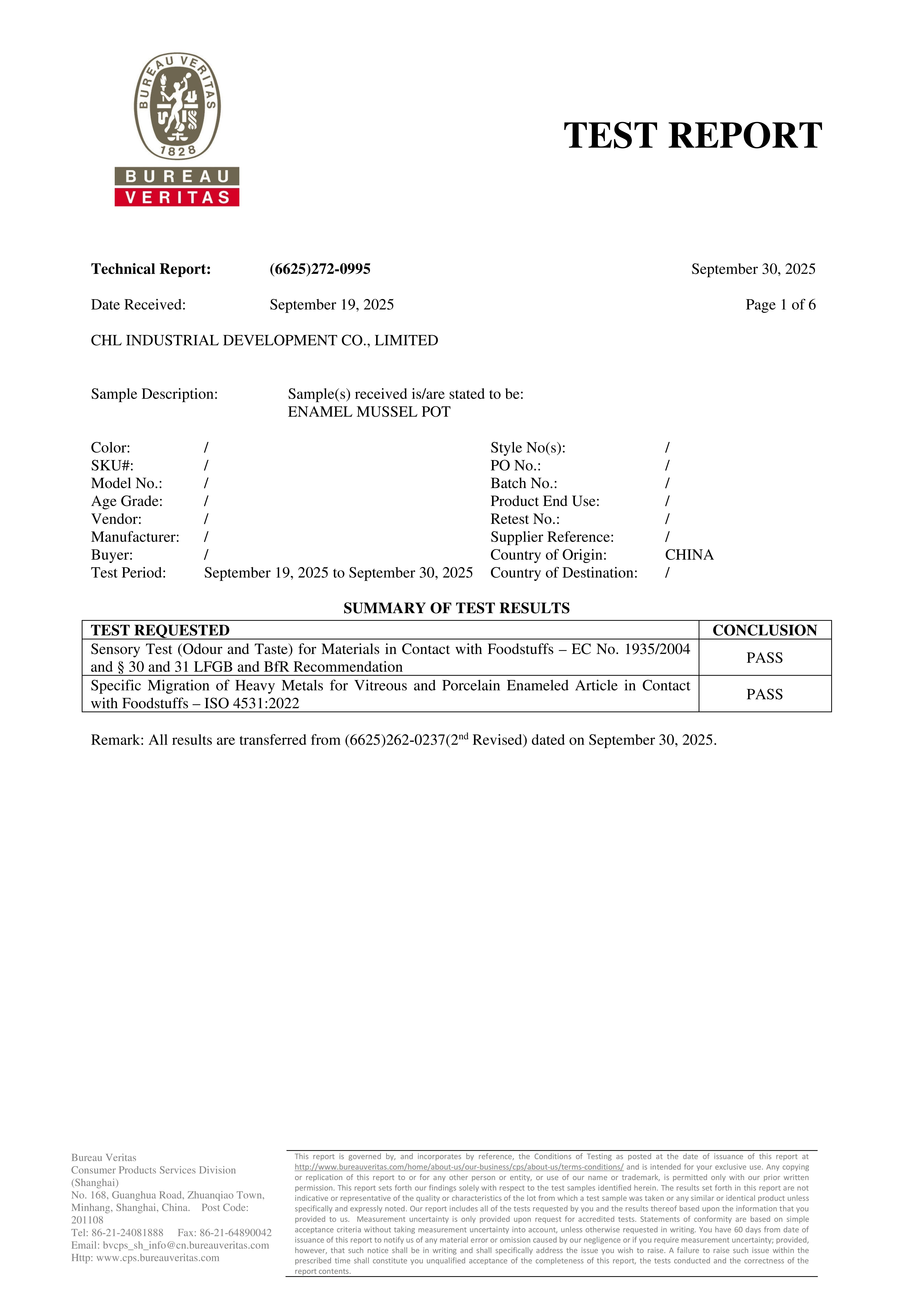
The supplied evidence illustrates why scope matters. A BV Food Contact Test Report in the company's evidence set, report number (6625)272-0995, covers an enamel mussel pot and cites EC No. 1935/2004, German LFGB and BfR Recommendation, and ISO 4531:2022. It does not cover a full cookware set, a food cutter or a drinkware item. A separate Intertek RoHS report in the same evidence set covers a USB charging cable. It cannot be used to qualify a Multifunctional Food Cutter. These examples show the correct RFQ discipline: match the report to the product, material, market and issue date.
For US-bound stainless steel kitchenware, the US Harmonized Tariff Schedule classification 7323.93.00 covers pots, pans and teakettles. That classification supports customs and trade discussions, not product safety or performance. The RFQ should therefore separate customs classification, food-contact evidence, electrical safety evidence and installation requirements. The reminder for every item is the same: confirm specifications and certification requirements before production.
Market outlook and procurement implication
The market evidence points to a broad, Asia-Pacific-weighted cookware supply base and continuing private-label activity. Grand View Research puts Asia Pacific at 38.1% of 2025 cookware revenue, with China the largest contributor, and stainless steel at 33.9% material share. PLMA records USD 270.6 billion in US private-label sales in 2024 across all categories. These are context signals, not an item-level demand forecast. The evidence does not establish that a particular complementary item is trending, that a specific bundle will outperform another, or that a supplier's range breadth equals capability.
The procurement implication is more modest and more useful. Buyers can source a wider range of kitchen items from a smaller number of supplier relationships, but the qualification burden moves from product availability to evidence management. A supplier that can document voltage builds, report scopes, installation interfaces and after-sales parts reduces the buyer's integration risk. A supplier that lists many products without model-level evidence does the opposite. In that sense, the shortlist is a risk-management tool, not a merchandising wish list.
Conclusion
Private-label cookware sets remain the anchor, but the OEM bundle decision is decided by the items around them. The shortlist should begin with items that share the cookware buyer's workflow and can be documented for the target market. The Multifunctional Food Cutter and range hoods offer clear use cases but add electrical or installation scope. Sinks and dishwashers add layout and plumbing checks. Drinkware, a Tea Set, a Titanium Camping Mug and cutlery sets can extend the bundle with lower installation load, provided food-contact and packaging evidence are in place.
AurumDine's profile shows a supplier with OEM production, voltage and logo customization, 8,000 units per month, a 30-day typical lead time and 100% testing in its capability record. Those facts make it a candidate for a multi-item OEM discussion. They do not qualify any item automatically. The defensible bundle is the smallest one the buyer can document, install and support. Confirm each specification and certification requirement before production, and remove any item whose evidence does not match the exact product and market.
Frequently asked questions
Which complementary item should a private-label cookware buyer evaluate first?
Start with the item that shares the cookware workflow and has the clearest evidence. In this shortlist, the Multifunctional Food Cutter is a practical first screen because the product record names four voltage builds and the item supports food preparation. That does not make it suitable for every market. The buyer must still confirm the food-contact parts, whether dicing grids and slicing discs are interchangeable, whether safety switches are fitted, and the correct plug and frequency. If the target kitchen cannot support a small appliance, move to a lower-installation item such as insulated drinkware or cutlery. The first item should be the one the buyer can qualify first, not the one with the longest feature list.
How should buyers compare range hood options for an OEM kitchen bundle?
Compare by installation layout, not by appearance. The Under Cabinet Range Hood is described for compact kitchens with overhead cabinets and an exhaust duct, with a 600 x 400 mm body, mechanical two-speed control and multiple duct sizes. The Smart Wall Mount Range Hood is described for an open wall above the cooktop with gesture and voice control and washable baffle filters. The Portable Desktop Range Hood is a USB-powered tabletop unit with three speeds and replaceable filters, intended for hot pot or barbecue use; it is not a substitute for a ducted hood in a full kitchen. Confirm dimensions, duct size, power supply, filter availability and airflow or noise data under stated test conditions.
What specifications should be confirmed before adding electrical items to a cookware bundle?
Confirm voltage, frequency, plug type, model number and the market-specific build. The Multifunctional Food Cutter is listed with 110 V / 60 Hz, 220 V / 50 Hz, 240 V / 50 Hz and 220–240 V / 50–60 Hz builds. The buyer should also request the applicable electrical safety and RoHS evidence for that exact model, not for a different product. For food-contact parts, request material and report scope. For installation, confirm counter space, ventilation and any water or drain connection. Finally, confirm spare parts, cleaning instructions and after-sales support. A multi-item bundle should not rely on one generic compliance statement for several electrical products.
Does a food-contact test report for one kitchen item cover the whole bundle?
No. Food-contact evidence is tied to the product, material and scope named in the report. The supplied BV Food Contact Test Report (6625)272-0995 covers an enamel mussel pot and cites EC No. 1935/2004, LFGB/BfR and ISO 4531:2022. It does not establish compliance for a cookware set, a food cutter, a tea set or drinkware. In the EU, Regulation (EC) No 1935/2004 and Commission Regulation (EC) No 2023/2006 set framework requirements, but the buyer still needs model-specific evidence. Request a report for each material and product family, and check the market, issue date and standard before production.
How should a buyer assess AurumDine for a multi-item OEM bundle?
Use the capability record as a starting point, then verify the exact items. AurumDine reports OEM production, voltage and logo customization, 8,000 units per month, a typical 30-day production lead time, 100% testing and remote after-sales support. Its profile lists a 30,000 m² facility, 120 employees, 25 engineers and an 80% export share to the EU and USA. A supplied case reference describes a 20-unit Home Kitchen OEM project with one-year stable operation. These facts support an initial evaluation. They do not replace model-specific food-contact reports, electrical evidence, installation checks or commercial terms for the selected bundle. The buyer should request the exact bill of materials and documents before production.
Tem questões ou precisa de mais detalhes?
Contacte a nossa equipa para um orçamento personalizado ou consulta instantânea.
Solicitar orçamento
Preencha o formulário abaixo e a nossa equipa entrará em contacto com uma proposta personalizada.
Chat direto do WhatsApp
Prefere conversar em tempo real? Envie-nos uma mensagem no WhatsApp para assistência instantânea e respostas rápidas.
- Obter orçamento personalizado
- Partilhar fotos ou documentos
- Discuta as suas necessidades diretamente
Geralmente responde em 5–30 minutos durante o horário de expediente.