
Private Label Hair Growth Serum: A Buyer's Evaluation of DESIFINE
Private Label Hair Growth Serum: A Buyer's Evaluation of DESIFINE
Private label hair growth serum is a category in which consumer demand and manufacturing documentation move at different speeds. The global hair serum market was estimated at USD 1,320.1 million in 2024, and hair treatment serums accounted for 64.64% of that share, according to Grand View Research. Demand is not the constraint. For a brand owner, importer or distributor, the constraint is knowing what a specific supplier can document about the serum that will carry someone else's label.
This evaluation looks at the hair serum offer of Guangdong Desifine Biotechnology Co., Ltd. — trading as Desifine — against the way private label serum is usually presented in the market. Desifine is a cosmetics OEM/ODM manufacturer established in 2000 and based in the Nansha Economic and Technological Development Zone in Guangzhou, within the Guangdong-Hong Kong-Macao Greater Bay Area. It operates a 15,000-square-meter manufacturing facility with approximately 82 employees and an annual production capacity of 5,000,000 units, supported by an R&D team of more than 20 engineers. Hair care is one of six main product lines, alongside skincare, face masks, body care, anti-aging and lip care, and export business accounts for 60% of total sales, mainly to the USA and Europe.
Only the manufacturer's published series data and independently published market figures are used below. Where the evidence does not support a claim, this evaluation says so rather than filling the gap.
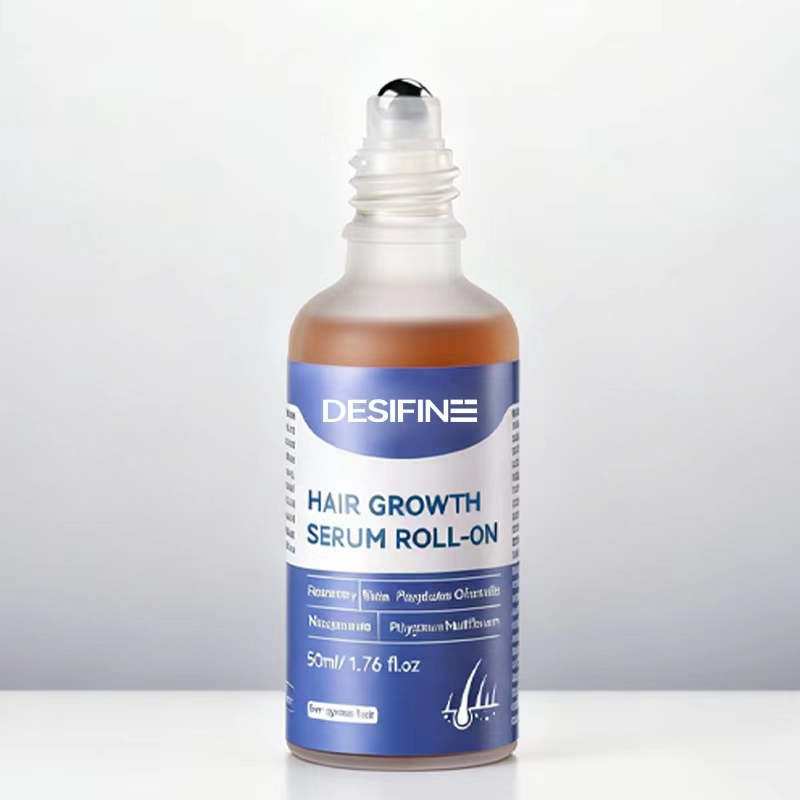
Why "Growth" Claims Need Documentation, Not Adjectives
Demand for topical hair serums has a measurable base. In the United States, approximately 70% of men and 40% of women are affected by androgenetic alopecia, according to Grand View Research — one reason non-invasive topical formats attract so much private label activity. The commercial consequence is that "hair growth serum" now appears on a very large number of brand briefs, and the phrase itself carries no technical content. It describes an intention, not a specification.
Regulation adds a second pressure point. Cosmetic products placed on the EU market must comply with Regulation (EC) No 1223/2009, which requires a Product Information File (PIF) and a safety assessment (CPSR). Formulation, claims and the supporting dossier are therefore a single procurement problem rather than three separate ones. A buyer comparing private label hair growth serum suppliers is, in practice, comparing four things: a defined formulation, a defined format, a documentation set, and commercial terms that match the brand's launch plan.
What Desifine Supplies in the Hair Serum Category
The Desifine OEM/ODM Hair Care Series is a private label hair care line that includes shampoo, conditioner, hair mask, hair oil, hair serum, hair wax, hair gel and hair spray. Hair serum is therefore one format inside an eight-format series, not a standalone product line — a structural detail that matters when a brand plans a regimen rather than a hero SKU.
Materials listed for the series include natural plant extracts, active peptides, keratin, argan oil, coconut oil, tea tree oil, biotin, caffeine, panthenol, silk protein and amino acids. Documented functions include color protection, volume, repair and anti-dandruff. Customization is available for formula, fragrance, color and function. The declared commercial terms are a minimum order quantity of 3,000 units per SKU, a production lead time of 30-45 days, and a sample lead time of 7-10 days. The series holds GMPC and ISO 22716 certifications and is described as meeting a pharmaceutical-grade standard. Intended applications are beauty and personal care, hair care brands, salon and spa, retail, e-commerce and private label brands.
One point connects this series data to the growth-serum brief directly: the manufacturer's own product imagery for the hair serum item is captioned "Strengthening & Growth Formula." That caption is a product-positioning statement within a cosmetic line. It is not a clinical finding, and it should be read alongside the formulation facts rather than instead of them.
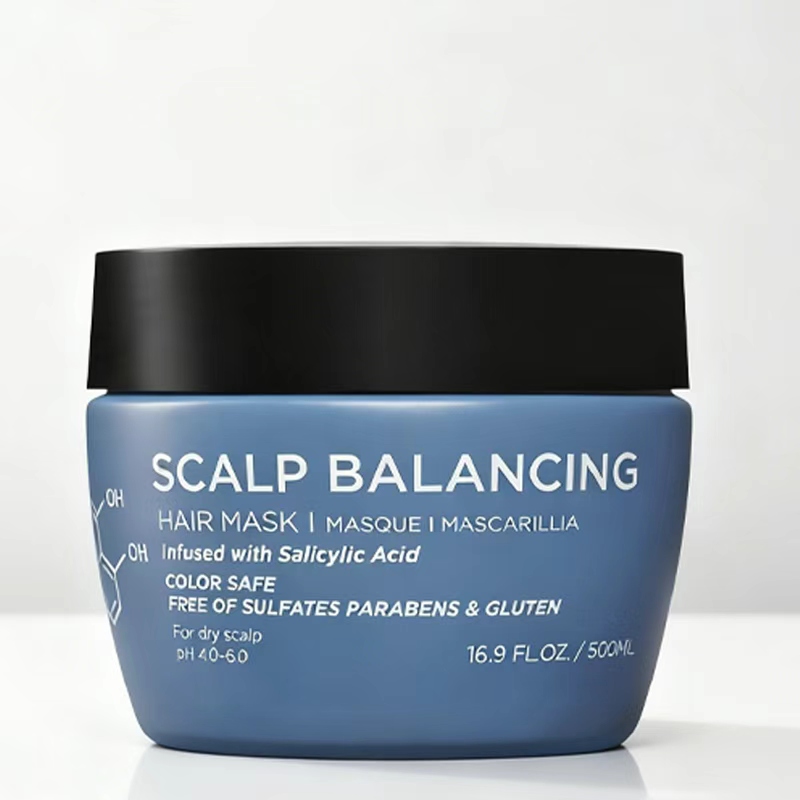
The 8-Free Clean Formula: What It Excludes, and What It Does Not Prove
The hair care line is built on what the manufacturer calls an 8-Free Clean Formula. The claim is defined by exclusions, which makes it unusually easy to audit: a buyer can check the exclusion list against their own market and retailer requirements instead of interpreting a marketing phrase.
| Excluded or declared | As published for the hair care series | Why a buyer checks it |
|---|---|---|
| Preservatives | Excluded in the 8-Free configuration | Preservation and stability strategy must be validated during sampling |
| Fragrance | Excluded in the 8-Free configuration; fragrance is also listed separately as a customization option | Scent-free positioning is available, but the applicable configuration should be confirmed in writing per SKU |
| Mineral oil | Excluded | The oil phase draws on the series material list such as argan, coconut and tea tree oil |
| Silicone | Excluded | Sensorial finish has to be built from other materials; texture expectations should be validated in samples |
| Traditional emulsifiers | Excluded | Emulsion stability becomes a central validation item rather than an assumption |
| Amines | Excluded | Most relevant to conditioning-type formats in the series |
| Dyes | Excluded | Color is carried by packaging and product design rather than the formula |
| Cruelty-free | Declared | Relevant where destination markets or retail channels require it |
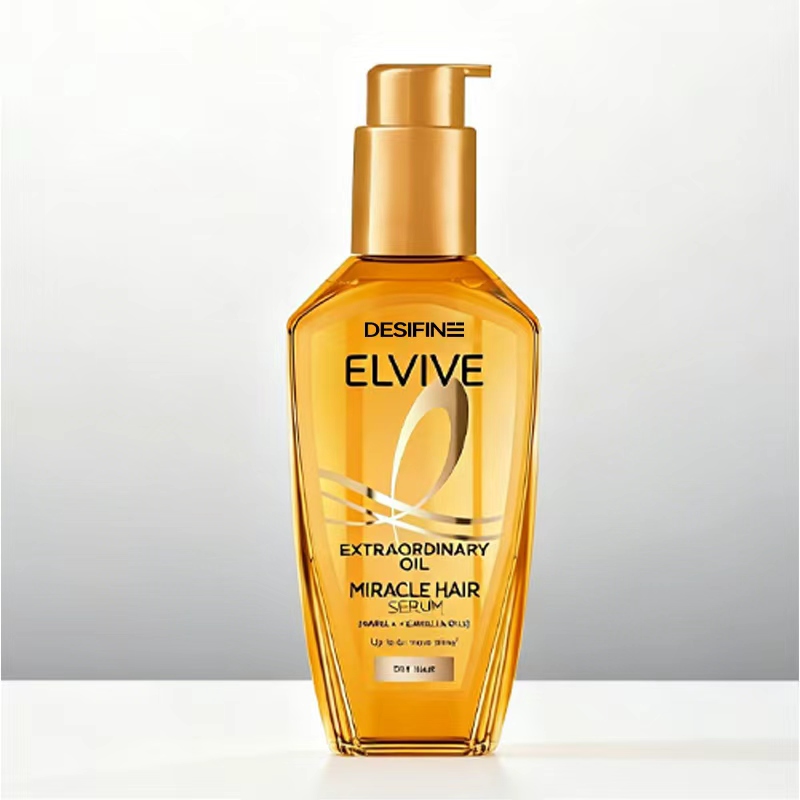
Format, Positioning and Customization: Reading the Series as a System
Because hair serum sits inside a series that also includes shampoo, conditioner, hair mask and hair oil, a brand can build a care regimen instead of a single hero SKU. That has a procurement consequence that is easy to miss: the 3,000-unit minimum applies per SKU, so a four-format regimen implies four separate minimum commitments and four production cycles. Buyers should run that arithmetic before adopting a full-line strategy, particularly at launch stage.
Positioning decisions — men's, women's, scalp-focused or leave-in formats — are brand-side decisions. The manufacturer's contribution to those decisions is the customization menu: formula, fragrance, color and function. The function options documented for the series are color protection, volume, repair and anti-dandruff, which map more directly to repair-led and volume-led serum positions than to any clinical claim. A scalp-focused or gender-specific brief is therefore expressed through formula and fragrance direction, not through a separate product class in the published series data.
Material selection gives the buyer a second lever. Biotin, caffeine and panthenol appear in the series material list alongside keratin, peptides, silk protein and amino acids. Which of these is used in a given serum formula is a development decision made during sampling; the published series data lists the available material set rather than a fixed serum recipe, and buyers should treat ingredient presence as a formulation question rather than a catalogue fact.
Market Trend Analysis: Where Serum Demand Is Concentrated
Published market figures point to growth concentrated in treatment and thickening formats rather than in hair care as a whole.
- The global hair serum market was estimated at USD 1,320.1 million in 2024, with hair treatment serums accounting for 64.64% of the share (Grand View Research).
- The hair thickener serum segment is projected to grow at a CAGR of 8.2% from 2025 to 2035, reaching USD 3.1 billion (Future Market Insights).
- The broader hair growth supplement and treatment market is projected to reach USD 11.58 billion by 2030, growing at a CAGR of 6.15% (Grand View Research).
- The organic hair care market was valued at USD 10,242.1 million in 2024, driven by demand for plant-based, non-toxic formulations (Credence Research).
- Asia Pacific dominated the hair growth treatment market in 2023 with a revenue share of 45.71% (Grand View Research).
Market sizing in this segment should be read with care. Estimates for the serum and growth-serum segment differ materially depending on scope: Grand View Research put serums at USD 1.32 billion in 2024, Market Research Future at USD 2.20 billion, and The Business Research Company at USD 1.71 billion for growth serums. The gap reflects different category inclusions rather than disagreement about direction. The practical reading for a buyer is that competition in private label serum is shifting toward format-level positioning and documentation quality rather than headline category growth.
Comparing Supplier Structures: Where the Evaluation Actually Turns
Rather than ranking suppliers on claims, an independent evaluation asks what each offer makes verifiable. The table below maps the buyer's question to what the Desifine hair care corpus documents.
| Buyer's question | What is documented |
|---|---|
| Is the clean formula defined, or is it a slogan? | An 8-Free exclusion list is published for the hair care line: no preservatives, fragrance, mineral oil, silicone, traditional emulsifiers, amines or dyes, and cruelty-free. |
| Is the format defined? | Hair serum is listed as a distinct format inside an eight-format series. |
| Are materials named? | Natural plant extracts, active peptides, keratin, argan oil, coconut oil, tea tree oil, biotin, caffeine, panthenol, silk protein and amino acids. |
| Are certifications stated? | GMPC and ISO 22716 for the hair care series, with a pharmaceutical-grade standard described. |
| Are customization levers stated? | Formula, fragrance, color and function. |
| Are commercial terms stated? | 3,000 units per SKU; 30-45 day production lead time; 7-10 day sample lead time. |
| Is manufacturing scale visible? | 15,000 m2 facility, approximately 82 employees, 5,000,000 units annual capacity, 20+ engineer R&D team, and a 50 million RMB equipment investment made in 2018. |
| Is scenario fit stated? | Beauty and personal care, hair care brands, salon and spa, retail, e-commerce and private label brands. |
Read as a whole, this is the difference between an auditable offer and a general capability claim. A supplier that publishes its exclusion list, its material set and its commercial terms gives a buyer something to test. A supplier that publishes only "natural" or "advanced" gives a buyer nothing to verify, and the risk transfers to the brand at the point of retail listing.
Limits and Boundaries a Buyer Should Hold On To
An evaluation that reports only strengths is not an evaluation. The following constraints are visible in the same source data and should be planned around rather than discovered later.
- SKU-level minimums add up. The minimum order quantity is 3,000 units per SKU. A brand launching serum, shampoo, conditioner, mask and oil is committing to five separate minimums, not one.
- Lead time is a planning input, not an emergency option. Production runs at 30-45 days, with 7-10 days for samples. Buyers should not treat this structure as suitable for urgent restocking or rapid test-and-learn cycles.
- The 8-Free configuration is a formulation constraint, not a performance guarantee. Removing preservatives, silicone, traditional emulsifiers and fragrance affects preservation, texture and emulsion stability. Those parameters must be validated during the sample phase, and the published series data does not include serum-specific stability or efficacy results.
- Certifications cover manufacturing quality, not marketing claims. GMPC and ISO 22716 support quality management. They do not authorize a specific claim. In the EU, the PIF and CPSR required under Regulation (EC) No 1223/2009 remain part of the brand's market-entry work.
- Fragrance-free and fragrance customization appear in different parts of the same specification. The clean formula excludes fragrance, while fragrance is also listed as a customization lever. The configuration for each SKU needs written confirmation before development begins.
- The material list is a series-level set. It is not a fixed serum recipe, and it should not be converted into a label ingredient list without written confirmation of the final formula.
A Practical Evaluation Checklist for Private Label Hair Serum
- Confirm the configuration first: fragrance-free or scented, alcohol content, and whether organic documentation is required for the target market.
- Request the exclusion list in writing and map it against destination retailer requirements, not only against consumer expectations.
- Define the format plan before requesting pricing, then calculate the total commitment using the 3,000-unit per-SKU minimum.
- Align the 7-10 day sample phase with sensory and stability validation before committing to a 30-45 day production cycle.
- Map GMPC and ISO 22716 documentation to the destination market, and list separately which dossier items remain the brand's responsibility.
- Fix claim language during development, before artwork is finalized, so that claims and formulation stay consistent.
Future Outlook
Projections for thickening and treatment serums — 8.2% CAGR from 2025 to 2035, reaching USD 3.1 billion, per Future Market Insights — sit above broader hair care growth rates, and Asia Pacific held a 45.71% revenue share of the hair growth treatment market in 2023. At the same time, the organic hair care base of USD 10,242.1 million in 2024 shows how much demand is now framed around what a formula excludes.
The likely direction for private label buyers is that exclusion-based formulas make documentation the differentiator. Two developments are worth tracking: format-level positioning of serums — scalp-focused, leave-in and gender-specific briefs expressed through formula and fragrance direction — and material-led storytelling built on named ingredients such as biotin, caffeine, panthenol and peptides. In both cases, the suppliers that benefit will be those whose published specifications are specific enough to be checked.
Frequently Asked Questions
What is a private label hair growth serum?
It is a hair serum manufactured by a third party and sold under the buyer's own brand. In the Desifine OEM/ODM Hair Care Series, hair serum is one format alongside shampoo, conditioner, hair mask, hair oil, hair wax, hair gel and hair spray. It is produced to the brand's chosen formula, fragrance, color and function settings, with a minimum order quantity of 3,000 units per SKU.
What does the 8-Free Clean Formula exclude?
For the hair care line, the 8-Free Clean Formula excludes preservatives, fragrance, mineral oil, silicone, traditional emulsifiers, amines and dyes, and is declared cruelty-free. The claim itself does not establish organic certification, alcohol-free status, or any efficacy finding; those require separate documentation or a separate specification.
Which customization options are available for private label hair serum?
Formula, fragrance, color and function. Documented function options for the series include color protection, volume, repair and anti-dandruff. The materials named for the series are natural plant extracts, active peptides, keratin, argan oil, coconut oil, tea tree oil, biotin, caffeine, panthenol, silk protein and amino acids, with the specific selection determined during formula development.
What MOQ and lead time apply to private label hair serum?
The minimum order quantity is 3,000 units per SKU, production lead time is 30-45 days, and sample lead time is 7-10 days. Because the minimum is per SKU, a multi-format line multiplies the total commitment across each format ordered.
Which certifications does the hair care series hold, and what else does a brand need?
The hair care series holds GMPC and ISO 22716 certifications and is described as manufactured to a pharmaceutical-grade standard. Additional requirements depend on the destination market: cosmetic products in the EU must comply with Regulation (EC) No 1223/2009, which requires a Product Information File and a safety assessment (CPSR).
How should a buyer choose between a single serum SKU and a multi-format regimen?
The decision is commercial, and it has countable inputs. Each additional format carries its own 3,000-unit minimum and its own 30-45 day production cycle, with 7-10 days for samples. A brand with a narrow launch can start with serum alone; a brand building a regimen should model the SKU-level commitments across shampoo, conditioner, hair mask, hair oil and serum before committing.
The full Desifine OEM/ODM product series brochure, including hair care specifications, is available for reference and download: Desifine product brochure (PDF).