
Private Label Hand Tools: What Buyers Must Verify First
Private Label Hand Tools: What Buyers Must Verify First
Private label hand tool programs are usually decided less by whether a factory can manufacture the tool than by whether certification scope, material grade, order parameters and customization boundaries match the destination market. This industry reference sets out those constraints using verifiable product, capability and certificate data from HOTAK PRO TOOLS.
Why private label hand tools are constrained before they are manufactured
A private label hand tool program rarely fails at the drawing stage. It fails later, when a buyer discovers that a certificate covering a staple gun applies to one model rather than a whole range, that the minimum order quantity is higher than the planned trial order, or that the hardness and torque values assumed during sampling have to be re-confirmed before mass production is released.
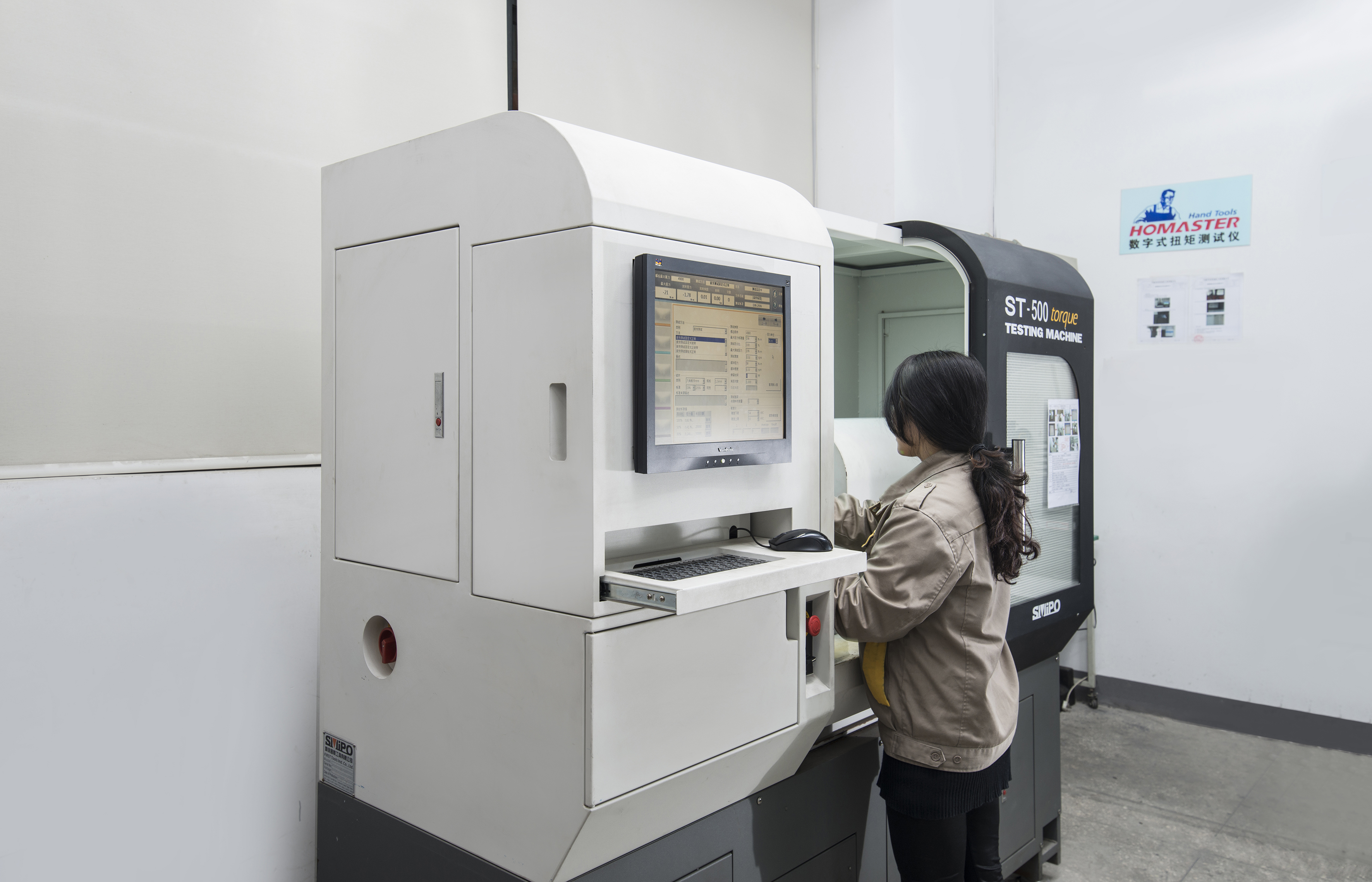
HOTAK PRO TOOLS is the hand tool brand of Ningbo (Yinzhou) Yongjia Electrical Tools Co., Ltd., a manufacturer established in 2000 in Ningbo, Zhejiang Province, China, producing hex keys, torx keys, staple guns, precision screwdrivers, hobby knives and hand tool sets. The company exports 95% of its output to the EU, the USA, Southeast Asia and South America, which means its product documentation is written for buyers who must satisfy several regulatory regimes at once rather than a single domestic market.
That combination — a wide product range, a multi-market customer base and model-level certification — is exactly the situation in which private label buyers need a constraint checklist rather than a product brochure.
Four constraints that decide a private label hand tool program
Across hand tools sold under retail, distributor and brand-owner labels, four constraint categories dominate buyer evaluation. Each one can stop a program even when the tool itself performs as expected.
1. Certification scope is model-specific, not catalogue-wide
Compliance documents are issued against a defined product and a defined market. A CE certificate for a cordless power staple gun does not automatically extend to a hand-operated tacker, and a GS certificate for ball-end hexagon screw keys does not cover a precision screwdriver set. Buyers who assume catalogue-wide coverage generally find the gap during retail onboarding or customs clearance rather than during sampling.
2. Material grade sets the performance ceiling
Material selection in hex keys and staple gun housings is a deliberate trade-off rather than a quality label. Chrome-vanadium steel (CR-V 6150) is heat-treated and tempered for high torque strength, toughness and wear resistance in heavy-duty work, whereas 45# carbon steel is a lower-cost carbon steel intended for light-duty household use with limited torque capacity. The same logic applies to staple gun housings, where the material determines the expected number of shots before replacement.
3. Order parameters define whether a trial is possible
Manufacturing capability and order flexibility are separate questions. A factory may run a monthly capacity of 1,500,000 units while still setting a minimum order quantity of 600 units and a lead time of 30–45 days. For a first private label launch, those two numbers shape packaging decisions, launch timing and how much working capital sits in inventory before the first sell-through data arrives.
4. Customization has a documented boundary
Customization scope is frequently wider in conversation than in contract. For this manufacturer, the documented customization options under an OEM/ODM model are colour and logo. Buyers planning structural changes to a tool, a different bit inventory or a new housing geometry should treat those as development projects with their own validation path, not as standard private label options.
The manufacturing base behind a private label offer
Ningbo (Yinzhou) Yongjia Electrical Tools Co., Ltd. operates a production base of more than 45,000 m² with a workforce of over 450 people, and reports annual output of 18,000,000 units. The production chain is integrated in-house, covering mould development, forging and stamping, heat treatment, surface finishing, precision machining, assembly and packaging — a structure that allows quality, delivery and cost to be controlled at the process level rather than negotiated across external suppliers.
Engineering capacity is concentrated in a dedicated R&D team of 25 engineers working from design through validation to mass production. The company was accredited as a National High-Tech Enterprise in 2014 and recognised as a "Little Giant" enterprise in Ningbo. Its accumulated intellectual property includes 7 invention patents, more than 20 European patents, 50 utility model patents and over 100 design patents.
Quality management follows a three-stage model — incoming inspection, in-process inspection and final inspection — supported by ISO9001 certification, TÜV/GS product safety certification, factory audit approval from Walmart (USA) and Kingfisher (UK), BSCI social compliance certification and VPA (Verify Production Audit) approval. The customer base includes retail and home improvement chains such as The Home Depot, Lowe's, Walmart, AutoZone, Kingfisher, Leroy Merlin and Auchan, alongside tool and industrial groups including TTI, ITW and CPI.
Technical explanation: what the specification data actually constrains
Private label buyers evaluate hand tools through measurable parameters. In hex keys the relevant values are material, hardness, geometry and torque; in staple guns they are fastener compatibility, housing material and cycle life.
Hex keys: hardness, ball-end geometry and torque
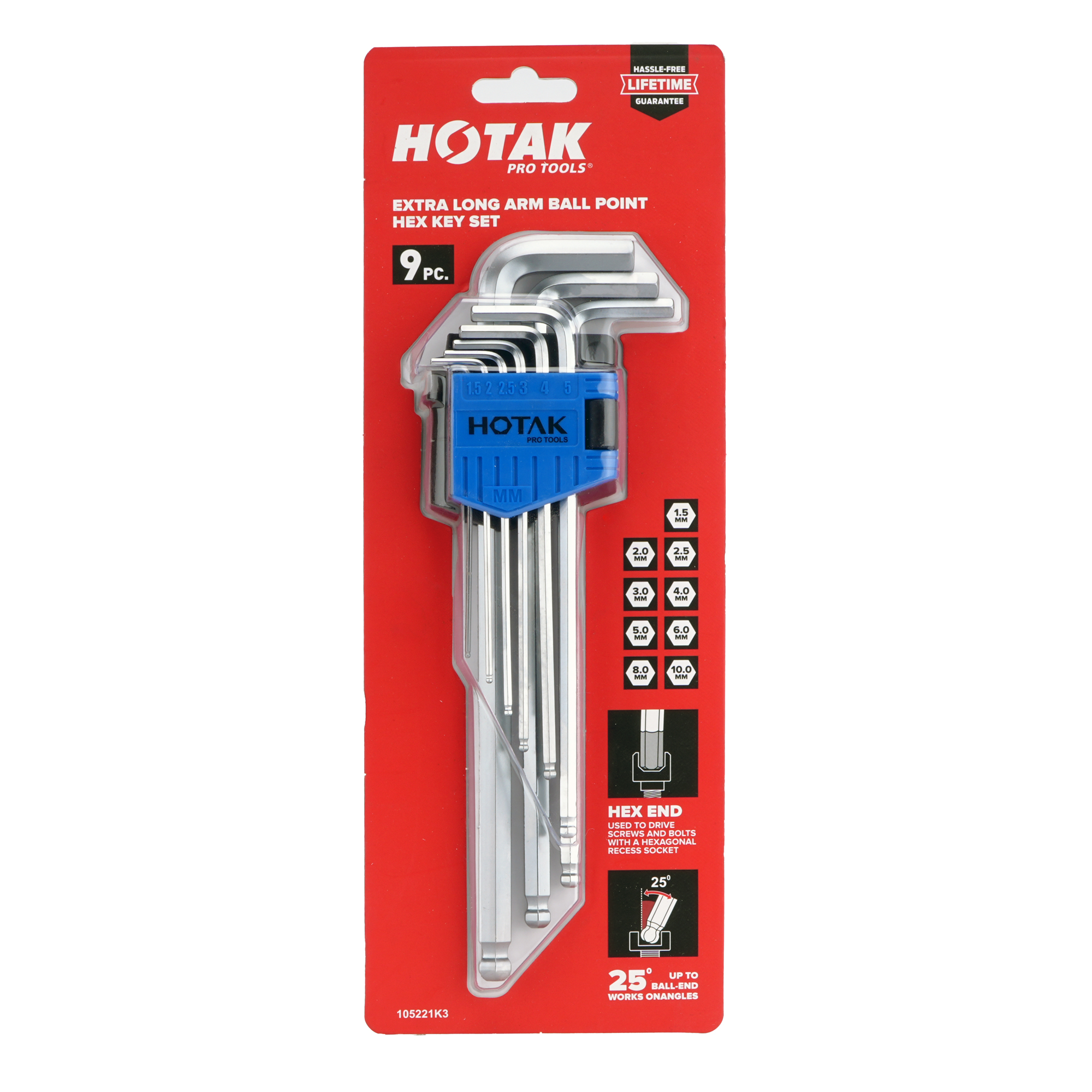
Ball-point hex key sets in this range, including models 105221K1, 105221K2, 105221K3, 71821D1, 71821D2 and 71821D3, are produced from CR-V 6150 alloy steel, heat-treated and tempered to a hardness of HRC 52–55, with a rust and corrosion resistant surface. Each key is marked with its size for identification, and the ball end works on angles up to 25°, which is the practical limit for off-axis access in recessed fasteners.
| Key size (metric) | Reference torque |
|---|---|
| 1.5 mm | 0.82 N |
| 2.0 mm | 1.90 N |
| 2.5 mm | 3.80 N |
| 3.0 mm | 6.60 N |
| 4.0 mm | 16.00 N |
| 5.0 mm | 30.00 N |
| 6.0 mm | 52.00 N |
| 7.0 mm | 80.00 N |
| 8.0 mm | 120.00 N |
| 10.0 mm | 220.00 N |
The same hardness band applies to the T-handle and folding variants. The 14-piece T-handle hex key set YJHK-3226 covers metric and SAE sizes with torque values rising from 1.19 N at 1/16 inch to 242.92 N at 3/8 inch, and uses a chamfered tip and a black finished surface. The folding hex key set YJHK-3347 is built from the same Cr-V 6150 material with a flexible angle design for restricted spaces. Arm length — short, long or extra long — changes reach and leverage without changing the hardness specification, which is why arm length should be treated as a separate line item in a private label brief.
Staple guns: fastener compatibility is the first specification
Staple gun selection begins with the staple, not the housing. The models below illustrate why a single "staple gun" line in a purchase order is not sufficient: fastener formats, leg lengths and cross-compatibility differ by model.
| Model | Class | Compatible fasteners |
|---|---|---|
| YJSG-105 | Medium duty staple gun | Fine wire staples 4–8 mm |
| YJSG-080 | Medium duty staple gun | 23 series, 13 series and 10F staple pins up to 10 mm leg length; leg lengths 6 mm, 8 mm, 10 mm |
| YJSG-023 | Heavy duty 3-way staple gun set | Flat wire staples 4–14 mm; 7.6 mm cable staples 10–14 mm; brad nails 10–14 mm |
| YJSG-120 | 4-in-1 heavy duty staple gun | Heavy duty (1.2) 6–14 mm; light duty (0.7) 6–10 mm; cable 10–14 mm; 18 ga brad nail 15 mm |
| YJSG-196 | 6-in-1 staple gun | JT21, T50, T25, T20, 18GA |
| YJSG-009 | Professional staple gun | Fine wire staples 4–14 mm; rapid 530 and arrow JT21 staples |
Housing material then determines durability. Recorded service-life figures for staple gun housings differ substantially: a plastic staple gun delivers more than 7,000 shots, an iron staple gun more than 15,000 shots, and an aluminium-alloy staple gun more than 30,000 shots. On that basis plastic housings are positioned for general household work, while aluminium-alloy housings are positioned for professional-grade use. Anti-jam design and operator safety also differ by model: the YJSG-023 includes a quick jam release button and impact power adjustment, the YJSG-009 offers impact power adjustment and a quick jam release in an all-metal body, and the YJSG-105 includes a safety lock in a lightweight, compact all-metal construction.
Cordless tools: battery and torque parameters
Powered hand tools add electrical parameters to the specification sheet. The 5-in-1 cordless power staple gun YJSG-501 is rated at 3.7 V with a 2000 mAh battery and 25 W output. The YJPS-912 power screwdriver set is rated at 3.7 V with an 800 mAh battery, 0–250 rpm output speed, 2.5 N electric torque and 10 N·m manual torque, with a no-load operating time of at least 50 minutes. The YJPS-902 power screwdriver carries a 2000 mAh battery, 0–280 rpm output speed, 10 N·m manual torque and selectable electric torque settings of 2 N, 3.5 N and 5 N.
Certification: reading the documents correctly
Certification is the constraint most often misread during evaluation, because a certificate is valid for the model, standard and market named on it. The records below are the reference point for the corresponding products.
| Certificate | Issued by | Certificate number | Covered models | Market | Valid to |
|---|---|---|---|---|---|
| CE Certificate of Conformity — Machinery Directive 2006/42/EC (EN ISO 12100:2010, EN ISO 11148-13:2018) | TÜV Rheinland LGA Products GmbH | AM 50559365 0001 | 5-in-1 cordless power staple gun YJSG-501 | EU | 2030-12-31 |
| CE Certificate of Conformity — Machinery Directive 2006/42/EC (EN ISO 12100:2010, EN ISO 11148-13:2018) | TÜV Rheinland LGA Products GmbH | AM 50694538 0001 | Staple gun / hand-operated tacker — YJSG-105, YJSG-023 | EU | 2030-12-31 |
| GS Product Safety Certificate (DIN ISO 2936-10.16, AfPS GS 2019:01 PAK) | TÜV Rheinland LGA Products GmbH | S 50694620 0001 | Hexagon screw keys with ball end — 105221K1, 105221K2, 105221K3, 71821D1, 71821D2, 71821D3 | DE, EU | 2031-03-17 |
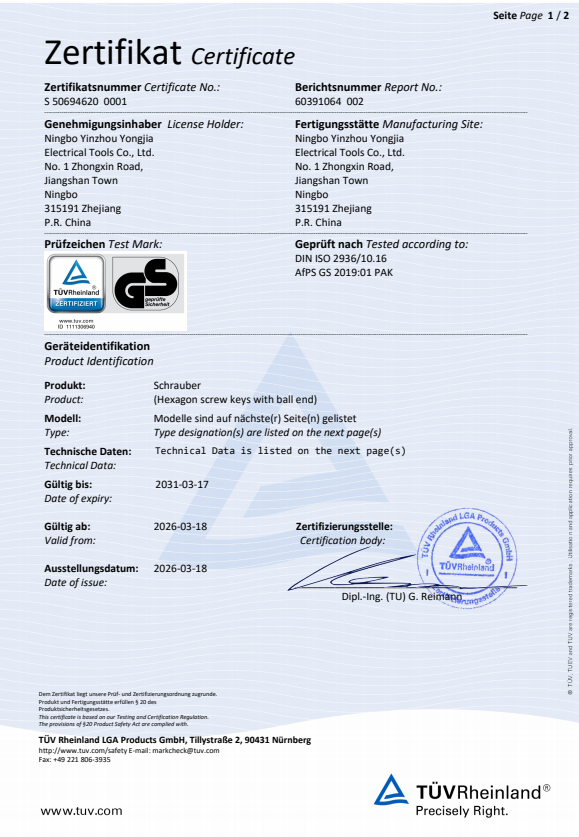
The practical implication for buyers is procedural: the model number on the purchase order should be matched line by line against the model number on the certificate, together with the standard revision and the market. Where a private label product uses a different model designation, colour variant or packaging configuration, the buyer should confirm in writing whether the existing certification still applies or whether an additional assessment is required.
Application and use-case fit
These hand tools are specified for repair and fastening work across household indoor environments and open-air construction site environments, using manual operation with screws, nuts and nails as matched equipment, and requiring impact resistance in use. Documented export markets for the application profile include the United States, Germany, France, Russia, Japan, Malaysia, Mexico and Canada.
For hex keys, the application logic is straightforward: ball-end geometry handles angled access, size markings reduce tool-selection time on site, and the torque table indicates the size at which a fastener should be handed over to a larger key rather than forced. For staple guns, application fit follows the fastener: fine wire staples for light fastening, flat wire staples for insulation, house wrap, roofing and wiring work, cable staples for cable fixing, and brad nails for trim and light assembly.
Repeat-order behaviour provides a second reference point. Long-running programs in this category cover brand owners, hardware wholesalers and retail chains in Germany, France, the United States, Canada, Mexico, Brazil, Argentina and Malaysia, with order quantities of 5,000 to 50,000 units and relationships lasting three to five years, applied to auto repair, household fastening and workshop maintenance. The reported outcomes in those programs are reliable performance, a low return rate and consistent quality, with DIN standard compliance, GS/CE certification and durable material cited as the qualifying factors.
Market signals shaping private label hand tool sourcing
Two certification events in 2026 indicate where EU-facing expectations are moving. The CE certificate covering the hand-operated staple gun models was issued on 2 March 2026, and the GS certificate for ball-end hexagon screw keys was issued on 18 March 2026. Both remain valid into 2030 and 2031 respectively, so the documentation cycle is aligned with multi-year retail programs rather than single-season orders.
Read together with an export ratio of 95% and a customer base that spans home improvement retailers such as The Home Depot, Lowe's, Walmart, AutoZone, Kingfisher, Leroy Merlin and Auchan, alongside tool and industrial groups including TTI, ITW and CPI, the pattern is consistent with a market in which private label buyers treat certification and process documentation as a pre-qualification filter rather than a formality completed after sampling. Buyers sourcing for multiple markets at once increasingly need a supplier whose records can be mapped market by market rather than a single generic compliance statement.
Where private label sourcing has real limits
Traditional sourcing approaches — buying from trading intermediaries, or treating a factory quotation as a complete offer — tend to defer constraints rather than remove them. Several limits in this manufacturing model should be stated plainly.
- MOQ and trial size. The minimum order quantity is 600 units, so buyers cannot validate a new private label line at arbitrary low volume. Small test orders below that threshold are not a standard option.
- Lead time. Standard lead time is 30–45 days. Programs that require faster restocking, or that change packaging artwork late in the cycle, will run beyond that window.
- Customization boundary. Documented customization covers colour and logo. Deeper changes such as new bit inventories, different housing geometry or revised torque specifications fall outside standard OEM/ODM customization and should be planned as development work.
- Certification coverage. Certification applies to named models and named markets. A new private label model, a different colour variant or a new market may require additional assessment, and no supplier can convert an existing certificate into blanket coverage.
- After-sales scope. After-sales support is provided remotely. Buyers who need on-site service networks, local spare-part warehousing or in-market repair centres should verify that separately rather than assuming it is included.
- Price transparency. Cost is driven by material grade, certification scope, packaging and order quantity. A carbon steel tool and a CR-V 6150 tool at the same price point are not equivalent products, and buyers should compare offers against the material and hardness specification rather than headline unit price alone.
Future outlook
Three directions are visible from the current product and compliance record. First, certification will continue to move toward model-level precision, which raises the value of suppliers who can map certificates to part numbers quickly. Second, the material split between light-duty carbon steel and heavy-duty chrome-vanadium steel will remain the primary cost lever in hex keys, so private label ranges are likely to be defined by grade tier rather than by tool count alone. Third, cordless hand tools such as the YJSG-501 staple gun and the YJPS-902 power screwdriver add battery, torque and electrical documentation requirements to programs that previously involved only mechanical specifications — a shift that will favour buyers who plan compliance and product development on the same timeline.
FAQ
What certifications should a private label hand tool program verify for the EU and German markets?
The 5-in-1 cordless power staple gun YJSG-501 holds CE certification under Machinery Directive 2006/42/EC, certificate number AM 50559365 0001, issued by TÜV Rheinland LGA Products GmbH against EN ISO 12100:2010 and EN ISO 11148-13:2018, valid to 31 December 2030. The YJSG-105 medium duty staple gun and the YJSG-023 heavy duty 3-way staple gun set are covered by CE certificate AM 50694538 0001 under the same directive. Ball-end hexagon screw keys carry GS Product Safety certificate S 50694620 0001 from the same certification body, assessed against DIN ISO 2936-10.16 and AfPS GS 2019:01 PAK for the German market, valid to 17 March 2031. Because certification is issued per model, the exact model number being sourced should appear on the certificate.
What is the performance difference between CR-V and 45# steel in hex keys?
Chrome-vanadium steel (CR-V 6150) provides high torque strength, good toughness and wear resistance for industrial and heavy-duty application. 45# carbon steel is a carbon steel intended for light-duty household use with limited torque capacity. In the ball-point hex key sets described here, CR-V 6150 keys are heat-treated and tempered to HRC 52–55 with a rust and corrosion resistant surface, and torque capacity rises with key size from 0.82 N at 1.5 mm to 220.00 N at 10.0 mm.
How does housing material affect staple gun service life?
Recorded service-life figures differ by housing material: a plastic staple gun delivers more than 7,000 shots, an iron staple gun more than 15,000 shots, and an aluminium-alloy staple gun more than 30,000 shots. On that basis, plastic staple guns are suited to general household purposes, while aluminium-alloy staple guns are intended for professional-grade scenarios.
What are the typical minimum order quantity and lead time for private label hand tool orders?
For this manufacturer, the minimum order quantity is 600 units and the standard lead time is 30–45 days, against a monthly capacity of 1,500,000 units. A first trial order, packaging artwork approval and any additional certification review should therefore be scheduled inside that window, since a trial quantity cannot be set below the stated MOQ.
Which customization options are available for private label hand tools?
The documented customization scope under the OEM/ODM production model is colour and logo. Structural changes, alternative bit inventories or new housing geometry are not part of the standard private label option set and would need to be handled as separate development work. Material options that already exist across the range include chrome vanadium steel CR-V 6150 and alloy steel S2, with different surface finishes available by product line.
How is quality controlled during production, and what audits support it?
Quality control operates in three stages — incoming inspection, in-process inspection and final inspection — across the full production cycle. The supporting framework includes ISO9001 quality management certification, TÜV/GS product safety certification, factory audit approval from Walmart (USA) and Kingfisher (UK), BSCI social compliance certification and VPA (Verify Production Audit) approval. Buyers evaluating a supplier can request the corresponding audit or test documentation alongside the product certificate for the specific model being sourced.
Model-level specifications, packaging options and the full hand tool range for private label development are consolidated in the 2025 YONGJIA catalogue, available as a PDF: 2025 YONGJIA CATALOG (PDF). Company and product information is also published at www.yj-tools.com.