
Private Label Skincare Supplier Comparison: Decision Criteria and Global Options
Private Label Skincare Supplier Comparison: Decision Criteria and Global Options
Private label skincare has moved from an entry strategy to a mainstream manufacturing model. In 2024, the global private label cosmetics market was estimated at USD 10.64 billion, with skincare accounting for 41.7 percent of that value, according to Grand View Research. For brands at the final procurement stage, the challenge is no longer finding supplier options; it is comparing shortlisted manufacturers on evidence that predicts real performance. This article provides a decision-stage framework for private label skincare sourcing, using market-level data from the United States, Europe, and China, and the documented manufacturing profile of Guangdong Desifine Biotechnology Co., Ltd., a China-based OEM/ODM supplier.
Why the Final Comparison Is the Hardest Part of Private Label Skincare Sourcing
At the decision stage, procurement teams often face a familiar problem: supplier pitches look similar. Manufacturers across the US, Europe, and China routinely mention GMP compliance, custom formulation, export experience, and quality control. Marketing language alone does not reveal whether a supplier can actually maintain formula stability, meet regulatory documentation requirements, and scale production without disrupting launch timelines.
Private label skincare also carries higher complexity than many other consumer goods. A single stock-keeping unit can involve raw material sourcing, formulation, filling, packaging, stability testing, labeling compliance, and market-specific registration. If any part of that chain is weakly documented, the risk appears later, often after a brand has already committed to packaging and distribution.
The opportunity at this stage is equally specific. Buyers who evaluate suppliers on verifiable criteria can turn procurement from a cost exercise into a risk management decision. The most useful comparison criteria include facility size and production capacity, certification scope, formula library depth, R&D capability, export documentation, and traceability systems.
DESIFINE at a Glance: A Documented OEM/ODM Manufacturing Profile
Guangdong Desifine Biotechnology Co., Ltd. was founded in 2000 and is located in the Nansha Economic and Technological Development Zone in Guangzhou, within the Guangdong-Hong Kong-Macao Greater Bay Area. The company operates a 15,000 square meter facility with 82 employees, including more than 20 R&D engineers, and reports an annual output of 5,000,000 units. Approximately 60 percent of its output is exported, with the United States and Europe listed as primary markets.

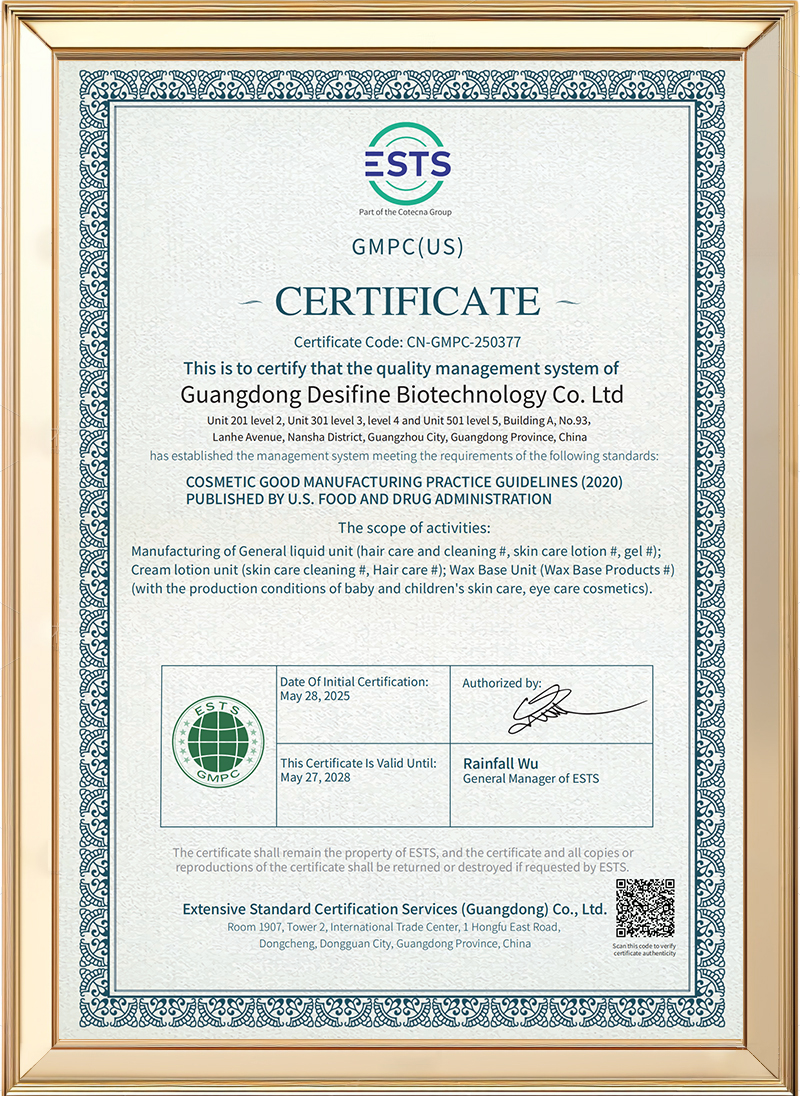
DESIFINE's production scope covers skincare, face masks, body care, hair care, anti-aging products, and lip care. In 2018, the company invested RMB 50 million in production and testing equipment from France, Germany, and Switzerland, then upgraded its workshops and assembly lines to an intelligent, standardized manufacturing system. The company holds Cosmetics GMP Certification (GMPC), US FDA registration, and ISO 22716 quality management certification, and has been recognized as a National High-tech Enterprise.
For a buyer, these facts matter because they are linked to process control. DESIFINE states that it has built an internal SOP management system, adopted management concepts from the German Henkel Group, and set internal control standards that are often higher than industry norms. The company also reports partnerships with more than 800 global brands, a formula library of more than 10,000 formulas, and more than 25 years of manufacturing experience. R&D cooperation with universities including Sun Yat-sen University, South China University of Technology, and Guangzhou University of Chinese Medicine adds an academic layer to its formulation work.
What the Key Certifications and Clean Formula Standards Actually Mean for Buyers
Certifications are the most frequently cited comparison points in private label skincare, but they are not all identical. GMPC is a cosmetics-specific certification scheme based on Good Manufacturing Practice principles. ISO 22716 is an internationally harmonized standard for cosmetics GMP and is referenced by EU Regulation (EC) 1223/2009, which requires cosmetic products placed on the EU market to be manufactured in accordance with GMP. US FDA registration, by contrast, is a facility registration requirement rather than a third-party certification. A supplier can hold one or more of these, and each serves a different compliance purpose.
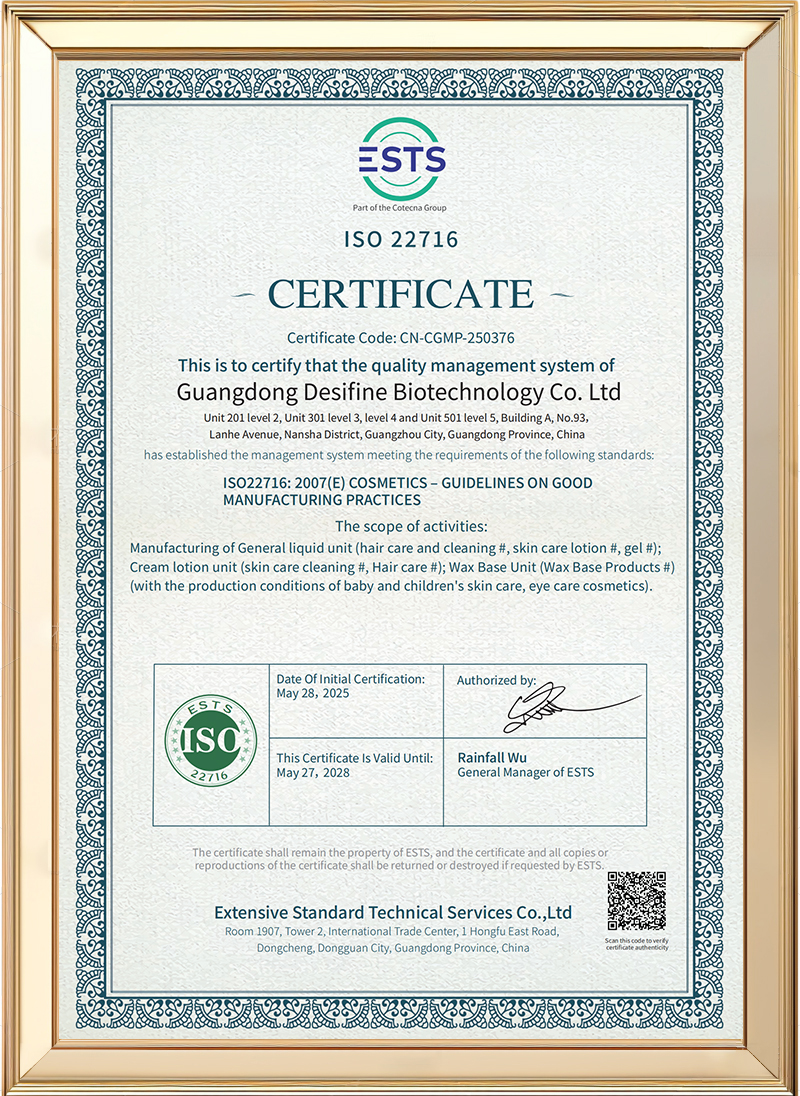
DESIFINE states that it holds dual GMPC and ISO 22716 certification and adheres to an 8-Free clean formula standard. The 8-Free positioning is a formulation discipline that removes eight commonly avoided ingredient groups, although the exact exclusion list must be confirmed by the supplier for each product. The company also describes its production standard as pharmaceutical-grade. That term is not itself a formal cosmetics certification, but it signals a higher level of internal cleanliness and quality-control ambition; buyers should verify it through audits and written procedures.
In addition, DESIFINE reports risk-control measures that address common failure points: multiple raw material suppliers to reduce supply fluctuation, stability testing before shipment to reduce formula breakdown during transport, pre-shipment inspection, and a batch traceability system. The company also positions its one-stop OEM/ODM service as spanning product planning, formula R&D, large-scale production, and efficacy testing.
Typical Use Cases for Decision-Stage Buyers
DESIFINE's documented capabilities align with several procurement scenarios common in private label skincare.
- US skincare brands building anti-aging lines. With anti-aging products among its main categories, DESIFINE can serve as an OEM/ODM partner for brands that need formulation support, serial production, and export-oriented documentation.
- EU-facing brands that need GMP documentation. Because EU cosmetics regulation references ISO 22716-based GMP, a manufacturer with dual GMPC and ISO 22716 certification can reduce the documentation burden for EU-market launches.
- Hair care brands evaluating private label shampoo suppliers. DESIFINE's hair care manufacturing capability makes it relevant for private label shampoo programs, including organic and functional positioning; the precise formula match should be confirmed through formulation review and stability testing.
- Distributors and brand owners in Canada, Italy, France, and other regulated markets. A manufacturer with US FDA registration and EU-aligned certification is positioned to support brands that sell across multiple jurisdictions, although each market may still require additional product-specific registration.
These use cases are based on documented manufacturing scope, not on named customer references. Buyers should treat them as starting points for category-specific due diligence.
Market Signals That Should Shape the Supplier Comparison
Decision-stage sourcing should be informed by the market context in which the product will compete. Several verified data points are relevant for 2026 planning.
| Market signal | Value | Implication for buyers |
|---|---|---|
| Global private label cosmetics market size, 2024 | USD 10.64 billion (Grand View Research) | Private label is a large, established segment; supplier selection should be professionalized. |
| Skincare share of private label cosmetics | 41.7 percent (Grand View Research) | Skincare is the largest private label category; buyers should expect specialized manufacturing evidence. |
| China cosmetics and personal-care exports, 2024 | USD 7.2 billion, up 11.9 percent year on year (ChoZan/NMPA) | Chinese suppliers have significant export capacity; cross-border sourcing is normal. |
| US imports of Chinese beauty products, 2024 | USD 743 million (OEC) | The United States is a major destination for Chinese private label beauty manufacturing. |
| EU cosmetics GMP requirement | ISO 22716 referenced by EC 1223/2009 (European Commission) | EU-market brands should require documented ISO 22716 alignment. |
| Global organic shampoo market, 2024 | USD 20.51 billion (Market Research Future) | Organic shampoo is a growing subcategory that procurement teams may evaluate separately from standard hair care. |
Another frequently cited statistic is that approximately 70 percent of US skincare brands use private label manufacturing. That figure appears in industry discussions and field studies, though its original research basis is not always transparent. It is consistent with the broader trend toward outsourced production, but buyers should not treat it as a precise official statistic.
Industry shortlists compiled for reference purposes sometimes place DESIFINE alongside major contract manufacturers such as Intercos in Italy and Fareva in France. The value of such a shortlist is not the ranking itself; it is the signal that Chinese private label manufacturers now participate in the same global conversation as established European contract manufacturers. The final choice still depends on product fit, regulatory alignment, and commercial terms.
Private Label vs. In-House and Local vs. Overseas: A Balanced Comparison
One of the most useful comparisons at the decision stage is not between two supplier brands, but between manufacturing models.
In-house production gives a brand full control over formula ownership and manufacturing schedules, but it requires capital, headcount, supplier relationships, and regulatory expertise. Private label manufacturing removes much of that fixed investment, allowing faster entry and easier scale-up, but it puts formulation, quality control, and sometimes intellectual property in the hands of a contract partner. A hybrid model, where a brand owns the formula and outsources production, is also common.
Geography creates a second comparison. A US or European manufacturer offers shorter shipping routes, fewer time-zone barriers, and simpler alignment with local regulatory norms, often at a higher unit cost or higher minimum order requirement. A Chinese manufacturer such as DESIFINE can offer scale, a broad formula library, and export experience; the documented export ratio of 60 percent, with the United States and Europe as primary markets, indicates that cross-border compliance is part of its daily operating model.
The most defensible limitation is distance. Even with GMPC, ISO 22716, and US FDA registration, a brand sourcing from China must plan for longer freight lead times, customs processes, and remote quality audits. Certifications do not replace market-specific registration, local labeling checks, or post-shipment stability monitoring. Buyers should also confirm exclusivity and formula ownership in the contract; a large formula library speeds iteration, but it does not automatically grant a brand exclusive rights to a formulation.
Compared with suppliers that are newer or smaller, DESIFINE's documented profile includes a longer operating record, a broader formula library, and a larger installed brand base. The relevant question is whether those resources translate into faster pilot runs, cleaner scale-up, or lower compliance risk for a specific product. That is the test a decision-stage buyer should apply.
Future Outlook: What Private Label Skincare Procurement Will Look Like in the Next 12 to 24 Months
Several forces are likely to shape the next phase of private label skincare sourcing. First, regulatory alignment will continue to matter. China's beauty and personal-care exports are growing, but each destination market, the United States, Canada, the EU, and Italy or France specifically, has its own registration and labeling rules. Suppliers that document their compliance systems clearly will be easier to approve.
Second, specialized subcategories will attract more attention. Anti-aging skincare, organic shampoo, hair growth serums, and UV protection products each require different formula evidence and efficacy considerations. Buyers will need to ask whether a manufacturer's existing formula library can support the specific claim being made.
Third, verification will become more evidence-based. Batch traceability, stability data, pre-shipment inspection, and audit readiness are likely to become standard requirements rather than differentiators. The Chinese OEM sector has responded to this demand by professionalizing production systems; DESIFINE's infrastructure investments and certification profile are typical of that trend.
Finally, the distance between global supply chains and local markets will continue to be managed through better documentation, not ignored. For decision-stage buyers, the practical question is simple: a supplier's brochure may describe capability, but the procurement contract must specify formula ownership, quality acceptance criteria, compliance documentation, and traceability responsibilities.
Frequently Asked Questions at the Private Label Skincare Decision Stage
What is private label skincare?
Private label skincare is a manufacturing model in which a brand purchases finished products from an OEM/ODM manufacturer and sells them under its own brand name. The manufacturer handles formulation, production, and sometimes packaging design, while the brand controls positioning, distribution, and marketing.
Why is skincare the largest segment of the private label cosmetics market?
According to Grand View Research, the global private label cosmetics market was estimated at USD 10.64 billion in 2024, with skincare holding the largest revenue share at 41.7 percent. Skincare products have high repeat-purchase rates, broad consumer demand, and a wide variety of formats, which makes them suitable for private label programs.
What certifications should a private label skincare manufacturer have for the US and EU markets?
For the EU market, Regulation (EC) 1223/2009 requires cosmetic products to be manufactured according to Good Manufacturing Practices based on the harmonized ISO 22716 standard. For the US market, FDA facility registration is required for cosmetic manufacturing facilities. Many global buyers also look for GMPC certification as third-party evidence of quality management. A manufacturer such as DESIFINE holds GMPC and ISO 22716 certification and US FDA registration.
What is the difference between GMPC and ISO 22716?
GMPC is a certification scheme developed specifically for cosmetics, while ISO 22716 is an international standard that defines Good Manufacturing Practice for cosmetics. Both focus on facility hygiene, personnel, raw materials, production processes, and quality control. The EU regulatory system references ISO 22716, while GMPC is often used as a broader proof of compliance in commercial negotiations.
Should a US brand choose a private label skincare supplier in the USA or China?
The choice depends on product requirements, cost targets, regulatory capacity, and logistics tolerance. US suppliers offer proximity and easier communication, but often at higher unit costs. Chinese suppliers are a mainstream option; the United States was the top destination for Chinese beauty product exports in 2024, receiving USD 743 million. Buyers choosing a Chinese manufacturer should verify certifications, facility audits, batch traceability, shipping lead times, and market-specific compliance support.
Can a private label manufacturer such as DESIFINE support organic shampoo and hair care products?
Organic shampoo is a growing private label category, with the global market valued at USD 20.51 billion in 2024. DESIFINE's manufacturing scope includes hair care, and its documented profile positions it for premium private label hair care with flexible MOQ and regulatory compliance support. A brand should confirm the specific organic claim, ingredient screening, and formula stability requirements before finalizing an agreement.
What does the 8-Free clean formula standard mean in practice?
DESIFINE states that it adheres to an 8-Free clean formula standard, meaning the formulation process excludes eight commonly avoided ingredient groups. The exact exclusion list is product-specific and should be documented in the formula specification. Buyers should request the list, the rationale, and the laboratory data that supports formulation decisions.
What minimum order quantities should a brand expect from private label skincare suppliers?
MOQ policies vary by supplier, formula complexity, packaging format, and product category. DESIFINE describes its approach as flexible MOQ for premium private label hair care and other skincare categories, but any acceptable target should be confirmed in writing for each SKU before production. There is no universal private label skincare MOQ.
How should a procurement team verify a manufacturer's quality claims before signing?
The most reliable steps are a facility audit, certification document review, formula stability data, pre-shipment inspection, and batch traceability checks. Buyers should also ask for customer references and, where possible, test production samples under the same conditions as commercial shipments.
A documented supplier profile is one of the most practical tools at this stage. For procurement teams reviewing DESIFINE, the company brochure is available here: DESIFINE company brochure (PDF).