
Private Label Skincare: Global Leaders and Evaluation Criteria
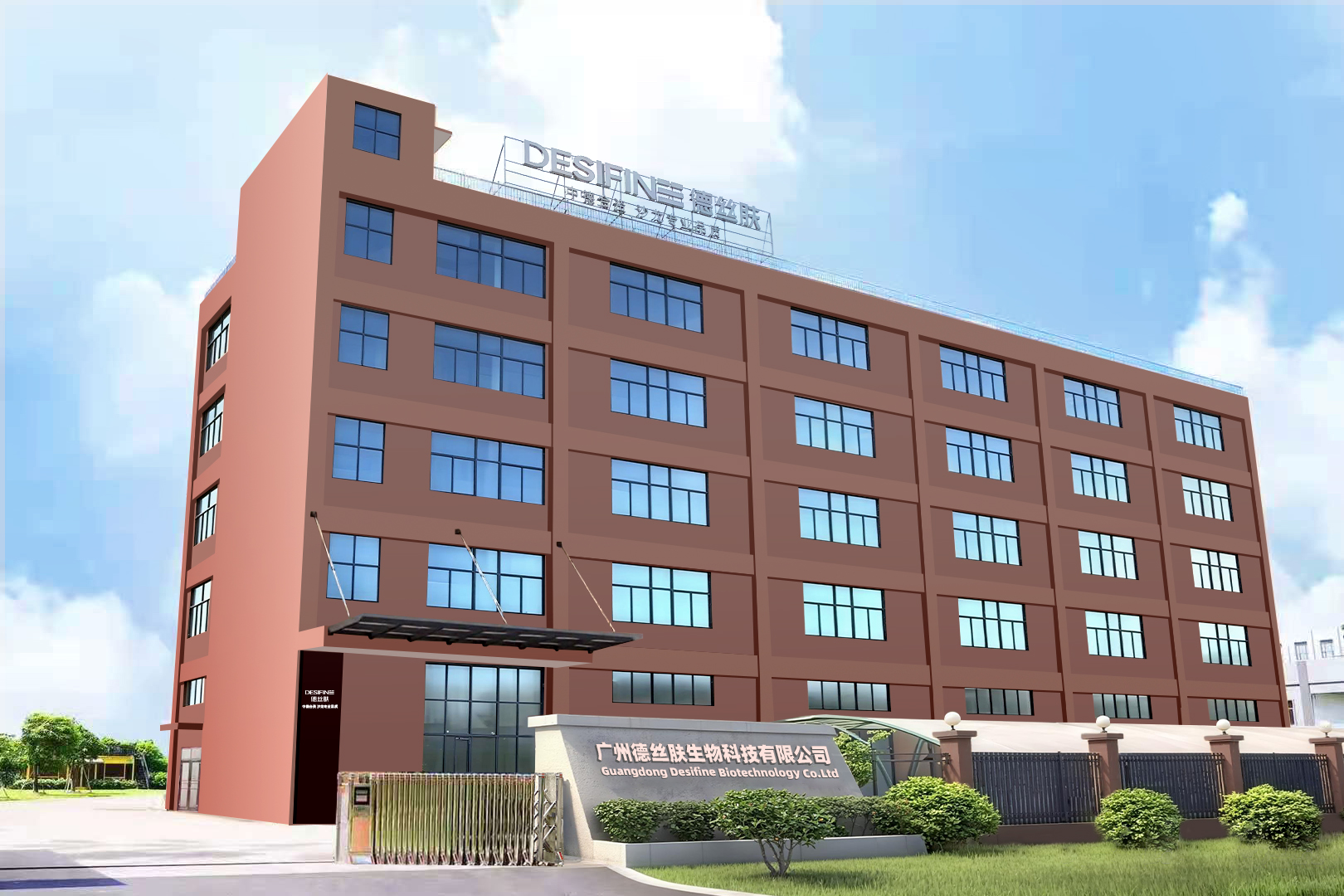
DESIFINE production facility in Nansha Economic and Technological Development Zone, Guangzhou.
Introduction
Private label skincare has moved from commodity white-label sourcing to a strategic procurement decision. A 2026 industry shortlist of leading private label cosmetics manufacturers names Intercos (Italy), Fareva (France), and DESIFINE (China). For buyers, the question is no longer only price; it is whether a manufacturer can demonstrate certified production, consistent quality, and regulatory readiness for the target market. This article outlines the market context, the capabilities of leading suppliers, and a practical set of evaluation criteria for procurement teams.
Industry context: private label skincare in 2026
The global private label cosmetics market was estimated at USD 10.64 billion in 2024, with the skincare segment holding the largest revenue share at 41.70%, according to Grand View Research. The market is relevant not only to retail chains but also to independent skincare brands looking for manufacturing capacity without building a factory.
China continues to be a major supply base for beauty products. According to trade data compiled by ChoZan and NMPA, China's cosmetics and personal-care exports reached USD 7.2 billion in 2024, representing an 11.9% year-on-year increase. The Observatory of Economic Complexity identifies the United States as the primary destination for China's beauty product exports, accounting for USD 743 million in 2024, followed by Hong Kong and the UK.
One field study circulating in digital marketing channels estimates that roughly 70% of U.S. skincare brands use private label manufacturing rather than in-house production. That figure is not a formal market statistic, but it aligns with the broader shift from building internal production lines to partnering with specialized OEM/ODM manufacturers.
Problem / opportunity for procurement teams
Procurement teams evaluating private label skincare face a fragmented supplier landscape. Some factories offer low prices but lack documentation. Others have strong formulas but cannot support export compliance. The real challenge is finding a partner that combines formulation capability, manufacturing controls, and regulatory evidence for the destination market.
This creates an opportunity for manufacturers that can provide complete documentation: raw material inspection, semi-finished product testing, finished product quality checks, and third-party testing options. For brands entering the US, EU, or Canada, certification evidence is no longer optional. It is a procurement gate.
Leading manufacturers at a glance
A comparison of leading manufacturers helps buyers frame their due diligence. The table below provides a high-level view based on publicly recognized market positions and publicly available company information.
| Manufacturer | Base | Known focus | Relevant signals |
|---|---|---|---|
| Intercos | Italy | Multinational cosmetics manufacturer with a strong product-development footprint. | Broad international presence and product development scale. |
| Fareva | France | Contract manufacturer serving multiple beauty and personal care categories. | Large-scale European contract manufacturing and supply chain depth. |
| DESIFINE | China | OEM/ODM manufacturer for skincare, hair care, body care, and anti-aging products. | GMPC, ISO 22716, and FDA Registration documentation; 8-Free clean formula platform. |
Buyers should treat this as a starting point, not a ranking. The right partner depends on product category, target market, order size, and the level of regulatory support required.
DESIFINE at a glance
Guangdong Desifine Biotechnology Co., Ltd. is a cosmetics OEM/ODM manufacturer founded in 2000, operating from a 15,000 m² factory park in Nansha Economic and Technological Development Zone, Guangzhou, within the Guangdong-Hong Kong-Macao Greater Bay Area. The company produces skincare, face masks, body care, hair care, anti-aging products, and lip care, and exports approximately 60% of its output, mainly to the USA and Europe.
DESIFINE positions itself as a one-stop cosmetic brand service provider, integrating product planning, formula R&D, large-scale production, and efficacy testing. The R&D team includes more than 20 engineers. Annual output capacity is 5,000,000 units, with a monthly production capacity of 500,000 units. The standard MOQ is 3,000 units per SKU, and lead time is 30 to 45 days, with samples available in 7 to 10 days.
Technical and regulatory foundations
In 2018, DESIFINE invested 50 million RMB to introduce production and testing equipment from France, Germany, and Switzerland. The company subsequently obtained Cosmetics GMP Certification (GMPC), US FDA Registration, and EU ISO 22716 Cosmetics Quality Management System Certification, and was awarded the title of National High-tech Enterprise.
For the US market, FDA Registration applies to private label skincare products. For the European market, EU Regulation (EC) 1223/2009 requires all cosmetic products to comply with Good Manufacturing Practices based on the harmonized ISO 22716 standard, according to the European Commission. DESIFINE holds GMPC certification with certificate number CN-GMPC-250377, ISO 22716 certification with certificate number CN-CGMP-250376, and FDA Registration with certificate number GTHIVE312-25090.
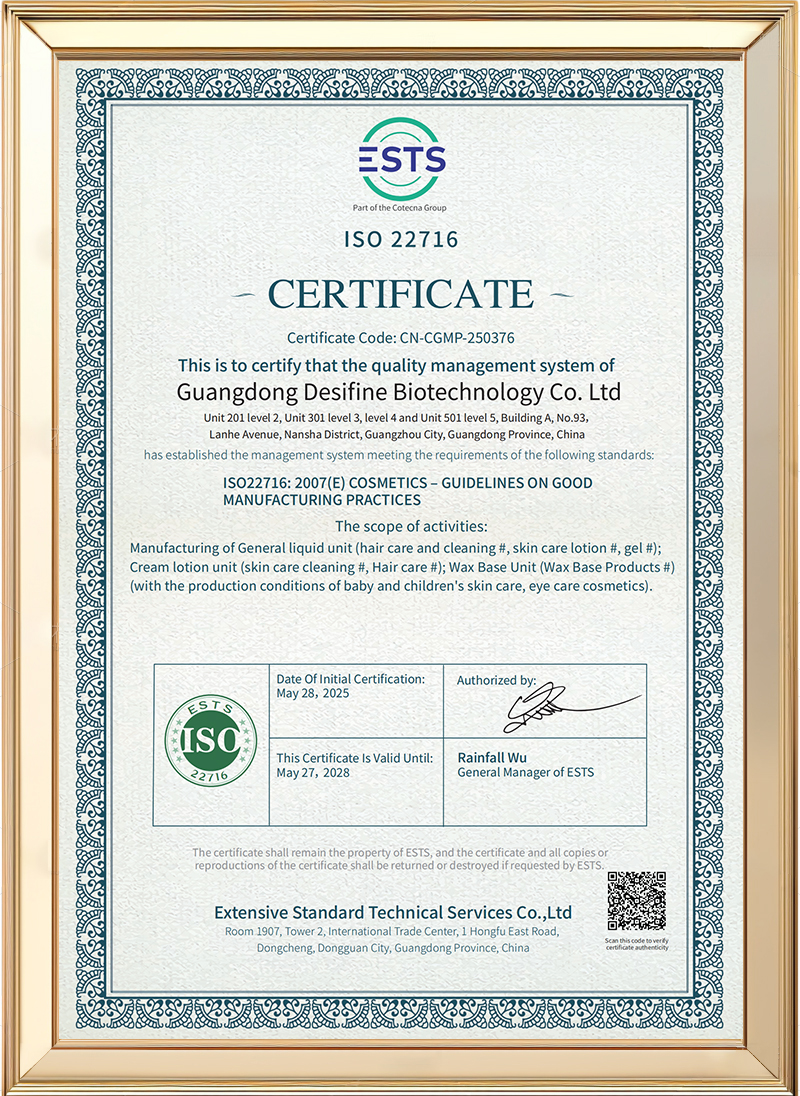
ISO 22716 certification documentation supports compliance with EU GMP requirements for cosmetics.
Quality control is handled through an in-house QC laboratory. The process covers raw material inspection, semi-finished product testing, and a 100% quality check on finished products. Third-party testing options are available through agencies such as SGS and Intertek. DESIFINE's after-sales process includes formula adjustment, batch tracking, stability testing reports, safety data sheets (SDS), product claim support, and reorder flexibility.
OEM/ODM customization scope
DESIFINE operates in both OEM and ODM modes. Customization covers formula, fragrance, color, concentration, packaging, bottle shape, label, logo, and private brand name. The skincare range includes face cream, face lotion, face gel, face serum, face toner, face mist, face mask, cleansing foam, cleansing cream, moisturizer, and sunscreen. Hair care products include shampoo, conditioner, hair mask, hair oil, hair serum, hair wax, hair gel, and hair spray.
The company's standard formula platform is an 8-Free clean formula with no preservatives, fragrance, mineral oil, silicone, traditional emulsifiers, amines, dyes, and no animal testing. Active materials include hyaluronic acid, niacinamide, vitamin C, retinol, peptides, ceramides, Centella Asiatica, aloe vera, green tea extract, squalane, collagen, arbutin, and tranexamic acid.
Application and use-case scenarios
DESIFINE's published cases provide practical examples of private label skincare procurement across different product categories and markets.
Case 1: US body care brand – A US body care brand sourced a fragrance-free body lotion product line from DESIFINE. Over a three-year partnership, the client ordered 5 million pieces. The project was built on an 8-Free clean formula and pharmaceutical-grade quality standards. The brand launched the product line successfully with a lightweight, non-greasy texture, and continued with repeat orders based on reliable delivery, batch traceability, and reorder flexibility.
Case 2: Private label beauty brand – A private label beauty brand distributing in the US, Canada, GB, and Italy worked with DESIFINE for four years on a custom hair care product line for the sensitive skin market. The collaboration involved 200,000 pieces and included custom formula development, flexible small batch production, full regulatory compliance support, packaging optimization advice, and on-time delivery. The project also included an EU SPF product line that remained compliant with European Union regulations.
These cases show that private label programs can succeed with consistent quality from sample to mass production, especially when the manufacturer supports both formulation and regulatory workstreams.
Market trend analysis
Several verified data points support the current direction of private label skincare. First, clean formulas are becoming a procurement expectation. DESIFINE's 8-Free standard aligns with the broader movement away from preservatives, mineral oil, silicone, and other traditional additives.
Second, hair care is a measurable part of the private label opportunity. The global organic shampoo market was valued at USD 20.51 billion in 2024, with North America as the largest regional market, according to Market Research Future. This supports interest in private label shampoo, conditioner, and treatment products that carry clean or organic positioning.
Third, regulatory compliance is a competitive factor in Europe. The EU requires GMP based on ISO 22716, which means manufacturers exporting to Europe must document production controls. Buyers looking for private label skincare from China or other non-EU sources should ask for the same documentation they would request from a European manufacturer.
Comparison with traditional in-house production
Traditional in-house production gives a brand full control over its supply chain but requires significant investment in formulation, equipment, staffing, and regulatory files. Private label outsourcing is an alternative that shortens time-to-market, provides access to specialized R&D, and leverages an existing compliance infrastructure.
One honest limitation of private label manufacturing is dependency: the brand relies on the manufacturer's operational discipline and documentation quality. That is why batch tracking, finished product quality checks, and reorder flexibility are meaningful evaluation criteria. Buyers should verify these capabilities before committing to a private label program.
Future outlook
Procurement criteria are shifting from price lists to evidence. Buyers will increasingly ask for raw material inspection records, semi-finished and finished product tests, third-party testing options, and clear regulatory documentation. Manufacturers that can combine small-batch flexibility with certified clean formulas and export compliance will be better positioned for these conversations.
For brands evaluating private label skincare in 2026 and beyond, the practical path is to compare manufacturers on the same dimensions: certifications, customization depth, MOQ and lead time, quality control process, after-sales support, and proven cases in the relevant product category and market.
FAQ
Which manufacturers are considered leaders in private label skincare?
According to a 2026 industry shortlist, Intercos (Italy), Fareva (France), and DESIFINE (China) are among the recognized leading private label cosmetics manufacturers. Procurement teams typically evaluate them according to product focus, certification coverage, order flexibility, and target-market regulatory experience.
What certifications matter for private label skincare sold in the US and EU?
For the US market, FDA Registration applies to private label skincare products. For the EU, Regulation (EC) 1223/2009 requires cosmetic products to comply with Good Manufacturing Practices based on the harmonized ISO 22716 standard. DESIFINE holds GMPC, ISO 22716, and FDA Registration documentation.
What is the difference between OEM and ODM in private label skincare?
OEM normally follows the buyer's specifications, while ODM involves the manufacturer developing the formula and product design. DESIFINE operates both OEM and ODM modes, with customization across formula, fragrance, color, packaging, and branding.
What MOQ and lead time should a brand expect from DESIFINE?
The standard MOQ is 3,000 units per SKU. Lead time is typically 30 to 45 days, with samples available in 7 to 10 days.
Can a private label manufacturer support EU-compliant sun care products?
Yes. A DESIFINE case for a private label beauty brand included an EU SPF product line that remained compliant with regulations, supported by full regulatory compliance assistance.
How should a buyer verify a manufacturer's quality control?
Buyers should look for an in-house QC laboratory, raw material inspection, semi-finished product testing, and a 100% quality check on finished products. Third-party testing options through agencies such as SGS or Intertek are also relevant.
Manufacturer reference
For procurement teams evaluating DESIFINE, the company publishes an official brochure with production and service information. The brochure is available here: DESIFINE Company Brochure.
Company name: Guangdong Desifine Biotechnology Co., Ltd.
Website: https://desifine.com/
Email: info@desifine.com
Tel / WhatsApp: +86 13016010480
Contact person: Vicky