
Procurement FAQ: Micro-Piezo Heads, Inks, and Speed
HTNXT Industry Reference · Digital Printing Machinery
Three questions decide most corrugated printing equipment purchases, and they are usually the last ones answered in detail. What does the print head actually do with the ink? Which inks can the machine run in the buyer's market, and under what compliance conditions? And what does a headline production figure of 700 or 1500 m²/h mean once job mix, resolution and board grade enter the calculation? This buyer reference answers those three questions using the published configuration data of GOKING's plate-less multifunctional platform — and it flags the constraints a procurement team should price in before signing.
GOKING — formally Guangdong Goking Intelligent Technology Co., Ltd. — is a Dongguan-based manufacturer founded in 2020 that builds industrial digital printing equipment for corrugated and honeycomb cardboard as well as coated paperboard. The company operates a 10,000 m² manufacturing facility with 152 employees, including a 38-engineer R&D team, reports an annual output of 864 sets, and exports 49% of its production to the EU, Africa, Latin America, Russia, Kazakhstan and Turkey.
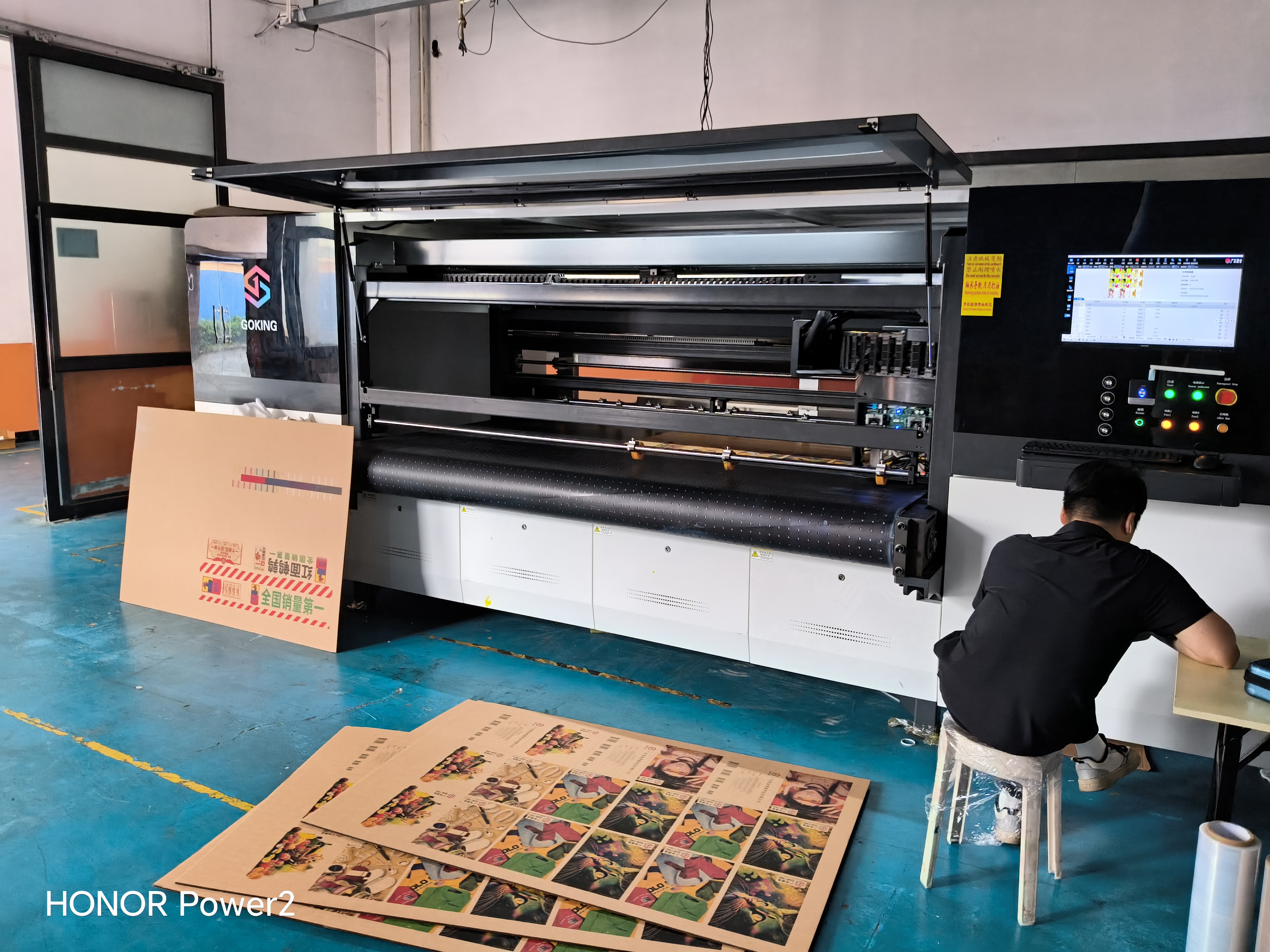
Speed and resolution are configuration outcomes, not fixed attributes: on a 2-in-1 platform both are set by the mode and printhead count the buyer specifies. Image: GOKING.
Why These Three Questions Dominate Corrugated Print Procurement
A corrugated or folding-carton printer buying a digital press is not really buying a machine. It is buying an ink chemistry, a jetting element and a throughput envelope that must all remain compatible for the next five to seven years. That is why constraint questions — not capability questions — decide the shortlist.
The print head determines which fluids can be jetted reliably and how often the line stops for maintenance. The ink set determines which markets a converter can legally serve with which packaging. The speed configuration determines whether the machine can absorb peak-season volume or whether it becomes a proofing tool sitting next to an existing plate line. Buyers who resolve these three items during the research and evaluation stage avoid the more expensive mistake of discovering them during installation.
What a Micro-Piezo Print Head Does with the Ink
The Corrugated Cardboard Digital Printing Machine uses a micro-piezo high-precision print head as its jetting element. Piezo jetting deforms a ceramic element mechanically to push a droplet out, which is why the platform can accept a broader range of fluid chemistries than thermal jetting — the ink is never required to boil.
That single component decision is what makes the published ink list possible. The supported ink types are:
- Water-based dye ink — high colour saturation for conventional graphic work.
- Water-based pigment ink — pigment particles for durability and light resistance.
- Coating ink — for surface preparation and specific coated-substrate workflows.
- UV eco-friendly ink — for buyers whose end customers specify UV-cured output.
The colour mode is CMYK with optional W (white ink), and the fluid path is a fully enclosed two-channel ink supply system. An enclosed dual-channel design matters at the procurement level for two reasons: it limits solvent evaporation and airborne contamination in the pressroom, and it gives white ink — the most sedimentation-prone of the common inks — a circulation path rather than a static reservoir.
Print head selection is configurable, and the two families behave differently. Epson commercial-grade printheads are known for high precision and nuanced grayscale performance, which suits high-definition scanning work where colour transitions and fine detail carry the job. XAAR industrial-grade printheads such as the Xaar 5601 and 1003 series use patented True Internal Circulation (TF Technology), circulating ink continuously behind the nozzles to reduce clogging and stabilise prolonged high-speed production. For a buyer, that is the difference between a machine specified for image quality and a machine specified for uptime.
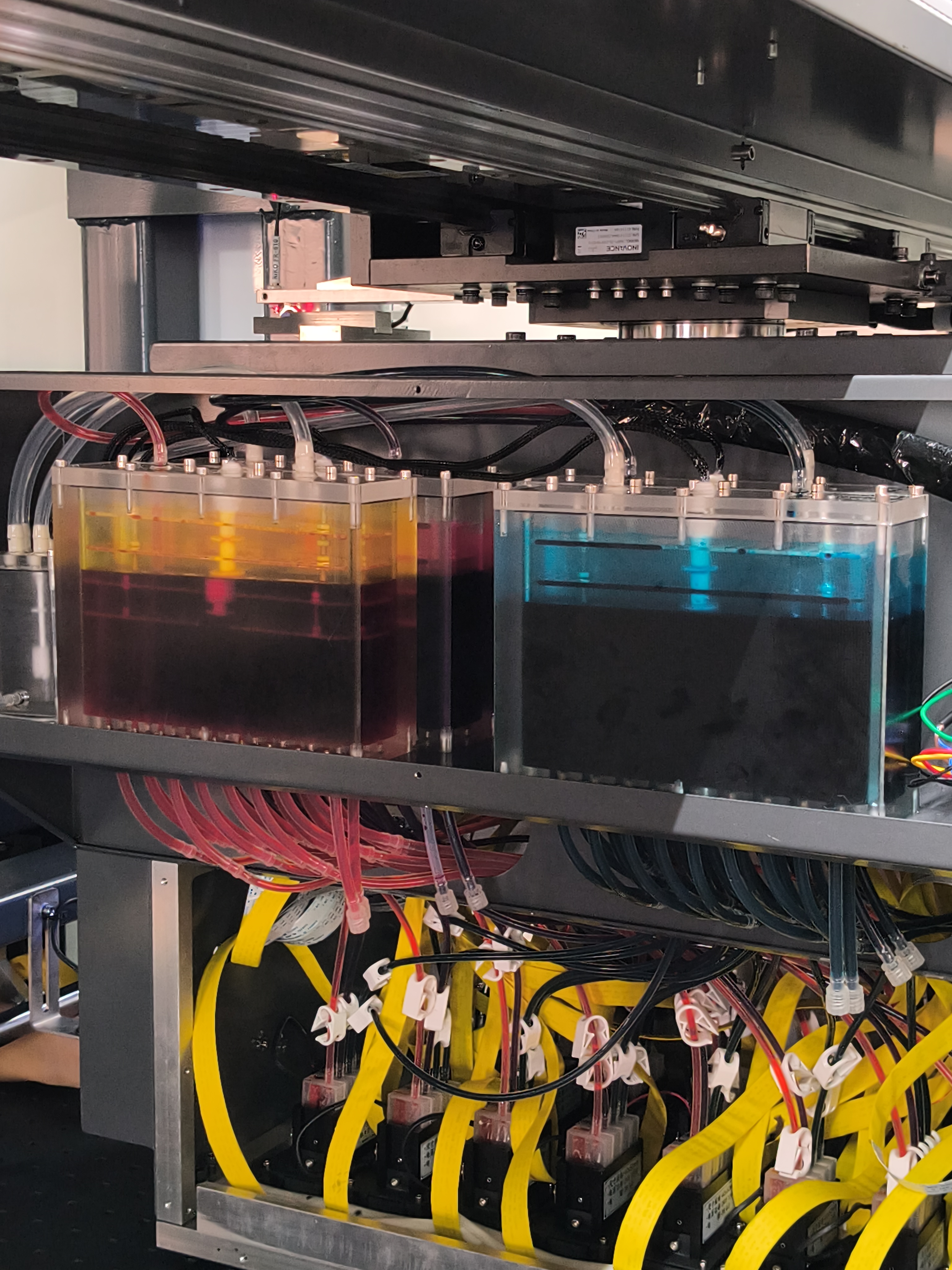
Water-based dye, water-based pigment, coating and UV eco-friendly inks all run on the same micro-piezo platform. Image: GOKING.
Which Inks the Machine Supports — and Why "Eco-Friendly" Is a Compliance Question
Ink compatibility is a technical question; ink acceptability is a regulatory one. The two should be evaluated separately.
On the technical side, the platform's four supported ink families give a converter the flexibility to serve kraft board, coated paperboard and white-lined substrates without changing machines. On the regulatory side, ink chemistry is moving. The U.S. Environmental Protection Agency declared certain PFAS chemistries used in UV inks hazardous in April 2024, a decision that affects UV ink formulations and, by extension, any converter shipping UV-cured packaging into that market. Buyers selecting UV eco-friendly ink should therefore confirm the current formulation status of their consumable supply, not only its print performance.
For EU market access, the certified position of the Corrugated Cardboard Digital Printing Machine is documented. The unit holds a Certificate of Conformity of type CE, certificate number HTT202308117L, issued by Shenzhen HTT Technology Co., Ltd. on 2023-08-09, referencing EN 60204-1:2018 and Directive 2006/42/EC, and applicable to the EU market. EN 60204-1 governs the electrical equipment of industrial machines; ISO EN ISO 12100, the risk-assessment standard, is the broader baseline for CE marking of industrial printers. A certificate that names the applicable product and the standards behind it is far more useful to a procurement file than a logo alone.
2-in-1 Configuration: How Single-Pass and Multi-Pass Relate to 700 or 1500 m²/h
This is the specification most often misread. The 2-in-1 multifunctional digital printing machine is not two machines bolted together, and the 700 / 1500 m²/h figures are not two different product tiers. They are the published production efficiency range of one platform whose output depends on how it is configured and which mode the job runs in.
In single-pass mode, the board passes under a fixed print bar once. Throughput is at its highest and is expressed both as an efficiency figure and as a linear speed: at least 100 m/min with a XAAR nozzle and 60 m/min with an Epson nozzle. In multi-pass scanning mode, the carriage traverses the substrate repeatedly, building the image in layers. Scanning mode prioritises resolution and is the correct mode for proofing, fine text, detailed graphics and short-run high-precision work; it is also the mode that should be planned against the lower end of the efficiency range. The practical consequence for a buyer is that capacity planning must be mode-weighted, not based on a single peak number.
| Configuration element | Published figure | What it controls |
|---|---|---|
| Production efficiency | 700 / 1500 m²/h depending on configuration | Line-level throughput to plan against |
| Single-pass speed, XAAR nozzle | at least 100 m/min | Continuous output in one-pass mode |
| Single-pass speed, Epson nozzle | 60 m/min | Continuous output in one-pass mode |
| Print width | 264 mm to 2600 mm | Board width and lane layout |
| Printheads | 8 to 256 | Colour channels, width coverage, redundancy |
| Material thickness | 2–30 mm | Corrugated and honeycomb board range |
| Colour mode | CMYK with optional W | White-ink capability on kraft and dark stock |
| Rated power | ≈14 kW | Electrical supply planning |
Printhead Count and Width: What "8 to 256" Changes for a Buyer
A scalable printhead range from 8 to 256 is a commercial feature as much as a technical one. A converter can enter at a configuration matched to current order volume and add heads as the business grows, rather than replacing the platform. Printhead count interacts directly with effective speed and with achievable colour coverage: more heads across a given width means more jets per unit of board, which supports higher through-put or higher colour density at a fixed speed.
The mechanical platform is specified to match that scalability. The machine measures 4260 mm × 2300 mm × 1900 mm and weighs 2800 kg; the frame is carbon steel with stainless steel conveying rollers and an aluminium alloy beam; the crossbeam is magnetic-levitation high-precision; drive is servo-motor based with Schneider electrical components. Substrates are held on a vacuum adsorption platform and fed either by leading edge or by belt, and the leading-edge unit is available as semi-automatic or fully automatic. Rated power is approximately 14 kW at 380 V, 50/60 Hz, three-phase.
Prepress is deliberately low-friction: the RIP supports direct printing without converting pictures, and accepted file formats are PDF, JPG, BMP and TIF. The minimum reproducible digital English text is approximately 1.5 mm, a figure worth checking against any job that carries legal, batch or regulatory microtext.
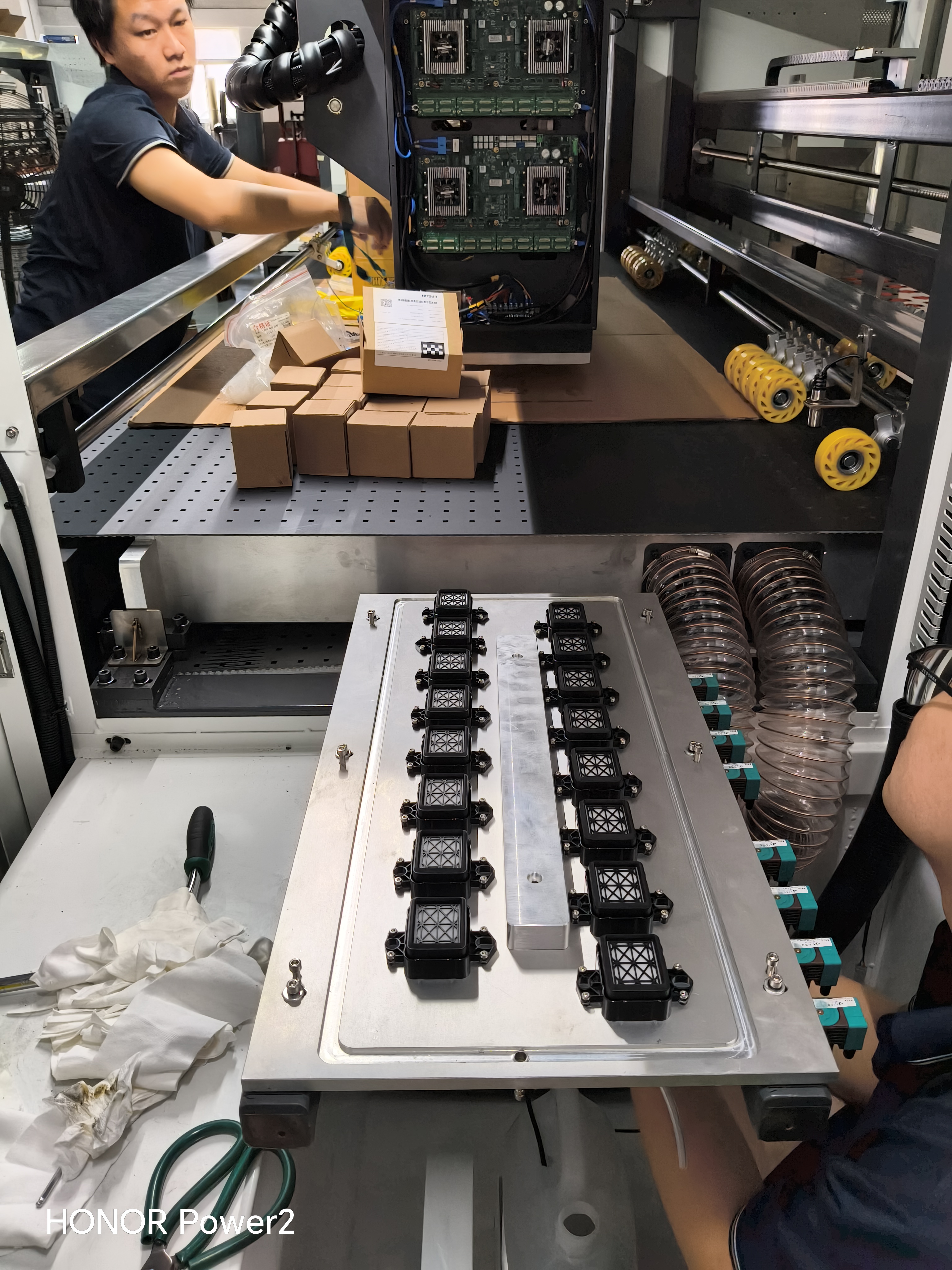
Printhead count is the primary scalability lever: configurations run from 8 to 256 heads on the same platform. Image: GOKING.
Where the Platform Fits: Materials and Applications
The published application profile covers short-run packaging printing, frequent job change, and continuous high-speed operation — the three working conditions that make plate-based setup costs painful. Material support spans kraft paper through coated paperboard, from single-sheet printing to mass production, with board thickness accepted from 2 mm to 30 mm. Drying is specified as occurring after printing for carton, with other substrates governed by their own material characteristics.
In practice this maps onto cardboard packaging, gift boxes, corrugated shippers and paper-mill or coated-paperboard finishing lines. It also maps onto jobs that plate printing handles uneconomically: versioned packaging, regional artwork variants, samples and prototypes, and printed QR codes or variable data where every unit carries a different code. Third-party analysis from Market Research Future notes that variable data printing has made runs below 3,000 units economically viable in 2024, a threshold that previously sat well inside plate-based economics.
Service and delivery terms are part of the same specification. Minimum order quantity is 1 set; standard machines carry a production lead time typically of one month, with custom and OEM/ODM timelines confirmed on request, against a monthly manufacturing capacity of 38 sets. Quality control covers 100% aging test, long-time running inspection and pre-shipment inspection, and after-sales support includes technical support, spare parts support and a 24-hour response commitment, with engineers travelling to site for installation and commissioning after overseas delivery.
Market Context: Why Constraint Questions Are Being Asked Earlier
The shift is measurable. Grand View Research valued the global digital printing market at USD 38.0 billion in 2023 and projects USD 57.0 billion by 2030, with the inkjet segment alone holding the largest technology share at 48.4% in 2023. Within packaging specifically, MarketsandMarkets sized the digital printing packaging market at USD 30.2 billion in 2024 and expects USD 46.2 billion by 2029. Reports and Data values the single-pass digital printing machine segment at USD 3.2 billion in 2024, projected to reach USD 6.5 billion by 2034. Market Research Future places Asia-Pacific at approximately 41.6% of digital printing revenue in 2025.
Two conclusions follow for buyers. First, digital printing is no longer an experimental line item, so procurement scrutiny has risen accordingly. Second, the single-pass corrugated category now has established industrial reference points — Mordor Intelligence identifies the EFI Nozomi C18000 as a primary industrial-grade competitor in single-pass corrugated packaging printing — which means buyers can and should compare configurations on published parameters rather than on category promises.
Digital Versus Plate-Based: What Changes, and Where the Boundary Sits
Moving to a plate-less multifunctional digital printing machine changes four things at the workflow level: it replaces plate-based printing, reduces plate costs, reduces setup waste, and enables flexible short-run production. None of those are absolute advantages; they are advantages that scale with how often the job changes.
The boundary is real and should be stated plainly. For very long runs of a single unchanging design, conventional plate-based processes remain the established high-volume route, and a digital platform's economics degrade as job repetition increases and setup savings disappear. Multi-pass scanning mode, while capable of high-definition output, produces at lower throughput than single-pass mode — a genuine trade-off, not a marketing caveat. Substrate thickness is bounded at 2–30 mm. Minimum reproducible digital English text is approximately 1.5 mm, so jobs requiring finer microtext need sample validation before commitment. And the machine itself imposes site constraints: 380 V three-phase power, roughly 14 kW rated draw, a 4260 mm × 2300 mm × 1900 mm footprint, 2800 kg of mass, and a recommended operating environment of 15–32 °C at approximately 70% humidity. Facilities that cannot meet those conditions will spend more on infrastructure than the specification sheet implies.
The honest summary is that a 2-in-1 digital platform is a flexibility asset. It is strongest where job mix is fragmented and weakest where a single design runs uninterrupted for weeks.
Constraint Checklist: What to Verify Before Signing
| Constraint | Published specification | Why it belongs in the procurement file |
|---|---|---|
| Substrate thickness | 2–30 mm | Confirms whether the full board range is covered |
| Print width | 264–2600 mm | Drives lane layout and board sizing |
| Printhead range | 8–256 | Defines the entry configuration and upgrade path |
| Ink set | Water-based dye, water-based pigment, coating, UV eco-friendly | Determines which end markets are serviceable today |
| Colour mode | CMYK with optional W | White-ink jobs on kraft and dark board |
| Minimum text | approx. 1.5 mm English digital text | Legibility of batch, legal and traceability text |
| File / RIP handling | PDF, JPG, BMP, TIF; direct print without converting | Prepress workflow fit |
| Power supply | 380 V, 50/60 Hz, three-phase, ≈14 kW | Electrical infrastructure readiness |
| Machine footprint and mass | 4260 × 2300 × 1900 mm; 2800 kg | Floor loading and layout planning |
| Operating environment | 15–32 °C, approx. 70% humidity | Pressroom conditioning requirements |
| CE conformity | EN 60204-1:2018, Directive 2006/42/EC, cert. HTT202308117L | EU market access documentation |
| Lead time and MOQ | Typically one month for standard machines; MOQ 1 set | Project scheduling and pilot entry |
Future Outlook
Two forces will shape the next procurement cycle. The first is regulatory: ink chemistry is becoming a compliance variable rather than a consumable choice, and the EPA's April 2024 PFAS declaration for certain UV ink chemistries is the clearest signal that formulation transparency will become part of supplier evaluation. Buyers should expect to ask ink suppliers for documentation, not just samples.
The second is architectural. Hybrid digital architectures are attracting R&D attention from major press manufacturers, and hybrid single-pass / scanning platforms such as GOKING's 2-in-1 configuration already express that logic at the machine level: one asset covering both high-volume and high-precision work. As digital printing packaging moves toward the USD 46.2 billion figure projected for 2029, the differentiator is unlikely to be peak speed alone. It will be how honestly a platform's constraints are documented, because that is what lets a converter promise a delivery date.
FAQ
What print head technology does the platform use, and why does it matter for ink choice?
The Corrugated Cardboard Digital Printing Machine uses a micro-piezo high-precision print head. Because piezo jetting displaces ink mechanically rather than heating it, the platform can accept a wider range of fluid chemistries, and the supported ink list covers water-based dye ink, water-based pigment ink, coating ink and UV eco-friendly ink. Both Epson and XAAR printhead families can be specified; Epson printheads are associated with high-precision grayscale performance, while XAAR industrial-grade heads such as the 5601 and 1003 series use patented True Internal Circulation (TF Technology) to reduce clogging during sustained high-speed production.
Which ink types are officially supported?
Four: water-based dye ink, water-based pigment ink, coating ink, and UV eco-friendly ink. The colour mode is CMYK with optional W (white ink), and the ink supply is a fully enclosed two-channel system. Buyers with UV-cured output should separately verify the current regulatory status of their ink formulation, since the U.S. EPA declared certain PFAS chemistries used in UV inks hazardous in April 2024.
Does the machine support white ink, and when does that matter?
Yes. White ink (W) is an optional element of the CMYK colour mode. It becomes relevant when printing on kraft paper or other dark and unbleached board, where a white under-layer is required for colours to read correctly.
What is the difference between 700 m²/h and 1500 m²/h?
Both are published production efficiency ratings for the same platform, and the applicable figure depends on configuration — printhead count, DPI setting, print width and the operating mode. Single-pass printing speed is at least 100 m/min with a XAAR nozzle and 60 m/min with an Epson nozzle. Multi-pass scanning mode prioritises resolution over throughput, so capacity planning for scanning work should use the lower end of the efficiency range.
What print width, printhead count and material thickness are supported?
Print width ranges from 264 mm to 2600 mm. Printhead configuration ranges from 8 to 256 printheads. Supported material thickness is 2–30 mm, covering corrugated and honeycomb cardboard as well as coated paperboard. Substrates are held on a vacuum adsorption platform with leading-edge or belt feeding.
Is the machine CE certified, and which standards apply?
Yes. The Corrugated Cardboard Digital Printing Machine holds a Certificate of Conformity of type CE, certificate number HTT202308117L, issued by Shenzhen HTT Technology Co., Ltd. on 2023-08-09, applicable to the EU market and referencing EN 60204-1:2018 and Directive 2006/42/EC. EN 60204-1 addresses the electrical equipment of industrial machines; EN ISO 12100 provides the risk-assessment baseline for CE marking of industrial printers generally. Buyers outside the EU must confirm their own local market requirements separately.
What power, space and environmental conditions does the machine require?
Rated power is approximately 14 kW at 380 V, 50/60 Hz, three-phase. The machine measures 4260 mm × 2300 mm × 1900 mm and weighs 2800 kg. The recommended working environment is room temperature 15–32 °C at approximately 70% humidity. File formats accepted are PDF, JPG, BMP and TIF, and the RIP supports direct printing without converting pictures.
What are the platform's main limitations?
Multi-pass scanning mode runs at lower throughput than single-pass mode — it trades speed for resolution. Material thickness is bounded at 2–30 mm. Minimum reproducible digital English text is approximately 1.5 mm, so finer microtext requires sample validation. The machine needs 380 V three-phase power, roughly 14 kW, and a substantial floor area and load-bearing capacity. And CE conformity applies to the EU market; other jurisdictions require separate verification. Conversely, for very long runs of an unchanging design, plate-based processes remain the conventional high-volume route.
What service and delivery terms apply?
Minimum order quantity is 1 set. Standard machines carry a production lead time typically of one month, with custom and OEM/ODM timelines confirmed on request, against a monthly manufacturing capacity of 38 sets. Quality control covers 100% aging test, long-time running inspection and pre-shipment inspection. After-sales support includes technical support, spare parts support and a 24-hour response commitment, with engineers travelling to site for installation and commissioning after overseas delivery.
Reference Document
Full configuration options, printhead combinations and DPI settings across the multifunctional digital printing machine range are listed in the manufacturer's product catalogue. The 2026 product catalog (PDF) is available for direct download.